
LEGO Movie Blooper Reel!
Posted on February 13, 2014 at 5:43 pm
Related Tags:
Posted on February 13, 2014 at 5:43 pm
Related Tags:
Posted on February 11, 2014 at 10:50 pm
Here’s a little glimpse behind the scenes. It looks like even more fun than you hope — playing with a 15-million brick set of LEGOs!
Posted on February 10, 2014 at 8:00 am
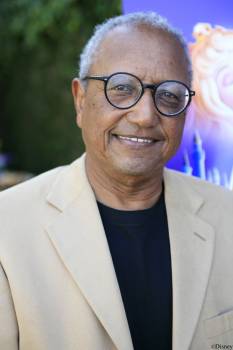 I am a big fan of Disney’s The Jungle Book
Is it true that when this film was first being put together Walt Disney threw everything out and started over again? How did that all happen?
You know Walt Disney was the boss at the Walt Disney studio. It was pretty much a one-man studio in the old days and that means Walt Disney ran everything. So the good part is you only had to please one guy. That was the nice part. But Bill Peet who was Walt’s ace story man had been developing Kipling’s The Jungle Book
Is it true that Walt said to ignore the book by Rudyard Kipling?
Oh very definitely. Walt called us all in and he said he wanted a show of hands. He said, “How many of you have read Rudyard Kipling’s The Jungle Book? Nobody raised their hands. Nobody had read it. Walt said, “Good, don’t read it. I don’t want you to read it because I am going to tell the story a different way.” So we started from scratch having never read The Jungle Book. I know it sounds crazy but that is what Walt wanted.
One of the things that makes this movie so popular is that it has some of the all-time great animated characters.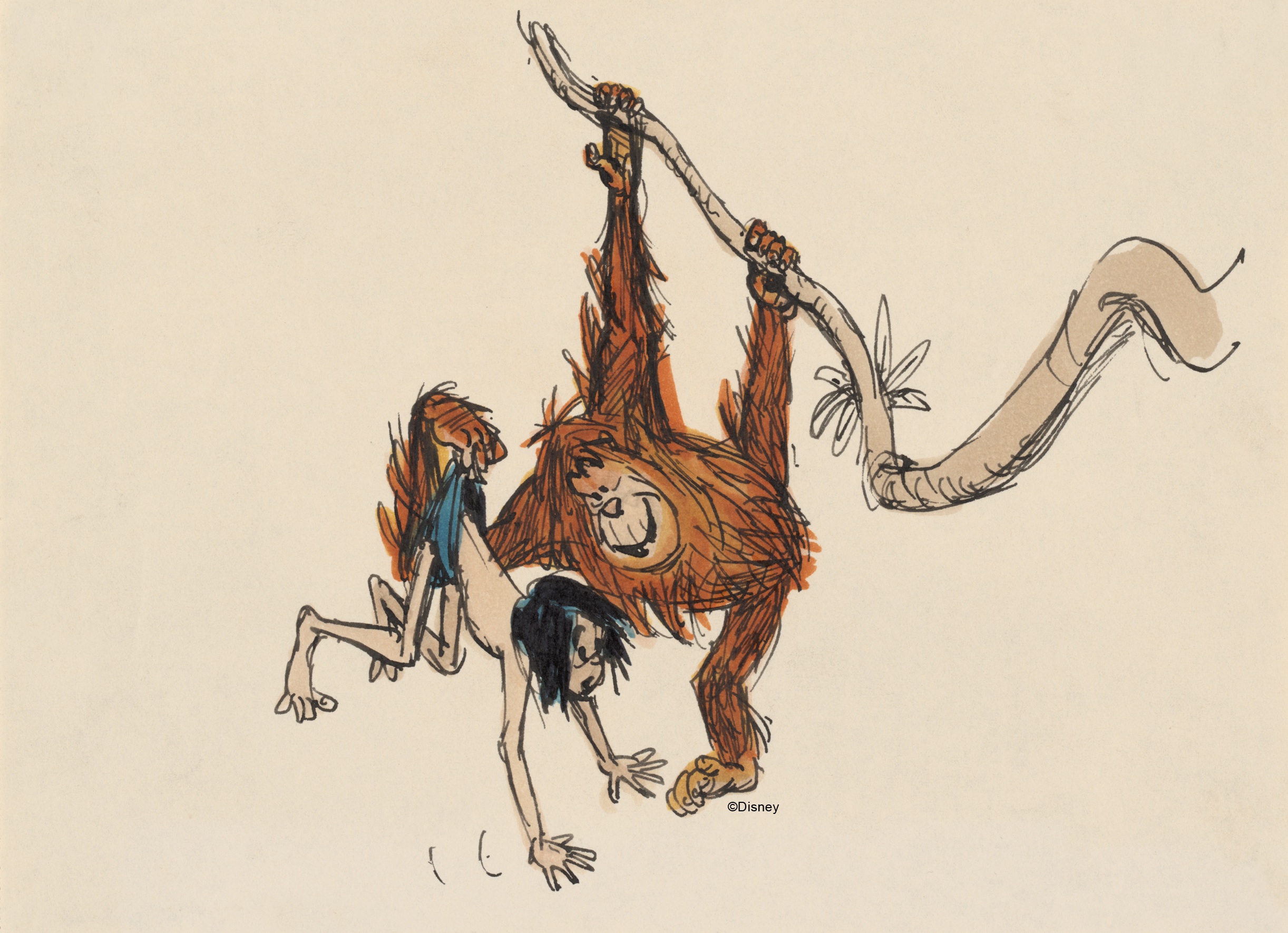
Oh you bet! That is very true. The characters are really the stars of this film. Now keep in mind the characters had already been developed by Kipling in his novels and Bill Peet had already taken these same characters Bagheera the panther, Baloo the Bear, Kaa the snake, and Shere Khan the tiger and further developed them for Disney. In a way we had our work already cut out for us. The characters were already there. The personalities were already in place. All we had to do now as story artists was to take these characters and put them in fun, exciting, and entertaining situations. So that was our job but as far as the character work, that groundwork had already been laid for us.
Had the actors been cast for the voices?
Many of them had already been cast when I started on the film. Mowgli had been cast. Walt had already chosen Phil Harris to be Baloo the bear. We knew we would be using Sebastian Cabot as Bagheera the panther. Sterling Holloway was already at the studio because Sterling was there recording “Winnie the Pooh.” So Walt said, “Hey we’ve got Sterling here, we might as well use him while he is here.” We grabbed Sterling to be the voice of Kaa the snake. So some of these things had already been done but a lot of them were happening as we were moving ahead on the new film story.
Did you observe bears, panthers, or tigers? There is a certain amount of animal movement but there is a certain amount of kind of anthropomorphic human movement in these characters. How do you do that?
That became mainly the job of our animators. They are the guys who were going to bring these characters to life. So they are the ones that are going to be truly studying animal movement and behavior. Guys like Milt Kahl, Frank Thomas, and Ollie Johnson are the guys who are really going to be taking these characters and bringing them to life. Our job as story tellers was knowing that we already had great Disney animators who were going to take our characters and make them live. Our job was to basically tell the story. So in one sense you might say our job was little bit easier in that we didn’t have to go out and go to the zoo and study animals. We can kind of take a certain amount of license of knowing we are going to have bears, panthers, and lions and the like behave like people. It made our job a little bit easier that we didn’t think about them so much as animals but as personalities.
With Kaa the snake however, you really take advantage of the coils and the movement of the snake.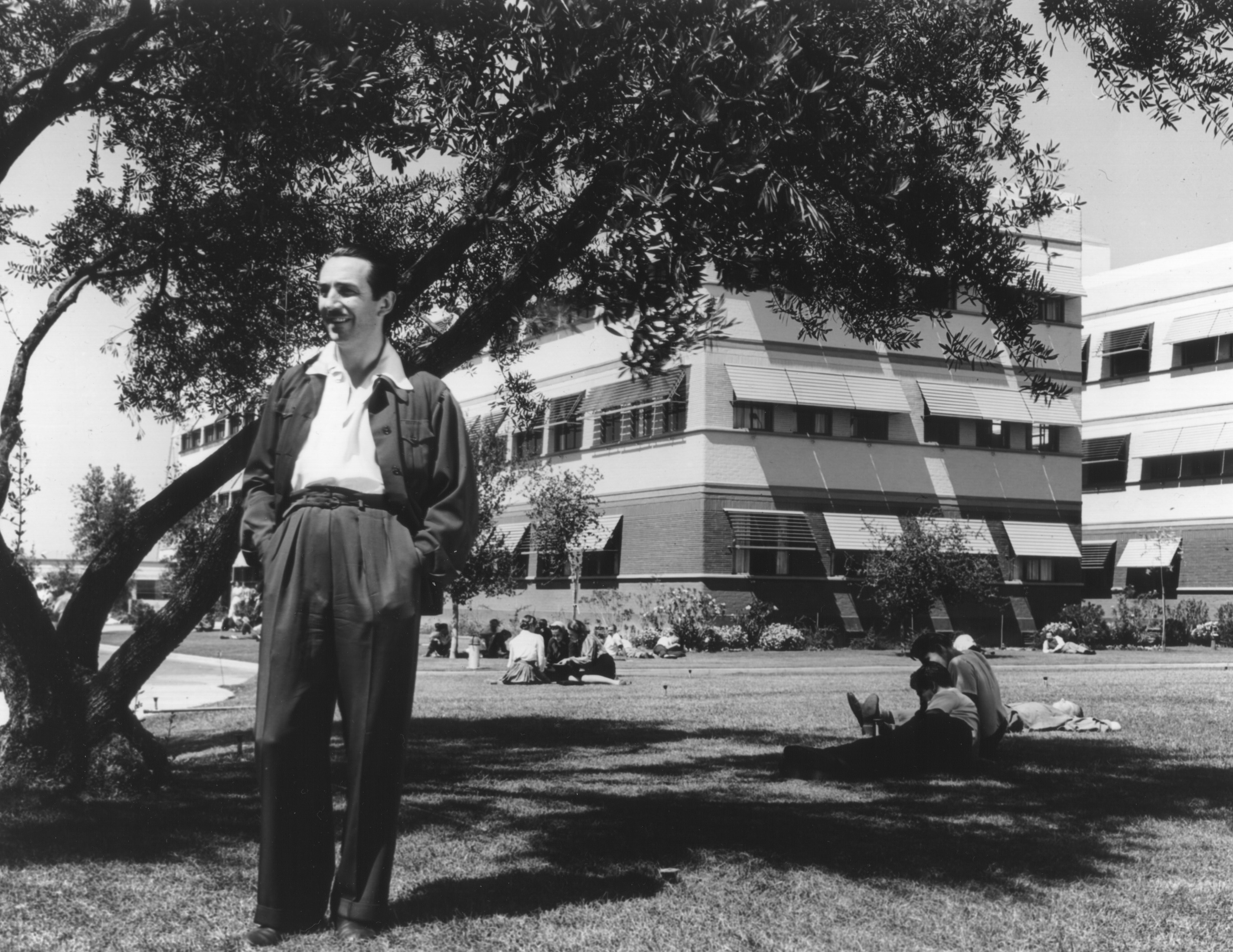
Kaa was a very shifty sneaky kind of character and Sterling Holloway gave him the perfect voice with his sibilance of a lot of hissing and a lot of “S” sounds perfect for the song “Trust In Me” a good deal of hissing there as well. So we just had fun with the characters. We had these marvelous characters and so it was just a great opportunity for a story guys. Our work could not have been more fun to take these great characters and then just put them through their paces. In many ways it made our job a lot easier.
I saw on your blog the photograph of the old setup that the animators had back in the 60’s. The silver thing is like a Lazy Susan turntable?
That is exactly it. It rotates so the artist doesn’t have to worry about moving his/her body they can simply rotate the disk and have it in any position they need to draw on. So it was very practical. It made sense.
Tell me a little bit about what you think the good and bad elements are of the changes in technology and animation.
Well you know that has been a debate that has been going on now for some time. I think it popped up again this morning. A bunch of animation fans — we call them animation geeks — started an argument over a statement made by our creative officer John Lasseter and it had to do with hand drawn animation and digital animation. This debate has been going on for the past few years and it is not going to stop any time soon. Pixar really pushed animation in a whole new direction. Technology changed animation and I think it changed it forever. We don’t make films the same way we did in years past and that is why I posted that photo on my blog of the drawing board and the pencil, and the paper. This is like today ancient history. We don’t make films like that anymore. This is not to denigrate that process because that process gave us Disney classics but now we have moved on to a new way of making films. Technology has moved in and some might say encroached on the process but I think Walt Disney would have welcomed it because Walt Disney was always pushing towards the future and not looking back at the past. You just move forward, that is all you can do and take advantage of the great new tools that the technology has given us.
Do you have a favorite moment in “The Jungle Book” or favorite song or character?
I could always say my sequence! (Laughter). The song where the snake sings a lullaby to Mowgli. He sings, “Trusssst in Me” and he hypnotizes Mowgli. Well I knew that I could not have the boy just stand there and fall asleep, I wanted to make it fun. I wanted to make it entertaining and funny. So what I had Kaa the snake do was sing a lullaby to Mowgli but have him do things in his coils like the coils form a hammock and the kid rocks back and forth in the hammock. The coils form steps and the kid sleepwalks down the steps and he does other things that are just fun and funny. Well I had to come up with those ideas because you’ve got to keep things interesting on screen and you have to entertain the audience.
You don’t want to put your audience to sleep. You want to put Mowgli to sleep but you don’t want to put the audience to sleep so I came up with a lot of interesting little bits where I could get a smile or a laugh and it was just such a pleasure working on this sequence and the recording session with Sterling Holloway because I was there with him when he recorded “Trust In Me” and just to create this great little sequence that was funny back in 1966 but it is still funny today.
My favorite parts are the expression on Mowgli’s face and also when Kaa falls out of the tree.
Oh yea, we had Kaa fall of the tree twice. (Laughter). Each time complaining about his sacroiliac.
http://www.youtube.com/watch?v=F1ILPl5FQaMWas the portrayal by Tom Hanks of Walt Disney in “Saving Mr. Banks” pretty much like your experience with him?
Yes. Yes. I was simply delighted by Tom’s performance of Walt Disney and I have to remind people that Tom Hanks does not look like Walt Disney. Tom Hanks does not even sound like Walt Disney but in his performance on screen I felt Mr. Hanks managed to capture the essence of Walt Disney so I thought it was simply a great performance and I loved the film. I’ve seen it several times. I like it every time I see it.
When you were growing up what were the images that really excited you? What were the pictures that really made you think about being somebody who makes pictures yourself?
My grandmother used to take me to the Santa Barbara Art Museum when I was a little kid so I was exposed to art at an early age and got to know the work of the masters. Even as I grew older they used to have art lessons on Saturday morning at the Santa Barbara art museum and I attended those so I was already headed for a career in art one way or the other. I just fell in love with drawing and painting and eventually even with storytelling.
You worked with the greatest animators of all time. Who were some of the ones that really taught you something?
Oh my! Coming to the Disney studio when I did, believe you me they were masters were still here; that is the people who made the films I saw as a child were still working. So think of the advantage I had to learn from the best and the brightest and to learn from the top animators, the top background artists, the top story tellers. They were all here and they were very gracious with their time. I wrote in my book Animated Life: A Lifetime of tips, tricks, techniques and stories from a Disney Legend
Posted on February 4, 2014 at 3:55 pm
David Foster Wallace

Posted on January 21, 2014 at 8:00 am
I am thrilled to be able to share with you exclusive excerpts from one of the best books ever to take you behind the scenes in film production — The Film Crew of Hollywood: Profiles of Grips, Cinematographers, Designers, a Gaffer, a Stuntman and a Makeup Artist
William Fraker, Cinematographer
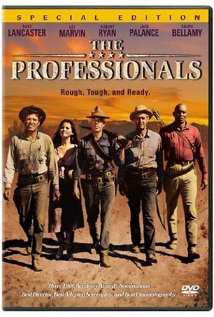 The notion of ‘following one’s instincts’ was first put to the test when Bill Fraker was hired by Hall to operate camera on the 1966 classic adventure western, The Professionals, helmed by a gritty, workhorse of a director, Richard Brooks. When asked about the picture, Billy smiled broadly while remembering his first (and nearly his last) conversation with the old-school director. About a week into the shooting schedule, a large complicated scene took place involving an Army train with dozens of troop extras and horsemen positioned around the tracks and platform cars. While shooting the intricate sequence with its secondary focus of a woman riding on horseback through frame, Fraker became fixated with a lucky accident. Upon holding a pan shot on actress Claudia Cardinale, (instead of cutting away after a three second beat as Brooks had instructed him to do), he was questioned by the livid Director at scene’s end. “What the hell did you do that for?” Brooks roared into Fraker’s serene face. “Because it was so damn beautiful,” Billy replied candidly. “It better be,” the Director said, turning and walking away. Certain that he was going to be fired (and fearing for his situation with Hall), on the following day Fraker was surprised to be invited into the screening room, as Brooks’ habit was to share dailies with as few folks as possible. In addition to directing, Brooks also wrote brilliant scripts for pictures such as Cat on a Hot Tin Roof, In Cold Blood, Blackboard Jungle, and Elmer Gantry, in 1960 (for which he won an Oscar for best screenplay). A tough ex-Marine (and no one to fool with by reputation), when the take in question was shown during dailies (with its hold on Cardinale and the horse, neck high flowing through the frame), Brooks had the projectionist in the back of his hotel room stop the machine. “Fraker,” he began sternly, “you were right to stay on her. Your shot was better. Would you like to see dailies with us from now on?”
Gaylin Schultz, Key Grip
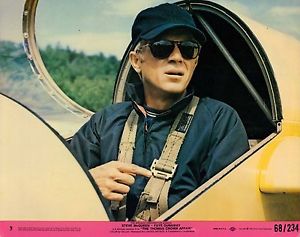 Gaylin’s biggest break in Tinseltown occurred when called by Jack Reddish to take over Key Grip duties on the Thomas Crown Affair, after Morris Rosen (of High Noon and Man with a Golden Arm fame), suffered a fatal heart attack during the first week’s filming. A case of one man’s misfortune being another’s ‘window of opportunity’ (an often repeated theme of advancement in Filmberg), Schultz was engaged at the suggestion of the movie’s producer, Walter Mirisch; who fondly recalled his heroic action from How To Murder Your Wife a few years earlier.
His first day on the film was a challenge that would mirror much of his career success to come. Tasked with staging a set of moving shots in an open field featuring a Schweizer SGS-1 sailplane for the picture’s opening montage, the images required fly-by coverage of the sleek machine swooping low over the horizon, and then rapidly descending into a graceful landing, with McQueen and Faye Dunaway exiting the craft at scene’s end. Told to relax by Rosen’s remaining grips, (who resented the outsider taking over), Schultz was informed that the shot was already worked out by their boss. Patiently, he watched in horror as a Honda motorcycle (carrying an operator sitting backwards with a hand-held Arriflex camera), attempted to get the shot, but failed miserably with a dozen takes of unusable footage. Rapidly falling behind his shooting schedule with nothing in the can for his morning’s work, Cinematographer Haskell Wexler thought he had the solution when getting producer Norman Jewison to secure a Cadillac convertible for use as a camera-car; crouching in the cavernous back seat, shooting the sailplane handheld. Again the results were poor as the heavy vehicle fishtailed worse than the Honda at half the speed. Finally calling lunch without a single printable take, the mood in the chow line was less then festive. Approaching Jack Reddish and Jewison for permission to work on an idea during lunch, (instead of eating with the still glum grips), Schultz borrowed a heavy-duty 6 by 6 wheeled Military work-truck from transportation (known as Hanks Helper to the electricians), originally used for laying power cable in rough terrain locations. Removing the passenger seat first and mounting a camera in its place, Gaylin and the one grip who agreed to help, John Bearsdick, rigged two stout tow-arms from the rear of the trucks vertical A-frame, then attached the glider to them, keeping the support hardware out of the shot. Allowing for speeds in excess of 40 miles an hour before the towed glider would buck to become airborne, Schultz’s cobbled together process trailer gave them the shot they wanted without the complications of multiple vehicles. Although ungainly in appearance, Wexler’s initial skepticism was quickly replaced with thanks after seeing the set-up through a lens. “If it hadn’t worked,” Gaylin chuckled, “I think I would have been on the next plane back home. But as it happened,” he continued, “That one shot kind of made me; for the rest of the movie, I was walking on water, so to speak.
In addition to impressing producers Jewison and Mirisch with his ability to get the job done, Gaylin Schultz also made an impression on Steve McQueen who would ultimately be instrumental in hiring him for some of the most important films in his career. Recalling a moment of bonding between the two men (who both loved the mechanics of machinery and fast automobiles), Schultz said he was installing a camera mount on a Ferrari 275 GTS Spyder that Faye Dunaway drove in the picture (later purchased by McQueen), when the actor walked up and began observing him carefully padding all the straps and hardware which might come into contact with the pricy sport car’s paint job. After watching Gaylin in silence for a few moments McQueen said, “Christ Schultz, you’re an artist!” Possibly the start of their friendship, he said the talented actor trusted him implicitly from that day forward to do things right.