
Interview: Mizuo Peck of ‘Night at the Museum 2’

Interview: Mizuo Peck of ‘Night at the Museum 2’

Posted on December 1, 2009 at 3:40 pm

In the middle of all the special effects and silly fun of the “Night at the Museum” movies is one character who lends the real heart to the story: Sacajawea, played by Mizuo Peck with such sweet, quiet dignity that it is no wonder Theodore Roosevelt (Robin Williams) falls in love with her. I had a chance to talk with her about my home-town museum, the Smithsonian, and what it’s like to film a love scene with Robin Williams. The movie is now available on DVD and Blu-Ray.

NM: This may sound silly, but who are you playing, Sacajawea or a statue of Sacajawea?

MP: That was an interesting question that we were thinking about the entire time when we were shooting. Was Teddy Roosevelt in pain? No he isn’t because he is made out of wax. So we don’t really have the history of the actual figure. But I personally as an actress did a lot of research about Sacajawea and approached the role as if I were a wax statute who was identifying with her.

night_mizuo_peck_sacajawea.jpg

NM: She was such an amazing character!

MP: Doing the research on her life was almost the most amazing part about this! I didn’t know much about her before. In the back of everyone’s mind, there’s Pocahontas and Sacajawea but we don’t learn much about them in school. I got to read and watch really cool documentaries and find out what a powerful and important historical figure she was. I was very, very proud to play someone so exciting. There’s all sorts of fun things to learn about her. The Lewis and Clark expedition might not have been successful without her.

She was not an official member of the Corps of Discovery. She was just the wife of one of the translators. But her contribution was essential. She was able to dig up roots when all the men were just about eating their horses. Her being there, a woman with a baby, made their encounters peaceful because it showed that Lewis and Clark weren’t there for war. There were all these swarthy men doing this expedition in the dead of winter and she was a young woman holding a newborn on her back the entire time, so more power to her!

NM: We in Washington were very excited that the second film was set in the Smithsonian. Did you visit the museum when you were here?

MP: Yes, the premiere was there at the Air and Space Museum so I got there a day early and my boyfriend and I got there and did the whole tourist thing, the Lincoln Memorial and the Washington Monument. Going to the museum is most definitely a different experience after making the movie! And it’s such a great aspect of the movie that it makes kids want to go to the museum and check out all these characters.

NM: What’s it like to play the love interest of Robin Williams?

MP: Extremely bizarre, I must say! One of the first scenes we did, he’s looking at me through the glass and I’m still getting over that there’s a huge giant star in front of me and then the fact that he is doting on me? And in the second one, I had a scene on a horse with him. I’m just like “pinch me” because it was incredibly surreal! We had a lot of down tme together so we got to joke around a bunch. One scene started with us in an embrace. We would get into position and be hugging and then there would be a wait before “action” and there were so many funny moments where we would be talking while we were in this hug! It is impossible not to enjoy him.

NM: Did you have a lot of special effects work?

MP: I didn’t have to do as much as the other characters like Owen Wilson and Steve Coogan. In the first one, Robin Williams was wearing green tights in the scene where he was in two pieces and it was funny to see him like that.

NM: What are you doing next?

MP: Nothing like this giant blockbuster! Some independent movies and my own script.

NM: What makes you laugh?

MP: When people do silly things, and when my boyfriend tickles me. The movie “Nacho Libre” — it’s so silly, but Jack Black makes me laugh.

NM: What’s your dream role?

MP: I always like it when a woman starts off vulnerable and gains strength, a really intense arc — I like complex characters. I’ve always been attracted to the role in “La Femme Nikita.” She starts at such a low point and keeps her vulnerability but becomes a real bad ass!

NM: What inspires you?

MP: You find inspiration all over the place. I’m a born New Yorker so just the people on the street give me inspiration, being exposed to so many different kinds of people. We all are so different but we all want the same thing, love, trying to make a living. We’re all so different and diverse but it boils down to a certain sense of love and happiness. That’s kind of inspirational to me.
Related Tags:


Actors Behind the Scenes Interview

Interview: John Hillcoat of ‘The Road’

Posted on November 23, 2009 at 3:56 pm

I spoke to John Hillcoat, director of the apocalyptic new film, “The Road,” based on the novel by Cormac McCarthy. We do not know what caused the cataclysmic damage that has wiped out most forms of life on earth and left everything covered in ash. All we know is that there is a father (Viggo Mortensen) trying to protect his young son (Kodi Smit-McPhee) from the physical and spiritual consequences of the devastation.

NM: Do you see this as a spiritual film?

JH: It can definitely be read that way. Yes, absolutely. I never wanted to be heavy-handed about the approach. I wanted it to be open to interpretation according to your own belief systems. It’s certainly got a kind of ancient, Biblical parable feeling to it. There’s a morality tale there. But in terms of essence of humanity, that’s really brought to the fore because everything’s stripped bare. There’s nowhere to hide. So it definitely has those dimensions to it. There are many spiritual aspects, but the whole idea of carrying the fire is an ancient one.

NM: I do not diminish the power of the film at all when I say that it seems like an exaggerated version of what every parent goes through in trying to both protect the children and give them the survival skills they will need when we are not here to protect them.

JH: Yes, absolutely. Knowing Cormac and his son, he calls him “Papa,” like the boy in the story. It’s obviously a personal work and that personal relationship is definitely embedded into the text and that’s also why it strikes such a deep cord, even thought it is set into such an extreme scenario. There’s a truth to it.

NM: For me, one of the most wrenching scenes in the film is when they return to the house the father grew up in, and it is only there that the father truly realizes that his son has no frame of reference to understand what life was like.

JH: Where does he learn? How does he become this amazing being? It’s like a scientific experiment. That drive to keep going and the hope they create in this idea of going to the coast. Every parent starts from scratch, but this story just makes that more stark. Ultimately, the boy becomes the teacher. That is something all parents see.

NM: I was very surprised to find Guy Pearce and Robert Duvall in the film. I did not recognize them at first.

JH: We tried to quite change their appearance quite a lot.

NM: The New York Times said that Kodi Smit-McPhee, the now-twelve-year-old who plays the boy, was so shocked by the cold water he was dunked in that he began to sob for real, but that he kept acting and you did not know how distressed he was until the scene was over. Is that true?

JH: Yes. It was actually a real turning point, early on in the shoot. My job was also to protect the boy. But Kodi was such a consummate professional. He didn’t tell anyone how cold he was. And afterward, we had an understanding that if there was any time that he felt real uncomfort that he’s got to tell us. He was so determined to get the best for everyone and the best from him as a performance. The most incredible thing was his maturity; he really understood what the story was about, what each scene was about. His instincts were razor-sharp. And yet, as soon as we stopped filming, he became this kid, joking around, playing. And we really encouraged that.

With that scene, I was about to call cut, and then I heard the dialogue, and everyone’s glancing around at each other, and we see that Viggo is actually responding totally. It’s this incredible thing of being real, Viggo’s concern for Kodi, and playing their parts. That was a great gift and I wouldn’t mess with that. Luckily, we shot it on two cameras, so that was it. And when we were done, Viggo kept holding Kodi. None of us had put two and two together to realize why he was so upset. I had spoke to him about coming out of shock. Kodi’s father was there; he played one of the cannibals. Viggo started to hand Kodi over to them but he stepped away. Kodi knew he was there but he and Viggo from that day had this incredible bond.

NM: Tell me how you achieved the look of the film. It is so bleak and stark and powerful.

JH: The spark for that came when I read the book. I was always trying to be true to the spirit of the book. Usually the post-apocalyptic films are about the big event and they feel so much like a spectacle and there’s no real human dimension or spiritual dimension or any other dimension really other than the roller coaster ride. So it was that feeling of authenticity, really simple things like pushing the shopping trolley with all your possessions in it. That’s the homeless in every city. And the dirty ski jackets. So it felt familiar. It’s almost like I’ve seen this before, not as a vision or a premonition, but we’ve actually witnessed these elements, just not on a local scale. That is what led us to those locations, and the locations were the key to the look. The bulk of what we got was in camera. We filmed in the winter in places like Pennsylvania like where all the mining leftovers are, the ash piles in the winter time. Where are the trees are bare of leaves. We had the aging and the muted colors of the wardrobe. There’s a strange beauty in these desolate locations. Then it also gave a real poignancy to working in a place like New Orleans, where the post-Katrina clean-up was still happening. When half your crew has lived through that, it really added focus. It also became something that the actors could really react off of, so it was like there was a third character working with Kodi and Viggo the whole time. We went to Mount St. Helens. We went to Oregon, the gray beaches. It was a patchwork tapestry of man-made and natural disasters that have already occurred. We added physical effects like spraying biodegradable ash and paper, but whatever we couldn’t get in the camera, CGI took over to eliminate signs of life, green pine needles, birds, jet streams. It was more to take out or put in. The challenge was when it was beautiful blue skies and sunshine, because we had to block the sun. There’s a shot of two ships sitting on a freeway. That’s 70 mil. IMAX footage from two days after Katrina. We had to replace the blue sky and green grass in that shot, but everything else is real. Even the smoke billowing in the background we took from was from 9/11. We deliberately used images we have all seen to make it more real and to give more poignancy and a warning sign and to surround it, because that’s what the book is about, grace under pressure. When you’re surrounded by your real fears, things that you know are possible in some way, it makes hope all the more special. The light shines brightest when it is surrounded by dark.

Related Tags:


Directors Interview
Interview: Vampires from ‘New Moon’

Interview: Vampires from ‘New Moon’

Posted on November 17, 2009 at 3:59 pm

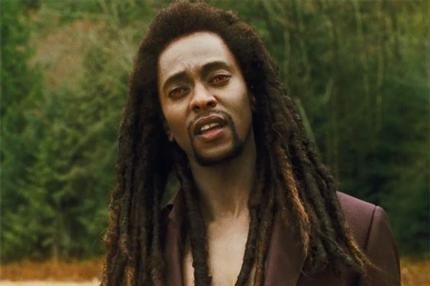
Edi Gathegi and Jamie Campbell Bower play bad guy vampires in “New Moon,” the second in the “Twilight” series based on the best-selling books by Stephanie Meyer. I had a chance to talk with them about making the movie. They were enormous fun, exceptionally friendly and happy to talk about making the movie.

NM: To begin with, this film has a different director, Chris Weitz of “American Pie,” “About a Boy,” and “The Golden Compass.” How will we see his influence on the story

EG: Every director has his own unique style. Even in big franchise film series they’ll often switch off. Chris knows how to direct big stories and he has worked with CGI and special effects. In terms of color scheme and tones, “Twilight” was very blue and “New Moon” is very brown, with the introduction of the wolves. It does look gorgeous!
NM: How do you develop your walk and other movements for these supremely graceful creatures, the Volturi?
EG: Stephanie Meyer said the Volturi glide. So it’s not a clumpy foot stomp. It has to be liquid looking
JCB: My character is very still. For the one small bit of walking I did from my perch to my next perch, I was like a snake almost.

EG: We went to a moving like a cat workshop with exercises and cat movement. The idea is more like a tiger, lion, or panther. This is a new mythology of vampires, no fangs, no crosses. The Volturi have no blood in their bodies. They never have to move. There is a lot of stillness.

We are not trying to pass ourselves off as human like the Cullens are.

NM: Tell me about the look of your characters. What do you wear?

JCB: The look of the Volturi is more stylish in its aesthetic. We are very well dressed even though we don’t get out much. We take what we can from our victims, so it is not always coordinated.

EG: It was a collective ensemble, the group look. Laurent was more rock star-y. He’s 300 years old, well traveled, picked from his favorite fashions of the day. He is fearless, doesn’t have to impress anyone. If it pleased him, he would wear a bright purple Russian car salesman suit.

NM: What’s the most fun about playing Volturi?

JCB: Getting to be incredibly evil and stare. We make use of the contacts, even though they are Irritating and decreased my vision.

EG: That’s the funny part! We are supposed to be the most gorgeous, perfect vision creatures in the planet, and with the contacts in, none of us can see!

Related Tags:


Actors Behind the Scenes Interview
THE MOVIE MOM® is a registered trademark of Nell Minow. Use of the mark without express consent from Nell Minow constitutes trademark infringement and unfair competition in violation of federal and state laws. All material © Nell Minow 1995-2026, all rights reserved, and no use or republication is permitted without explicit permission. This site hosts Nell Minow’s Movie Mom® archive, with material that originally appeared on Yahoo! Movies, Beliefnet, and other sources. Much of her new material can be found at Rogerebert.com, Huffington Post, and WheretoWatch. Her books include The Movie Mom’s Guide to Family Movies and 101 Must-See Movie Moments, and she can be heard each week on radio stations across the country.

Website Designed by Max LaZebnik