Owen Suskind and His Parents Talk About the Autism Documentary “Life, Animated”

Posted on July 8, 2016 at 8:00 am

Owen Suskind tells me, “It feels interesting to be on the autism spectrum and fascinating.” His parents remember what he has said to them about how it feels to have autism. Ron Suskind reminds him, “Remember you said you see everything at once and you can remember all the moments in your life, maybe too many moments, but you go across them and you get a sense of what?”

“My place in the world,” Owen answers.

Cornelia Suskind adds, “And sometimes it’s a little overwhelming having all the stimulation coming in to you at once. You need to create a quiet space around you. When you were younger it was hard to communicate, language was really hard.”

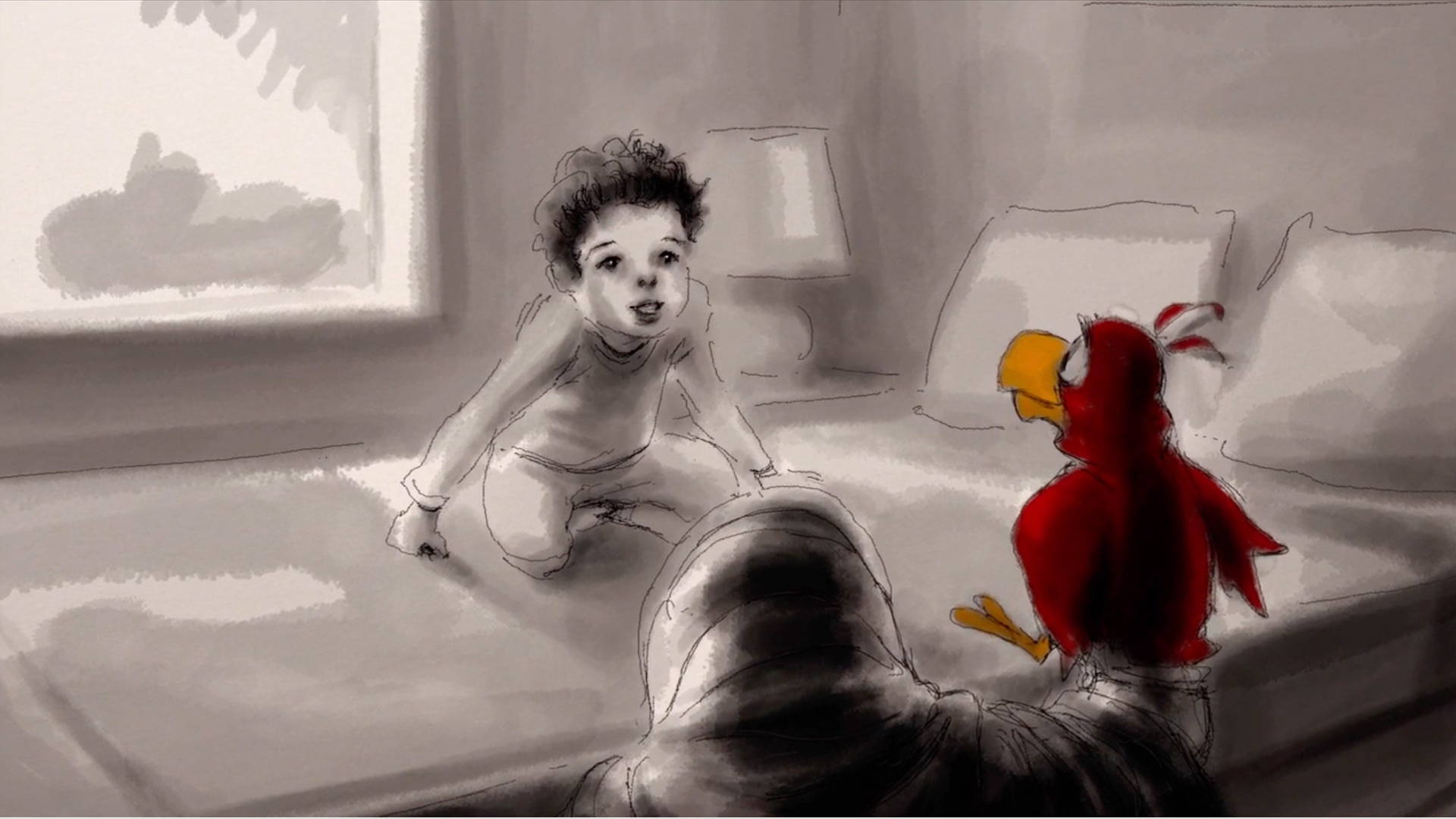
The Suskinds were there to talk about their new documentary, “Life, Animated,” based on Ron’s best-selling book about Owen and how he taught himself about the world through Disney films. The movie is about Owen and autism and the scary and exciting adventure of leaving home, but most of all it is about family. The Suskinds are one of the most loving, devoted, and compassionate families ever to appear on screen. It is a joy to spend time with them, whether through the book, the film, or an interview.

Owen has regressive autism, meaning that he developed along typical milestones until about age 2½, and then lost his ability to communicate and continue to develop. He loved to watch Disney animated films but barely spoke until age 6, when he suddenly told his parents that his brother Walt did not want to grow up, “like Peter Pan and Mowgli.” Owen was using Disney films to teach himself how people feel, behave, and communicate.

“They helped me communicate to find my place in the world and get my speech back,” Owen said.

Cornelia explained, “Movies are always the same. Every time you pop it in, every time you put in a VHS it will always be the same movie and the same language and the same characters instead of constantly changing, the way it does with people, even my expressions, with you and me sitting here. it’s always the same, very, very exaggerated, very colorful. And I think the combination of the music and animation together activating those parts of the brain were really key in tapping into how Owen was feeling but not able to express.”

When Owen was younger, he preferred hand-drawn animation “because it does expressions and feelings.” Now, he likes computer animation as well, perhaps because it has come closer to hand-drawn in its expressiveness and richness of detail. He has very strong views about sequels: “The only four theatrical animated sequels I love are ‘The Rescuers Down Under,’ ‘Fievel Goes West,’ ‘Toy Story II’ and ‘Fantasia 2000’ and the only direct-to-video animated sequels I love are after the very first film of ‘The Land Before Time’ the animated film theatrical in 1988 were ‘The Land Before Time’ direct to video animated sequels. I would go all the way until the 10th one from late 2003, early 2004 and then conclude right there.” He loves to draw the sidekick characters, who have special meaning for him. His favorites are Sebastian from “The little Mermaid,” Iago from “Aladdin,” and Lucky Jack from “Home On The Range.”

Owen has his own YouTube channel, Owen’s Disney Club, where he discusses his favorite movies, displays Disney paraphernalia currently available for bid on eBay in a weekly “Finds of the Week” screencast, tours his personal collection of rare and hard-to-find Disney items, and interviews special guests.

Owen may be the only fan whose favorite Jimmy Stewart role is in “Fievel Goes West,” where his character says, “Just remember Fievel, one man’s sunset is another man’s dawn. I don’t know what’s out there beyond those hills but if you ride yonder, eyes steady, head up and heart open, I think one day that you’ll find that you are the hero that you’ve been looking for.”

Owen pointed out that Stewart, like a surprising list of other stars, made his last performance in an animated film. Another favorite is Mary Wickes, whose last performance was as a gargoyle in “Hunchback of Notre Dame.” Owen quoted her: “Life’s not a spectator sport. If watchin’ is all you’re gonna do, then you’re gonna watch your life go by without ya.”

Cornelia’s hopes for the movie are equally inspiring: “If we could share a little bit of a positive experience, not that obviously every minute in the film is a positive and our every minute has not been positive, but just the reality of it for people to get another image of what a person on the spectrum is like instead of ‘Rain Man,’ to see how fully realized Owen’s life is and that his wants and desires are every bit exactly the same as ours. I mean it’s extraordinary, it really is. So we’ve guided him for sure and try to teach him but he teaches us a lot more in a profound way.” And in this movie, they teach us all.

Related Tags:


Disabilities and Different Abilities Documentary Interview

Alex Gibney on the Stuxnet Documentary “Zero Days”

Posted on July 8, 2016 at 7:00 am

You will not see a more purely terrifying movie this year than “Zero Days,” a documentary from Alex Gibney (“Enron: The Smartest Guys in the Room,” “Going Clear,” “We Steal Secrets”), one of my favorite filmmakers. He spoke to journalists along with Eric Chien and Liam O’Murchu, two of the film’s most important figures, the men who discovered what they dubbed the Stuxnet computer virus, which turned out to have been developed by the Unites States and Israeli governments to unleash on the nuclear facilities in Iran. As an expert in the film explains, for centuries countries had armies and navies, and then in the 20th century they had to have air force capacities. But now, in the 21st century, wars will be fought through computer networks, probably more frequently and more devastatingly than on battlefields.

As a filmmaker, Gibney had a challenge to present a non-cinematic story in a dynamic visual medium. “It was mostly men sitting in rooms with suits on. The main character was a piece of computer code. Talk about challenging. You’ve seen ‘Enron.’ Back then I broke rule number 1A of the filmmaking manual which is never make a film about accounting.” He worked with a special effects company to “design a code, with the help of Eric and Liam, to be able to make it both accurate and also make it feel like it’s a living breathing thing. So it really was like entering the Matrix or something like that. That was key — it was to come up with a visual design for the film and then also a narrative design for what is basically a detective story. It’s kind of a spy thriller and Eric and Liam were the detectives.”

Chien provided some historical context. “I think the internet itself sort of changed how we function, our economy, a lot of growth, and the ‘internet of things’ will grow equally as well…It is very insecure and a bit worrisome and I think we fear that we will repeat mistakes that we made in the past. When we started computing it was quite open and free which was great and you could hack the computer in the old traditional sense of hacking the computer and that allowed the sort of insecurity where we are at today. We did not design computer and networking with security in mind at the start. We designed it so anyone can use it and it would be completely free. We sort of learned a lesson that you needed some level of security and that lesson currently is not being applied to the internet of things. That’s what worries us the most the right now. There is a lot of push right now to get internet of things on board with some sort of standard with some sort of default security.”

In the film, Chien and O’Murchu, in evaluating the Stuxnet virus to protect their commercial customers, quickly realized that the code was vastly more powerful and robust than anything they had seen before. The obvious conclusion was that it came from a government. But that does not mean they stop trying to find a way to stop it because it may be coming from “the good guys.” O’Murchu said, “It’s funny when you say bad guys can do this, how do you define that? The whole problem is that there are no good guys and bad guys here.” “In our world the good guys are us and the bad guys are anyone else,” Chien added, “anyone who is writing malicious codes to get unauthorized access to a computer that ultimately we normally are in charge of protecting. That is our view so we don’t ignore code because it looks super sophisticated or might be from a nation state. We have customers all over the world in countries like Germany and Belgium that Western countries have attacked equally as well and we’re responsible for protecting those computers. I would say in some sense fortunately code doesn’t come with a marker that says this is from this particular country and even if it did you can’t say that anyone would put in their code ‘Welcome from so and so.'”

The film begins with a sequence of witnesses saying some variation of “I can’t talk about it.” So how can Gibney be sure of what he is reporting? “Obviously, there are false flags. People lie to you all the time but over time you develop patterns and you try to convince yourself that actually you got the story right.”

The most candid (to a point) and compelling witness in the film is an unidentified (until the end) insider portrayed as a disembodied face made of cascading pieces of code, created for the film by a company called Scatter. “We wanted to create a character that would be in the kind of code world of the film but would also be a means of protection. So what we did was, we shot an interview with a woman, and we shot it in a way that was very much straight on but it was like we were mapping her in a 3-D space. And then it allows you to go in after the fact and both render camera moves and also break down the image into points, lines and flesh and recombine them in different ways so that they both mask the identity but also create that kind of interesting sort of hacked computer look of the character. And as you move around to the side because they were mapping only 180° in space, suddenly it starts to trail or get messy and if you go all the way around actually in the first rendering of the character we were able to literally jump outside the room and then track in, that was all after-the-fact. So it was really a wonderful device and it also helped us in terms of convincing sources to come forward that we would have a device that would be so otherworldly that it would mask identity.”

In this movie about secrets, Gibney was especially careful to protect his sources. “One of the things we did for protection was the combined testimony of a number of different people. While the New York times would frown on that technique within the context of the film I think it’s perfectly appropriate and also frankly it was key to persuading the sources to come forward and that was very important to us.” He believes that in documentaries “form follows content.” Some stories require more narrative shaping and commentary. With his Lance Armstrong film, “The Armstrong Lie,” “we hung out with Lance, we follow Lance, we don’t comment in addition I did interviews but we film for 21 days at the Tour de France. So it depends. In a lot of the films that I do tend to look back at recent events and understand them in a different way. Usually knowledge narratives get built around them and then I go in after the fact and say is this really what happened. It’s like cold cases. Is this really what happened or actually is it different than we thought it was? Is very hard to use cinéma vérité in the past, impossible in fact. I’ve got nothing against it; for the right film I love it.”

This movie can be seen as a companion piece to Gibney’s documentary about Wikileaks, “We Steal Secrets.” “It’s a matter of momentum. So far the momentum on the side of the government has been to make more and more things clasified. It becomes almost a default policy and to read more and more people into these secrets so that they are unable to talk about this. Well if you create a mountain of secrets and a huge number of people who hold these secrets it shouldn’t be surprising that there are leaks. Despite the Obama administration’s insistence on prosecuting people who leak more than all other administrations combined, you continue to get these big leaks in part, I think, because there is a belief that what the government is doing is hiding either misguided, immoral, or illegal behavior behind those secrets and therefore not being held to account. You are seeing that in the torture debate, you are seeing that in the drone debate and now you are seeing it with Stuxnet. So at some point they’ve got to wake up and understand that if they are misusing secrets James Harper lied before the Senate regarding the operations of the NSA, there’s going to be blowback and the blowback is more leaks.” Chien called it “rough justice.”

The movie calls for some international negotiations on the use of cyber-weapons. “I think the point is if we start then we’ve got a shot at it. To just throw up our hands and say ‘well, it’s impossible so let’s not worry about it,’ I think that’s just the wrong answer. We have to embark on that and part of it also is that these technologies that these weapons exist because then all of us as citizens can say well is this what we want, a complete Wild West world where everybody is launching weapons at each other all the time and we don’t know when they might launch or who might launch them, not a good thing. Someone in the film says, ‘Right now the norm is do whatever you can get away with,’ not a very good norm.”

Related Tags:


Directors Documentary Interview
Life, Animated

Life, Animated

Posted on July 7, 2016 at 5:34 pm

B+
Lowest Recommended Age: Middle School
MPAA Rating: Rated PG for thematic elements, and language including a suggestive reference
Profanity: None
Alcohol/ Drugs: None
Violence/ Scariness: Emotional upheavals
Diversity Issues: A theme of the movie
Date Released to Theaters: July 8. 2016
Copyright 2016 The Orchard

Temple Grandin described her experience of trying to understand social interaction as a person with autism: like an anthropologist on Mars. The kinds of social cues that come naturally to neurotypicals can seem strange and even disorienting to people on the autism spectrum, who may be overwhelmed with undifferentiated input that makes it even more difficult to understand the mood and motives of the people around them. “Life, Animated,” based on the best-seller by Ron Suskind, is the story of Owen Suskind’s efforts to use Disney animated films to help him understand and communicate with the people around him. Taking up where the book ends, it is the story of the most universal of human experiences — leaving home, becoming independent, negotiating romance and work — as seen through the unique mind of a man who finds his answers in Disney movies.

And of course so many Disney movies are about growing up. We see Owen watching Wendy in “Peter Pan” as she says, “I have to grow up tomorrow.” And Owen tells us he is a little nervous and a little excited about graduating and moving out of his parents’ house and into a group home.

Owen was developing normally until age three, and then suddenly he “vanished.” He stopped speaking. “It’s like we were looking for clues to a kidnapping.” His parents found themselves in those less-friendly doctor’s offices, the ones that have rooms with special windows for observation. Owen was diagnosed with “pervasive developmental disorder,” which basically means: “we have no idea what the problem is or how to fix it.”

The Suskinds, one of the most loving, wise, and devoted families ever put on film, were determined to undertake “a rescue mission to get inside this prison of autism and pull him out.”

And it turned out, from the inside of that prison, Owen was on his own rescue mission. Suddenly, at 6 1/2, after years of no clear sign that he could still speak or of how much he understood, he said to his parents after his brother’s birthday party, “Walter doesn’t want to grow up, like Mowgli and Peter Pan.”

That is not only a complex sentence; it is a complex idea. The family began to use the Disney films as a sort of English as a second language mode of communication. Owen’s father used a puppet of “Aladdin” character Iago to speak to him, and Owen answered back. “We began to speak to him in Disney dialog.” As an expert in the film notes, animated characters are exaggeratedly expressive. Their fear, anger, and affection is clearly shown, and repeat viewings are illuminating and reassuringly the same, a welcome consistency in a world of chaos and unpredictability. “Disney keeps the world neat and tidy.”

It also gives Owen a chance to interact. He starts a Disney club for other people with autism. A surprise visit from two Disney voice talents is a movie highlight, and, clearly for the actors unused to such unalloyed enthusiasm, a career highlight for them.

And Owen draws the characters, too. But only the sidekicks, never the principals, the stars. Perhaps he feels that he is a sidekick as the people around him have adventures he will not.

Director Roger Ross Williams, a family friend, is clearly trusted by the family and he more than earns it with a sensitive, understanding approach. With the permission of Disney, he includes clips and animation inspired by Disney that tells Owen’s story in a way that lets us see through his eyes the way that “Peter Pan” and “Aladdin” let him see through ours.

Parents should know that this film includes discussions of autism, growing up, and separation, a painful break-up, and a mild sexual reference.

Family discussion: What movie helped you understand feelings and communication? What is the best way for families and friends to help people like Owen?

If you like this, try: “How to Dance in Ohio” and “The Story of Luke”

Related Tags:


Disabilities and Different Abilities Documentary Family Issues Movies -- format

AFI Docs 2016 — Highlights

Posted on June 28, 2016 at 4:44 pm

The 2016 AFI Docs festival is over and the audience award winner was “Maya Angelou: And Still I Rise,” which will be featured on the PBS “American Masters” series.

This year’s AFI DOCS attendees included renowned filmmakers Judd Apatow, Ramin Bahrani, Heidi Ewing, Alex Gibney, Rachel Grady, Werner Herzog (this year’s AFI DOCS Charles Guggenheim Symposium honoree) and Barbara Kopple, along with documentary subjects Sharon Jones and Norman Lear. I was struck by the pair of films about the internet, Werner Herzog’s “Lo and Behold” and Alex Gibney’s Stuxnet film “Zero Days.” Other highlights included “Life, Animated,” the extraordinary story of a boy with autism who used Disney animated films to teach himself how to communicate (coming to theaters over the next few weeks), and “Gleason,” the story of football player Steve Gleason, who was diagnosed with ALS.

Related Tags:


Documentary Festivals
Interview: Morgan Neville on Yo-Yo Ma and “Music of Strangers”

Interview: Morgan Neville on Yo-Yo Ma and “Music of Strangers”

Posted on June 22, 2016 at 3:55 pm

© 2016 THE MUSIC OF STRANGERS

music of strangersMorgan Neville is the man behind some of my favorite documentaries including “20 Feet from Stardom” and “Best of Enemies.” His latest film, “The Music of Strangers: Yo-Yo Ma and the Silk Road Ensemble,” is about cellist Yo-Yo Man bringing together international musicians to share their sounds and traditions in a group called The Silk Road Ensemble. As we learn more about the challenges faced by performers from Spain, Syria, China, and other countries, the music they create together becomes even more moving.

That does not mean it was not a challenge for Neville to work with people from so many different cultures, whose only common language was music. “It was difficult but incredibly rewarding. I mean this was such an ambitious film that I think if I had known how ambitious it was at the beginning I would have been a lot more scared. I think when you make films it’s like being like a mother who’s had a baby. Your body forgets the pain; you have this conscious amnesia where you convince yourself that it won’t be that hard. And this was hard. We shot in seven countries in six languages and so from a production point of view it was hard, but creatively it was fascinating. Trying to take the ideas and the music and the scale of what is happening in the Silk Road Ensemble and trying to put that into a movie was daunting, but it was amazing experience at the same time.”

The film goes back to the first gathering in 2000, and some of the film was archival, coming from a local PBS station. “I didn’t know when I started making the film that any of that stuff existed but we just found little bit and pieces in archives that helped us tell the story and helped shape the story. But I basically filmed everything from 2011 on.” There were so many musicians he had to select a few to focus on. “Not only did I want to represent the diversity of the geography and background and experience but at the same time they had to be on the same type of journey. There were other great musicians and great stories in the ensemble but their stories are less related. I think the thing that united everybody that we focused on was that they all made a decision to leave, to not do the obvious thing or take the road less traveled and to go out into the world and then all returned back to home with some new found perspective on what made their home special or made that tradition special.”

The musicians all cherish their traditions and cultures, but they clearly relish the musical adventure of combining sounds and trying something new. Neville agreed that those two impulses could create some tension. “In all these cultures there are traditionalists, people who basically don’t want things to change, and I get that, but I think what Yo-Yo says in the film is that all traditions are born of real innovation. In a way what they’ve all tried to do with their tradition is the best way of preserving it. They are trying to keep it growing. What you are doing with a bagpipe or a peepa; a Galician gaita or a pipa, it’s taking it and expanding the vocabulary of that language. That’s a way of celebrating its uniqueness and making sure it stays relevant, it doesn’t die out like you see with the Xang Family banned in China . To me they are just tremendous, they are amazing, but there is no future for it. And there is a whole other counter-argument you could make, which is why the metaphor the Silk Road is so appropriate. Things that seem like pure embodiments of specific cultures usually aren’t, whether we are talking about pipas or pasta. I will give you one example, the Persian instrument which is a Kamancheh, a very traditional, personal instrument. It has four strings on it; it used to have two strings on it until they saw violins and said, ‘Well, if they’ve got four strings we should have four strings.’ And now people want to protect it but it already has a vocabulary, it’s already in dialogue with the rest of the world even going back before this tradition. People like Wu Man and Kayhan , even though actually they left their homes, they’ve done more to preserve their tradition than the people that stayed. If you look at how China regards its own traditional music now or how Iran regarded its traditional music after the Gulf War, they not only stopped all Western influence, they stopped all traditional music in the cultural Revolution and that’s part of why Kayhan had to leave, everybody had forgotten how to play the Kamancheh.”

While Neville has made documentaries on other subjects, his favorite topics begin with music. “To me, the best music films are not about music. Music is a way of telling the story. It’s a language but it’s got to say something with that language. I think Yo-Yo is very much about that. I feel like it’s an amazing tool to have as filmmaker and I love investigating those stories. But every music film I’ve done is about something beyond the music. This one is about all these ideas. I mean it’s really about these big questions in its most elemental form, the importance of culture. Does culture matter, how does it define us and connect us in ways we don’t see? How can culture help us humanize the other in a world where we are so caught up in building walls and demonizing the other, how does culture work as antidote to that? I mean all of these kinds of questions I think we’re the ones we were investigating.” He gave as an example one moment in the film he said was one of his favorites: when Yo-Yo Ma is playing a Bach piece and another musician is singing a very traditional Taiwanese song as a mashup between the two seamlessly.” At first, the film had more expert explanations, but “at the end of the day it just felt like we were talking more than showing and that the music expressed so much that we just kept pulling back on it and trying to find the emotional story.”

Related Tags:


Directors Documentary Interview Music
THE MOVIE MOM® is a registered trademark of Nell Minow. Use of the mark without express consent from Nell Minow constitutes trademark infringement and unfair competition in violation of federal and state laws. All material © Nell Minow 1995-2026, all rights reserved, and no use or republication is permitted without explicit permission. This site hosts Nell Minow’s Movie Mom® archive, with material that originally appeared on Yahoo! Movies, Beliefnet, and other sources. Much of her new material can be found at Rogerebert.com, Huffington Post, and WheretoWatch. Her books include The Movie Mom’s Guide to Family Movies and 101 Must-See Movie Moments, and she can be heard each week on radio stations across the country.

Website Designed by Max LaZebnik