The Maltese Falcon

Posted on December 13, 2002 at 5:17 am

Plot: Sam Spade (Humphrey Bogart) is a private detective. A woman who says her name is Ruth Wonderly (Mary Astor) comes to see him, asking for help in finding her sister. Sam sends his partner, Miles Archer (Jerome Cowan) to follow her when she meets Floyd Thursby, the man she thinks her sister is with, and both Archer and Thursby are killed. It turns out that the woman has given him a false name. She is really Brigid O’Shaughnessy, and it turns out it is not her sister she is seeking, but a small, jeweled statue of a falcon, and she is mixed up with some people who will do anything to get it.

One of those people is Joel Cairo (Peter Lorre), who comes to see Sam to insist — with a gun — that he be allowed to search Sam’s office to see if it is there. Sam is not at all intimidated by Joel, but allows him to search. Also after the statue is Mr. Gutman, “the fat man” (Sidney Greenstreet), with his “gunsel,” Wilmer. They alternately threaten and attempt to bribe Sam, while Brigid appeals to his protective nature and his heart. But Sam turns them all over to the police, including Brigid, whom he loves.

Discussion: One of the most interesting aspects of this classic movie is the way that Sam Spade thinks though the moral dilemmas. When he is deciding whether to tell the police about Brigid, he is very explicit about weighing every aspect of his choices. It is not an easy decision for him; he has no moral absolutes. On one hand, he loves her, and he did not think much of his partner. On the other, he does not trust her, he does not think she trusts him, and he knows that they could not go on together, each waiting to betray or be betrayed. And he has some pride; he says that when your partner is killed, you are supposed to “do something.” While it may be good for business not to appear too ethical, it is bad for business to allow a partner in a detective firm to get killed without responding. If he turns her over to the police, he loses her. But if he does not, he loses a part of himself, his own kind of integrity.

When this movie was made, moviegoers were used to cool, debonair detectives (like Philo Vance and Nick Charles, both played by William Powell), a sort of cross between Sherlock Holmes and Fred Astaire. But Sam Spade, created by Dashiell Hammett based on his experiences as a detective, was a modern day version of the cowboy, a loner with his own sense of honor.

This was the first movie directed by John Huston, who also wrote the screenplay, but he was already a master. Watch the two scenes where Sam goes to talk to Gutman, and see how the camera angles in the first scene lead the viewer to suspect that Sam’s drink is spiked (it isn’t), and then how different angles are used in the second one to make the viewer confident that it won’t be (it is).

Questions for Kids:

· What does Sam mean when he says the statue is “the stuff dreams are made of”?

· Where is Sam faced with moral conflicts? How does he resolve them? What are his reasons?

Connections: Bogart appeared as a similarly tough detective, Philip Marlowe, in “The Big Sleep,” based on the novel by Raymond Chandler. The books by Hammett and Raymond Chandler are well worth reading. Note the director’s father, Walter Huston, in an uncredited brief appearance as Captain Jacobi. Jerome Cowan, who appears briefly as Miles Archer, plays the prosecuting attorney who tries to prove that Kris Kringle is not Santa Claus in “Miracle on 34th Street.”

Related Tags:


Based on a book Classic Crime Thriller

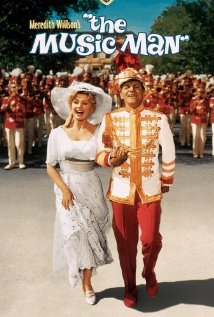
The Music Man

Posted on December 13, 2002 at 5:17 am

“Professor” Harold Hill (Robert Preston) is a con man posing as a salesman of band instruments and uniforms. He happens upon River City, a small town in Iowa. As the citizens explain in song, Iowa is a place of stubborn people who keep to themselves unless someone needs help. But Hill happens upon an old friend, Marcellus Washburn (Buddy Hackett), and is ready to run his favorite scam. He plans to sell the town on the idea of a boys band, with himself as leader, get them to order instruments and uniforms, and skip town with the money. Marcellus tells him a bit about the town and its people, and especially about the town librarian and music teacher, Marian Paroo (Shirley Jones).

Copyright Warner Brothers 1962

Marian lives with her mother (Pert Kelton) and her little brother Winthrop (Ronny Howard), a shy boy with a lisp, who deeply mourns his late father. In her own way, Marian, like Winthrop, is still grieving, and finds it hard to allow herself to become close to anyone. This is especially difficult because she is the subject of some gossip in the town. She has the job as librarian because an elderly man, a friend of her fathers, bequeathed the library building to the town, but left the books to her, to ensure that she would have permanent employment. This has caused some speculation about their relationship. And the ladies in the town also think the books she recommends (including the Rubiyat and Balzac) are improper. Despite her mother’s attempts to encourage her to be friendlier, Marian is very skeptical about Harold’s motives and his credentials. He is able to dazzle the town (with the famous patter song “Trouble,” offering the band as an alternative to the decadence of the town’s new pool parlor), but she vows to check his credentials.

The town gets caught up in the notion of the band. Harold’s charm and smooth promises enrapture everyone from the town council (he transforms them from four squabbling politicians into a harmonizing barbershop quartet) to the teen-age boy all the others look up to (Harold challenges him to invent an apparatus for holding the music so that the piccolo player can read it and encourages his romance with the mayor’s daughter). Harold even charms Winthrop, who is at last excited and happy about something. Harold tells all the parents that their children are wonderfully gifted and that the band will make them stars. Meanwhile, Harold’s attention to Marian is becoming more than just a way to help him get the money. And, despite evidence that he does not have the credentials he claims, and her certainty that he is not what he pretends to be, she finds herself softening toward him and protecting him.

Because of her, he stays too long, and he is arrested. As he says, “For the first time, I got my foot caught in the door.” But somehow, the boys force a few sounds out of the instruments, enough for their proud parents. And Harold stays on — it turns out that all along, deep inside, what he really wanted was to lead a band.

Discussion: Robert Preston brought his award-winning performance as Harold Hill on Broadway to the screen in this impeccable production, perfect in every detail. In addition to the glorious production, with some of the most gorgeous music and dancing ever filmed, there is a fine story with appealing characters. Marian learns about the importance of dreams from Harold, and he learns about the importance of responsibility from her.

Harold has made a life out of other people’s dreams, creating them and then spoiling them. He gives people an image of themselves as important and creative, and it is clear that this is what he loves about what he does, not stealing the money from them. Marian has faith in Harold. It is not the blind faith of the rest of the town, the people who see the seventy-six trombones he sings about. She sees what is good inside him, the real way that he affects people like Winthrop, the way he affects her. As she sings, “There were bells on the hills, but I never heard them ringing, oh, I never heard them at all, ’til there was you.” When Marian sees Harold and is willing to love him in spite of his past, he is for the first time able to move on from the notion of himself as a thief and a liar. Each finds the core of the other, allowing both of them to heal and take the risk necessary to make their dreams come true. For him, the risk is prison and disgrace. For her, the risk is the kind of hurt she felt when her father died, the risk we all take in loving someone. And because this is a musical, they live happily ever after.

Questions for Kids:

· Why is Winthrop so shy? What makes him change?

· How does Harold change people’s minds? Is that good or bad?

· How does the music help to tell the story? Listen to the songs “76 Trombones” and “Goodnight My Someone” again. They are very much alike, as you can tell when they are sung together. What did the composer want that to tell you about the people who sing them?

· Why were the parents worried about their children playing pool? What do parents worry about today?

· How is Marian’s library like yours? Do you know your librarian? Do people in your town ever argue about what books should be in the library?

Connections: This movie shows some of the most talented people of their time at the top of their form. Shirley Jones appeared in many musicals, including “Oklahoma” and “Carousel,” always exquisitely lovely in voice and appearance. She also won an Oscar for her dramatic role as a prostitute in “Elmer Gantry.” And of course she was the mother in television’s musical comedy series, “The Partridge Family.”

Robert Preston had more luck in theater than in movies finding roles that gave him a chance to show all he could do. But every one of his film appearances is worth watching, including “The Last Starfighter” and “All the Way Home.” Choreographer Oona White also did the sensational dance numbers in “Bye Bye Birdie.” Composer Meredith Willson never came close to the glorious score for “The Music Man,” but he produced some nice songs for “The Unsinkable Molly Brown.”


Related Tags:


Classic Crime For the Whole Family Musical Romance

All the President’s Men

Posted on December 13, 2002 at 5:17 am

A+
Lowest Recommended Age: Middle School
MPAA Rating: PG
Profanity: Some very strong language for a PG including the f-word
Alcohol/ Drugs: Drinking and smoking
Violence/ Scariness: Some tense moments
Diversity Issues: None
Date Released to Theaters: 1976
Date Released to DVD: June 11, 2012
Amazon.com ASIN: B000CEXEWA

This week is the 40th anniversary of the Watergate break-in and a good time to look at the Oscar-winning movie about the two reporters who would not give up on the story of the Watergate break-in, this is as gripping as any detective novel. Bob Woodward (Robert Redford), a junior reporter for the Washington Post, is sent to cover a small-time break-in to the office of the Democratic National Committee (located in the Watergate office building). He works with Carl Bernstein (Dustin Hoffman), another reporter, to find, after tediously painstaking research, that it is just part of a complex pattern of corruption in President Nixon’s re-election campaign.

Producer/star Redford was so intent on authenticity he even flew actual garbage from the Washington Post wastepaper baskets out to the set. The movie does a good job of showing how much of the work of the reporters was dull persistence, and it also does a good job of showing us what went in to the decisions of editor Ben Bradlee (Jason Robards in an Oscar – winning performance) and (off-screen) publisher Katharine Graham about what they needed in terms of proof in order to be able to publish the story.

There is an interesting range of moral choices and calibrations. The famous “Deep Throat” (Hal Holbrook), unidentified until 2006, is someone from the inside who will not allow himself to be identified or even quoted, but is willing to confirm what the reporters are able to find elsewhere.

Others involved in the scandal, both in the corruption itself and in its cover-up, must decide what to do and how much to disclose. “Deep Throat” will not tell them anything new, but will confirm what they find out and give them some overall direction, most memorably, “follow the money.” One key development is the decision made by someone identified only as “the bookkeeper” (Jane Alexander) to talk to Bernstein. The participants must also deal with the consequences of their choices. Donald Segretti (Robert Walden) manages to evoke sympathy when what began as juvenile pranks leave him in disgrace. Woodward and Bernstein also make mistakes and must deal with the consequences.

As the movie ends, in 1972, Nixon is re-elected, and it seems to the reporters that their work has had no impact at all. Kids who view this film may need some context in order to understand it, and will want to know what else happened before Nixon resigned in August of 1974.

Families who see this movie should discuss these questions: Why were Woodward and Bernstein the only reporters interested in the story? Why did they insist on two sources before they would publish anything? What were Donald Segretti’s “dirty tricks?” How was he different from Sloan? From the bookkeeper? From Deep Throat? One of the people portrayed in the movie later testified before the Watergate Committee that he had “lost his moral compass.” What does that mean? How does something like that happen? How has technology changed the way that reporters do research and prepare their stories?

Families who enjoy this movie might like to see “The Final Days,” a made- for-television sequel, based on Woodward and Bernstein’s follow-up book. For more on this era, see Nixon with Anthony Hopkins, and Nixon’s famous “Checkers” speech and resignation statement. An odd little movie called Nasty Habits is an allegory of Watergate, set in a convent, with Glenda Jackson as a Nixonian nun. And a very funny satire, Dick (for older audiences) sees these events through the premise that it was all uncovered by a couple of high school girls.

If audiences want to know more, they should know that the book this movie was based on is not much fun to read and has more reporting than analysis. Older kids who want to know more can read Breach of Faith: The Fall of Richard Nixon by Theodore White, To Set the Record Straight: The Break-In, the Tapes, the Conspirators, the Pardon, by Judge Sirica, or the books by John Dean and H. R. Haldeman. In 2006, the identity of “Deep Throat” was revealed and Woodward told the story in The Secret Man: The Story of Watergate’s Deep Throat.  President Nixon’s series of television interviews with David Frost inspired the Oscar-nominated film Frost/Nixon,  and the interviews are also available on DVD.

Related Tags:


Based on a book Based on a true story Classic Crime Drama DVD/Blu-Ray Pick of the Week

Next Friday

Posted on December 13, 2002 at 5:16 am

On the one hand, this movie is a lazy, dumb, and misogynistic and it promotes pot smoking, unemployment, and burglary. On the other hand, it is genial and unpretentious. If it does not take drug use, crime, racism, and sexism too seriously, it does not take itself too seriously either. Almost every joke in the movie is taken from another movie, but the cast enjoys them so much that they occasionally make it work.

This is the sequel to “Friday,” a movie that performed modestly in theaters but became a hit on video. In the original, Craig (played by rap star Ice Cube, who co-wrote the screenplay) spent the day smoking pot and beat up the neighborhood bully. The sequel, again written by and starring Ice Cube, has the bully breaking out of prison and looking for revenge. Craig goes off to the suburbs to stay with his uncle, who bought a house with money he won in a lottery.

Craig again spends the day smoking pot — with his Uncle Elroy and Elroy’s sexually rapacious girlfriend, and with Elroy’s son Day-Day and his friend from work (before they get fired). When they have to raise $3600 to pay off delinquent property taxes, it never occurs to them to earn it or to go to the bank to get a home equity loan. No, clearly the best choice is to steal it from some vicious Latino drug dealers across the street.

Parents should know that the movie is extremely raunchy and includes just about every kind of material except for graphic violence that parents try to keep away from kids. Parents whose kids do see this movie should at least try to talk with them about the portrayal of women (either sexual predators, compliant bimbos or terrifying harridans) and minorities and drugs as a way to bond and to escape worries.

Related Tags:


Comedy Crime Series/Sequel

Run Lola Run

Posted on December 13, 2002 at 5:16 am

Teenagers with a taste for the offbeat will enjoy this German import about a woman who gets a frantic phone call from her boyfriend and has only 20 minutes to find 100,000 marks (about $60,000), or he will be killed by the drug dealer to whom he supposed to deliver the money. Lola (Franka Potente) and her boyfriend Manni (Moritz Bleibtreu) live in a sort of of punk post-modern demi-mondaine. The key image of the movie is Lola, with her Raggedy Ann mop of bright red hair, running to save her beloved Manni from the drug dealer, and from himself — he has threatened to hold up a store if she cannot get him the money. When she interacts with people on her way — and in her way — we sometimes get glimpses of what their lives ahead will hold.

Lola runs to her father, who works at a bank, to ask him for the money. But he has his own problems. She does not make it in time, and the result is tragic. But Lola’s determination is such that she will not let that happen. All of a sudden, we are back in her apartment and she is getting Manni’s call again. Everything starts over, this time with tiny differences that have huge consequences for Lola and Manni and for the people around them. It takes three tries before Lola’s running is over.

The movie is fun to watch, with a lot of very clever jump cuts and effects, and it can be a nice jolt for kids who are used to pedestrian big-budget film-making. Parents should know that there is some rough street language, references to out-of-wedlock pregnancy and adultery, and that the main characters live on the edge of the underworld — the money Manni leaves on a train belongs to a drug dealer. Families may want to discuss the movie’s theme about the way that the tiniest choices and interactions can have the most wide-reaching consequences.

Families who enjoy this movie will also like “Diva.”

Related Tags:


Action/Adventure Crime Drama Independent Thriller
THE MOVIE MOM® is a registered trademark of Nell Minow. Use of the mark without express consent from Nell Minow constitutes trademark infringement and unfair competition in violation of federal and state laws. All material © Nell Minow 1995-2026, all rights reserved, and no use or republication is permitted without explicit permission. This site hosts Nell Minow’s Movie Mom® archive, with material that originally appeared on Yahoo! Movies, Beliefnet, and other sources. Much of her new material can be found at Rogerebert.com, Huffington Post, and WheretoWatch. Her books include The Movie Mom’s Guide to Family Movies and 101 Must-See Movie Moments, and she can be heard each week on radio stations across the country.

Website Designed by Max LaZebnik