Looper

Posted on September 27, 2012 at 6:00 pm

B+
Lowest Recommended Age: Mature High Schooler
MPAA Rating: Rated R for strong violence, language, some sexuality/nudity, and drug content
Profanity: Very strong language
Alcohol/ Drugs: Drinking, drug use and addiction
Violence/ Scariness: Intense and graphic violence with adults and children injured and killed, suicide
Diversity Issues: Diverse characters
Date Released to Theaters: September 28, 2012
Date Released to DVD: December 24, 2012
Amazon.com ASIN: B005LAII8A

Joseph Gordon-Levitt and Bruce Willis play the same man in a twisty time-travel thriller about “loopers,” assassins who use short-range guns called blunderbusses to kill targets sent back in time from the future.  The first thing we see is an ornate antique pocket watch as young Joe (Gordon-Levitt) waits next to a cornfield, a cloth spread out on the ground in front of him.  The seconds tick by and then the target appears on the cloth, hands cuffed behind him with a bag over his head.  Joe shoots, turns over the victim to retrieve the silver bars under his jacket, and disposes of the body.  The criminals in the future have found a neat (in both senses of the word) method of dispatching their enemies.

It is 2044.  The dead man was sent back from 2074.

Young Joe goes out clubbing with other loopers, the hapless Seth (Paul Dano) and another looper who has been retired.  In what is called “closing the loop,” his last target is his future self.  These final assignments bring payment in gold along with the knowledge of what will happen to the young assassin when he faces himself in three decades.  Seth lets his future self escape and gets in trouble with Abe (a superb Jeff Daniels) the man in charge of the loopers.  There are some special challenges that come with the problem of two different versions of the same person running around at the same time; apparently, you can’t just shoot him/them without disturbing the time-space continuum or something like that.  Old Joe and Young Joe know themselves/each other too well to trust each other and too well to hide from or outsmart each other.  And just like Marty McFly, they have to reckon with the fact that any big changes they make in the now will result in even bigger changes in the future.  Which is Old Joe’s past.

Still with me?

As with his brilliant and ground-breaking “Brick,” also starring Gordon-Levitt, writer/director Rian Johnson has an engaging and compelling way of mixing genres.  There are some overlays of the Western, the noir crime story, and a “Terminator”-style time travel mind-bender.  The efforts to make Gordon-Levitt and Willis look even a little bit like they might be the same guy are ineffective and distracting, but other than that, this is a smart, exciting, mind-bender and a lot of fun.


Parents should know that this film has intense and graphic violence and peril.  Adult and child characters injured and killed.  The film includes a suicide, disturbing images, drinking, drug use and drug addiction, nudity, sexual references and situations, and very strong language.

Family discussion: Do you agree with Joe’s decision at the end?  How did his experience with Seth affect his choices later on?  What elements of today’s society inspired this idea about the future?

If you like this, try: “Brick,” from the same writer/director and star and time travel stories like “12 Monkeys” (also with Bruce Willis) and “Frequency”
 

Related Tags:


Action/Adventure Crime Drama DVD/Blu-Ray Pick of the Week Fantasy Science-Fiction

Trouble With the Curve

Posted on September 20, 2012 at 6:00 pm

B
Lowest Recommended Age: High School
MPAA Rating: Rated PG-13 for language, sexual references, some thematic material, and smoking
Profanity: Very strong language
Alcohol/ Drugs: Drinking and scenes in bars
Violence/ Scariness: Tense family confrontations
Diversity Issues: None
Date Released to Theaters: September 21, 2012
Amazon.com ASIN: B009AMAK0E

“Trouble with the Curve” pitches softballs to power hitters.  It has major league players and a bush league script.

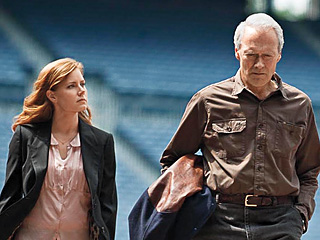
Clint Eastwood plays — surprise! — a grumpy old guy, a role he is too comfortable in, on and off screen.  Here he is  Gus Lobel, the John Henry of the Moneyball era.  He is a baseball scout who relies on his instincts and experience while the youngsters look at metrics and formulas.  His approach may be out of fashion, but the old-timers believe in him.  The problem is that he is losing his eyesight.  As he prepares to go on one last scouting trip, to watch a talented but arrogant power hitter, his friend (John Goodman) asks Gus’s estranged lawyer daughter (Amy Adams) to accompany her father on the road.  Her name is Mickey, as in Mickey Mantle and the senior lawyers at her firm are about to decide between her and an ambitious fellow associate for a big promotion.  She decides to go, bringing her laptop and a bunch of resentments and abandonment issues as well.  And on the road they meet up with Johnny (Justin Timberlake), a former player turned scout, hoping to become the team’s radio commentator.

This is a “guy cry” movie.  Guys can feel manly going to see it because it stars Clint Eastwood and it is about baseball and the individual literally against the machine, raging at the dying of the light and all that good stuff, so they don’t mind tearing up a little, or sitting through the romantic portion.  While Matthew Lillard as Gus’s young rival explains that “these programs are an essential tool in evaluating today’s talent,” Gus knows that even if he can’t see talent, he can hear it.  He’s been watching so long that he can tell from the crack of the bat whether a batter is hitting a fastball or a curve.  And just as we know that the preening young prospect will need to be taken down a notch, we know that the guy in the suit who tells Mickey he wants to move their relationship forward because “we’re perfect on paper” will be gone by the second act.   As will Mickey’s vegan cuisine, no match for a minor-league hot dog.  And Timberlake’s shirt.

There’s nothing new or surprising here, except perhaps when things get completely over-the-top at the end.  Oh, and Eastwood singing on screen for the first time since “Paint Your Wagon,” when he visits his late wife’s grave to attempt “You Are My Sunshine” with a gravelly warble.”  “As you know, to hit the magical 300, you fail seven out of ten times,” Timberlake explains. This film is entertaining, but not especially memorable.  Maybe it bats around .240.

Parents should know that this film has some strong and crude language (including the r-word), sexual references, a reference to child molestation, drinking and drunkenness, and a lot of smoking.

Family discussion: Why was it hard for Gus and Mickey to tell each other how they felt?  Compare this movie to “Moneyball” – which approach to finding new players is the right one?

If you like this, try: “Field of Dreams” and “Gran Torino”

Related Tags:


Drama Family Issues Movies -- format Romance Sports

The Master

Posted on September 20, 2012 at 5:58 pm

B+
Lowest Recommended Age: Adult
MPAA Rating: Rated R for sexual content, graphic nudity, and language
Profanity: Extremely strong, explicit, and crude language
Alcohol/ Drugs: Smoking, drinking and drunkenness
Date Released to Theaters: September 21, 2012
Amazon.com ASIN: B008V0OKGG

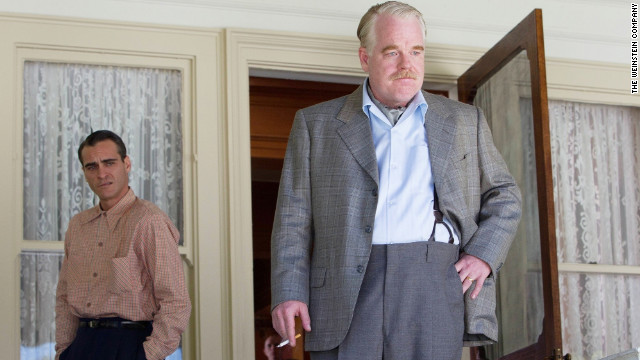
In the sixth movie from virtuoso writer-director P.T. Anderson (“There Will be Blood,” “Boogie Nights”), we see Freddie (Joaquin Phoenix) pause on the dock to look at what seems like the ultimate dream of civilization, a party on board a luxurious yacht filled with light, glamour, elegance, and belonging.  He served in the Navy in WWII and his adjustment to civilian life has been troubled.  Now, after losing his jobs as a department store portrait photographer and a field worker, with no connection to any thing or person or place or plan and no special skill except for the ability to make very potent alcoholic drinks out of whatever chemicals are at hand, the glow of the party and the people on the ship draws him in with a combination of the exotic and the familiar.  He hops over the railing like an experienced sailor and somehow both improbably and inevitably he is taken in by the group and its leader (Philip Seymour Hoffman), called Lancaster Dodd by the authorities but Master by everyone else.

The party is for Dodd’s daughter, who is getting married.  The Master himself is performing the ceremony, but more than that, as we will see him do throughout the story, he acts as a full-time master-of ceremonies as much as he is a teacher or leader of what seem to be a perpetual group of rapt followers.  He invites Freddie to join them, and to keep making his powerfully intoxicating (and memory-destroying) elixer.

The Master’s acolytes are subjected to a series of private and public interviews, where they are asked to reveal the most intimate details of their lives, and seemingly random and sometimes humiliating tasks.  The followers sit in chairs as though they are watching a play as Freddie paces back and forth between the window and the wall, ordered to describe what he sees.  The Master, who describes himself as to Freddie as “a writer, a doctor, a nuclear physicist and a theoretical philosopher, but above all, I am a man, a hopelessly inquisitive man, just like you.”  Self-aggrandizing, pompously un-pompous, and demonstrably false on its face.  If Dodd was in fact inquisitive, he would have noticed that Freddie is not at all inquisitive.  He operates entirely on instinct and lives almost entirely in the moment, musing only about his lost love, a 16-year-old neighbor he romantically idealizes though he has not seen or contacted her for years, and about his most animalistic carnal urges.  At the group’s evening gathering, he imagines all of the women naked — old, young, even the pregnant wife of the Master (Amy Adams).

It is sumptuously photographed in 70mm (try to see it on the big screen it was shot to fill), and has a jumpy, provocative score by Jonny Greenwood punctuated with retro standards from the American Songbook.  Ella Fitzgerald sings “Get Thee Behind Me Satan” as Freddie tries to keep his impulses in check.  The performances are breathtaking in their scope, commitment, intelligence, and humanity.  The frequent clashes of styles between Phoenix’s nearly feral Method approach, Hoffman’s more thoughtful, structure, and Adams’ iron-willed emotionalism are like timed flares going off to illuminate the story.  Freddie is referred to repeatedly as an able-bodied seaman but his body seems anything but able.  He is dark, stiff and hunched over, his elbows awkwardly extended back with his hands on his hips as his shoulders bend forward, his mouth twisted to one side when he speaks.  Hoffman’s blondness, brilliantly photographed by Mihai Malaimare Jr., makes him seem leonine.  He moves like a big, magnificent cat.  As in Anderson’s “Boogie Nights,” this is the story of a group of people who create a sort of family.  As in his “There Will Be Blood,” it is the story of two men held together by a complicated and sometimes toxic blend of fear, respect, longing, and power.  There is a chilliness and remove that keeps the struggle from feeling personal.  Perhaps it is a metaphor about post-WWII America, overwhelmed by its own success, audacious, overconfident, careless, and, as ever, struggling between head and heart, past and future, body and soul.

Parents should know that this film has very explicit sexual references and situations, including pornography, very explicit nudity, very strong language, and some disturbing themes.

Family discussion: Why did Dodd want to keep Freddie in the group?  What did they have in common?  Why was Helen upset by the change from “remember” to “imagine?”

If you like this, try:  “Magnolia” and “There Will Be Blood” by the same writer/director

Related Tags:


Drama Movies -- format

Liberal Arts

Posted on September 13, 2012 at 6:00 pm

B
Lowest Recommended Age: Mature High Schooler
MPAA Rating: Unrated
Profanity: Strong language
Alcohol/ Drugs: Drinking, drugs
Violence/ Scariness: Suicide attempt (off-screen)
Diversity Issues: None
Date Released to Theaters: September 14, 2012
Amazon.com ASIN: B0090SI3HU

It is true.  At heart, everyone is 19, except for the people who actually are.  “How I Met Your Mother” star Josh Radnor has followed his promising debut as a writer/director with the uneven but intriguing “Liberal Arts,” a throwback to the neglected tradition of the college-based story that has almost nothing to do with getting wasted or pranks.  Radnor also stars as Jesse, a New York City-based college admissions officer who (like the characters he plays in his television series and his previous film) seems stuck in that stage between being in school and being a grown-up.

He is delighted when one of his favorite professors from his own college days calls to invite him back to the campus in Ohio.  (The never-named small but prestigious liberal arts school is played in the film by Kenyon College.)  The professor (Richard Jenkins as lefty Peter Hoberg) is retiring, and he invites Jesse to come to his farewell dinner and say a few words.  Also on campus for the dinner are a couple whose daughter is a sophomore at the school (Elizabeth Olson as Elizabeth, nicknamed Zibby).  Jesse and Zibby hit it off, quickly developing a nice rapport. She makes a mix CD for him and he promises to write her a real letter with his reactions.  Jesse also meets the morose Dean (John Magaro), a brilliant but troubled student, and a non-student named Nat who is just hanging around campus being all adorably whimsical played as winningly as is humanly possible by Zac Efron, despite the considerable handicaps of an impossibly fey character and one of those knit ski caps with the strings and the tassel that has never done anyone any favors.

Jesse and Zibby have a refreshingly retro epistolary conversation and in one of the movie’s sweetest sequences he writes to her about the way her classical music mix CD has transformed his interaction with the world around him.  Not knowing what kind of relationship she has in mind but tantalized by her, he returns to the campus and again encounters not just Zibby, Dean and Nat but also Peter and his other favorite professor, the icy Judith Fairfield (Alison Janney).  Peter is already regretting his retirement.  Dean is struggling and feels isolated.  Zibby is the only one who seems comfortable with where she is, a large part of what draws him.  “I just can’t figure out whether it’s because you’re advanced or because I’m stunted,” he says, making her the adult.

But as he shows quite literally with calculations on a legal pad, the numbers do not add up.  Zibby, too, is trying to be a different age.  The only one who is completely comfortable with who and what he is is the guy in the ski hat, who is at this point in the movie further burdened with an excruciating speech about, oh, dear, caterpillars turning into butterflies.  I’m pretty sure Professors Hoberg and Fairfield would take out their red pens and write “TRITE” over that one.

The Dean character does not work well, either, even if you give Radnor the benefit of the doubt and think of Dean, Nat, and even Zibby and Peter as ways for Jesse to confront versions of himself rather than genuine characters.  Lovely moments like the classical music discussion, a genuinely moving passion for the written word, and nuanced performances (Radnor is tops in casting and directing actors) may make you smile mistily about being 19, no matter which side of it you’re on.


Parents should know that this film has strong language, a suicide attempt, sexual references and situations, drinking and drunkenness.

Family discussion:  How many different ways does this story present the struggle people have to act their age?  What does Jesse miss about his time at Kenyon?  What does he learn from Zibby, Nat, and Dean?

If you like this, try: “Happythankyoumoreplease” by the same writer/director and “Garden State”


Related Tags:


Drama Movies -- format Romance

Touchback

Posted on September 3, 2012 at 5:00 am

B
Lowest Recommended Age: Middle School
MPAA Rating: Rated PG-13 for some mature thematic elements
Profanity: Mild language
Alcohol/ Drugs: Some drinking
Violence/ Scariness: Some tense emotional confrontations
Diversity Issues: None
Date Released to Theaters: April 13, 2012
Date Released to DVD: September 3, 2012
Amazon.com ASIN: B005TCL1P2

Haven’t we all wished for a chance to live that one moment over again?

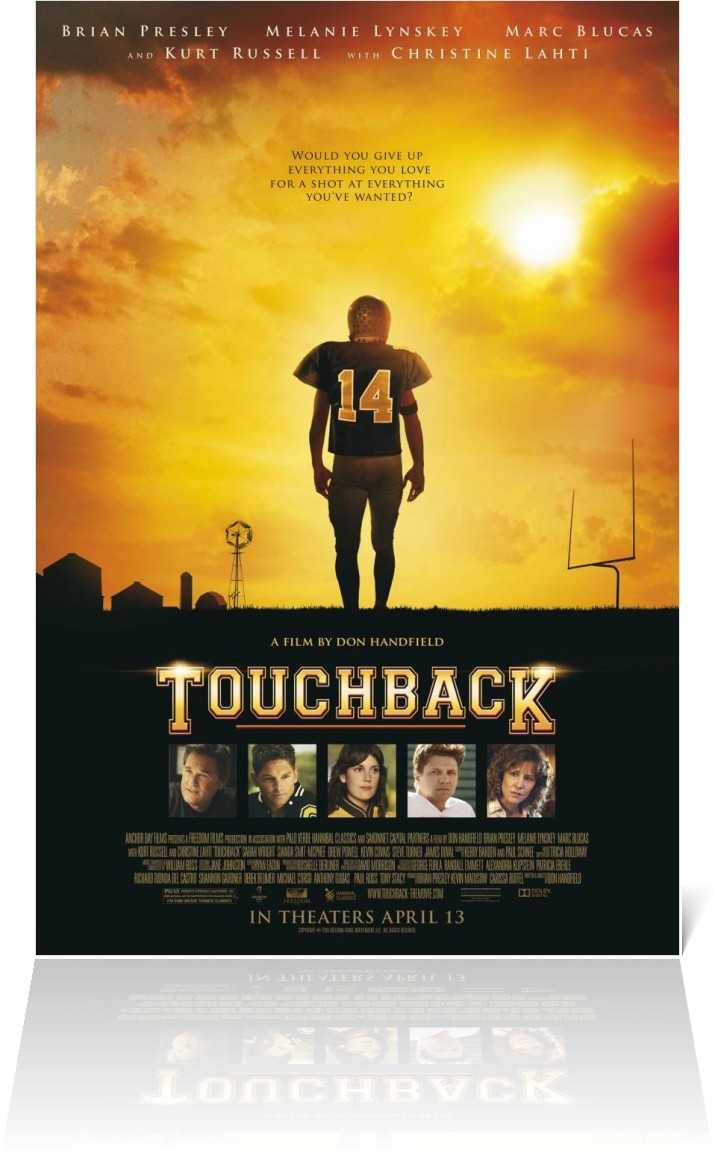
Scott (Brian Presley, who also produced) has that opportunity in “Touchback,” the story of a man who wants to go back to his days as a star high school football player, before a career-ending knee injury on a game-winning goal ended his days as a player.  He gets that chance to see what could have happened in this touching story reminiscent of “It’s a Wonderful Life.”  But will he choose his knee over the win?  Will winning the game keep him taking his success for granted and overlooking the girl who isn’t the popular cheerleader but who understands integrity and loyalty?  And would she notice him if he was still the arrogant jock?

(Cue Garth Brooks’ “Unanswered Prayers.”)

Kurt Russell, Marc Blucas, Christine Lahti, and Melanie Lynskey co-star in the film, which is sure to lead to some good family conversations.


Related Tags:


Drama DVD/Blu-Ray Pick of the Week Family Issues Spiritual films Sports
THE MOVIE MOM® is a registered trademark of Nell Minow. Use of the mark without express consent from Nell Minow constitutes trademark infringement and unfair competition in violation of federal and state laws. All material © Nell Minow 1995-2026, all rights reserved, and no use or republication is permitted without explicit permission. This site hosts Nell Minow’s Movie Mom® archive, with material that originally appeared on Yahoo! Movies, Beliefnet, and other sources. Much of her new material can be found at Rogerebert.com, Huffington Post, and WheretoWatch. Her books include The Movie Mom’s Guide to Family Movies and 101 Must-See Movie Moments, and she can be heard each week on radio stations across the country.

Website Designed by Max LaZebnik