
The Sisterhood of the Traveling Pants

Posted on May 31, 2005 at 12:58 pm

This is a story about one summer in the life of four friends, told with sincerity, heart, and a little bit of magic — the very same qualities that made the original book and its sequels a “you have to read this” classic for young girls.

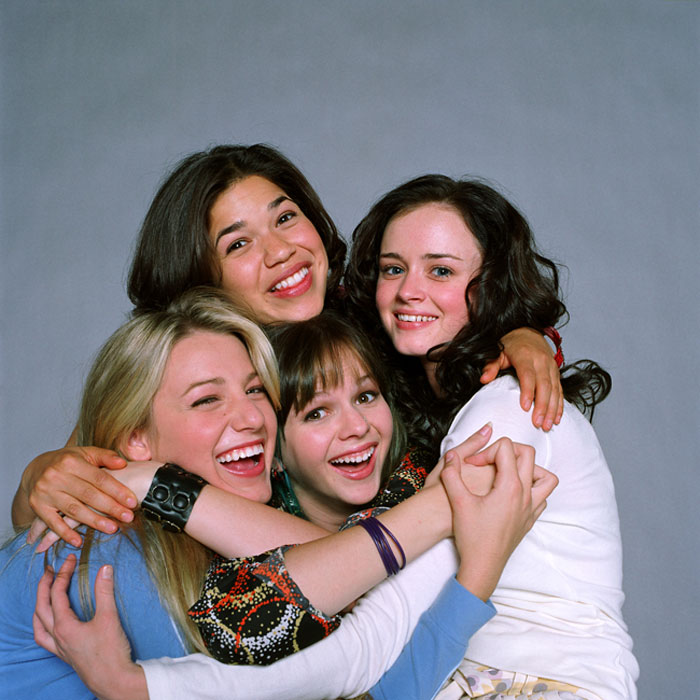
Four 16-year-olds, friends since before birth, when their mothers met in a prenatal exercise class, are about to be separated for the summer for the first time ever. Just before they leave, they find a mysterious pair of blue jeans that somehow fit each of them perfectly, even though their sizes as shapes are as different as their personalities. They decide to share the pants as a way of sharing their experiences over the summer. As they mail the pants back and forth to each other, the jeans will help them share their stories and stay connected.

The first to wear the pants is shy artist Lena (Alexis Bledel of television’s Gilmore Girls) goes to Greece to visit her grandparents. On the island of Santorini she meets Kostas. Despite a multi-generation feud between their families — and a promise never to see him again, Lena and Kostas fall in love.

Outgoing and athletic Bridget (Blake Lively) goes to soccer camp. She thinks a romance with her handsome coach is what she needs to make up for the emptiness that she has felt since her mother died.
traveling pants.jpgAspiring writer Carmen (America Ferrera of Real Women Have Curves) goes to South Carolina to see her father (Bradley Whitford), who did not tell her that he was living with a woman (Nancy Travis) with two children and planning to get married.

And rebellious would-be film-maker Tibby (Amber Tamblyn of television’s Joan of Arcadia) stays home, working at a huge discount store called Wallman’s and trying to make a movie about how bleak and meaningless everything is. She meets a girl named Bailey (Jenna Boyd) who becomes her film crew.

Each of the girls wears the pants and sends them on to the next with a letter. As they all try on new experiences and emotions and feel a little lost and vulnerable, the pants and their friendship keeps them feeling close and supported.

What takes this above the level of the average something-for-everyone collection of stories with a group hug at the end is its willingness to keep things a little complicated and messy instead of tying everything up neatly into the TV-style resolutions most people think are required in stories for young audiences.

Characters make real mistakes, not cute flubs that are either quickly corrected or happy accidents that work out even better than the original plan. Some characters learn lessons and change their minds or their behavior, but others do not. Some wounds are healed and some of what is lost is found, but some not. This is more reassuring, rather than less, because in our hearts even kids know that is true; all endings are not happy. It is good to see how people handle that — and can even be enlarged by it.

The film benefits, too, from sensitive and committed performances by its five young stars (including the precociously centered Boyd, a real presence on screen here as she was in the otherwise awful Dickie Roberts: Former Child Star). They make us believe in the connection between very different characters. It’s almost possible to think of them as different aspects of the same adolescent — shy and bold, thoughtful and impulsive, cynical and hopeful. Together, like the movie itself and like those magical Levis, they are more than the sum of their parts.

Parents should know that there is a subtle reference to a sexual encounter that one of the characters initiates but later considers a mistake. This is handled sensitively and responsibly. The same is true of other difficult issues the characters must face, including the suicide of a parent, a difficult adjustment to a divorced parent’s re-marriage, and a very sad death.

Families who see this movie should talk about what makes such different girls such loyal and devoted friends? What are the most important lessons each one of them learns over the summer? Why don’t the pants fit Bailey? Families should talk about why this movie does not try to give everyone a happy ending or even an ending at all. Why was Bridget so wrong about what she thought would make her feel less lonely? How did her mistake help her to share her feelings with her friends in a way she could not before? What could Carmen have done to try to get to know her father’s new family better?

Families who enjoy this film will also enjoy The Baby Sitters Club. And, of course, they should read the bookand its sequels. They might also enjoy a different kind of story about a magical piece of clothing shared by a disparate group of people in a life-changing series of adventures, The Wonderful Ice Cream Suit.

Related Tags:


Based on a book Comedy Drama Series/Sequel

Freddy vs. Jason

Posted on August 13, 2003 at 4:30 am

I hope needless to say, this extremely violent movie is only for the hard-core fans of the genre who are old enough not to be traumatized by it. Since I do not think I can be fair to these movies, this guest review was provided by the son of the Movie Mom, a 19-year-old fan of slasher movies who wanted me to give the movie an A-. Here’s what he had to say:

I was lucky enough to catch KISS in concert two days before I saw Freddy vs. Jason. Like KISS, the Freddy (“Nightmare on Elm Street”) and Jason (“Friday the 13th”) series have lasted for decades, are loved by ardent cult followings, and are hated by pretty much everyone else, especially parents and critics. The newest addition to the series will meet or surpass the expectations of the fans, while the heretics, I mean, deriders, will know to avoid it.

What is there to say about “Freddy vs. Jason?” The plot is ridiculous, and even if it made any sense it would be too pointless and too complicated to put down into a review. It’s just an excuse to have two of the scariest guys in movie history fight each other. Besides, the fans won’t want the key elements given away, and the plot isn’t what the naysayers want to hear about anyway. What both care about is the carnage.

It sure isn’t the characters or performances. Outside of the title characters, the cast is uninteresting, even interchangable; they’re only there to get killed anyway. Save for the classically trained Robert Englund, who reprises his role as the diabolical Freddy Krueger, there are no memorable performances, just busty, pouty-lipped girls in revealing clothing and stereotyped, drunk high school guys who scream and run and get gutted like fish. The highlights are definitely Freddy (of Nightmare on Elm Street fame) and Jason (of Friday the 13th fame), who kindly keep the audience from enduring the dumb teenagers for long, and join to engage in possibly the best movie fight you’re going to see all year, which is what we came to see. Cool, huh?

If you ask anyone why they love or hate these movies, they’d both probably answer with something like the above paragraph.

Freddy vs. Jason makes for a more interesting contrast than, say, Freddy vs. Chucky or Jason vs. Michael Myers would make, mainly because of the killers’ personalities. Whether you prefer killers like Jason who brood mutely while hulking towards you with a cleaver or killers like Freddy, a wild-eyed, deranged, wisecracking, sharp-fingered bloodthirsty hillbilly, no one will be left unsatisfied. The crowd I saw it with laughed, occasionally shrieked, and applauded, especially whenever Freddy cackled while slaughtering someone or Jason disembodied a victim. They obviously loved it, as will probably anyone who pays to see it. So much, in fact, that they’ll see the inevitable sequel. Sure, the chances of it even being considered for an Oscar nomination are even less than those of KISS ever getting a Grammy, but whether it’s a guilty pleasure or the film you’ve been anticipating ever since you first read about it on Wes Craven’s website, Freddy vs. Jason delivers.

Parents should know that the movie contains lots of nudity and some sex, lots of foul language, and characters who drink and do drugs. There is also an ambiguous date rape and a brief racial slur towards the only black character in the entire movie. Oh yeah, people are gutted, stabbed, impaled, torn apart, sliced open, burned, crushed, and killed in just about any way that produces lots of gushing blood. But if it’s any consolation to conservative parents, all the kids who engage in stupid behavior pay for it pretty heavily.

Families who see this movie should discuss the enduring appeal of slasher films, particularly the consistent theme that teens who have sex or use drugs get horribly killed. They may also want to talk about the impact a film like this has compared to more realistically portrayed violence as in “Saving Private Ryan.”

Families who enjoy this movie will also enjoy the others in the series as well as the clever and convention-challenging Scream.

Related Tags:


Horror Series/Sequel

American Pie

Posted on December 13, 2002 at 10:34 am

This is a movie about teenagers who promise each other that they will have sex before the night of the prom, and then do whatever they can to make it happen. It is one of the raunchiest and most explicit movies ever released by a major studio. The title, for example, refers to an apple pie that the main character masturbates in. A girl explains that she used her flute to masturbate. A boy ejaculates into a glass of beer. Boys hide a camera so they can broadcast pictures of a girl changing her clothes over the internet. A little boy hides in a closet so he can see teens have sex.

Parents whose kids see this movie may want to see it themselves, so they can give kids their own ideas about the appropriate ways to make responsible choices about sex, showing respect for themselves and their partners.

Related Tags:


Comedy Series/Sequel

Ice Age

Posted on December 13, 2002 at 5:17 am

B+
Lowest Recommended Age: Kindergarten - 3rd Grade
MPAA Rating: Rated PG for mild peril
Profanity: None
Alcohol/ Drugs: None
Violence/ Scariness: Some peril, off-screen deaths including family members of main characters
Diversity Issues: A theme of the movie
Date Released to Theaters: 2002

Ice Age” is a clever, funny, and touching story of an unlikely trio of animals who band together to return a human baby to his family.

The story is set when glaciers covered much of the earth, 20,000 years ago. As all of the other animals migrate south in search of food, three characters are moving in the opposite direction. They are a wooly mammoth named Manny (voice of Ray Romano), a sloth named Sid (John Leguizamo), and a saber tooth tiger named Diego (Denis Leary). In classic road movie fashion, they don’t like or trust each other very much at the beginning and the journey becomes a psychological one as they share experiences and confidences that make them see each other – and themselves – very differently.

This does not reach the level of Shrek for wit, there is no romance to keep the grown-ups happy, and the plot has no surprises. But it is told with terrific energy, imagination, visual invention, and humor and it moves along very quickly. Interestingly, the three lead voices are provided by performers who began as stand-up comics rather than actors. Their voices are edgy and distinctive, perfectly matched with their characters.

The computer animation is truly magnificent, from the majestic ice-covered mountains to the acorn treasure toted around by a hilarious squirrel who shows up over and over again in the travels of our heroes. The texture of the fur and feathers, the glint of the sun on ice, and soft sparkle of the snowflakes falling at night are perfectly rendered. The pristine settings convey a sense of vastness and promise that will make grown-up viewers pause to think about whether civilization has been all that civilized. All ages will enjoy the facial expressions, body language and — I have to say it — performances of the ice age mammals, so vivid and so true that you may forget that they are pixels, not people.

Parents should know that the characters face peril several times throughout the movie, and it may be upsetting for younger children. The mother of a young child is killed (off-screen) saving the child’s life. Another character recalls the death of his family. While it is fairly mild on the “Bambi” scale, the issues of human hunting of animals, animal predators, and extinction are raised. A character makes a skeptical comment about “mating for life.” There is some mild diaper humor.

Families who see this movie should talk about what Manny says about members of a herd being willing to risk their lives for each other. Why was it so important for Manny to return the baby, even though the humans had hunted his herd? How did that help to heal some of Manny’s sadness? Why did Diego change his mind about Manny? Why did Manny change his mind about Sid? Was it because of something Sid did or because of something Manny learned about himself, or both? What is different about the way that Diego and Manny react to human attacks?

Families who enjoy this movie will enjoy learning more about the real Ice Age, and should visit a local natural history museum or look at this virtual tour from the Smithsonian Institution’s museum in Washington. They should take a look at the real cave paintings from that era to see paintings of mammoths and saber tooth tigers by people who really saw them. Families with younger children will also enjoy the “Land Before Time” series of videos and Disney’s “Dinosaur.

Related Tags:


Animation Movies -- format Series/Sequel Talking animals

Rocky

Posted on December 13, 2002 at 5:17 am

Plot: Rocky Balboa (Sylvester Stallone) is a sweet-natured but not very bright boxer and small-time enforcer for a loan-shark. He has a crush on Adrian (Talia Shire), the painfully shy sister of his friend, Pauly (Burt Young). Apollo Creed (Carl Weathers) is the heavyweight champion, whose big upcoming fight is canceled when his opponent is injured. Creed and his promoters decide to give an unknown a shot at the title, and pick Rocky.

Rocky has never really committed to anything before, but this opportunity galvanizes him. He works with Mickey (Burgess Meredith) a demanding trainer. He takes Adrian on a date, and they fall in love. When her brother becomes furious over their relationship, she moves in with Rocky. Rocky knows he cannot beat Creed; his goal is to “go the distance,” to conduct himself with class and dignity in the ring and still be standing at the end of the fight. Apollo, sure of himself and busy marketing the fight, neglects his own training. Apollo wins, but it is a split decision. Rocky goes the distance. Surrounded by fans and the press, he bellows over and over “Adrian!”

Discussion: In Rocky’s first fight, we get a glimpse of his potential. But it is also clear he has failed to make a commitment to anything. Mickey wants to throw him out of the gym because he doesn’t take boxing seriously enough. It is less an insult to boxing than an insult to himself. He takes pride in small things, like his pet turtles, and the fact that his nose has never been broken. When he gets the call from Apollo, he assumes that he is going to be invited to be a sparring partner for the champion, the greatest honor he could imagine for himself.

But Apollo’s impetuous offer gives Rocky a chance to see himself differently. That offer does for him what Paul does for Billie in “Born Yesterday,” what Miss Moffat does for Morgan in “The Corn is Green,” or Obi-Wan does for Luke in “Star Wars.” Rocky has a chance to think of himself as someone who can hold his own with the world champion, and once he has that image of himself, it is just a matter of taking the steps to get there. That image also gives him the courage to risk getting close to Adrian. Rocky also gives Adrian a chance to see herself differently. He was told when he was young that he was not smart, so he should concentrate on his physical ability; she was told she was not pretty, and should concentrate on her mental ability. Each of them sees in the other what no one else did. He sees how pretty she is; she sees how bright he is; each sees the other as loveable, as no one has before. This, as much as anything, is what allows both of them to bloom.

Rocky is realistic about his goal. He does not need to win. He just needs to acquit himself with dignity, to show that he is in the same league as the champion. In order to achieve that goal, he will risk giving everything he has, risk even the small pride of an unbroken nose. He develops enough self-respect to risk public disgrace. This is a big issue for teenagers — adolescence has been characterized as the years in which everything centers around the prayer, “God, don’t let me be embarrassed today.” Rocky begins as someone afraid to give his best in case it is not good enough, and becomes someone who suspects that his best is enough to achieve his goals, and is willing to test himself to find out.

It is worth taking a look at Creed as well. Like the hare in the Aesop fable, he underestimates his opponent. He is so sure of himself, and so busy working on the business side of the fight that he comes to the fight unprepared.

It is especially meaningful that the action behind the scenes paralleled that in the movie. Stallone, a small-time actor, was offered a great deal of money for this script, which he wrote. But he insisted instead on selling it for a negligible sum, provided that he play the lead. The entire movie was made for less than $1 million. Stallone beat even longer odds than Rocky did when the movie went on to win the Oscar as Best Picture. Stallone also became only the third person in history (after Charles Chaplin and Orson Welles) to be nominated for both Best Actor and Best Screenplay.

Questions for Kids:

· Why did Mickey want to throw Rocky out of the gym?

· Why didn’t Rocky have higher aspirations, until after he got the offer from Apollo?

· How is Apollo like the hare in the fable about the tortoise and the hare? Why is it so hard for Rocky and Adrian to get to know one another?

Connections: There are four sequels, all increasingly garish and cartoonish. They are barely more than remakes, and are only for die-hard fans.

Related Tags:


Drama Series/Sequel Sports
THE MOVIE MOM® is a registered trademark of Nell Minow. Use of the mark without express consent from Nell Minow constitutes trademark infringement and unfair competition in violation of federal and state laws. All material © Nell Minow 1995-2026, all rights reserved, and no use or republication is permitted without explicit permission. This site hosts Nell Minow’s Movie Mom® archive, with material that originally appeared on Yahoo! Movies, Beliefnet, and other sources. Much of her new material can be found at Rogerebert.com, Huffington Post, and WheretoWatch. Her books include The Movie Mom’s Guide to Family Movies and 101 Must-See Movie Moments, and she can be heard each week on radio stations across the country.

Website Designed by Max LaZebnik