The Incredible Burt Wonderstone

Posted on March 14, 2013 at 6:00 pm
Everyone on screen seems to be having a blast, but this story of rival magicians in Las Vegas is not as much fun for the audience.  It wants to pull a rabbit out of a hat, but there’s really nothing there.

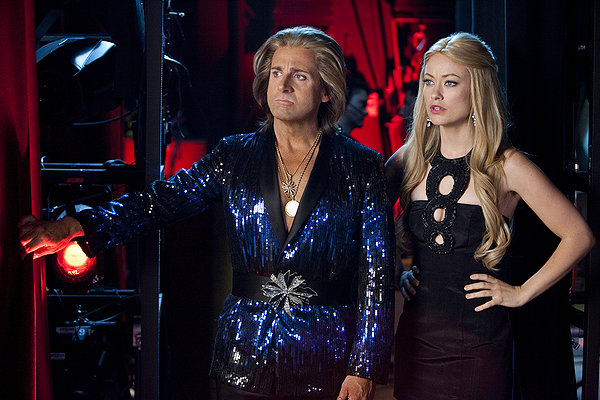
Steve Carell plays Burt Wonderstone, who fell in love with doing magic tricks when he was a bullied kid.  His only friend was Anton (Steve Buscemi) who also loved magic, and they developed an act together that led to a very successful run at a Las Vegas hotel owned by Doug Munny (James Gandolfini, nicely showing the thuggishness under the veneer of geniality).   They were headliners.  They had their own theater.  And they had a series of beautiful assistants.  All were given the same blonde wig and all were called Nicole.  The most recent Nicole is Jane (Olivia Wilde).

But the act has gotten stale.  Burt has 70’s hair and is so slick with spray tan it may require slight of hand to keep from sliding out of his clothes.  As for the act, Burt is just phoning it in, waiting for his next empty sexual encounter.  He seems more excited by having the biggest bed in Vegas than by what goes on in it.  And audiences are excited by a new street performer named Steve Gray (Jim Carrey) known as “The Brain Rapist.”  What he does is not magic.  He does a series of dangerous stunts, most of which involves some form of mortification of the flesh.  That card an audience member selected from the deck?  He will slice his cheek open to pull it out, covered in blood but still bearing the name scrawled on it with a Sharpie.  He doesn’t just walk across hot coals; he spends the night on them, barbecuing himself.  “They’re calling him the future of magic,” Munny says.

Burt ends up alone and broke, with no place to live and “in need of rabbit food and birdseed.”  Finding the magic again will require him to break through the years of numbness and self-involvement.

There are a skit’s worth of good moments, mostly about Burt’s arrogance and cluelessness.  When Jane makes dinner for him in her apartment, he offers to clean up, but thinks that means putting the dishes outside her front door.  And Carell has a funny cry.  Carrey captures the faux mysticism of “endurance artists” like David Blaine, but there’s no pay-off in seeing him suffer.  Wilde is underused in the usual endlessly-patient-until-the-time-to-grow-up speech, especially frustrating given the film’s superficial claim to countering the marginalization of female characters.  Even Alan Arkin cannot make interesting the old-time magician who first inspired the young Burt to learn to make things disappear.  What this movie is missing is — magic.

Parents should know that this film includes sexual references and non-explicit situations, crude humor, drinking and drunkenness, scenes in a bar, a bully, comic drug use including drugs surreptitiously given to adults and children, strong language (many s-words, one f-word), and comic but dangerous stunts with graphic injuries.

Family discussion: What went wrong with the act and how did that relate to what went wrong with their friendship? What made Burt change his mind? To audiences really enjoy acts involving physical danger and mutilation? Which trick did you like the best and why?

If you like this, try: a terrific documentary about young magicians called “Make Believe”
Related Tags:


Not specified

Movie of the Month: The Passion of the Christ

Posted on March 3, 2013 at 8:00 am

Thanks to the editors at Beliefnet for inviting me to write about our Movie of the Month, The Passion of the Christ.

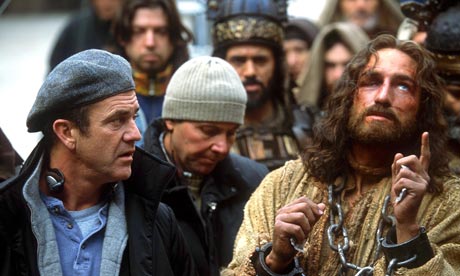
Mel Gibson’s “Passion of the Christ” is both more and less than a movie. In one sense, it is less a movie than the heartfelt prayer of a gifted film-maker and devout Catholic who has had some very public struggles with sin. In another it is a narrow and harrowing perspective on a story that, no matter what your faith, is bigger than any attempt to portray on film.

Mel Gibson has made this movie to convey his view of the last hours of the life of Jesus. It is not history and not drama, though it has elements of both. It is not a full retelling of the Gospels or of the life of Jesus. It is a personal and spiritual statement about the view that the suffering Jesus endured in the last hours of his life demonstrated his divinity and his sacrifice in taking on the sins of the world.

According to the film’s website, the use of the word “passion” is taken from the Latin for suffering, but is also used to mean a profound and transcendent love. The theme of the movie is Jesus’ statement, “You are my friends, and the greatest love a person can have for his friends is to give his life for them.”

– See more at: http://www.beliefnet.com/Entertainment/Movie-Corner/Movies/Passion-of-the-Christ.aspx#sthash.j9sOUKS6.dpuf


Related Tags:


Not specified

Audience Vote: King’s Faith

Posted on February 25, 2013 at 8:52 pm

Faith Street Film Partners, a Rochester, NY-based collective of filmmakers, churches, investors, and supporters – totaling more than 1,000 people – decided to fund, film, and release their new movie by listening to the audience.

“Audiences are changing, and so should storytelling,” director Nicholas DiBella said. “King’s Faith” is a very personal, true-to-life story that will resonate with the realities of families and teens – this is a bottom-up experience, very grassroots and community-driven which invites the audience to be actively involved every step of the way. That is the way real transformation happens.”  Waking Giants Entertainment Group is inviting audiences and groups to decide where the movie opens. Audiences can demand that “King’s Faith” come to their local theater at www.kingsfaith.com

Based upon early demands, the movie will open in Charlotte, NC, Dallas, TX, Phoenix, AZ, Colorado Springs, CO, Rochester, NY, Buffalo, NY, and Huntsville, AL. The producers and distributor are planning interactive audience tools including group study materials, outreach partnerships, and a specialty youth campaign to create awareness and heighten audience attendance.

“King’s Faith” tells the story of Brendan King (Crawford Wilson) who attempts to leave his turbulent gang life behind him, but his past continues to threaten his new-found faith, family, and future. The film prompts audiences to consider questions that many struggle within our world today: Where do I fit in? How can I stand firm in my faith when life’s challenges put me to the test? Can someone find true forgiveness from their wrong choices?

http://www.youtube.com/watch?v=qVCq2k_9fDA

“King’s Faith” reminds us that our past doesn’t define us,” DiBella said. “No matter where you’ve been, or how lost you feel, you should never give up hope or faith.”  It stars Emmy Award winning actress Lynn Whitfield (Eve’s Bayou, The Women of Brewster Place), Crawford Wilson (Judging Amy, Zoey 101), Kayla Compton (Entourage), and James McDaniel (Malcolm X, NYPD Blue).


Related Tags:


Not specified

The Guilt Trip

Posted on December 18, 2012 at 6:00 pm

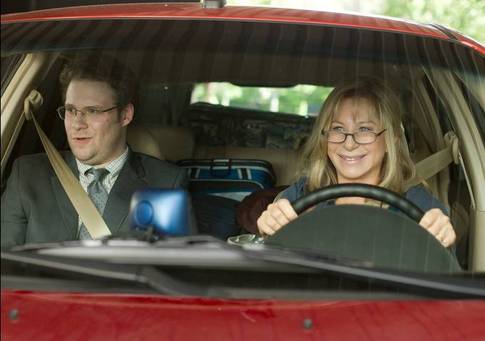
If you know the title, you know the painfully unfunny movie with this dull slog across America that Barbara Streisand inexplicably selected for her first lead role in 16 years.  Seth Rogen plays chemist-turned-cleaning product inventor Andy Brewster, who never returns his mother’s endless calls or responds to her smothering questions but nevertheless impulsively invites her to come with him on a cross-country sales trip in a rental car (she says the SUV is too expensive, even with the coupon she fishes out of her purse).

The inevitable irritations, revelations, accusations, and reconciliations occur, and through it all, Rogen and Streisand almost never change expression.  There’s a reason Rogen’s best work in film has been providing voices for animated characters (“Paul” and “Monsters vs. Aliens”).  He only has two looks, a squinchy pained look and a dull confused look.  Streisand is always an appealing screen presence, but Joyce, her character here, is such a stereotype of a New Jersey Jewish mother that she is stuck in a rut between cutesy-but-annoying and annoying-but-cutesy.  Annoying wins.

Joyce is, of course, the queen over the over-share.  Which must make Andy the champ at the under-share, holding on to all of the details of his life as though allowing his mother to know anything about him might just regrow the umbilical cord.

Much of the intended humor of the story comes from the various ways that Joyce embarrasses Andy by inquiring too deeply into his life, telling him too much about hers (she confesses that he was named after the love of her life, her first boyfriend who did not love her the way she loved him), and infantilizing him by clucking over him as though he was a toddler, buying him underwear and licking her palm to smooth down his hair before an important meeting.  This causes him to act like a petulant teenager, rolling his eyes, shutting her out, and letting her know that he can barely tolerate having her around.

Things that are supposed to be funny, but aren’t: A stripper fixes their car.  Joyce brings along the Oprah-endorsed audiobook Middlesex by Jeffrey Eugenidies, read by Kristoffer Tabori, about a character with both male and female sexual characteristics.  Joyce takes on a challenge to eat a four-pound steak dinner.  Joyce picks up a hitch-hiker.  Joyce gets drunk and talks to a lot of men in a bar.  Joyce is constantly snacking.  Andy is embarrassed.  Andy feels smothered.

Things that are supposed to be touching, but aren’t: Joyce schools Andy about treating her with respect.  Andy begins to appreciate her, especially when he takes her advice and it (highly improbably) works.  Also the ending, but I don’t want to give that away to those who still want to see it.

The movie also wastes the talents of top-notch actors like Colin Hanks, Ari Graynor, and Adam Scott, suggesting that there might be some deleted scenes somewhere.  It’s fair to assume they are better than what stayed in.

Parents should know that this film includes strippers and some humorous but crude sexual references, drinking and drunkenness, brief scuffle with punches, and some strong language (one f-word, several s-words).

Family discussion:  Did the confrontation in the hotel make you see Joyce differently?  Why do adults sometimes have trouble talking to their parents?  Talk to your family about some of their road trips.

If you like this, try:  “Funny Girl” and “What’s Up, Doc?”

Related Tags:


Not specified

Support the Troops and Their Families — Christmas 2012

Posted on December 15, 2012 at 8:00 am

Please take a moment during the holiday season to remember those who make great sacrifices to protect our freedoms.  You can send Christmas boxes to the troops or even Christmas stockings.  And Operation Ensuring Christmas cares for the families of fallen military, to let them know they are not alone.

Related Tags:


Not specified
THE MOVIE MOM® is a registered trademark of Nell Minow. Use of the mark without express consent from Nell Minow constitutes trademark infringement and unfair competition in violation of federal and state laws. All material © Nell Minow 1995-2026, all rights reserved, and no use or republication is permitted without explicit permission. This site hosts Nell Minow’s Movie Mom® archive, with material that originally appeared on Yahoo! Movies, Beliefnet, and other sources. Much of her new material can be found at Rogerebert.com, Huffington Post, and WheretoWatch. Her books include The Movie Mom’s Guide to Family Movies and 101 Must-See Movie Moments, and she can be heard each week on radio stations across the country.

Website Designed by Max LaZebnik