This American Life: Live “Invisible Made Visible” Show Available Online and on DVD

Posted on November 13, 2012 at 3:33 pm

Radio you can watch – that’s the idea.

On November 15th, 2012, the public radio show This American Life will release a video of a two-hour episode entitled “The Invisible Made Visible.” Fans can download or stream the video for $5.  It will also be released on DVD, exclusively via the show’s web store.

“The Invisible Made Visible” was originally performed onstage and broadcast live into movie theaters in May, 2012, to over 70,000 people across the U.S., Canada and Australia. Host Ira Glass personally curated the show. “The whole point,” he says “was to do stories that are far too visual to ever be on the radio.”

The result is a mix of animation, live dance from Monica Bill Barnes & Company, a wildly funny short film by Mike Birbiglia starring Fresh Air’s Terry Gross (I promise, you will not guess the ending), a classic This American Life story (told by Glass) about the brilliant street photographer Vivian Meier, a Chicago nanny who never showed anyone the pictures she took over decades on her days off.  They were discovered almost by accident after her death.  The show also has comic monologues by David Sedaris, Glynn Washington, and Ryan Knighton. My favorite is the story by comedian Tig Notaro (recently in the news for her monologue about cancer) about repeatedly running into 80’s pop star Taylor Dayne. There is music from OK Go. It’s all performed in front of changing illustrated backgrounds.

Probably the most memorable moment in the episode comes during a story by longtime This American Life contributor David Rakoff. He talks about the abilities he’s lost during his fight with cancer, and then, gracefully, beautifully, does a solo dance onstage. It was the last story Rakoff ever wrote for the radio show. He died three months later, in August.


Related Tags:


Not specified

Interview: Rasmus Heisterberg and Nikolaj Arcel of “A Royal Affair”

Posted on November 11, 2012 at 10:18 am

A Royal Affair” is Denmark’s submission for the best foreign language Oscar is the true story of a queen and the love affair that changed Danish history.  I spoke with writer/director Nikolaj Arcel and his co-writer Rasmus Heisterberg, who also worked together on the Swedish “Dragon Tattoo” trilogy.

Caroline Mathilde was a member of the British royal family who was sent to Denmark in 1766 to marry a cousin she had never met, King Christian VII.  He had severe mental illness (possibly bi-polar) and came to rely very heavily on his German doctor, Johan Friedrich Struensee.  He and the queen fell in love and when he became increasingly powerful they worked together to bring about reforms that helped to usher in the modern era.

“The queen was bright and well-read.  She loved the ideas of the Enlightenment and read a lot of books and had a lot of opinions on what kind of queen she wanted to be.  And when she met the doctor who shared a lot of her ideas, very progressive, very modern, very radical for that time, they became soul mates,” Heisterberg told me. “They started to grow a friendship because of their common ideas and then they fell in love.  It actually began as a meeting of the minds.”  He and Arcel spent a year researching the history and relied heavily on the queen’s letters.  “You can see how bright she was from her letters.”  The king did not write but made “funny little drawings and cartoons. He wanted to become an actor.  He loved the theater,” Arcel said. “He created the Royal Theater.  He used the theater as a shield, a way to protect himself.  And theater was the way he survived.  In court, he sort of created a character he could portray.  That was his way of surviving in this harsh environment he wasn’t cut out for.  We found that so fascinating.  He’s a complex character because he wasn’t just raving mad.  When the doctor arrives, he understood him and that helped him become a better, more sane person.  Their friendship is part of the story as well.  When the doctor falls in love with the queen it’s not only forbidden.  It’s a betrayal of the friendship as well.”

The queen was a devoted mother.  “She breast-fed, which was very radical for the time,” Arcel said.  “She wanted her son to have fresh air and be outside playing” despite the objections of those around her.  She was influenced by Rousseau.  “Usually these things just end with –she felt isolated and felt unhappy.  But in her story this dream guy arrives and not only does she fall in love with him but he was someone who was willing to change the country and even make the king a better person.”

“The challenge for us was to make a cross-breed between a romance and a political drama.  Using the theme of freedom became the key for us,” Histerberg said.


Related Tags:


Not specified

Flight

Posted on November 1, 2012 at 5:59 pm

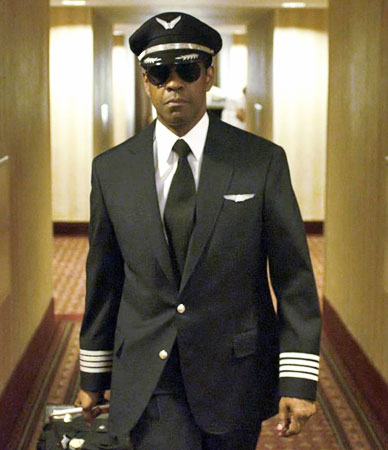
Denzel Washington is at his best playing a man who is at his worst.  “Whip” Whitaker is a brilliant airline pilot who flies commercial jets.  He is also in deep denial about a substance abuse and addiction problem that is out of control.  We see him waking up in a daze next to a naked girl, taking an angry phone call from his ex-wife, and medicating his hangover with some alcohol and cocaine.

And then he climbs into the cockpit and takes off into a heavy, gusting rainstorm.  And then something goes very, very wrong.  The plane takes a nosedive.  No one has time to figure out what is wrong and almost no one would have enough time to figure out how to land the plane safely.  But danger hits Whip like another snort of cocaine.  He is suddenly fully present, awake, and in command.  He issues quiet but commanding directions to the co-pilot and senior flight attendant and he comes up with a daring series of maneuvers from jettisoning the fuel to rotating the plane that allow him to land in an open field, with a minimum of injuries and fatalities.

Director Robert Zemeckis (“Forrest Gump,” “Back to the Future,” makes a welcome return to live action after a 12-year detour to work on motion capture animation (“Beowulf,” “A Christmas Carol,” “Mars Needs Moms”). He does a masterful job staging a thrilling but almost unbearably intense plane crash, which ends with a striking image as white-gowned Baptists from the church in the field race toward the plane to help rescue the passengers.

After the crash, two things become clear.  Whip saved the lives of all but six of the people on the plane, something no other pilot could have done.  And Whip was severely impaired at the time because he has an enormous substance abuse problem and an even bigger denial problem.  A sympathetic union rep (the always-reliable Bruce Greenwood) and savvy lawyer (the always-excellent Don Cheadle) try to protect Whip — and, not incidentally, the union, the airline, and its insurer.  They challenge the toxicology report which shows the levels of alcohol and drugs in Whip’s blood at the time of the accident, so that it cannot be reviewed as evidence by the NTSB.  And they warn him that he had better straighten out before the hearing.  But before he leaves the hospital, he is visited by his closest friend and drug dealer (a brilliantly funny John Goodman).

In the hospital, recovering from the injuries he suffered in the crash, Whip meets Nicole, a recovering drug abuser (Kelly Reilly of “Pride and Prejudice” and “Sherlock Holmes”).  They have an eerie encounter in the stairwell with an outspoken cancer patient (a terrific James Badge Dale) who chills them with his gallows humor.  After they get out, Whip invites Nicole to live with him, in part because he feels sorry for her and in part because he is no good at being alone.  He must learn that it is his behavior that isolates him, no matter how much he tries to hide from it. And he senses that the same qualities that make him so good as a pilot may make him vulnerable to addiction.

The script wobbles and many people will find the ending unsatisfactory.  It is not clear how we are supposed to feel about the religious themes that are raised by some of the characters and Whip’s ultimate choice may seem insufficiently supported.  We know not to expect an easy answer about how his problems started or what he thinks of himself, but we are entitled to a clearer understanding of what matters to Whip than we get.  Still, Washington may win a third Oscar for the depth, understanding, courage, and humanity of his performance.  He is always mesmerizing on screen and the power of his charisma and the subtlety of his performances makes it easy to overlook just how specific he is as an actor.  But he has always been a little reserved, a little held back.  He is smart and dedicated enough to use that quality to good effect in creating his characters.  But here he opens up more than he ever has, allowing us to be disturbed by Whip’s carelessness and irresponsibility and the way he hurts others but holding on to our attention and loyalty.  Washington is the finest actor in Hollywood and it is genuinely thrilling to watch him.

Parents should know that this is a frank portrayal of substance abuse and addiction with drinking, drunkenness, drug use and drug dealing.  Characters use very strong language and the movie includes explicit sexual references and non-explicit sexual situations and pornography.  There is also an extremely graphic plane crash with characters injured and killed.

Family discussion:  Which characters help Whip lie?  Which ones don’t?  Why?  How do the qualities that make Whip a good pilot make him vulnerable to addiction?  What will his answer be to the question he is asked at the end of the movie? Why do the people in this movie refer to the passengers and crew as “souls?”

If you like this, try: Substance abuse classics like “The Days of Wine and Roses” and “The Lost Weekend”

Related Tags:


Not specified

The Words

Posted on September 7, 2012 at 2:57 pm

This movie about an unsuccessful writer who appropriates an old manuscript and sells it as his own feels like a movie made by a writer who has the same problem.

This is an idea that has already been explored by Woody Allen (“You Will Meet a Tall Dark Stranger“), Frankie Muniz (“Big Fat Liar“), and Ira Levin (“Deathtrap”) and it is of far more interest and appeal to a writer struggling between the passion to tell a story and the self-doubt that blocks the progress from the idea to the page.  But this idea should have stayed where it was.

It’s a story within a story within a story.  And a long flashback.  The movie opens with its first preposterous setting — a distinguished author named Clay Hammond (Dennis Quaid) is on stage in an auditorium with a rapt audience but apparently all he is there to do is read aloud from his book, with an intermission in between for him to chat up and be chatted up by Daniella, a pretty grad student (Olivia Wilde).  In real life, with the possible exception of a story hour for preschoolers, authors do more in front of audiences than recite the words in the book, but in the world of this movie, that is what this one does.

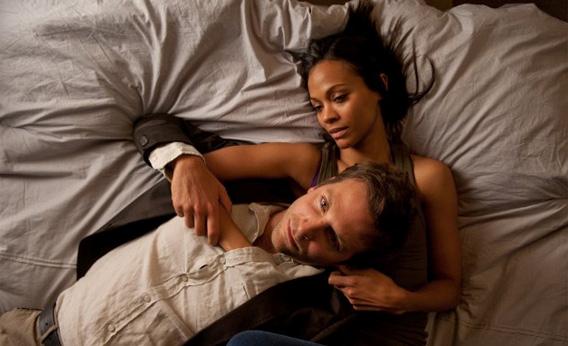
Much of the film is the story he reads, and this is the part about the poor but (temporarily) honorable young writer named Rory Jameson (Bradley Cooper — character names are not this movie’s strong point) who is just fine with having his father and his gorgeous and devoted wife Dora (Zoe Saldana) support him while he bangs away at his keyboard, looking intense.  “I gotta pay my dues!” he says when asked for yet another loan from his father.  “No, I gotta pay your dues,” says his dad, suggesting maybe writing should just be Rory’s hobby.

He finally takes a job pushing the mail cart at a publishing company.  After a couple of years, he produces a manuscript, which is rejected by everyone, most painfully by an agent who gives him the most devastating assessment possible: he thinks it is brilliant but unpublishable.  At least if it was lousy, Rory could give up.

And then, in an old leather portfolio Dora buys at a Parisian curio shop, Rory finds a manuscript.  He types out every word just to feel the sentences go through his fingers.  Dora loves it.  He submits it to the publisher.  The publisher loves it: “It’s so interior!  It’s artistic, it’s subtle, it’s a piece of art,” he says, like no person in publishing ever. Then the critics and the readers love it, even though it has the dumb name, “The Window Tears.”  (Rain, right?)  And then an old man, this one thankfully without a name and even more thankfully played by Jeremy Irons, shows up.  He is the author.

Remember, this is all still Dennis Quaid’s book, the one he is reading aloud to the audience.  And then we get a flashback within a story within a story as Jeremy Irons tells us how the manuscript was written and how it got lost.  It is about this time that the movie gets lost, too, as we go back and forth between Rory’s attempts to put things right and Clay’s strange encounter with Daniella in his apartment filled with unpacked boxes.  There are some random parallels between the stories (a guy in an undershirt hugging a woman standing at the kitchen sink, dealing with a loss by getting drunk, and some sophomoric exchanges about truth and art, and then it does not end — it just stops.

Parents should know that there are some sensual but non-explicit sexual situations, a tragic death of an infant, drinking and drunkenness, some strong language, and a lot of smoking.  There are also brief not-graphic war images.

Family discussion: What should Rory have done when the publisher told him he loved the manuscript?  What should Dora have done when she found out the truth?  What does the framing story add to the meaning of the film?

If you like this, try: “The Stone Reader,” a documentary about a real-life search for a mysterious author of a critically acclaimed but forgotten book and learn about the real-life story of a famous author’s lost manuscript

Related Tags:


Not specified

40th Anniversary Tribute to “The Godfather” — Archival Memorabilia

Posted on August 31, 2012 at 8:00 am

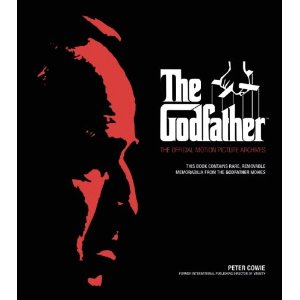
There are two big releases in honor of the 40th anniversary of one of the most critical and popular successes in film history, The Godfather.  First, coming out October 1, is The Godfather: The Official Motion Picture Archives, the definitive behind-the-scenes guide to the making of one of modern film’s greatest works from Peter Cowie, a film historian who has written extensively on the work of Francis Ford Coppola, and in particular The Godfather trilogy.

The films received 52 Oscar nominations and 29 Oscar wins, and netted $484,000,000.00 in worldwide box office sales.  It is second on the American Film Institute’s top American films of all time.

This stunning book of memorabilia and never-before-published photos takes you behind the scenes to reveal the seldom-told story of how this epic was created against great odds. Despite the critical acclaim and financial success of the venture, the initial Paramount production was made under pressure-cooker conditions. Coppola was Paramount’s third choice for director; no one wanted to gamble on an unknown actor named Al Pacino; and the studio initially wanted Robert Redford or Ryan O’Neal to play Don Corleone. This production is brought to life through previously unpublished photos of experiences on the set and on-location filming that captures the grit of 1970s New York and glimpses of deleted scenes.

Second, Paramount studios has granted permission for replicas of fifteen items of archival memorabilia, including a poster publicizing the original film, a special leaflet on the prosthetic teeth worn by Marlon Brando, and a page from Mario Puzo’s novel annotated during the writing of the screenplay.

Related Tags:


Not specified
THE MOVIE MOM® is a registered trademark of Nell Minow. Use of the mark without express consent from Nell Minow constitutes trademark infringement and unfair competition in violation of federal and state laws. All material © Nell Minow 1995-2026, all rights reserved, and no use or republication is permitted without explicit permission. This site hosts Nell Minow’s Movie Mom® archive, with material that originally appeared on Yahoo! Movies, Beliefnet, and other sources. Much of her new material can be found at Rogerebert.com, Huffington Post, and WheretoWatch. Her books include The Movie Mom’s Guide to Family Movies and 101 Must-See Movie Moments, and she can be heard each week on radio stations across the country.

Website Designed by Max LaZebnik