
Downton Abbey: The Grand Finale
Posted on September 11, 2025 at 5:09 pm
B +| Lowest Recommended Age: | High School |
| MPAA Rating: | Rated PG for smoking, suggestive material, some thematic elements |
| Profanity: | Mile language |
| Alcohol/ Drugs: | Alcohol and cigarettes, characters get tipsy |
| Violence/ Scariness: | None |
| Diversity Issues: | Class issues |
| Date Released to Theaters: | September 12, 2025 |
You could have a very successful drinking game if you took a swig every time someone in “Downton Abbey: The Grand Finale” talks about change, coping with it, changing with it, or trying to ignore or prevent it. But you’d be far too tipsy to enjoy this movie’s many pleasures for those who have watched the characters in the title estate for the past 15 years, through five television seasons and two previous feature films. Beginning with the death of the heir to the estate in the sinking of the Titanic in 1912, through world events and domestic developments, the series explored social norms, family dramas, both of the titled family and their servants, and the impact of world events. It was romantic and glamorous. (Those clothes! Those dinners! Those romances!) It had everyone’s favorite, Dame Maggie Smith as Lord Grantham’s mother, the acid-tongued Violet, Dowager Countess. It was often thoughtful and endearing, as characters adapted and matured and relationships reconciled. This film will be of greatest interest to those who have followed the story, though you need not have seen or remembered every detail. But for those who have come to care about these characters, it is a very satisfying conclusion.
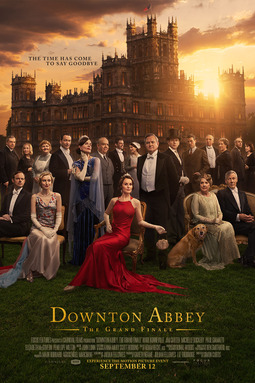
This film takes place in 1930, and as it begins the family and some of the servants are attending a glittery performance of Noel Coward’s operetta, Bittersweet. After the show, Lord Grantham (Hugh Bonneville), his wife (Elizabeth McGovern), their daughter, Lady Mary (Michelle Dockery), and Lady Edith Hexham (Laura Carmichael) and her husband (Harry Hadden-Paton) go backstage to congratulate the play’s star, Guy Dexter (Dominic West), who became a family friend after appearing in a movie filmed on the estate. The Grantham’s former footman, Thomas Barrow, is there as well because he is now Dexter’s companion/manager. As Lord Grantham says, their relationship appears “hearty.” Dexter introduces them to Coward (a louche and very charming Arty Froushan).
Lady Mary is unaccompanied because she and her husband are getting divorced, at the time so scandalous she will become a “social pariah,” thrown out of a fancy party by the hostess (Joely Richardson) because members of the royal family are about to arrive and it would be unthinkable for them to be in the same room with someone who is divorced.
Lord and Lady Grantham have both lost their mothers. The memory of Violet and Smith lofts above the story, with Violet’s portrait in the hall and frequent references, and hopes for the disposition of the American estate of Lady Grantham’s mother because Downton always needs money. Lady Grantham’s brother, Harold (Paul Giamatti) arrives to tell her it is not what she hoped, and he brings with him an associate named Gus Sambrook (the always- excellent Alessandro Nivola).
“Downton Abbey” creator and screenwriter Julian Fellowes has a gift for melding drama with an exquisite sensitivity to social hierarchies. He understands the smallest details and the way they reflect the emotional and social upheavals. When Lady Mary is shunned by even those they thought of as close friends, her sister, Lady Edith, who has perhaps come the longest way of the characters in the show, is wise and sophisticated enough to know that the world has changed (there that word is again) enough so that there is one path to putting her back in the social world, and it is not about the old hierarchies of noble titles but about another kind of social currency.
As always, the lives of the servants are of equal importance. Two of the key figures are retiring, in a parallel to the difficulties Lord Grantham has in letting Mary take control of the estate. That means two others in the downstairs community have new responsibilities, underscored by Lady Merton (Penelope Wilton), whose more populist views come into play as she brings two members of the downstairs staff into a prominent role in community affairs.
And, as always, it is gorgeous to look at and revel in. The tiaras! The Royal Enclosure at the Ascot races! The sumptuousness of the surroundings and the empathy for the characters bring this saga to most a satisfying conclusion. If Fellowes cannot resist a wink at the audience by giving a character a speech about the importance of screenwriters, what can we do but wink back at him?
Parents should know that this movie includes sexual references and non-explicit situations as well as family difficulties.
Family discussion: How do we decide when to change and when to hold on to traditions? Which of the characters is best at adapting?
If you like this, try: the “Downton Abbey” series and earlier films and Fellowes “Belgravia,” “The Gilded Age,” and “Dr. Thorne.”