Many thanks again to the wonderful Blake Howard for inviting me back to his All the President’s Minutes podcast to talk about one of my favorite movies, “All the President’s Men.” Blake is going through the film with episodes about each minute of the film. He’s up to minute 107-108, Bob Woodward (Robert Redford) leaving the parking garage after a disturbing encounter with Deep Throat (Hal Holbrook), so disturbing that he suddenly feels afraid of every sound.
I have a special interest in “All the President’s Men” and the Watergate scandal because I was a Senate intern on Capitol Hill the summer of the Watergate hearings and got to sit in on them twice. I live near many of the landmark locations, as you will hear in the podcast.
Blake says:
ALL THE PRESIDENT’S MINUTES IS A PODCAST WHERE CONVERSATIONS ABOUT MOVIES, JOURNALISM, POLITICS AND HISTORY MEET. EACH SHOW WE USE THE SEMINAL AND INCREASINGLY PRESCIENT 1976 FILM ALL THE PRESIDENT’S MEN AS A PORTAL, TO ENGAGE WITH THE THEMES AND THE WARNINGS OF THE FILM RESONATING SINCE ITS RELEASE. FOR MINUTE 108, I WELCOME BACK FRIEND OF THE SHOW – A MOVIE AND CORPORATE CRITIC AND EDITOR AT EBERT VOICES, NELL MINOW. NELL AND I TALK ABOUT THE MARK TWAIN-ISM THAT “HISTORY DOESN’T REPEAT ITSELF, BUT IT RHYMES, TALKING TO AARON SORKIN ABOUT BEING ON A “COLLISION COURSE WITH HISTORY” AND THE DEFINITIONAL CORRUPTION OF THE NIXON ADMINISTRATION.
Rated R for drug use, bloody images, language throughout, and some violence
Profanity:
Constant very strong language
Nudity/ Sex:
Brief sexual references
Alcohol/ Drugs:
Drugs, alcohol
Violence/ Scariness:
Historical violence including riots, references to Vietnam War
Diversity Issues:
A theme of the movie
Date Released to Theaters:
October 16, 2020
Copyright Netflix 2020
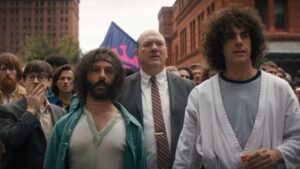
They say that history doesn’t repeat itself, but it rhymes. And that is how “The Trial of the Chicago 7,” based on events that occurred in 1968-69 and in development as a film more more than a decade, seems to have been made for exactly this moment of the fall of 2020. In an interview, Aaron Sorkin, first brought it to write the script by Steven Spielberg in 2006, said that he did not change a word. But he acknowledged that the world moved much closer to the issues in the film, based on the anti-Vietnam War demonstrations at the 1968 Democratic convention in Chicago that led to riots, with then-mayor Richard J. Daley telling the police to “shoot to kill” and calling in the National Guard.
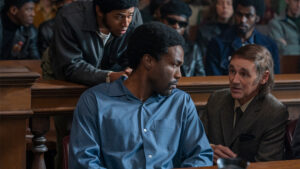
A year later, eight of the leaders of the protest were indicted for conspiracy and incitement to riot. The seven white defendants were represented by the activist lawyer William Kuntsler and Constitutional law expert Leonard Weinglass. The sole Black defendant, Bobby Seale, who was only in Chicago for four hours during the convention, was represented by civil rights attorney Charles Garry, who was in the hospital. Seale asked for a delay until his lawyer could be there, and the autocratic judge, Julius Hoffman (Frank Langella), clearly and vocally affronted by the protesters and their disrespect for authority, refused. Kunstler and Weinglass offered to represent him until Garry recovered, but he refused. Later, his case was separated from the others, which is why it is still known as the Chicago 7 trial.
The opening of the film is a master class on how to introduce a large group of central characters. The leaders of each group talk about their hopes and plans for the convention. Lyndon Johnson, whose decision not to run for re-election was in part due to increasing national opposition led to the nomination of his Vice President, Hubert Humphrey, as the Democratic candidate. Many people thought there was no real difference between Humphrey and Johnson and between Humphrey and the Republican candidate, Richard Nixon. This was the era of the “generation gap” as the baby boomers came of age wanting to see major changes in the treatment of what were still referred to as minorities, poor people, and women. But the different groups had very different ideas about how to be effective. Sorkin very effectively showcases the arguments for incremental vs. drastic change, for working within the system to replacing it with a better system.
Langella captures the frustration of a man who believes in the rules that got him where he is and fears that they all collapsing, with him all that stands between order and anarchy. Redmayne is perfect as the thoughtful, studious, thoroughly decent Hayden, and Cohen accomplishes the difficult balancing act of not turning the other Hoffman (the judge seems to take it very personally that they share a name) into the cartoon he sometimes seems to wish to be. Yahya Abdul-Mateen II gives Seale enormous courage and dignity and rising star Kelvin Harrison, Junior continues to impress with his performance as Chicago Black Panther leader Fred Hampton (whose murder is the subject of another rhymes with history 2020 movie, Judas and the Black Messiah). Also exceptional are Mark Rylance as Kuntsler (perhaps more thoughtful and even subdued than the real-life attorney) and Michael Keaton in two scenes as former Attorney General Ramsey Clark.
Sorkin continues to be the best there is with elevating the dialogue just enough that we can almost imagine real people might be that intelligent and articulate and, well, decent. In any year, this film would be outstanding. But as it arrives on what Sorkin called “a collision course with history,” it is both a cautionary tale and a guiding light out of the darkness.
Parents should know that this film includes constant very strong language, some drug use and alcohol, and historical peril and violence, including riots and references to the Vietnam War.
Family discussion: Which of the defendants best represents your view of tactics and communication strategies? What parallels do you see between this trial and the issues people are concerned about today? What are the most significant achievements from the 1968 protests?
If you like this, try: the animated documentary about the trial, “Chicago 10: Speak Your Peace,” Haskell Wexler’s “Medium Cool,” a fictional story filmed at the 1968 Democratic convention, with real scenes of the protest.
Extended horror-style peril and violence, monsters, childnapping, no one seriously hurt
Diversity Issues:
Diverse characters
Date Released to Theaters:
October 15, 2020
Copyright 2020 NetflixKids know monsters. They always have. The very earliest stories of all, even before there were movies, before there were books, before there was written language at all, when stories were just told around a campfire, there were stories about monsters. Then, as now, they were stories about how scary the monsters were, before they were defeated. Those stories, at least the ones that survived the centuries to reach us today, were just scary enough until they were reassuring. Stories about monsters were among the first way humans began to make sense of the world, and they did it by imagining a narrative that helped them think about how they would outsmart whatever terrifying challenges came their way.
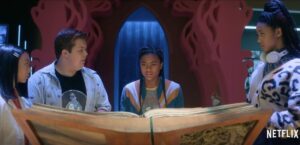
The latest in this grand tradition is the terrific “A Babysitter’s Guide to Monster Hunting,” based on the first book in the series by Joe Ballarini. Director Rachel Talalay knows scary — she is the only woman to have directed one of the “Nightmare on Elm Street” movies. And she knows how to mix fantasy and fun, because she has directed seven “Dr. Who” episodes. Her film has gorgeously imagined settings, a great cast, and an exciting story that hits the exact sweet spot between funny-scary and scary-funny. Which means it is exciting, fun, and, I hope, soon to be followed by Chapter 2.
Kelly Ferguson (Tamara Smar) is a shy high school freshman (but in sophomore math) who is looking forward to a Halloween party with her friends and the boy she has not yet had the nerve to talk to. But it turns out that her mother and father are also going to a Halloween party, held by her mother’s company, and they have promised the boss that Kelly will babysit.
The boss is Mrs. Zellman (Tamsen McDonough), imperious in a spectacular Ice Queen costume. She gives Kelly a long list of don’ts for taking care of Jacob (Ian Ho of “A Simple Favor”). No sweets, no ice cream, no gluten, no dairy, no more than 30 minutes of screen time, no running, shouting, or discussing current events, and a three-hour bedtime check-list. No trick-or-treaters. And she promises to be home at midnight on the dot.
Jacob is afraid of the monsters he sees in his nightmares. Kelly reassures him that “it’s just your mind playing tricks on you. They can’t hurt you…There’s no such thing as monsters.” She says when she was his age she thought the monsters in her nightmares were real, too. But then she grew up and is scared of real-life things like inequality, climate change, and talking to the boy she likes.
And then, Jacob is kidnappped by monsters. There are three scary/silly looking (CGI) toothy Toadies, led by The Grand Guignol (“Harry Potter’s” Draco Mallfoy, Tom Felton). Jacob’s gift for creating imaginative nightmares has made him a tempting target because his dreams can help create an army of infinite nightmares to ruin the world.
Kelly is at a loss, and then Liz Larue (Oona Laurence) arrives on a motorcycle, with a baby in her backpack. She is part of a centuries-old cadre of monster-fighting babysitters. Liz and Kelly will have to track down the underground lair of The Grand Guignol, Brown University, and that party where Kelly’s friends are celebrating Halloween. It will take courage, determination, magic, and, yep, math, to get Jacob home before his mother gets back.
Production designer David Brisbin and costume designer Carrie Grace deserve special mention for the gorgeous look of this film. Each of the settings, from the Grand Guignol’s lair to the babysitter headquarters is stunning and filled with enough intriguing detail to reward repeated viewings.
The young actors are all excellent, each creating a vivid and appealing character. It is a lot of fun to see Kelly grow in confidence and courage. Liz’s matter-of-fact, business-like curtness softens when she explains how she became a monster hunting babysitter. Felton has a blast as the monstrous nightmare collector (and the requisite British accent for a truly satisfying bad guy). His slithery movements are shiver-inducing.
It is also heartening to see these young characters solve problems with intelligence, courage, and teamwork. It was especially intriguing to see babysitters from around the world called on for help, and I hope we’ll get more from them in the next chapter.
As more kids are stuck at home this year, with trick-or-treating cut back by COVID-19, “A Babysitter’s Guide to Monster Hunting” is just the right movie to celebrate the year’s most happily scary holiday.
Parents should know that this is a Halloween movie about monsters with some scary images and peril, though it is punctuated by comedy and no one gets seriously hurt. There is some schoolyard language.
Family discussion: Where does the name Grand Guignol come from? Look up the famous names who are listed as historic babysitters including Rosa Parks, Frida Kahlo, and Maria Tallchief. Which of the babysitters is most like you? Which one would you want to sit for you?
If you like this, try: “Goosebunps,” “Monsters, Inc.,” “Spy Kids,” “Monster House,” and “The House with a Clock in its Walls”
Amazon Studios and Blumhouse Television in partnership with Little Cinema, presents WELCOME TO THE BLUMHOUSE LIVE: a first-of-its-kind virtual adventure celebrating the exclusive release of four highly-anticipated Blumhouse features on Amazon Prime Video this October with special performances by Ludacris and DJs Questlove, Toro Y Moi, and JADALAREIGN. Step inside the worlds of Nocturne, Black Box, Evil Eye, and The Lie, for an interactive mystery designed to unnerve and delight. The films are available exclusively now on Amazon Prime Video worldwide.
Guests can RSVP now to join the exclusive WELCOME TO THE BLUMHOUSE LIVE experience. Admission is free. Spots are strictly limited.
For the weekend of October 16 and 17, movie fans worldwide are invited inside WELCOME TO THE BLUMHOUSE LIVE to solve the mystery of a missing student and a strange family, all while exploring a labyrinth of virtual sanctuaries, live performances, interactive tarot readings, an escape room, and more unsettling twists. The club room in the basement of the house will host a special performance by Grammy-award winning rapper & actor Ludacris on Saturday, October 17, with Brooklyn-based DJ JADALAREIGN closing out the club. Multi-talented DJ-producer Questlove will DJ open-to-close on Friday, October 16. After the house closes on Saturday, attendees are invited to the basement club afterparty for a special DJ set by electro-pop darling and chillwave pioneer Toro Y Moi.
Taking inspiration from the unsettling thrillers Black Box, Evil Eye, The Lie and Nocturne, WELCOME TO THE BLUMHOUSE LIVE weaves the Blumhouse universe together in chilling synchrony – with twists and Easter eggs behind every door. There are two shows each on two separate nights, for a total of 4 chances to probe this virtual universe before it disappears.
The WELCOME TO THE BLUMHOUSE LIVE experience begins with the vanishing of Lindberg Academy student Erin Templeton. Your investigations suggest that Erin has several important ties to the Blum family, beckoning you to explore the BLUMHOUSE LIVE for clues to her disappearance. Enter through the basement, where Ludacris (October 17) or Questlove (October 16) will set the musical vibe for the thriller that lies ahead. Have a drink in the kitchen and probe your bartender for hints with direct, real-time interaction. Discover clues about your past, present and future with a live Tarot reading. Experience the power of memory and rivalry as you weave your way through the upper floors. Feel yourself being drawn closer and closer to the attic by powerful forces beyond your control… but first you’ll need to find the key before you can enter.
The unique collaboration between Amazon Studios, Blumhouse Television, and art collective Little Cinema forges a single narrative thread connecting four groundbreaking films into a cohesive interactive universe. Demonstrating the power of shared direct experience through sound, performance, film and technology, THE BLUMHOUSE LIVE is a truly exhilarating virtual adventure.
Explore the world of Welcome to the Blumhouse on October 16 + 17, all under one virtual roof.
Aaron Sorkin answered questions from a small group of critics about “The Trial of the Chicago 7,” premiering this Friday, October 16, on Netflix. The all-star cast play the eight men accused of conspiracy and incitement to riot at demonstrations during the 1968 Democratic convention in Chicago. The highly unpopular Vietnam war and the frustration with candidates who seemed old and out of touch, the fury at the loss of Martin Luther King and Robert Kennedy earlier that year, led several groups to send protesters to the convention. Mayor Richard J, Daley called in the National Guard and gave the local police orders to “shoot to kill.” The battle between the police and the demonstrators became very violent and many were arrested and injured.
In the film, Nixon’s new Attorney General, John Mitchell (later sent to prison himself for crimes associated with Nixon’s re-election and the Watergate scandal) orders the District Attorney to bring charges. Among the eight defendants (later reduced to seven when one’s case was separated), the two characters that are the focus of the film are the flamboyant, outspoken Abbie Hoffman (Sasha Baron Cohen) and the quieter, more traditional Tom Hayden (Eddie Redmayne).
Sorkin told us that he first met with Steven Spielberg in 2006 to talk about the film. Spielberg asked Sorkin if he would be interested in writing a film about the Chicago 7. Sorkin said “It sounds like a great idea; I’d love to do it,” then “as soon as I left his house I called my father to ask who the Chicago 7 were.”
The trial, which was filled with colorful characters and memorable confrontations, exemplified and embodied many of the conflicts of the era, between old and young (this was the era when the term “generation gap” was popular), between tradition and upheaval in resolving issues of civil rights and social justice.
Copyright Netflix 2020
It was front page news around the world in 1969 but not generally remembered today. “I had to go to school on this,” Sorkin told us. That included the many books on the trial and the 21,000-page trial transcript. But most valuable to him was the time he spent talking with the late Tom Hayden, one of the leaders of the group. “In my head, the film organized itself into three stories that would be told at once: the courtroom drama, the evolution of what was supposed to be a peaceful protest into a riot, a violent clash with the police and the National Guard, and the third story, one that wasn’t in any of the books or the trial transcript, and that I would only be able to get from Tom, was the relationship between Tom and Abbie , two guys on the same side who can’t stand each other, who each think the other is doing harm to the movement, but in the end they come to respect each other. I turned in the first draft and the next day the Writer’s Guild went on strike.”
So, everything was on hold and the film kept getting “kicked down the road for a while, until two things happened at once. One was that Donald Trump got elected. And he was holding big rallies where he would say of a protester, ‘In the old days they would have carried that guy out of here on a stretcher; I’d like to punch him in the face and beat the crap out of him,’ being nostalgic for 1968, and by that time I had directed my first film, ‘Molly’s Game,’ so Steven said, ‘The time is now and you should direct it.'”
“We thought the film was pretty relevant when we were making it last winter. We didn’t need it to get more relevant, but obviously, it did.” He spoke about seeing tear gas and nightsticks used at the Black Lives Matter protests “with Donald Trump in the role of Mayor Daley. We couldn’t believe our eyes; it was chilling, it was shocking.” He said he had been asked whether he made changes in the script to reflect the current conflicts, to make the parallels more explicit. “The answer is, not a word, not a frame. Events in the world changed to mirror the script…Ultimately, I feel like the film has been on a 14-year crash course with history.”
The only part of the story that could not be found in a book or the trial transcript was the relationship between Hayden and Hoffman, so that became the heart of the story. There was another key point he learned from Hayden that becomes significant in the film, which I won’t spoil here. “It’s a personal story. Most of the conflict in the story is about ideas, but it gets more personal than that. I was coming at these people and at this event with next to no knowledge at all…Coming at this with no preconceived notions turned out to be a blessing. I had a hard time getting fully on board with Abbie Hoffman…I found his antics counterproductive, the way Hayden does. I wanted to have my cake and eat it, too. But I wanted him to be a hero. Tom and Abbie kind of balance each other out. It’s a reflection of the Democratic party today, the intramural friction between the left and the further left, between people who want incremental change and want to work within the system and people who are tired of incremental change and want revolution. I have respect for both of those points of view and I have respect for both men as well as the others, and I thought that was an argument that belonged in this film and that the tension throughout between the two of them that was leading to an explosion in the third act was helpful for the film.”
Sorkin talked to “smart people” of the era, not necessarily involved but with strong, principled views about the issues and who was right and who was wrong, “to see how much of other people’s intelligence I could borrow and inject into the film.”
He talked about the challenges of shooting riot scenes on a budget, with help from the real-life locations, like Chicago’s Grant Park, which allowed them to blend new footage with archival images. “I don’t want to be glib, but the tear gas was helpful, too, having all that smoke, we could camouflage certain things, make it look like more people there than there really were.”
Sorkin talked about what it is appropriate to change in a story based on real life. “There’s a difference between what you are doing and journalism, just like there’s a difference between a painting and a photograph.” He gave an example from “The Social Network,” where in real life Zuckerberg drank beer, but Sorkin thought a screwdriver was “more cinematic.” Director David Fincher disagreed, and in the movie it is beer. Here, one departure from the real story was the look of the courtroom itself. The real-life courtroom was an unprepossessing mid-century design that “looked like a middle school multi-purpose room.” The grander one in the film better suggests the power dynamic in the force of the US government being brought to bear on the protesters. “Real courtroom scenes aren’t as entertaining and snappy and dramatic.” And the real trial went on for almost six months. “Your inner compass has to decide what’s an important truth and what’s an unimportant truth — and if yours is broken, the studio legal department will be glad to help you out.”




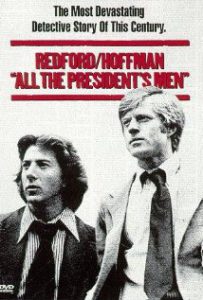 Many thanks again to the wonderful Blake Howard for inviting me back to his All the President’s Minutes podcast to talk about one of my favorite movies, “All the President’s Men.” Blake is going through the film with episodes about each minute of the film. He’s up to minute 107-108, Bob Woodward (Robert Redford) leaving the parking garage after a disturbing encounter with Deep Throat (Hal Holbrook), so disturbing that he suddenly feels afraid of every sound.