What kind of movie do you feel like?

Ask Movie Mom

Find the Perfect Movie

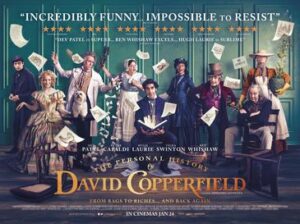
The Personal History of David Copperfield

Posted on August 27, 2020 at 5:51 pm

A-
Lowest Recommended Age: Middle School
MPAA Rating: Rated PG for thematic material and brief violence
Profanity: None
Nudity/ Sex: None
Alcohol/ Drugs: Alcohol and alcoholism, smoking
Violence/ Scariness: Brief violence including a fight scene and some abuse, sad offscreen death of a parent
Diversity Issues: Race-blind casting
Date Released to Theaters: August 28, 2020

Copyright 2019 FilmNation Entertainment
There is no higher praise than to say that Armando Iannucci (“In the Loop,” “Veep”) has adapted the book Charles Dickens said was his favorite of all the novels he had written, the book closest to his own history, in a manner as jubilant and shrewdly observed, as touching, as romantic, as exciting, as the novel itself.

For those who made not be familiar with the story: David Copperfield is a Bildungsroman that begins with the birth of the title character to Clara, a sweet but naive weak-natured young widow (played by Morfydd Clark, who also plays David’s first love, Dora). They have a blissful life together until she marries the stern and cruel Mr. Murdstone (Darren Boyd), who, with his equally formidable sister (Gwendolyn Christie), takes over the household.

Murdstone sends David to work in a bottle factory, where he lodges with the impecunious Mr. Micawber (Peter Capaldi). Years later, he runs away to his only relative, the formidable Miss Betsey Trotwood (Tilda Swinton), who lives with a kind-hearted but rather vague man named Mr. Dick, who struggles with intrusive thoughts about King Charles I.

Miss Betsey sends David to school, where he meets the indolent Steerforth (Aneurin Barnard of “Dunkirk”) and is befriended by Agnes (Rosalind Eleazar). After graduation he goes to work for Mr. Spenlow, and is immediately overwhelmed with love for his daughter, Dora. During all of these adventures and more David changes names and positions in society several times, and the concerns he and others have about their status in society is a recurring theme.

David Copperfield is one of my favorite books of all time, and I well understand it would take a trilogy as ambitious as “Lord of the Rings” to fully do justice to all of its characters and events. But even I had to admit that it has been judiciously pruned (the characters of Rosa Dartle and Mrs. Steerforth have been combined, no Barkis or Miss Mowcher, Tommy Traddles only mentioned, etc.). I strongly concur with dropping the “Little” from Emily’s name, and quickly got used to the idea that she was nearly an adult when David was a child. And I even applauded some happier resolutions for some of the characters. After 170 years, they deserve it.

And the cast! Not since the grand 1935 MGM version with Freddie Bartholomew as young David, Lionel Barrymore as Daniel Peggoty, Edna May Oliver as Aunt Betsey Trotwood, and Basil Rathbone as Mr. Murdstone (no one has ever been as good at naming characters as Charles Dickens), has there been such fitting richness of acting talent. Iannucci’s decision to use race-blind casting, without regard to the genetic realism of biological connections only adds to the universality and ample bounty that is fitting for Dickens, who populated his works with more vivid and varied characters per page than any other author in the English language.

Dev Patel is a superb choice for David, who is thoughtful, open-hearted, and innocent but with a strong core of honor and optimism. We first see David, like the real-life Dickens who went on very popular speaking tours, reading the book’s famous opening line on stage before an appreciative audience. “Whether I shall turn out to be the hero of my own life, or whether that station will be held by anybody else, these pages must show.” That framing, that self-awareness is fitting for an authorial voice that opens a book by challenging us to make up our own minds about what is to come. Iannucci’s theatricality and gift for telling stories cinematically shimmers through the film, with occasional images projected onto a wall, a hand reaching down into a model of the set, Patel talking to his younger self, played by Ranveer Jaiswal.

Class as it is perceived and as it is in reality is a theme of the film, but so is story-telling itself. Mr. Dick struggles to tell his story without reference to Charles I, and David comes up with an ingenious way to help him. Even as a young child, David wrote down memorable turns of phrase he heard on scraps of paper. His realization that those pieces of paper and pieces of memories are the basis for understanding his past, his purpose, and his future is a deeply satisfying answer to the question he poses at the beginning.

Parents should know that this film includes some tense and sad moments including an abusive stepfather and the offscreen death of a parent. There are financial reversals, confrontations (one fistfight), and a character embezzles.

Family discussion: Is David the hero of the story? Why is it so important to him to be considered a gentleman?

If you like this, try: The MGM version and the book, as as well as other film adaptations of Dickens books including the David Lean “Great Expectations” and the many, many versions of “A Christmas Carol” and a film about the writing of “A Christmas Carol” with Dan Stevens as Dickens, “The Man Who Invented Christmas.”


Bill and Ted Face the Music

Posted on August 27, 2020 at 5:32 pm

B +
Lowest Recommended Age: Middle School
MPAA Rating: Rated PG-13 for some language
Profanity: Some mild language
Nudity/ Sex: None
Alcohol/ Drugs: None
Violence/ Scariness: Sci-fi/fantasy peril and violence, mostly played for comedy
Diversity Issues: None
Date Released to Theaters: August 28, 2020
Date Released to DVD: November 9, 2020

Copyright 2020 Orion Pictures
I am pleased to report that Bill and Ted are still excellent. Bill and Ted Face the Music is the third in the series, 31 years after the original “Bill and Ted’s Excellent Adventure,” where the two dim but sweet-natured would-be rockers from San Dimas managed to pass their high school history class by traveling through time in a telephone booth. They also learned that their destiny was to create a song that would unite the world. Two years later, in “Bill and Ted’s Bogus Journey,” their adventures continued, including a visit to hell and a “Seventh Seal”-inspired encounter with Death. Much of the core cast of the original films returned, including Alex Winter (who also produced) as Bill, Keanu Reeves as Ted, William Sadler as Death, Hal London, Jr. as Ted’s stern father, and Amy Stoch as Missy, who was in high school with Bill and Ted but in the first film is married to Bill’s father.

In the present day, Bill and Ted are married to the medieval princesses who traveled through time with them in the earlier films, now played by Erinn Hayes and Jayma Mays. Things are not going well. Bill and Ted still perform as the Wyld Stallyns, but not in arenas. Their current gig is at Missy’s latest wedding, to Ted’s younger brother Deacon (“SNL’s” Beck Bennett). Their performance of a song named something like “That Which Binds Us Through Time, The Chemical, Physical and Biological Nature of Love,” combines some of the strangest sounds known to music, even stranger in combination guttural throat singing, bagpipes, and a theramin is, at best mystifying to the wedding guests. Basically, they hate it. Their wives insist on marriage counseling (with the always-great Jillian Bell) and we get a sense of the problem when the guys cannot understand why “couples counseling” might not mean both couples at the same time.

Each couple has a daughter. Ted’s daughter is Billie (Brigette Lundy-Paine) and Bill’s is Thea (Samara Weaving, the niece of Hugo Weaving who was Reeves’ nemesis in the “Matrix” films). The girls are 24, still living at home, and spend all day listening to music. In other words, they take after their dads.

Bill and Ted are beginning to question whether they should just give up their music. But then Kelly (Kristen Schall) shows up in a futuristic, egg-shaped time traveling capsule. That song that was going to unite the world — they would have to produce and perform it that night or it would be the end of everything. “The Great Turntable is Tipping. Reality will collapse and time and space will cease to exist.”

Everyone ends up getting involved. The guys go forward in time to see if they can get the song from various future selves. (Boy, the people in charge of hair had some fun with that.) The princesses/wives explore the multiverse to see if there’s a happier ending. And Billie and Thea do what Bill and Ted did in the first film; they go back in history and pick up some help.

Some viewers will need to be brought up to date on the earlier films, as there are references that will delight the fans. Some younger viewers will need a history lesson about phone booths. (Of course Bill and Ted do their time traveling old school.) And some fans of the original many need to check with a younger member of the family to learn who Kid Cudi is. I hope all ages know who Dave Grohl is.

It’s all sweet, silly fun, with a conclusion that is likely to bring some tearing up from the parents in the audience, and make all Bill and Ted fans feel that this has been a very excellent adventure for us all.

Parents should know there is some mild language and some mostly comic peril and violence, including characters who are temporarily “killed” and sent to Hell.

Family discussion: Would you want to meet the future versions of yourself? What would you want to know?

If you like this, try: the two earlier “Bill and Ted” movies and the San Diego Comic-Con panel about the movie.

Re-Design at Rogerebert.com

Posted on August 27, 2020 at 4:08 pm

I’m delighted with the elegant and more user-friendly re-design at rogerebert.com, where I serve as assistant editor and critic. Editor in chief Chaz Ebert has generously used the re-launch to pay tribute to our writers, including a link to my appreciation essay about Carl Reiner. It is one of the great honors of my professional life to be a part of the site founded by Roger Ebert, whose work has been an inspiration for me since his first review in the Chicago Sun-Times when I was in high school.

How Many Movie Characters Have Your Name?

Posted on August 23, 2020 at 8:00 am

On Twitter I asked people to tell me their favorite movie character with their name. I got a lot of great answers and some surprising “none” answers, which led me to this study. Type in a name and see how many movies have a character by that name. The implications for gender and race and ethnicity of movie characters are illuminating.

Orion Pictures Will Now Focus on Diverse Voices

Posted on August 22, 2020 at 2:05 pm

MGM is putting some of its money where its mouth is and rebooting its subsidiary Orion Pictures to focus on films from diverse voices, headed by Alana Mayo, who will have the most coveted power in Hollywood; the power to greenlight a project.

Power in Hollywood still belongs almost exclusively to white men. “There are almost no people of color in the film industry who have the power to say, ‘This movie is getting made and by this person,’” said Ana-Christina Ramón, an author of studies about Hollywood hiring that are published annually by the University of California, Los Angeles.

On Thursday, Metro-Goldwyn-Mayer, the 96-year-old home of James Bond, Rocky and RoboCop, took a modest yet meaningful step toward correcting the imbalance, hiring a young producer, Alana Mayo, to remake its Orion Pictures division to focus exclusively on underrepresented filmmakers and stories. Ms. Mayo will lead a greenlight committee made up entirely of women — meaning the chairman of MGM’s film group, Michael De Luca, will not have a vote in selecting the films that Orion makes or acquires for distribution.