


What kind of movie do you feel like?

Ask Movie Mom

Find the Perfect Movie

Larry Crowne

Posted on June 30, 2011 at 6:00 pm

“Larry Crowne” is such a perfectly pleasant movie that it may not be until you walk toward the exit that you realize that something is missing. Until then, the good spirits of stars Tom Hanks and Julia Roberts, clearly enjoying themselves and each other as they beam their considerable star power our way keep us feeling if not entertained at least appreciated. Hanks, directing for the first time since his debut with the terrific “That Thing You Do” is immensely hospitable. He all but hands out milk and cookies to make the audience feel welcome, with a series of recession-era but sweetly comic scenes and quirky but endearing characters and a can’t miss theme of a man literally and metaphorically casting off the elements of his past that are holding him back and discovering that he is capable of taking on new challenges and new relationships.

But Hanks the star and director has a problem with Hanks the co-screenwriter (along with “My Big Fat Greek Wedding’s” Nia Vardelos). Something is missing from the story.

Of course we fall in love with Larry Crowne (Hanks) right from the opening credits. The very first thing we see him do is pick up trash in the parking lot on the way to his job at a big, WalMart-style store. Then in a quick montage we see that he always does more than expected and genuinely enjoys his job. He is ever-cheerful with colleagues and helpful with customers, and an eight-time winner of the “Employee of the Month” award. And then he gets fired. Our first clue that something is not right with the story is the over-the-top awfulness of the termination, but we let that pass because we want to see what he will do.

Larry is downsized because he does not have a college degree. He joined the Navy after high school, got out after 20 years as a culinary specialist (cook), and has been working at the store ever since. He is in a financial pinch because he bought out his ex-wife’s share of their home, which is now worth much less than its mortgage. A perky blonde bank representative (Hanks’ real-life wife, Rita Wilson) keeps offering him complimentary coffee as she gives him the bad news. Larry can’t find a new job and realizes he needs to go to college. He sells his gas guzzler and trades his flat-screen TV for a scooter.

Mercedes (Julia Roberts) is a teacher at the community college whose greatest hope is that fewer than 10 students will register for her classes so she can cancel. She feels very far from what she once aspired to, supporting a husband (“Breaking Bad’s” Bryan Cranston) whose own aspirations have shrunk from novelist to comment on a blog. She once hoped to teach Shakespeare and Shaw. Now she teaches students who cannot even remember how to pronounce her name how to get up in front of the class and say something.

So we know where this is going, and we want it to go there, and the ingredients are all assembled. The situation is timely and engaging. The cast is exceptional. Larry has adorable neighbors (Cedric the Entertainer and Taraji P. Henson), and adorable classmates: the ravishingly lovely Gugu Mbatha-Raw as the girl who gives Crowne a literally top-to-bottom makeover and introduces him to her scooter-riding gang, Grace Gummer (Meryl Streep’s daughter) as a lacrosse-player more comfortable on the field than in the classroom, “Night at the Museum’s” Rami Malek, sweet but a little dim. George Takei is marvelous as a professor of economics. Mercedes has a sympathetic colleague (the always-welcome Pam Grier).

But something is missing. All of Roberts’ movie star magic can’t make the character of Mercedes as appealing as she needs to be. We never get a sense of how she got to the slough of despond she is in and the character is so inconsistent she seems blurry. All of Roberts’ usual tricks, the dazzling smile, the laugh, the walk, can’t disguise the fact that while she tells her students what she is teaching them is to care, it is not clear to her or to them or to us that she has learned that lesson herself. There is no moment of change or connection or even notice to make us feel that there is a genuine basis for a relationship, and the ending is hurried and superficial. There is build-up without pay-off. I enjoyed spending time with these characters. I wish they were in a better movie.

(more…)

Transformers: Dark of the Moon

Posted on June 28, 2011 at 10:19 pm

I feel like Goldilocks.  It’s not as good as the first one, but it’s not as awful as the second one.  So, if that doesn’t make it just right, at least it makes it better than the second one and with some summer movie chases, fights, and explosions that make it popcorn-worthy.

It begins with a prologue that cheekily re-imagines the space race of the 1960’s as a secret mission to learn more about a mysterious rocket that crashed on the dark side of the moon in the late 1950’s.  Archival footage of Presidents Kennedy, Johnson, and Nixon, and newsman Walter Cronkite is used to make it appear that in the brief moments our first moon landing was not visible from earth, the astronauts were exploring a cavernous machine.  Even the 1986 Chernobyl nuclear accident is tied into cold war-ear secrets about what was found on the moon.

Then, we are in present day where Sam (Shia LeBeouf) returns as Sam Witwicky.  Still in high school in the first movie, he is now out of college and looking for a job in Washington D.C.  It’s tough these days, especially when you’re not allowed to put “saved the world — twice” on your resume for reasons of national security.  Sam also has a new girlfriend named Carly (model Rosie Huntington-Whiteley).  The departure of Megan Fox is explained in a few short lines.  No one seems to miss her.

Sam meets Carly’s boss Dylan (Patrick Dempsey), a fabulously wealthy but very arrogant businessman (think Dr. McSleazy) and tries not to be jealous, even after Dylan gives Carly a $200,000 Mercedes.  But, you know, blah blah and the bad robot decepticons are back, blah blah the head of National Security (Frances McDormand) tries to keep Sam away from his friends the autobots, and blah blah all something will do something if Sam doesn’t get that tractor beam out of commission, I mean knock out that pillar that has “the ability to reshape the universe” and build a bridge to another world (didn’t we just see that in “Thor?).

And then the humans fight each other and the robots and the robots fight each other and the humans.  In 3D.  Various characters turn out to be not what we thought.  There are surprise guest cameos.   And at two and a half hours it goes on much too long (believe me, they could have lost an hour and had a nice, brisk evening at the movies).     McDormand, Ken Jeong (stuck with an embarrassing attempt at homophobic humor, literally with his pants down), and John Malcovich are completely wasted.  Huntington-Whiteley is better at posing than acting — but she’s got legs and knows how to use them.  And we once again do not get enough of John Duhamel.  John Turturro wore out his welcome well before the first one ended but Alan Tudyk makes the role of his aide into something enjoyably off-kilter.  It’s too loud, it’s too long, some of the battles are hard to follow, the action is entertaining and so is the but relief that it isn’t as awful as the last one.

(more…)

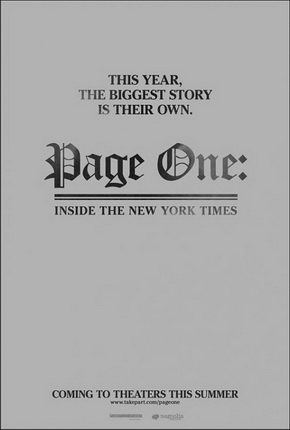
Interview: Brian Stelter and Andrew Rossi of ‘Page One’

Posted on June 28, 2011 at 8:00 am

“Page One” takes us behind the scenes at the New York times in a year of turmoil and transition.  We see how its media reporters cover their own industry.  We see the release of the first Wikileaks material and how it competes with and is reported on and interpreted by the main-est of the mainstream media.  We see how the Times buys out and lays off experienced staff and brings on a college student who has been scooping them with his blog about television news.  I sat with director Andrew Rossi and blogger-turned New York Times reporter Brian Stetler in the sunny courtyard of a Washington DC hotel to talk with them about reporting on the reporters and the future of journalism.

A recent law school class was asked how many of them read a paper newspaper every morning and not one hand went up.  What does that mean about the future of newspapers and of news?

Stelter: People get the news in different sources.  They may be getting links on Twitter or Facebook.  As Katrina vanden Heuvel says in the film, there’s lots of information out there. That’s the predicament “Page One” is trying to address.

I thought the most powerful statement in the film was “Daniel Ellsberg needed us.  Wikileaks does not.”  And yet, the movie shows that reader do need  the New York times to digest and interpret and verify the material.

Stelter: In a day where everyone can be a publisher, not everyone can be an editor.  The film fundamentally is about editing. You see reporters and editors figuring out what’s news and what’s not news and in the case of Wikileaks, figuring out how to cover someone who is a publisher, but not an editor.  Wikileaks does sometimes redact material and decide what not to post, but fundamentally they’re not bringing to bear those judgment calls that journalists are.  I love the movie for those scenes with editors where you see them making judgment calls.

We’ve seen new media blow the whistle on failures of old media and old media expose the failures and misrepresentations of new media.  Are we going to be in an endless cycle of “gotcha?”

Stelter: That’s an element going forward, one element of a complicated structure.  It’s good that we can all truth squad each other.  In the film you see the Times trying to decide how to handle a report by NBC news about the end of the Iraq war and eventually deciding not to write about it because it was, I don’t want to say an imagined end but a “mission accomplished” moment.

It was surprising to see in the film the way Brian Williams made NBC’s role a part of the story and fascinating to watch the reaction in the newsroom.

Stelter: It baffles my mind.

How do the changes in media and reporting affect elections and politics?

Stelter: We get more saturated by the day-to-day minutia of the campaigns.  It’s easier to write about and follow along.  What me may lose there is the broader picture.  But the other change is the interactivity.  Citizens now can prod journalists to cover the campaign differently.  Readers, listeners, viewers can push us to do a better job.  We’ve seen some of that already but we will see more going forward.  That’s one reason transparency is such a positive force.  We can talk back in a way we couldn’t before.  I love when readers talk back to me and tell me what to improve on.

I was very intrigued by the use of music in the film.  How did you select it?

Rossi: “Paper Tiger” is the song that plays beneath the credits. It’s by Beck. It has a very sort of somber but driving sound and David Carr’s final lines in the film that drive the song are “The New York Times does not need to be a monolith to survive.” I think that is one of the very important messages of the film. There are multiple voices and there shouldn’t be any Zeus character with thunderbolts saying, “This is the only truth that can be known.” “Paper Tiger,” there’s a double entendre because of the word “paper” but it is also an expression the Chinese have for something that seems scary but really is not. Mao used to use that expression to refer to Russia and England as monolithic powers that were really just made of paper. The song has the right audiophilic quality but also a double meaning. Paul Brill did the score. He’s worked a lot on films that treat very serious topics but in ways that are accessible and have an entertainment value. That is the type of palette we were going for in the film.

You include reporters who cover the business side of the media, but you do not include anyone from the business side of the New York Times. Why is that?

Rossi: There’s a high and firm wall between the newsroom and the corporate side. Bill Keller, the executive editor, authorized the project after various discussions and meetings and it was really done under the purview of the newsroom so we really never butt up against the corporate side. I did request an interview with the publisher and CEO, both of whom declined. The film is really trying to look at the journalism involved, though certainly we treat the financial obstacles.

What’s the difference between writing for the web and writing for print?

Stelter: Paper is so permanent, a one time shot to get it right and there’s a high cost to making a correction. If I write something for the web in the afternoon I can make it better all day and then put the final product in the paper.  Corrections are the first symbol of us opening ourselves up to the public.  This movie is just another form of transparency.

Contest Winner: The Adjustment Bureau

Posted on June 27, 2011 at 8:14 pm

Congratulations to the winner of “The Adjustment Bureau” on DVD, Pam H. of Kennewick, WA.  Thanks to all who entered!