

What kind of movie do you feel like?

Ask Movie Mom

Find the Perfect Movie

Dialect Coach Stephen Gabis of ‘The 39 Steps’

Posted on March 20, 2010 at 8:00 am

The 39 Steps is a riotously hilarious theater experience based on the classic Alfred Hitchcock movie, itself based on a popular 1915 thriller by John Buchan. The play has 150 zany characters — all played by four actors. The show features an on-stage plane crash, handcuffs, missing fingers and some good old-fashioned romance as the hero and heroine go on a chase that takes them through Scotland and into a London music hall. The touring stage version is opening in Washington DC this week. 39steps.jpg Four actors performing 150 parts means not just a lot of split-second costume changes but a lot of lightning-fast changes of character, voice, and accent, what dialect coach Stephen Gabis calls “a living, breathing actor’s nightmare.”
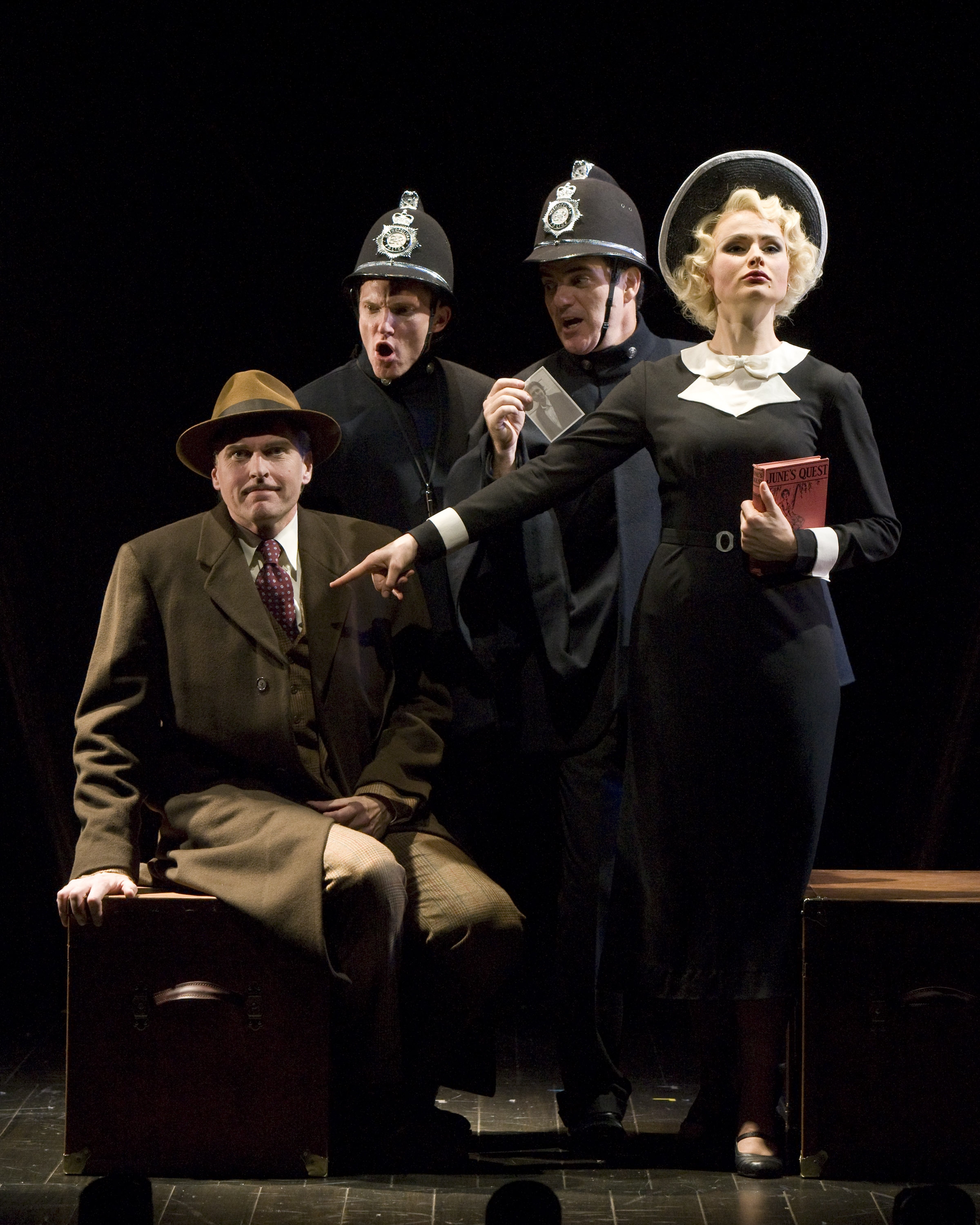
I spoke to Mr. Gabis about working on the show and what makes accents so important in creating a character. Part of the fun of talking to him was the way he almost sub-consciously slipped in and out of a dozen different accents to illustrate his comments.
This has to be one of the most accent-intensive challenges of any theatrical production.
And there’s an understudy who has to cover not just the main character but all of the other roles as well! From my vantage point, it is like boot camp for the first week, about the dialect. It really has to become muscle memory. Everyone has a different skill set; everyone’s brain is complicatedly and differently wired for this sort of thing. Some people have a kind of mimicry chip and can pick it up on their own. Some are good at some accents and not good at others. For this particular piece, a consistent problem is for the Scots characters. You have the Highlands accent and the Glaswegian girl and the guys on the platform in Edinburgh and the bobbies that are chasing them, keeping them out of Ireland! Americans have some misconception that mixes Irish and Scots accents.
Can you give me an example of the differences?
You’re going to say any of your sounds like “love” or “come” or “mother” would be “loove” if you’re Irish but the Scots would say it like an American. I got “te” go instead of I got “to” go. You don’t have to roll your r’s, you just have to be able to tap them. That over-emphasized rolling would be exaggerated, what I call “music hall Scots.” That’s what performers like Harry Lauder used to do, for emphasis and to be entertaining. The R takes that tap when you’re in the position to make a D. American speech is very lateral. Words kind of lean on each other. More legato. There’s a bit of a bounce to this stuff. This play exaggerates some of the speech in the text. And Scots will repeat what the other person says for emphasis.
So it isn’t only pronunciation, then, it’s cultural.
Yes! For instance, knowing the relationships between the different cultures that live together and the effect they have on each other. And whether the person is educated or not is important, too, not just where they live. The Glasgow girl in this show sounds like one of my classmates when I was in drama school, Sharman Macdonald, that soft voice — she is the mother of Kiera Knightly.
Were you always interested in accents?
I grew up around a lot of different accents and I’m a mimic. I studied acting but I am an autodidact. I resisted learning all of the phonetic alphabet stuff in drama school but had to discipline myself when I began to coach and teach.
Are accents as important as they once were in identifying people and their backgrounds?
Things are mushing together — media has made accents get a bit homogenized and put into a blender. I have to be really attuned to when it is taking place. This play is set in the 30’s. But I can’t overdue the authenticity, either. It has to be understandable for the audience. You don’t want a museum piece, too mannered, like Colin Clive in “Frankenstein.” The accent can’t be a distraction.

Socalled: A Documentary about a Klezmer/Hip-Hop/Cowboy/Video-Artist

Posted on March 19, 2010 at 3:42 pm

Socalled is a documentary with 18 short films about klezmer hip-hop music and video Montreal-based artist Josh “Socalled” Dolgin, featuring Katie Moore, Fred Wesley, C-Rayz Walz, David Krakauer, Matt Haimovitz, Arkady Gendler, Benjamin Steiger Levine, D-Shade, Gonzales and lounge legend Irving Fields. For a limited time, the entire Socalled movie is available for viewing for 99 cents on YouTube.

Clash of the Titans — the Original

Posted on March 19, 2010 at 3:00 pm

Get ready for the upcoming release of the new “Clash of the Titans” by taking another look at the original, starring Harry Hamlin as Perseus and Laurence Olivier as Zeus, now available on Blu-Ray and on iTunes. It is an epic fantasy, filled with drama, passion and old-school stop-motion animated creatures from creative genius and special effects wizard, Ray Harryhausen.
The new “Clash of the Titans” stars Liam Neeson, Ralph Fiennes and “Avatar’s” Sam Worthington and will be in theaters April 2.

World Premiere of ‘Wimpy Kid’ at Alexandria’s Riverside School

Posted on March 19, 2010 at 7:17 am

Alexandria, Virginia’s Riverside Elementary School hosted the World Premiere of “Diary of a Wimpy Kid,” thanks to a winning entry selected out of 5000 competing schools in a competition to host the premiere for their students.

The school safety patrols lined up on the playground to yell “I am a Wimpy Kid!”

The premiere event was held after school yesterday in conjunction with the National Education Association’s (NEA) “Read Across America” program, which focuses on motivating children and teens to read through events, partnerships, and reading resources; the NEA has designated March as National Reading Month. NEA also sponsored the contest, along with 20th Century Fox, School Library Journal, and publisher Harry N. Abrams Inc. The School Library Journal hosted and facilitated the promotion, and Promethean presented the school with its ActivClassroom technology.

There was a full Hollywood-style red carpet with the school patrol kids providing security. I spoke to April Cage, the instructional coach who wrote the winning entry.

Author Jeff Kinney told me that the question he gets asked most often by kids is “What does ploopy mean?” It’s just a made-up word that his sister used to call him.

I asked Robert Capron about playing Rowley (note the Zooey Mama t-shirt!):

Director Thor Freudenthal talked about how happy he was to bring the movie to the Riverside school.

IMG_7283.JPG

Zachary Gordon told me how lucky he felt to play Wimpy Kid Greg Heffley — and to go to a school that is the opposite of the one in the movie because it’s the kind of place where “if you fall everyone comes over to make sure you’re all right.”

Botox vs. Acting

Posted on March 18, 2010 at 8:00 am

Amanda Fortini writes in New York Magazine about the impact that Botox and other beauty treatments have had on acting. What is a star to do when deciding between a face that can show emotion and one that looks younger but can’t move?

These days, to watch television or to go to the movies is to be jarred, put off, and sometimes saddened by our nonstop exposure to cosmetic interventions. We’re all familiar with the usual specimens, the Heidi Montags and Mickey Rourkes, whose many extreme surgeries and baroque physical changes are routinely dissected by blogs and tabloids. But I’m talking about a different species of performer. Less freakish yet far more abundant are the actors who, by virtue of a range of injectable substances (Botox and its cousin, Dysport; Restylane, Juvéderm, and other fillers of this ilk), are mysteriously unaffected by gravity, childbearing, or free radicals. They seem to have avoided growing old entirely or, like Benjamin Button, to be growing younger with each year. Either that or they look as if they’ve ripened abnormally, their features drifting off in odd, conflicting directions.

What I like about this article is the way it goes beyond the usual tabloid “who’s had work done?” or even “who’s had freakishly bizarre work done?” articles to talk about the way these treatments have affected the style of acting. If you watch early talkies, movies from the 1930’s-late 1940’s, you will still see remnants of early 20th century stage acting with its arch, mid-Atlantic cadences and theatrical gestures. Movie acting was still in its infancy and it really was not until the 1950’s that what we think of today as acting, the natural, intimate, style of performers who understand that the camera will pick up their smallest changes of expression.

The Method brought Freudianism to the screen. Its numerous devotees (Marilyn Monroe, James Dean, Paul Newman, Jane Fonda) ushered in an era of fluid, naturalistic acting that has continued to flourish to this day….The aim of the Method has, over time, come to define the fundamental mission of dramatic acting itself: to use the face and the body to express subtle, complex, conflicting psychological and emotional states.

But by freezing the face and removing the ability to convey emotion and character with the eyebrows, the forehead, and the mouth, Botox and other treatments have led to a return to acting through more emphasis on gesture and voice, and Fortini says the result is a different kind of character.

Some actors appear to be underplaying their characters, consciously making them cool, without affect. If you can’t move your face, why not create an undemonstrative character? Others have taken the opposite approach: On two cable dramas starring actresses of a certain age, the heroines are brassy and expansive, with a tendency to shout and act out, yet somehow their placid foreheads are never called into play. Usually, when a person reenacts a stabbing or smashes a car with a baseball bat, some part of the face is going to crease or bunch up. Not so with these women. As though to compensate for their facial inertia, both perform with stagy vigor, attempting broad looks of surprise or disappointment, gesticulating and bellowing. If you can’t frown with your mouth, they seem intent on proving, you can try to frown with your voice.

The conflict is getting even more pointed as HD televisions threatens to do to less-than-perfect faces what the introduction of sound did to actors whose voices did not match their profiles. On the other hand, “Avatar” would not have been nearly as affecting without the performance of Zoe Saldana, whose stunningly expressive face was translated by computers that could never hope to replicate true the communication of true emotions, making, for that film, acting the real special effect.