
What kind of movie do you feel like?

Ask Movie Mom

Find the Perfect Movie

Spore!

Posted on September 7, 2008 at 8:00 am

Spore is not just one of the most highly anticipated computer games of the year. It is one of the most highly anticipated works of art and entertainment in any category. Think I’m exaggerating? Sales last year were $9.5 billion. Sixty-five percent of American households play computer or video games. The average game player is 35 years old and has been playing games for 13 years. And forty percent of all game players are women and women over the age of 18 represent a significantly greater portion of the game-playing population (33 percent) than boys age 17 or younger (18 percent). In 2008, 26 percent of Americans over the age of 50 played video games, an increase from nine percent in 1999. Super Mario Brothers has sold over 40 million units. Best-selling video games sell many times more copies than best-selling books and have as many viewers/users as top movies and music.

Games have gone way beyond blowing stuff up and killing bad guys and aliens. Spore comes from the people who did the wildly popular Sims series. It gives players the chance to create entire universes, starting with one-celled creatures who evolve into complex organisms. It allows for an unprecedented level of imagination and interactivity for the participants, even allowing players to exchange creatures and visit each other’s planets. Spore gives players (I think we need a new word here — maybe participants?) the change to be creative while absorbing lessons about logic, programming, and consequences. Executive producer Lucy Bradshaw said in an interview with the Washington Post

Every single planet you go to was going to bring this sense of surprise and awe to the game. That was central and why we made the creation tools the way we did. Not only that we’d made the building blocks and could tap into the creativity of a million players, but the fact that the content is so compressible. The model data for a creature is like 3 kilobytes, the thumbnail picture is about 18 to 20KB. So a grand total of 25KB, which means that we can actually share all of this content without bandwidth issues.

And then we did things like the YouTube partnership, the Planetwide Games deal involving a Comic Book Creator, and a make-your-own postcard system that we put in the Creature Creator that allows players to take things outside of just the elemental game play, share it with other players, and see where those players might take it. We even did a Facebook application that ties back to our servers. We really want to see what directions players take all this stuff. We’ve built a really strong tool that lets users share their experiences in different venues, and I can’t wait to see what unravels next.

I love the way that Spore creates a sort of universal Wiki game, with everyone who participates helping to direct it.

And this discussion of games gives me a chance to share one of the funniest video clips I have ever seen, from the wonderful Australian music group, Tripod:
Are Some Words Forbidden No Matter What?

Posted on September 6, 2008 at 8:00 am

Should some words be banned entirely? In a debate reminiscent of the battles over The Adventures of Huckleberry Finn, a coalition of disability rights groups called for a boycott of Tropic Thunder over the use of the term “retard.” The Washington Post published an opinion piece criticizing “Tropic Thunder,” written by the mother of a developmentally disabled child that began with an anecdote about a cruel passer-by who used that term to insult her child.
She failed to understand that the movie used the term exactly the way she did — to demonstrate that the speaker is a misguided and ignorant person.
In discussing this issue on BDK’s radio show, I mentioned that when I reviewed First Sunday, the newspaper that printed the review used N**** instead of spelling out the first word in the name of Ice Cube’s rap group. But that story did not make it on the air. The radio station did not broadcast the word, even though the word was not being used as an epithet but a word chosen by a group of men about themselves as a way of removing the pejorative and diminishing aspects of the term and giving it power instead. I might not agree with that use of the word but I respect the right of people to determine for themselves what they want to be called and to determine whether they want anyone who is not a part of the group to use it.
And I oppose any effort to ban any word. It makes it impossible to have a conversation about the meaning of the word and it gives the word too much power.
Oh, and the very first protests of “Huckleberry Finn,” which began as soon as the book was published, also focused on language that was considered inappropriate and shocking. The objections were not to the n-word but to the use of terms like “sweat” instead of “perspiration.” And yet, like the music of NWA, it is the language Huck and Twain use that is central to the appeal and authenticity of the works.
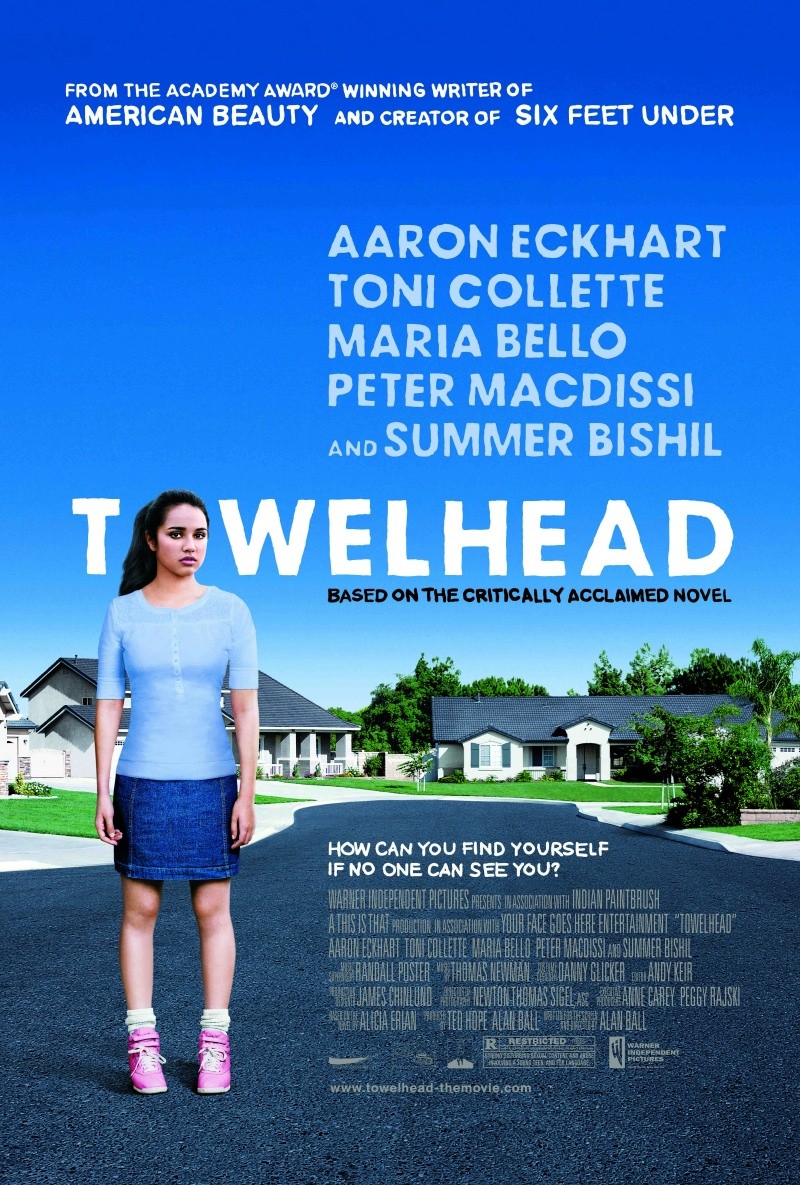
towelhead1.jpgNow there is a protest over the title of a new film called, as was the book it was based on, “Towelhead.” This is one of several cruel and insulting terms that the main character, the daughter of an American mother and a Lebanese father, is called by racists. The author of the book, Alicia Erian, and the director of the movie, Alan Ball (of “Six Feet Under” and “American Beauty”) have issued very thoughtful and compelling statements about the title and the term that are well worth reading, supported by the studio and by a group of scholars. Here are the statements in full:

(more…)

Coming Attractions (September 2008)

Posted on September 5, 2008 at 10:00 am

There’s only one movie opening up this week, “Bankok Dangerous” with Nicolas Cage. That’s everything I know about it. It isn’t screening for critics, and that means the studio is pretty sure it won’t even get one good review.

But next week, things really pick up! I am very excited about “Righteous Kill,” starring Robert DeNiro and Al Pacino.

And I am even more excited about “Burn Before Reading,” from the Coen Brothers (“Fargo,” “No Country for Old Men”), starring George Clooney, Frances McDormand, and Brad Pitt.

Stay tuned!

The ‘Bechdel Rule’

Posted on September 5, 2008 at 6:00 am

Neda Ulaby’s column on NPR starts with a rule established by Alison Bechdel, author of one of my favorite books, Fun Home: A Family Tragicomic. In Bechdel’s comic strip, a character said she’d only go to see a movie if it had:

1. At least two female characters, who …
2. talk to each other about…
3. something besides a man.

Ulaby quotes Eric Deggans, who covers television for the St. Petersburg Times. He
says it comes down to who’s writing the scripts: There’s not a lot of diversity among successful TV writers. As a result, Deggans says, there aren’t a lot of fully realized African American characters, and not many conversations between women on a convincing range of topics. He notes that shows like “Sex in the City” fail to meet that test. But she recommends one, “The Middleman” on ABC Family that qualifies. I’ll have to check it out. I think “Buffy the Vampire Slayer” qualifies, too. Ulaby asked Deggans and “The Middleman’s” Natalie Morales for their variations on the Bechdel rule.
The Deggans Rule
(from Eric Deggans, The St. Petersburg Times)
1. At least two nonwhite characters in the main cast …
2. in a show that’s not about race.
The Morales Rule (from Natalie Morales, ABC Family’s The Middleman)
1. Nobody calls anybody Papi.
2. No dancing to salsa music.
3. No gratuitous Spanish.

Check out the comments on the rules, which include more variations and recommendations.

Do All-Star Casts Live Up to Their Billing?

Posted on September 4, 2008 at 6:00 pm

Loyal reader jestrfyl left a provocative comment about my post on the 1939 and 2008 versions of “The Women.” He’s a skeptic about all-star casts. He writes:

There is no Constellation that is made of all first magnitude stars, and I wonder if that lesson from nature should apply to films. However, if they can gel as a company and not only work with each other, but encourage and embolden each other, it could be an amazing experience. Are there any other films that are good examples of many combined super-celebrities?

It is sometimes called “stunt casting” when the point of selecting a particular actor relates not to talent or fitness for the part but to what the audience knows outside of the movie that they bring with them when they watch. As that suggests, it can be a distraction. And stars used to, well, star treatment can have a clash of egos that can lead to scene-stealing. But there’s a reason stars are stars and those who are truly talented and committed love to work with people who can challenge them to do their best.

Some good, bad, and ugly examples of all-star casts:

1. Oscar-winners Shirley Maclaine, Sally Field, and Olympia Dukakis are joined by force-of-nature Dolly Parton and all of them are eclipsed by then-newcomer Julia Roberts in one of the great weepies, “Steel Magnolias”

2. One of the first high-profile all-star casts was in 1956 Best Picture Oscar-winner “Around the World in 80 Days.” Mike Todd (who was married to Elizabeth Taylor until his tragic death in an airplane crash) produced and used his considerable charm to get extra publicity by coaxing just about everyone in Hollywood to appear in the film. For example, when a honky-tonk piano player turns around for a moment we see that it’s Frank Sinatra. Todd made it seem like a tiny part was not disrespectful. On the contrary, it was something special and highly coveted. He even coined the word for a brief appearance by a big star, using the name of a small, valuable piece of jewelry: a cameo. (And Shirley Maclaine is in that one, too!)

3. One of the most popular recent all-star casts was “Oceans 11” and its sequels. Just like the original, which had “the Rat Pack” (Dean Martin, Joey Bishop, Peter Lawford, Sammy Davis, Jr., etc. — and Frank Sinatra), this one was filled with big-time Hollywood names. It was like a People’s “Sexiest Man Alive” reunion with winners George Clooney, Matt Damon, and Brad Pitt. (And Julia Roberts is in that one, too, with joke billing “introducing” her.)

4. One of the most prestigious all-star casts was in “Glengarry Glen Ross,” with Oscar-winners Jack Lemmon, Kevin Spacey, Alan Arkin, and Al Pacino, and equally brilliant work by Alec Baldwin, and Ed Harris.

5. One of the smallest all-star casts was a film, recently remade with one of the original stars. The original is the only movie with the entire cast nominated for Oscars. Any guesses?

6. “How the West Was Won” and other episodic or compilation films like “O. Henry’s Full House” or “Zeigfield Follies” have all-star casts. Disaster films like “Airport” and “The Towering Inferno” also frequently have all-star casts.

7. “Murder on the Orient Express” had a train car full of suspects, every one of them played by a star.

8. “It’s a Mad Mad Mad Mad Mad Mad World” had a big big big big big big cast of almost every comedian in Hollywood, including Mickey Rooney, Phil Silvers, Ethel Merman, Jimmy Durante, the Three Stooges, Jerry Lewis, Sid Caesar, Jonathan Winters, Milton Berle…and Spencer Tracy.

9. “Bobby,” about the night Robert Kennedy was killed, stars Sharon Stone, Anthony Hopkins, Lindsay Lohan, Laurence Fishburne, Martin Sheen, Helen Hunt, Ashton Kutcher, Demi Moore, and Elijah Wood.

9. And then there’s the ugly. Some all-star casts have no-star scripts. Stay away from the original “Casino Royale,” with David Niven, William Holden, Ursula Andress, Deborah Kerr, Orson Welles, and Woody Allen.