From the opening shots of the American flag fluttering gracefully from a barn in the Iowa morning mist, to the closing scenes of cheering crowds at the baseball field, The Final Season is one great big corn-fed cliche.
The movie tells the story of the small town of Norway, Iowa (population 586) which, despite its small size, consistently manages to field a winning baseball team due to pluck, hard work and good Iowa values. As one crusty old timer puts it, “In Norway, our baseball tradition is as rich as the Iowa soil.†The school is going to be closed as a result of some nasty legal tricks and budget cuts by people far away who don’t appreciate the special character of a small town. So this is to be the last hurrah for the Norway Tigers.
Despite its small size, Norway is large enough to contain every stereotype known to man: the tough and disrespectful city kid whose life is transformed when he is exposed to good country values; the sharp city slickers who want to shut down Norway’s school (including the beautiful young professional woman in a business suit who succumbs to the homespun charm of the team coach); the father who made the crucial play in a ball game many years ago, watching his son step up to the plate in the exact same situation; the aging coach who hands over his team to his young and unsteady replacement, and many more. Yes, you’ll meet them all here in Norway.
The plot of “The Final Season” does not have much to commend it; this same story has been told better hundreds of times before. The script is often unbearably hackneyed. (“Every player who ever wore a Norway uniform is going out there with you today…â€) The characters are so stereotyped that there is not much room for quality acting. Norway is a Nuance-free Zone.
But what this movie does have is montages of healthy, graceful teenage boys leaping, running, catching, and playing under the big Iowa sky. It shows them working as a team. It has baseball. And sometimes, that can be enough.
Parents should know that there is brief strong language, smoking, and a drug reference, all disapproved of.
Families who see this movie should talk about the role of sports in community-building.
Families who enjoy this movie will also enjoy “The Sandlot.”







 : The Shaping of Our Mythic Tradition — an exploration of the psychology, history and biology of myth, and an introduction to the Western mythos.
 : The Shaping of the Eastern Tradition –an introduction to the great mythic traditions of South and East Asia
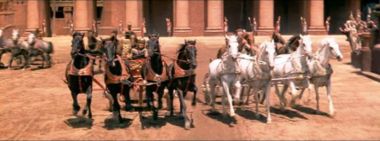 Charlton Heston, who died this morning at age 84, had the screen presence for larger than life, heroic roles, and often appeared in films with religious themes. He will be best remembered for his Oscar-winning performance as
  and for appearing as Moses in
  . He also played John the Baptist in
  . Heston created audio recordings of
  and provided voice talent for a series of animated Bible stories for children.
  as a policeman who lives on the border, literally and metaphorically, and in a rare romantic comedy, “The Private War of Major Benson.” Whether he was leading a circus (
 ) or a stranded team of astronauts (
 ) or even trying to survive as the last man on earth (
 ), his conviction and commitment made him the essence of a movie star.