


What kind of movie do you feel like?

Ask Movie Mom

Find the Perfect Movie

Little Lord Fauntleroy

Posted on December 13, 2002 at 5:18 am

B+
Lowest Recommended Age: Kindergarten - 3rd Grade
Profanity: None
Nudity/ Sex: None
Alcohol/ Drugs: None
Violence/ Scariness: None
Diversity Issues: Class Issues
Date Released to Theaters: 1936

Plot: Cedric (Freddie Bartholomew), who lives in New York with his widowed mother, finds out that he is the grandson of a British earl, and is to go to England to live in his castle. After marrying an American, Cedric’s father was estranged from the Earl, but now that both of the Earl’s sons have died, Cedric is the only heir. He says goodbye to his best friends, Mr. Hobbs (Guy Kibbee) and Dick (Mickey Rooney), and leaves for England, not knowing that the Earl has forbidden his mother to set foot in the castle.

The Earl is a rigid and somewhat pompous man, but, encouraged by his mother, Cedric sees everything the Earl does as wonderfully generous and kind. The old man is utterly charmed by Cedric, as are all who meet him, and he tries to live up to Cedric’s image of him. They grow to love each other. There is a crisis when they are told that the Earl’s older son was married and had a son of his own before he died, and that boy is the rightful heir. With the help of Dick, they prove the new heir a fraud, the Earl realizes that Cedric’s mother is a fine woman, and they all live happily ever after.

Discussion: This is basically a male version of “Pollyanna.” Like Pollyanna, Cedric goes to live with a wealthy but crusty and snobbish relative, insists on seeing the best in everyone (even when it isn’t there), and wins the hearts of all who know him. Not quite as sugary as its reputation, it may still put off kids who think Cedric is too perfect. But his colorful friends, his maturity under stress, and the fun of the idea of his being brought from poverty to an Earldom make it hold up surprisingly well.

Questions for Kids:
Maid in Manhattan

Posted on December 13, 2002 at 5:18 am

B
Lowest Recommended Age: Middle School
Profanity: Some vulgar language
Nudity/ Sex: Non-explicit sexual situation
Alcohol/ Drugs: Social drinking
Violence/ Scariness: None
Diversity Issues: A theme of the movie
Date Released to Theaters: 2002

Romantic comedies are so endlessly appealing both to those looking back on their own experience of falling in love and those looking forward to it that Hollywood keeps cranking them out. The elements seem so simple – the plucky but vulnerable heroine, the wisecracking best friend, the handsome hero all but dumbstruck by the heroine’s charm and beauty, the second act complication, and the happily-ever-after ending. Yet, like love itself, perhaps, it is a goal more often sought than obtained, and the key ingredient to make it work is impossible to define.

“Maid in Manhattan” is as careful a combination of ingredients as it is possible to package. Every aspect is a proven commodity designed to go to the heart of the core fantasies of a 13-year-old girl, and the end result is undeniably pleasing, if not particularly memorable.

It’s Cinderella in a hotel. Jennifer Lopez plays Marisa, a maid at a big luxury hotel in Manhattan. She has a darling son, an unreliable ex-husband, and a mother who tells her not to dream of more than she has. Cashmere-voiced Ralph Fiennes plays Chris, a Senate candidate who has no heart for the hypocrisy of the campaign. Marisa’s fairy godmother is her best friend who urges her to try on a fabulously expensive designer pantsuit about to be returned by a hotel guest. Chris sees her in the suit, thinks she is staying at the hotel instead of cleaning it up, and invites her out. Then there are forty minutes of various excruciating complications before Marisa has to tell the truth and Chris has to decide whether she really is the person he thinks – or wants to think – she is.

Marisa is an appealing heroine, beloved by her son and her co-workers, loyal, practical but optimistic. She dreams of being more but isn’t anything as icky as ambitious or confident or focused. Chris, too, dreams of more but isn’t craven, like his political advisor. Everything is at the fairy tale level, which means we never dwell on troubling realities like what, exactly, Chris hopes to achieve as a senator or how, exactly, Marisa gets a job after being fired for stealing. The best and worst you can say about the movie is that there are no surprises – no bad ones, but no good ones, either.

Parents should know that there is some crude humor (mostly from the wisecracking best friend) and brief strong language. Chris and Marisa have sex (off camera and no nudity). She apparently intends for it to be a one-night stand, an issue parents will want to discuss. The movie does make it clear that stealing and lying are always wrong and have severe consequences.

Families who see this movie should talk about how – and why — Marisa’s mother was an obstacle to pursuing her dreams. How is the end different from most movies of this kind? Why? How is this story like Cinderella and how is it different?

Families who enjoy this movie will also enjoy “Notting Hill” and “The Runaway Bride.” They might also enjoy some of the Depression-era comedies with similar themes, like “Easy Living” and “The Lady Eve.”

Martin Lawrence Live: Runteldat

Posted on December 13, 2002 at 5:18 am

C+
Lowest Recommended Age: Mature High Schooler
Profanity: Extremely strong language
Nudity/ Sex: Lots of sexual humor
Alcohol/ Drugs: Never encouraged, but a theme of his stand-up nonetheless
Violence/ Scariness: None
Diversity Issues: A theme of his stand-up
Date Released to Theaters: 2002

Martin Lawrence Live: Runteldat is a personal, autobiographical stand-up act from Martin Lawrence that should please his fans.

Runteldat is a live comedy concert that opens with reels of newsmen talking about Lawrence’s tumultuous last few years, including his arrest for disturbing the peace and his collapse and subsequent coma while jogging on the hottest day of the year. Lawrence gives a voiceover monologue about the struggles both in his life and on the job as a stand-up comedian and we see him backstage calmly preparing himself to deliver his act to an enthusiastic Washington DC audience. When he gets to the show, he gives his notoriously raunchy act and has his fans in stitches, but also finds time to take a comedic but responsible look at his life. By the end of the show, even those turned off by his dialogue will be impressed by what he’s learned.

Martin Lawrence is undeniably gifted, and always shines even when his material doesn’t. He’s better off here than in some of his recent movies, as he just gets a chance to make us laugh rather than having to worry about a plot. The movie title comes from his life being a topic for public discussion and speculation (“Guess what Martin just did, run n’ tell dat”) and he doesn’t hesitate to tell his side of the story. His language, as well as his takes on sex and race, are filthier than all four comics in The Original Kings of Comedy but he’s always likeable and relatively unegotistical, making this film a real treat for fans of stand-up comedy.

Parents should know that this film has more coarse language than anything else you are likely to see all year, and anyone who has been offended by his previous acts, from You So Crazy! to Def Comedy Jam should skip this one. He avoids being sexist or racist himself, and addresses both topics extensively. Interestingly, his only references to drugs and alcohol are commenting on what an ass he made of himself when he had too much of either.

Martin consistently brings up the theme of living life to its fullest. Families can discuss the risks and rewards of working as hard as Lawrence does (he talks about stand-up being one of the hardest things anyone can do) and getting as far as he has if that means embarrassing oneself with substance abuse and having his private life in the public eye.

Anyone who enjoys Martin Lawrence Live should check out the aforementioned stand-up concert films as well as Martin’s best, Bad Boys and Blue Streak.

Mary Poppins

Posted on December 13, 2002 at 5:18 am

A+
Lowest Recommended Age: Kindergarten - 3rd Grade
MPAA Rating: G
Profanity: None
Nudity/ Sex: None
Alcohol/ Drugs: None
Violence/ Scariness: None
Diversity Issues: The cause of votes for women is presented as unimportant, even daffy; subtext that parents should spend time with their children in
Date Released to Theaters: 1964
Date Released to DVD: December 09, 2013
Amazon.com ASIN: B00E9ZAT4Y

marypoppins5In honor of the upcoming “Saving Mr. Banks” and the 50th anniversary of the original film, Disney is releasing a superclifragilisticexplialidocious new edition of Mary Poppins.

Based on books by P.L. Travers (whose reluctance to allow a film to be made is the subject of “Saving Mr. Banks,” the film switches the 1930’s-era setting to the more picturesque London of 1910, where the Banks family has a loving, if rather chaotic, household. A nanny has just stormed out, fed up with the “incorrigible” children, Jane and Michael. Mr. Banks (David Tomlinson) writes an ad for a new nanny and the children compose their own, which he tears up and throws into the fireplace. The pieces fly up the chimney, where they reassemble for Mary Poppins (Julie Andrews), who is sitting on a cloud. The next day, a great wind blows away all of the nannies waiting to be interviewed, as Mary floats down.

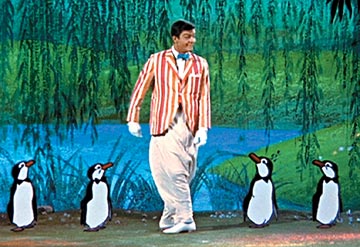
Somehow, she has a mended copy of the qualifications written by the children that Mr. Banks tore up and threw into the fireplace.  To the children’s astonishment, she slides up the banister.Out of her magically capacious carpetbag she takes out a tape measure to determine the measure of the children (“stubborn and suspicious” and “prone to giggling and not tidying up”) and her own (“practically perfect in every way”).  She directs them to clean up the nursery, and shows them how to make it into a game (“A Spoonful of Sugar Helps the Medicine Go Down”). Once it is clean, they go out for a walk, and they meet Mary Poppins’ friend Bert (Dick Van Dyke) drawing chalk pictures on the sidewalk. They hop into the picture and have a lovely time, or, rather, a “Jolly Holiday” in a mixture of live-action and animation that has Bert dancing with carousel horses and penguins.

Mary-Poppins-RooftopMary takes the children ato see her Uncle Arthur (Ed Wynn), who floats up to the ceiling when he laughs, and they find this delightfully buoyant condition is catching. Later, Mr. Banks takes the children to the bank where he works, and Michael embarasses him by refusing to deposit his tuppence because he wants to use it to buy crumbs to feed the birds. There is a misunderstanding, and this starts a run on the bank, with everyone taking out their money. Mr. Banks is fired.

Mr. Banks realizes that he has been too rigid and demanding. He invites the children to fly a kite with him. Mrs. Banks realizes that in working for the vote for women, she had neglected the children. Her work done, Mary Poppins says goodbye, and floats away.

This sumptuous production deserved its many awards (including Oscars for Andrews and for “Chim Chimeree” as best song) and its enormous box office. It is fresh and imaginative, and the performances are outstanding. (Watch the credits carefully to see that Van Dyke also plays the rubber-limbed Mr. Dawes.) The “jolly holiday” sequence, featuring the live-action characters interacting with animated ones, is superb, especially Van Dyke’s dance with the penguin waiters.

The resolution may grate a bit for today’s families with two working parents, but the real lesson is that parents should take time to enjoy their children, not that they should forego all other interests and responsibilities to spend all of their time with them.

Family discussion:  If you were writing a job notice for a nanny, what would it include?  Which of the children’s adventures did you most enjoy and why?

If you like this, try: books by P.L. Travers and the documentary about this film’s Oscar-winning song-writers, The Boys: The Sherman Brothers’ Story. And go fly a kite!

Men in Black II

Posted on December 13, 2002 at 5:18 am

C+
Lowest Recommended Age: Middle School
Profanity: Some strong language
Nudity/ Sex: Some vulgar humor
Alcohol/ Drugs: None
Violence/ Scariness: Comic book-style peril, sometimes intense, scary creatures
Diversity Issues: Diverse characters are strong, brave, and smart
Date Released to Theaters: 2002

The original Men in Black (1997) is one of my all-time favorite movies, just for originality and sheer attitude. Director Barry Sonnenfeld, production designer Bo Welch, and stars Tommy Lee Jones, Will Smith, Linda Fiorentino, and Vincent D’Onofrio achieved near perfection with a tone that was just off-center and the essence of cool. The story and special effects were perfectly satisfying, but the movie was all about throwaway lines like “Now I’m going to have to buy the white album again” and “We’re not hosting an intergalactic kegger down here.” I highly recommend the DVD, which has one of the best packages of extras I have ever seen, especially the commentary from Jones and Sonnenfeld.

The sequel has flickers of the original spirit, but it is like a fifth generation photocopy, a blurry reproduction rather than a re-imagined original.

Sonnenfeld, Welch, Jones, and Smith return, along with MiB1’s Rip Torn and Tony Shaloub, but the movie squanders our pleasure at seeing favorite characters return and then makes things worse when the additions and new characters are not up to their level. Worst of all, the underlying story line is lackluster, with plot holes and a brief running time that suggest that we may get a lot of deleted scenes on the DVD.

At the end of MiB1, agent J (Smith) erases the memories of his partner, K (Jones), so that he can return to a normal life. But as MiB2 begins, a scary-looking alien (disguised, of course, as a Victoria’s Secret model and played by Lara Flynn Boyle) returns to earth and only K knows how to deal with her. J has to track K down (he works for a post office in Massachusetts), un-erase his memory, and work with him to save the planet from the scum of the universe.

Along the way, they meet up with a variety of characters, both alien (a subway-swallowing serpentish thing named Jeff and the cutest little furry guys since Dr. Seuss) and human (the very lovely Rosario Dawson). The talking dog and smart-alecky worm guys from MiB1 are back with more screen time as well.

Parents should know that the PG-13 rating is for intense peril, graphic violence (comic-book-style), some gross-out special effects, and some vulgar humor, including a sight gag about kneeing an alien’s most vulnerable spot. Some viewers will find the resolution of the story unsettling.

Families who see this movie should talk about what they think creatures from other planets might be like, and why the way we think about them tells us more about us than it does about them. Why doesn’t J want to erase Rita’s memory? Why is it important to find someone you can tell your real feelings to?

Families who enjoy this movie will enjoy the original and director Sonnenfeld’s Addams Family Values.