

What kind of movie do you feel like?

Ask Movie Mom

Find the Perfect Movie

Shallow Hal

Posted on December 13, 2002 at 5:17 am

C+
Lowest Recommended Age: Mature High Schooler
Profanity: Very strong language for a PG-13
Nudity/ Sex: Sexual references and situations
Alcohol/ Drugs: Drinking and smoking
Violence/ Scariness: None
Diversity Issues: A theme of the movie
Date Released to Theaters: 2001

The Farrelly Brothers, known for shattering the good taste barrier with gross-out comedies like “There’s Something About Mary” and “Dumb and Dumber” have taken a couple of giant, if uncertain, steps toward the mainstream with a fairly conventional romantic comedy. It even has an undeniably sweet moral. If you’ve ever seen one of their movies, you know that “moral” is not the first word that comes to mind, unless you could say that the moral of “There’s Something About Mary” is that guys should be very careful when they zip up their pants and girls should watch what they put in their hair. But here the moral is that true beauty is seen with the heart, not the eyes (short pause for everyone to say, “Awwwwwww”).

Hal (Jack Black) and his best friend Mauricio (Seinfeld’s Jason Alexander) are two pudgy guys who insist on women with absolute physical perfection. We see why Hal feels that way in a brief prologue from his childhood. His dying father, a minister, tells him that the one thing for him to remember is that “hot young tail is what it’s all about” and he should “never settle for average.” Even though Hal grows up to be a pretty nice guy who is good at his job, when it comes to women, he is undeniably shallow.

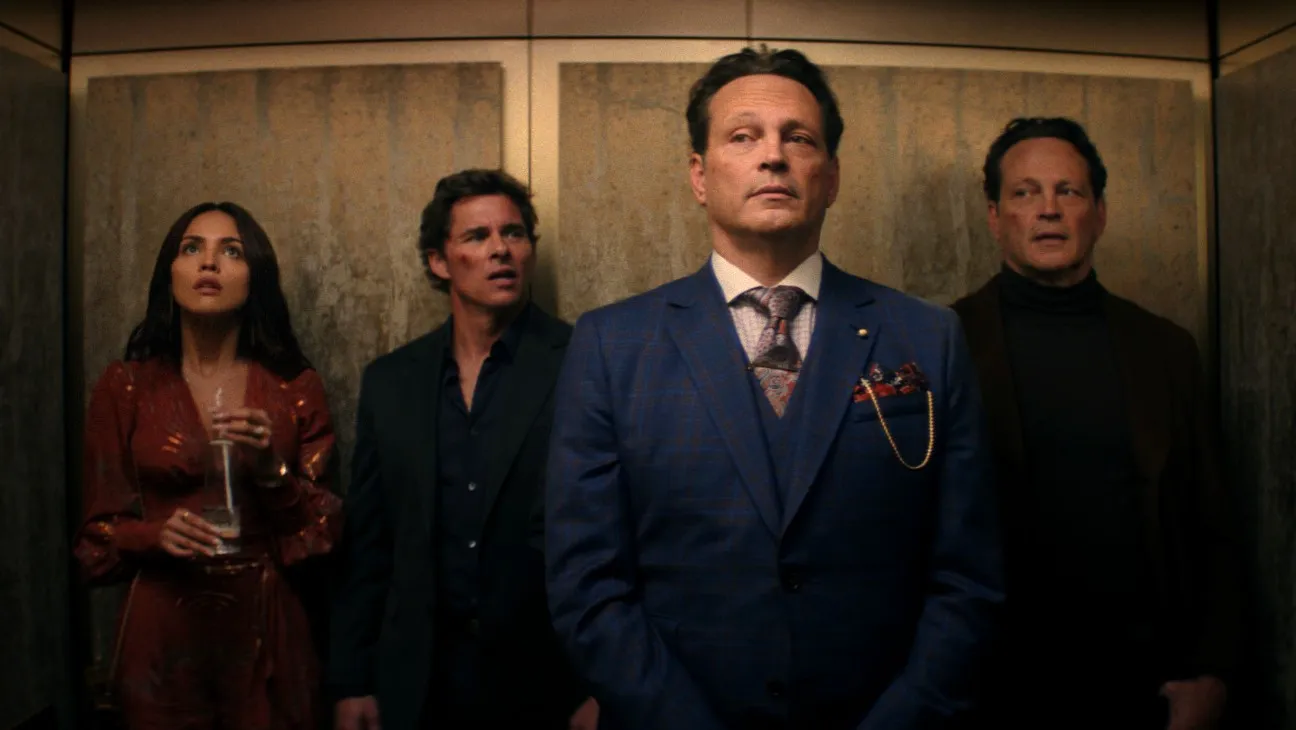
Then he and infomercial star Anthony Robbins (playing himself) get stuck in an elevator together, and Robbins gives Hal a gift — from now on, Hal will see people the way they are, not the way they look. Suddenly, all around him are gorgeous girls who are very interested in him. They’re interested in him because he thinks they are beautiful, and he thinks they are beautiful because they are kind, generous, beautiful people. Mauricio is horrified, especially when Hal falls for Rosemary (Gwyneth Paltrow), who volunteers at the local hospital and works for the Peace Corps. Mauricio looks at her and sees a hugely obese woman. Hal looks at her and sees — Gwyneth Paltrow.

Black is one of my favorite comic performers. His performance was the best part of “High Fidelity” and he made “Saving Silverman” almost worthwhile. His speciality is a sort of frenzied but charming energy, and unfortunately, this movie does not give him much opportunity to show it off. Paltrow has some nice moments as Rosemary. She makes us see the vulnerability of a woman who has felt humiliatingly invisible all her life. But one problem with the movie is that instead of the characters themselves being funny, the jokes in the movie happen around them. A bigger problem is that almost all of the jokes are in the commercial and coming attraction. Black and Paltrow do the best they can, but there just is not enough comic energy at the core of the movie.

Some Farelly trademarks make it into the movie, including a disabled character (athlete Rene Kirby, who has spina bifida) and a bizarre physical aberration. But overall, it seems as though it is something of a transitional film for the Farrellys, enjoyable on its own and as a suggestion of better things to come.

Parents should know that the movie has very strong language for a PG-13, especially the sexual references. Characters drink, and several scenes are set at a bar/nightclub. The overall theme of the movie is the importance of judging people based on their behavior, not their looks. Robbins explains that Black is not hypnotized now — he was hypnotized before, when he thought that all of the television and movie images of beauty were what mattered. Some viewers may feel that the movie itself makes fun of people who do not fit current standards of beauty. A disabled character is treated with complete naturalness — he is by no means perfect (because he gets around on all fourts, he tells girls he recognizes them by their panties), but he is good-hearted and respected.

Families who see this movie should talk about what we look at and what we look for when we meet people. If we saw the way Hal does, who would be the most beautiful person you know? How would you look? Would you like to see people the way Hal does?

Families who enjoy this movie will also enjoy Outside Providence based on a book by Peter Farrelly.

Shanghai Noon

Posted on December 13, 2002 at 5:17 am

C+
Lowest Recommended Age: Mature High Schooler
Profanity: Some strong language
Nudity/ Sex: Scenes in a brothel, sexual situations
Alcohol/ Drugs: Drinking and drug use
Violence/ Scariness: Comic violence, characters in peril
Diversity Issues: A theme of the movie
Date Released to Theaters: 2000

Jackie Chan has his best American movie role so far as Chon Wang, an imperial guard sent from China’s Forbidden City to Colorado’s Carson City to rescue a kidnapped Princess (Lucy Liu) in the old West of 1881. Along the way he meets Roy (Owen Wilson) a smooth-talking robber and con man, and they have various adventures that provide many opportunities for humor and many, many opportunities for fight scenes that show off Chan’s trademark fast, flashy, and funny footwork.

In classic buddy movie fashion, Roy and Chon begin as antagonists, and it takes them a while (and Roy’s finding out that there is gold involved) to figure out that they are on the same side. Chan and Wilson have a nice rapport and Wilson’s easy-going surfer style works very well with Chan’s more reserved approach. Liu is elegant and beautiful at home in the palace, spirited and honorable when she finds out that she has been kidnapped and that Chinese people are being used for slave labor. And of course the fight scenes are sensational, as Chan uses anything he can get his hands and feet on to help him vanquish all the bad guys.

A lot of younger kids will want to see this movie. Parents should know that the movie has some bad language, potty humor, scenes in a brothel, and drinking and drug use (portrayed humorously, including a prolonged drinking game and a drunken horse). The racism of the era is touched on. Chong is thrown out of a bar and he is very hurt when he overhears Roy agree with an anti-Chinese comment. The prostitutes are portrayed stereotypically, but the leading women in the movie are brave, smart, capable, and loyal.

Families who see this movie should talk about how Roy and Chong learn to trust each other and work together, how Chong uses quick thinking (and a good knowledge of basic physics) to use whatever he can find to help him fight the bad guys, and how people from many different cultures reacted to life in America. Families who enjoy this movie will enjoy Chan’s other films, especially “Mr. Nice Guy” and “Rumble in the Bronx.”

Showtime

Posted on December 13, 2002 at 5:17 am

B+
Lowest Recommended Age: Mature High Schooler
Profanity: Very strong language
Nudity/ Sex: Comic sexual references
Alcohol/ Drugs: Drug dealers, smoking, drinking
Violence/ Scariness: Characters in peril, often comic but sometimes serious, characters killed
Diversity Issues: A theme of the movie
Date Released to Theaters: 2002

Who imagined that one of the best comic actors of the 21st century would be…Robert DeNiro? The brilliant timing and utter fearlessness when it comes to looking goofy that DeNiro showed in “Analyze This” and “Meet the Parents” gets kicked up a notch higher for inspired silliness in this knowing but affectionate parody of buddy cop films.

DeNiro plays Mitch, a (what else) tough, seen-it-all police detective who just wants to everyone to stay out his way so he can do his job. Eddie Murphy is Trey, a cop who wants to be an actor. Both end up in a new “reality TV” series produced by Chase (Rene Russo) called “Showtime.” As Mitch and Trey try to track down a gun dealer, cameras and a satellite uplink follow them everywhere they go.

The movie tries to have it both ways but succeeds best as satire, with some very funny digs at cop shows, reality and otherwise. William Shatner contributes a hilarious performance that plays with his own image as the former star of “T. J. Hooker,” now directing Mitch and Trey in such time-honored TV cop essentials as jumping on the hood of a car and raising one eyebrow very slightly to indicate that an important statement is about to be made. Johnny Cochran makes a brief but very funny appearance, showing that he is a far better performer than the guy who parodied him on “Seinfeld.” Chase and her assistant redecorate Mitch’s office and apartment to respond to research reports about what viewers like to see, and their matter-of-factness about their notion of “reality” plays off of DeNiro beautifully.

The movie’s action plotline is less effective, requiring even more suspension of disbelief than usual. Despite protestations from Mitch that real cops are nothing like those on television, he ends up behaving like a TV cop, throwing punches and mistreating a suspect. That seems out of character for both Mitch and the movie.

Parents should know that the movie has a lot of action violence, including a special highly destructive gun that can blow up a car or knock down a house. Characters are killed (offscreen). Characters deal in drugs and illegal weapons. The police violate police procedure and abuse the rights of suspects and prisoners, manipulating one into talking without his lawyer present and getting into a fistfight with others. Characters use strong language, including comic sexual references.

Families who see this movie should talk about whether “reality television” is an oxymoron. Is it possible to put “reality” on television? How do TV cops differ from real ones?

Families who enjoy this movie will also enjoy Eddie Murphy in two action-comedy classics, “48 Hours” and “Beverly Hills Cop” as well as a popular buddy cop series “Lethal Weapon” and its sequels. Those who are interested in seeing more about what happens when cameras follow people around should watch DeNiro in “15 Minutes” (very violent) and the comedy “EdTV.”

Shrek

Posted on December 13, 2002 at 5:17 am

A+
Lowest Recommended Age: Kindergarten - 3rd Grade
Profanity: Strong language for a PG movie, potty humor
Nudity/ Sex: Mild sexual humor
Alcohol/ Drugs: None
Violence/ Scariness: Characters in peril, scary fire-breathing dragon, no one hurt
Diversity Issues: Tolerance of individual differences
Date Released to Theaters: 2001

It has an enchanted princess in a tower, guarded by a fire-breathing dragon. It has a big, green ogre with a Yiddish name. It has a donkey that not only talks, and not only sings, but sings the old Monkee’s song, “I’m a Believer.” It has an evil (but short) bad guy, kickboxing, a Robin Hood and Merry Men who perform an Irish Riverdance, potty humor, and some digs at Disney. And it has sensational animation, adventure, romance, and laughter – enough to make this one of the best movies of the year.

Shrek is a big, green ogre who lives happily alone in a swamp. But Lord Farquaad of nearby Dulac has a plan for creating the perfect kingdom, and that means getting rid of all of the fairy tale characters and sending them to “a designated resettlement community.” Soon, the three blind mice, the three little pigs, the gingerbread man, all the broom-flying witches, Pinocchio, and a talking donkey are all relocated to the swamp. Shrek is furious at the intrusion. He makes a deal with Farquaad, who needs to marry a princess to put the final touch on his kingdom. Shrek will rescue Princess Fiona and bring her to Farquaad, and Farquaad will give Shrek his swamp back.

The movie is a marvelous fairy tale, with a thrilling quest and a happily ever after ending. It has the great themes of enduring myths, about believing in yourself, being loved for the person you really are, and good triumphing over evil. It is also a delicious satire, tweaking all of our assumptions about ogres, princesses, rescues, and even fire-breathing dragons. The voice talents of Michael Myers (as the Scottish-burred Shrek), Eddie Murphy (as the talking donkey), Cameron Diaz (as Princess Fiona), and John Lithgow (as Farquaad) are all perfect. The computer animation is breathtaking, like nothing ever done before. The textures are stunning. The glass, fire, clouds, and water seem three-dimensional, and you will feel that the donkey’s fur almost brushes your hand. The animation has wonderful warmth and depth, but it also has a great deal of character and wit. The facial expressions and body language are such a treat that the audience can’t help thinking that if ogres and donkeys and don’t really look like that, they should.

Parents should know that this movie is rated PG, but it is right up at the limit of PG-13, with edgy humor directed at teenagers and adults. It is a shame that Hollywood finds it necessary to include this material in a movie that would be otherwise perfect family fare, but that is the economic reality of this era of moviemaking. You can’t have a major hit without selling tickets to teenagers, and teenagers will not go without some jokes worth sniggering at. They will be over the heads of most younger children, but parents should be ready for some questions. Parents should also know that it has some potty humor and some gross-out jokes. There are also some scary scenes with characters in peril, and some fighting. A bird explodes and its eggs are eaten, and a character loses a leg, but very few others get seriously hurt.

Families who see this movie should talk about the donkey’s statement that Shrek has “that kind of ‘I don’t care what nobody thinks of me’ thing.” Is it true that Shrek did not care what people thought of him? How can you tell? What did it mean to say that ogres are like onions? What does it mean to say that people have layers? Who in the movie is judged on his or her looks? By themselves or by others? Why does Shrek yell at the donkey when he is really angry about something else? Do you agree that “friends forgive each other?” Can you look up into the stars and see stories?

Families who enjoy this movie will also enjoy “Ladyhawke” and “The Princess Bride.” Families with younger children will enjoy some of the books by William Steig, who wrote this story. My favorites include Sylvester and the Magic Pebble and Brave Irene.

Singin’ in the Rain

Posted on December 13, 2002 at 5:17 am

A+
Lowest Recommended Age: Kindergarten - 3rd Grade
MPAA Rating: G
Profanity: None
Nudity/ Sex: None
Alcohol/ Drugs: None
Violence/ Scariness: None
Diversity Issues: None
Date Released to Theaters: 1952
Date Released to DVD: July 16, 2012
Amazon.com ASIN: B0087YYHZU

The 60th anniversary of one of the best-loved movies of all time is being celebrated with gorgeous new DVD and Blu-Ray releases.

Silent movie star Don Lockwood (Gene Kelly) is paired on screen with Lina Lamont (Jean Hagan), who would like to be paired with him offscreen as well. But Lina’s personality is as grating as her squeaky, nasal voice. She is mean, selfish, arrogant, and stupid. Chased by fans following the opening of their latest movie, Don jumps into the car of Kathy Seldon (Debbie Reynolds), who tells him she is a serious actress, and not at all interested in the movies. But later, at a party celebrating the new movie, Kathy appears again, jumping out of a cake. Don teases her about her “art” and she throws a pie at him, getting Lina right in the face by mistake. Lina, furious, has Kathy fired.

At the party, the guests are treated to an exhibition of the latest technology, “talking pictures.” Everyone present dismisses it as a novelty. But when “The Jazz Singer” becomes a hit, everyone in Hollywood begins to make talkies. Production is halted on the latest Lockwood/Lamont movie, “The Dueling Cavalier,” while the stars are coached in vocal technique (with a delightful song mocking the exercises, “Moses Supposes”). But the movie is a disaster. Test audiences jeer and laugh.

Meanwhile, Don and Kathy have fallen in love. After an all-night session, Don, Kathy, and Don’s best friend, Cosmo (Donald O’Connor), come up with an idea. They can make it into a musical, “The Dancing Cavalier,” dubbing Kathy’s voice for Lina’s. Don resists at first, because it is unfair to Kathy. But they persuade him that it will just be this one time, and he goes along.

With Kathy’s voice and some musical numbers, the movie is a success. Lina insists that Kathy continue to dub all her movies, and, when the audience insists on hearing her sing, Lina forces Kathy to stand back stage so she can perform. But Don, Cosmo, and the beleagered studio head reveal the secret, and Don introduces Kathy to the audience as the real star of the movie.

Discussion: This is often considered the finest musical of all time. Certainly it has it all, classic musical numbers and a witty script, unusually sharp and satiric for a musical comedy, especially one making fun of the industry that produced it. Asked to name the top ten moments in the history of movies, most people would include the title number from this movie, in which Gene Kelly splashes and sings the rain with what Roger Ebert called “saturated ecstasy.” When he swings the umbrella around and around and dances on and off the curb, his “glorious feeling” is contagious. Only in a movie containing that sequence would Donald O’Connor’s sensational “Make ‘Em Laugh” number be mentioned second. It is a wildly funny pastiche of every possible slapstick gag, done with energy and skill so meticulous that it appears it is entirely spontaneous.

Screenwriters Betty Comden and Adoph Green, asked to use some of the classic songs by Arthur Freed (later producer of most of the great MGM musicals) and Nacio Herb Brown, decided to set the movie in the era in which they first appeared, the early talkies. This gave them a chance to use some of the Hollywood folklore of that era, when careers like John Gilbert’s were destroyed overnight, as audiences found out that their voices didn’t match their faces. One especially funny scene has the technicians trying to find a way to record Lina’s dialogue. When they put the microphone on her dress, all you hear is the sound of her pearls as she rubs them. When they put it lower down, you hear her heartbeat. When they put it near her, her voice fades in and out as she tosses her head. Note that the cameras are put inside huge boxes — that is authentic, as the cameras of that era were so loud that they had to be encased to prevent their own whirring from being recorded.

Don and Cosmo are consummate adaptors. As we see in flashback, they have already switched from vaudeville to movies, and then Cosmo from performer to accompanist (to musical director) and Don from stunt man to leading man. Lina resists change and tries to bully her way out of it, but Don, Cosmo, and Kathy all demonstrate resilience and openness to new ideas, and a willingness to be creative in solving problems.

Questions for Kids:

· Why does Kathy at first lie about liking the movies?

· Why does Don lie about his background? How is that different from the way that Lina behaves?

· Have there been any new inventions that you have seen that have changed people’s jobs a lot?

· What inventions do you use that your parents didn’t have when they were children? Your grandparents?

Connections: The transition from silent movies to talkies was also lampooned in the first play by George S. Kaufman and Moss Hart, “Once in a Lifetime.” A silent star who has become deranged is the centerpiece of “Sunset Boulevard.” When told “You used to be big in pictures,” she says, “I’m still big — it’s the pictures that got small.” She also says, memorably, that in her day stars didn’t need to talk: “We had faces then!”

Activities: Children might like to see some of the early silent movies to get an idea of what Hollywood was like in the days depicted in this movie. The films of Charlie Chaplin, Laurel and Hardy, Buster Keaton and Harold Lloyd are still wonderful, and kids will enjoy learning that a story can be told without words.