
What kind of movie do you feel like?

Ask Movie Mom

Find the Perfect Movie

The Flintstones in Viva Rock Vegas

Posted on December 13, 2002 at 5:17 am

C+
Lowest Recommended Age: Preschool
Profanity: A couple of mild naughty words and some potty humor
Nudity/ Sex: Very mild
Alcohol/ Drugs: Social drinking
Violence/ Scariness: Cartoon-style pratfalls, pie in the face
Diversity Issues: Class issues
Date Released to Theaters: 2000

First things first — it is better than the original, famously troubled 1994 version that sank under the weight of too many screenwriters (reportedly over 30) and too many commercial tie-ins. This prequel benefits from lower expectations (it was originally intended as a straight-to-video release) and improved technology (the CGI dinosaurs are terrific). Okay, it begins with a fart joke (the guilty party — a dinosaur — says, “Hey, I got three stomachs, cut me some slack!”). And the rest of the humor is only slightly more elevated. And some of its jokes are older than the Stone Age. But it is not too bad, there are even a couple of genuinely funny moments, and it can provide for a moderately enjoyable family outing or a first-class birthday party for anyone in the 5-8-year-old range. The kids at the screening I attended cheered and applauded.

Mark Addy (from “The Full Monty”) and Stephen Baldwin (from “The Usual Suspects”) play Fred and Barney as though they are really enjoying it. The wonderfully talented Kristen Johnston (“Third Rock from the Sun”) is sadly underused as Wilma, but she looks sensational in her “Isaac Miz- rock-hi” animal skins. Wilma is the pampered daughter of the snobbish Pearl Slaghoople (Joan Collins in sort of prehistoric “Dynasty” mode) and the loving but addled Colonel (Harvey Korman). She has no interest in a life of country clubs and snobs. She runs away and is befriended by waitress Betty O’Shale (Jane Krakowski of “Ally McBeal”). They meet Fred and Barney and all goes well until Chip Rockefeller (“Dharma & Greg’s” Thomas Gibson), who is after Wilma’s fortune, invites them to his new resort in Rock Vegas. But all ends well, and we even get to see the origins of Wilma’s upswept hairstyle and pearls.

The highlight of the movie is Alan Cummings. He plays both Gazoo, the space alien who comes to earth to observe human mating rituals, and Mick Jagged, the (what else) rock star, frontman for (what else) the Stones. It’s a real pity that he plays only two roles – the movie fades whenever he is off screen. In the soundtrack’s highlight, Ann-Margret simultaneously salutes two of her career highlights — the original Flintstones cartoon (as “Ann Margrock”) and “Viva Las Vegas” with a terrific rendition of “Viva Rock Vegas.”

Parents should know that there are a few naughty words and mild sexual references (one afternoon Betty tells Barney that she wants to come back to his apartment and make him breakfast, and he wonders what she wants to do until morning), and some pie-in-the-face/pratfall cartoon violence.

Families who see this movie should discuss why Wilma feels unsatisfied despite her wealth, why Fred feels that he has to make a lot of money to compete with Chip, and how Betty and Barney create trouble by jumping to conclusions instead of telling each other about what worries them. Parents will also want to talk about Betty’s decision to go off with Mick when she thinks Barney has been unfaithful. Whether it is out of spite or a way to bolster her spirits, it is a foolish response.

Families who enjoy this movie will enjoy the old Flintstones and Jetsons cartoons, and may even get a kick out of looking for the similarities between them.
The Gift

Posted on December 13, 2002 at 5:17 am

B+
Lowest Recommended Age: Mature High Schooler
Profanity: Very strong language
Nudity/ Sex: Nude corpse, sexual references, including sexual abuse of a child
Alcohol/ Drugs: Characters drink and smoke
Violence/ Scariness: Very scary with graphic, gruesome images, peril, murder
Diversity Issues: Character makes racist and anti-Semitic comments
Date Released to Theaters: 2000

Cate Blanchett plays Annie Wilson, a widow from rural Georgia who has the gift of second sight. She supports her three sons by doing readings with cards, so she hears a lot of problems and secrets. Her clients include Valerie Barksdale (Hilary Swank), a battered wife and Buddy Cole (Giovanni Ribisi), a troubled garage mechanic.

The local belle, Jessica King (Katie Holmes), disappears, and her father, her fiancé, and the police come to Annie to ask if she can help them find her. Annie sees nothing at first, but later she is able to lead them to a pond on the property of Valerie’s abusive husband, Donnie (Keanu Reeves). Annie’s testimony helps to convict Donnie, but then she begins to get visions that lead her to believe that Donnie was not the killer.

Director Sam Raimi is a master of horror and suspense. He knows how to make the bayou trees hang down ominously and the heavy mist and mournful violins prickle the hairs on the back of your neck. This is one of those movies where someone hears a funny noise inside the house and goes in to investigate, where someone agrees to go to a deserted pond on a rainy night, where a child asks, “Is everything going to be all right now?” and is reassured that it is, despite the fact that there is still about half an hour to go in the movie and it’s pretty clear that it isn’t going to be spent showing how relieved and happy everyone is to have it all over.

The plot is a little predictable, but first-class atmosphere and performances make it a superior entry in the horror genre. Cate Blanchett is quietly moving and completely convincing as a woman who is at times more at home with her second sight than with her first. Giovanni Ribisi gives great depth and humanity to the part of the troubled mechanic who sees Annie as his only friend. Keanu Reeves struggles to appear menacing, but manages to do better when he has to testify in the murder case. Katie Holmes shows her ability to create a complete character with the toss of her hair as the glossy Veronica to Annie’s Betty.

Parents should know that the movie is very scary, with a lot of tense moments, characters in peril, jump-out-at-you surprises and fake-out twists and turns. There is a nude dead body, a battered wife, an an inexplicit scene of characters having sex, and a reference to child sexual abuse. A character is doused with gasoline and then lit. The movie has very strong language, including a racist and anti-Semitic comment.

Families who see the movie should talk about why people go to see Annie. It seems that they care more about being listened to and heard than about hearing what she has to say. Why are Valerie and Buddy unable to help themselves? What are their options? Annie faces a moral dilemma when she realizes that Donnie is not the murderer. How does she handle it? Should she have warned Jessica about what she saw with her ESP? Should she have warned Wayne about what she saw at the country club? Annie tells others that they should face up to their problems, yet she has a hard time talking to her children about her late husband. How does that change?

Families who enjoy this movie will also enjoy “The Sixth Sense” and “Don’t Look Now.”

The Grapes of Wrath

Posted on December 13, 2002 at 5:17 am

A+
Lowest Recommended Age: Middle School
Profanity: None
Nudity/ Sex: None
Alcohol/ Drugs: None
Violence/ Scariness: Fighting and shooting
Diversity Issues: Class issues
Date Released to Theaters: 1940

Plot: The classic John Steinbeck novel about dust-bowl farmers emigrating from Oklahoma to California became a classic film with Henry Fonda as Tom Joad and Jane Darwell (in an Oscar-winning performance) as his mother. Tom returns home after serving time in prison for manslaughter to find that his share-cropper family is preparing to leave. They have lost the right to farm the land, so they are setting off to find jobs in California. Ma takes one last moment in their shack of a home, holding her earrings up to her ears, and then all twelve of them pile into the truck, including Casey, a former minister. On the way, their grandfather dies, and they bury him themselves. The grandmother dies, too, but Ma holds on to her and does not tell anyone until they get to California. Thousands of migrants have arrived for the 800 available jobs. Exploited and even robbed by the bosses, the workers are so desperate that they will do anything for any wage. They are too frightened to organize and insist on better treatment.

The bosses have hired thugs who prevent anyone from objecting to their treatment. Tom kills one to protect the people he is shooting at and Casey takes the blame. Casey is killed, and Tom kills the assailant. Wanted by the authorities, Tom cannot stay with his family, which has now found a government-sponsored work camp with better conditions. He tells his mother farewell: “Well, maybe it’s like Casey says. Fella ain’t got a soul of his own. Just a little piece of a big soul. One big soul that belongs to everybody… I’ll be around in the dark— I’ll be everywhere. Wherever you can look—wherever there’s a fight, so hungry people can eat, I’ll be there. Wherever there’s a cop beating up a guy, I’ll be there. I’ll be there in the way guys yell when they’re mad. I’ll be there in the way kids laugh when they’re hungry, and they know supper’s ready, and when people are eatin’ the stuff they raised, and livin’ in the houses they built, I’ll be there, too.” After he leaves, Ma says, “Rich fellers come up. They die. Their kids ain’t no good and they die out. But we keep a-comin’. We’re the people that live. Can’t wipe us out. Can’t lick us. We’ll go on forever, ’cause we’re the people!”

Discussion: This brilliant film shows us a family of enormous dignity and commitment. Though Ma says that they are not “the kissin’ kind,” and they show little emotion (except for Ma’s delight in Tom’s return from prison) there is clearly a great deal of love in the family.

Questions for Kids:

· Director John Ford was famous for using the landscapes in his movies to help create the mood and tell the story. How did he do that here?

· Casey is often considered to be a Christ-like figure. What causes people to make that comparison?

· What do you think about Tom’s comment that we all have “a piece of a big soul”? About Ma’s comment that “the people will go on”?

· What is the life of migrant workers like today? To the extent that it has improved, what and who made it better?

Connections: John Ford won an Oscar as Best Director. Darwell can be glimpsed as “the bird lady” in “Mary Poppins.” Carradine is the father of actors Keith and Robert Carradine.

Activities: Teens should read the book by John Steinbeck. They may also appreciate his books Of Mice and Men and East of Eden, and the films based on them.

The Great Escape

Posted on December 13, 2002 at 5:17 am

A+
Lowest Recommended Age: Middle School
MPAA Rating: Not rated
Profanity: None
Nudity/ Sex: None
Alcohol/ Drugs: Some drinking, smoking
Violence/ Scariness: Very tense moments, characters in peril and many killed
Diversity Issues: People from a variety of backgrounds and countries work together toward a common goal
Date Released to Theaters: 1963
Date Released to DVD: May 7, 2013
Amazon.com ASIN: B00BN3DUVE

great escape

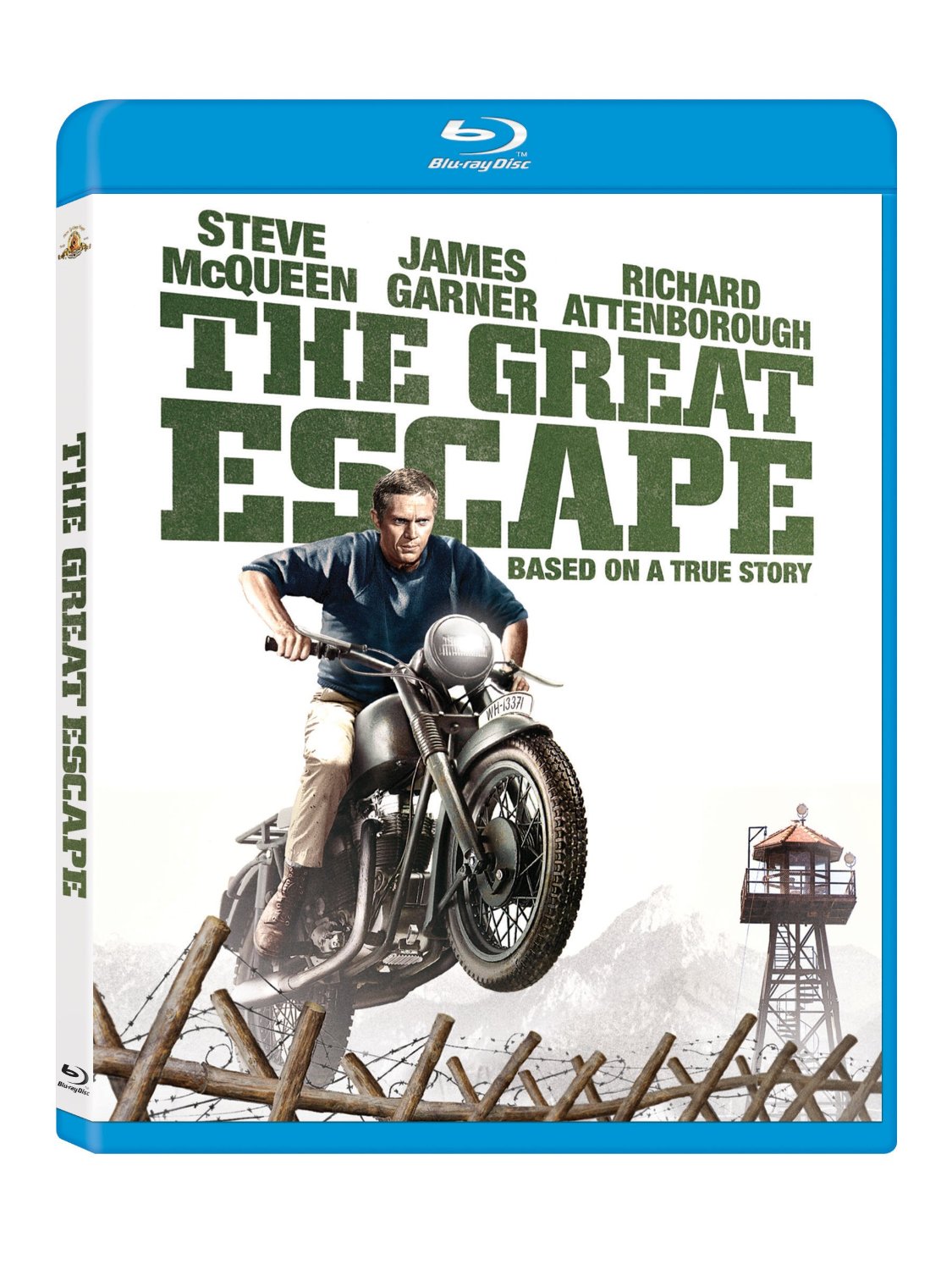
In honor of the Blu-Ray release of this classic film, it is the Pick of the Week – and I am delighted that I have one Blu-Ray to give away.  Send me an email at moviemom@moviemom.com with Escape in the subject line.  I will pick a winner at random on May 15.  Don’t forget your address!  (US addresses only.)

Towards the end of WWII, the Germans built a special high-security prison camp for Allied prisoners with a record of escape attempts. This is the true story of the extraordinary courage and ingenuity of the men imprisoned there, and of their plans for the greatest escape ever. As the British ranking officer explains, when the camp commandant urges him to relax and “sit out the war as comfortably as possible,” his duty is to escape, or, if escape is impossible, to force the enemy to use as many resources as possible to contain them.

Each man contributes his expertise. There are “tunnel kings” to dig the three tunnels, a “forger king” (Donald Pleasence) to forge the papers the soldiers will need when they escape, a “scrounger” (James Garner) to beg, borrow, steal, or obtain through blackmail the materials they need, and others who work as tailors and manufacturers. An American who is something of a loner, Hilts (Steve McQueen) becomes the “cooler king” for his long stints in solitary confinement, as a result of his independent escape attempts. When “Big X” (Richard Attenborough), the British officer who supervises the escape, asks Hilts to go through the tunnel to get information about the area surrounding the camp, and then allow himself to be recaptured, so he can let them know what he has found, he refuses. But when his friend is killed trying to escape, his spirit broken by the camp, Hilts changes his mind.

Seventy-five of the prisoners are able to escape before the tunnel is discovered. The Germans track almost all of them down, and fifty are killed, including Big X. It is to “the fifty” that the film is dedicated.

As in “Stalag 17” and many other films about prison camp, the prisoners in this story must adapt to the direst of circumstances, and they choose differing approaches. Hilts adapts by working on his own, or with one partner, while others work on a massive group escape. Ives and Danny begin to unravel under the stress, not so much a “choice” as an involuntary response.

Unlike other prison camp movies, this one does not dwell on disputes between prisoners or on the deprivations of the prison camp, which seems almost comfortable. It is about the professionalism, courage, resourcefulness, teamwork, and loyalty of every one of the prisoners.

As in a traditional “heist” film, the story focuses on defining a problem and then solving it. They examine the restrictions imposed by their conditions, change the ones they can, and adapt to the ones they cannot. They must also adapt quickly and calmly when the plan does not go as they expected.

The story gives us an exceptional example of teamwork and loyalty. Note the way that the prisoners protect each other. When Danny (Charles Bronson) cannot take it any more and wants to escape on his own, his friend talks him out of it. When the Forger goes blind, Big X wants to leave him behind, for his own protection. But the Scrounger promises to take care of him.

Point out to kids what factors do — and do not — go into the prisoners’ calculations and strategy. Big X is cautioned not to allow his personal wish for revenge determine their strategy. But pride (in the sense of morale) is permitted to be considered. When asked “Have you thought of what it might cost?” he answers, “I’ve thought of the humiliation if we just tamely submit — knuckle under and crawl.” They also consider the risk of failure, to the extent they can. At the end, when the Scrounger asks whether the escape was worth the price, the best the British Commander can do is answer truthfully, “It depends on your point of view.”

Note: The  screenplay was co-written by blockbuster novelist James Clavell (Tai-Pei, Shogun). His own experiences as a prisoner of war in a Japanese prison camp are the subject of “King Rat.” The outstanding musical score is by Elmer Bernstein (“The Magnificent Seven” and “To Kill a Mockingbird”). Richard Attenborough, who played Big X, became a director in the late 1960s of films such as “Gandhi” and “Shadowlands.” He continues to appear as a performer, and played Dr. Hammond in “Jurassic Park” and Kris Kringle in the 1994 version of “Miracle on 34th Street.”

Family discussion: Why are the experts called “kings”?  What makes Hilts change his mind about getting the information they want? Who was right about taking the Forger out through the tunnel, Big X or the Scrounger? Given the results of their action in this story, should officers who have been taken prisoner feel duty-bound to try to escape?

If you like this, try: “Stalag 17” and “King Rat”


The Great Race

Posted on December 13, 2002 at 5:17 am

B+
Lowest Recommended Age: Kindergarten - 3rd Grade
Profanity: None
Nudity/ Sex: Fate and Max speculate mildly about Leslie's relationship with DuBois
Alcohol/ Drugs: The prince has a drinking problem; Leslie frequently has champagne as evidence of his sophistication and elegance
Violence/ Scariness: Slapstick punches and, of course, the pie fight
Diversity Issues: The reporter played by Natalie Wood is something of a caricature of feminism, more committed to shocking people than to any thoughtful concept of equality. But she has an unquenchable spirit, she is courageous and resilient, and, of course she is Natalie
Date Released to Theaters: 1965

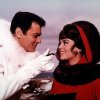
Dedicated to “Mr. Laurel and Mr. Hardy,” this movie is both a spoof and a loving tribute to the silent classics, with good guys, bad guys, romance, adventure, slapstick, music, wonderful antique cars, and the biggest pie fight in history. The opening credits are on a series of slides like those in the earliest movies, complete with cheers for the hero and boos for the villain, and a flickering old-fashioned projector that at one point appears to break down. Always dressed in impeccable white, the Great Leslie (Tony Curtis) is a good guy so good that his eyes and teeth literally twinkle. His capable mechanic and assistant is Hezekiah (Keenan Wynn). The bad guy is Professor Fate (Jack Lemmon), assisted by Max (Peter Falk). Like Wile E. Coyote, Fate’s cartoonishly hilarious stunts to stop Leslie inevitably backfire.

After a brief prologue, in which Fate tries to beat Leslie in breaking various speed records, literally trying to torpedo him at one point, they both enter an automobile race from New York to Paris. So does a beautiful reporter (Natalie Wood as Maggie DuBois) trying to prove she can get the story — dressed in an endless series of exquisite ensembles designed by Hollywood legend Edith Head. Great%20Race2.jpg

The race takes them across America, through the Wild West, to a rapidly melting ice floe in the Pacific, and into a European setting that is a cross between a Victor Herbert operetta and “The Prisoner of Zenda,” where a spoiled prince happens to look exactly like Professor Fate and it takes all of the stars to foil an evil Baron (Ross Martin) who wants to use Fate to take over the throne.