
What kind of movie do you feel like?

Ask Movie Mom

Find the Perfect Movie

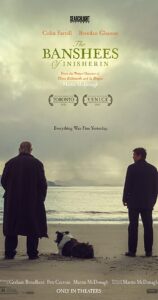
The Banshees of Inisherin

Posted on October 19, 2022 at 10:30 am

B +
Lowest Recommended Age: Adult
MPAA Rating: Rated R for language throughout, some violent content and brief graphic nudity
Profanity: Strong language
Nudity/ Sex: Brief male nudity, reference to child sexual abuse
Alcohol/ Drugs: Drinking and drunkenness
Violence/ Scariness: Domestic abuse including sexual abuse, suicide, graphic and disturbing self-mutilation, arson
Diversity Issues: None
Date Released to Theaters: October 7, 2022
Date Released to DVD: December 19, 2022

Copyright 2022 Searchlight
As The Banshees of Inisherin, the new film from Martin McDonagh, the writer/director of “In Bruges” and “Three Billboards Outside Ebbing, Missouri” begins, Pádraic (Colin Farrell) looks like a man who understands his life and is content with it. He nods companionably at people he passes, as he walks along the spectacularly beautiful path of (fictional) Inisherin Island, off the coast of Northern Ireland. He knows where he fits into the world, he knows everyone around him and the names of all their animals, and he knows what each day holds, tending to his cows and the little donkey named Jenny that is a beloved pet, stopping at the home of his best friend Colm Doherty (Brendan Gleason) every day at 2:00 pm to invite him to the pub for some drinks before he goes home to dinner made by his sister Siobhan (Kerry Condon).

If he thought about it, which he does not, because he does not think about much and takes comfort in not having to think about much, Pádraic would feel comforted by that familiarity and certainty. So, as this movie begins, Pádraic pets Colm’s dog, as usual, then invites him to the pub, as usual, it is deeply disturbing when Colm does not answer and even more disturbing when Colm does come to the pub but will not sit with him. Pádraic offers to apologize for anything he may have done to insult or upset Colm. But Colm shakes him to the core by saying he no longer likes Pádraic or wants to be friends with him.

Colm has been doing some thinking about life and has decided he no longer has time for chit-chat about meaningless topics. He wants to spend all of the time he has left creating something that will live on after he is gone. Pádraic is not able to understand this. he believes that meaningless chit-chat has value because it is kind; perhaps it is all that has value. When he refuses to let Colm alone, Colm makes a terrible promise. He will cut off a finger every time Pádraic tries to speak to him.

Gleason and Farrell, re-teamed with “In Bruges” writer/director McDonogh, give performances of deep complexity and authenticity. We can see them each, in his own way, struggling with his thoughts and emotions they find difficult to explain. Director of Photography Ben Davis places this small story of a small quarrel in the midst of spectacular beauty, with an evocative core from Carter Burwell. The characters occasionally refer casually to the far-distant sounds of gunfire from the battles of the Irish civil war and one mentions the payment and free lunch he will get from providing security at an upcoming hanging, though he does not remember which side the condemned men were on. They may give some thought to existential questions about the meaning of life, but when it comes to the affairs of the world, they seem to have no impact at all. The local shop proprietor insists on being paid in local gossip as well as money, the more lurid the better as long as it does not pertain to someone she cares about. But no one seems connected enough to try to respond to what is going on. Everyone knows that the local policeman constantly abuses his son (a heart-wrenching performance by Barry Keoghan as the damaged man). Other than offering him a night in their home — only one, Siobhan insists, no one intervenes.

There’s a sterility to the community. None of the main characters are married and we see almost no children. Siobhan is the only one who seems connected to the larger world, through a love of books the rest of the community considers mildly odd. And yet, in their own way, each of the characters is trying to find purpose. Neither Pádraic nor Colm is right. Kindness and art are both ways to find meaning. They may be wrong in considering them mutually exclusive. McDonagh pursues these questions here, as he did in “Three Billboards Outside Ebbing, Missouri” and “In Bruges,” with a unique combination of dark humor, shocking violence, and an invitation to the audience that is both heightened and very real.

Parents should know that this movie included graphic and very disturbing self-mutilation, sexual and violent abuse of an adult by his parent, suicide, off-screen (real-life) war violence, strong language, drinking and drunkenness

Family discussion: Who is right about what is important in life, Colm, Pádraic, or Siobhan? Why is the story set during the time of the Irish Civil War? Why are the characters in this story unmarried and childless?

If you like this, try: “In Bruges”
Halloween Movies for Families 2022

Posted on October 17, 2022 at 1:47 pm

Happy Halloween!

Halloween gives kids a thrilling opportunity to act out their dreams and pretend to be characters with great power. But it can also be scary and even overwhelming for the littlest trick-or-treaters. An introduction to the holiday with videos from trusted friends can help make them feel comfortable and excited about even the spookier aspects of the holiday.

Kids ages 3-5 will enjoy Barney’s Halloween Partywith a visit to the pumpkin farm, some ideas for Halloween party games and for making Halloween decorations at home, and some safety tips for trick-or-treating at night. They will also get a kick out of Richard Scarry’s The First Halloween Ever, which is Scarry, but not at all scary!

Curious George: A Halloween Boo Fest has the beloved little monkey investigating the Legend of “No Noggin.” Disney characters celebrate Halloween in Mickey Mouse Clubhouse – Mickey’s Treat.

Witches in Stitches is about witches who find it very funny when they turn their sister into a jack o’lantern. And speaking of jack o’lanterns, Spookley the Square Pumpkin, is sort of the Rudolph the Red-Nosed Reindeer of pumpkins. The round pumpkins make fun of him for being different until a big storm comes and his unusual shape turns out to have some benefits.

Kids from 7-11 will enjoy , A Babysitter’s Guide to Monster Hunting. It has gorgeously imagined settings, a great cast, and an exciting story that hits the exact sweet spot between funny-scary and scary-funny. Which means it is exciting and fun. “Muppets Haunted Mansion” combines all the Muppet favorites with one of the most popular attractions at the Disney theme parks.

Don’t forget the classic It’s the Great Pumpkin, Charlie Brown and the silly fun of What’s New Scooby-Doo: Halloween Boos and Clues. Try The Worst Witch movie and series, about a young witch in training who keeps getting everything wrong. School-age kids will also enjoy The Halloween Tree, an animated version of a story by science fiction author Ray Bradbury about four kids who are trying to save the life of their friend. Leonard Nimoy (Mr. Spock on the original “Star Trek”) provides the voice of the mysterious resident of a haunted house, who explains the origins of Halloween and challenges them to think about how they can help their sick friend. The loyalty and courage of the kids is very touching.

Debbie Reynolds plays a witch who takes her grandchildren on a Halloween adventure in the Disney Channel classic in Halloweentown.  Recent favorites include The House with a Clock in Its Walls, The Curse of Bridge Hollow, and Goosebumps.

Older children will appreciate The Witches, based on the popular book by Roald Dahl ((the original with Anjelica Huston, not the remake with Anne Hathaway) and Hocus Pocusand the new sequel, with children and teens battling three witches played by Bette Midler, Sarah Jessica Parker, and Kathy Najimy. And of course there is the deliciously ghoulish live-action double feature Addams Family and Addams Family Values based on the cartoons by Charles Addams. Episodes of the classic old television show are online and  there are now two animated films for younger kids. The second is better than the first.  The new Munsters from Rob Zombie is not good, but the original TV series episodes are still fun.

Beetlejuice is a classic, now even a Broadway musical. I’m fond of Beautiful Creatures, based on the best-selling YA novels about a witchy family in the American South.

ParaNorman and Monster House  are two wonderful movies that should become a  family Halloween tradition. Frankenweenie,  Igor, and the Hotel Transylvania series are also a lot of fun.

The Nightmare Before Christmas has gorgeous music from Danny Elfman and stunningly imaginative visuals from Tim Burton and Henry Selick in a story about a Halloween character who wonders what it would be like to be part of a happy holiday like Christmas. Selick’s Coraline, based on the book by Neil Gaiman, is wildly imaginative and I am looking forward to the Halloween release of his latest, “Wendell & Wild,” co-written with Jordan Peele, who lends his voice to the film with his longtime colleague Keegan-Michael Key.

And don’t forget old classics like The Cat and the Canary and The Ghost and Mr. Chicken. (horror/comedy treats) and the omnibus ghost story films Dead of Night and The House that Dripped Blood.

Looking for a romantic comedy for Halloween? Try Jimmy Stewart, Kim Novak, and Jack Lemmon in “Bell Book and Candle.”

Or Frederic March and Veronica Lake in “I Married a Witch.”


Happy Halloween!

Tár

Posted on October 13, 2022 at 5:58 pm

B +
Lowest Recommended Age: High School
MPAA Rating: Rated R for some language and brief nudity
Profanity: Some strong language
Nudity/ Sex: Brief non-sexual nudity, themes of sexual predation, #metoo
Alcohol/ Drugs: Alcohol and medication
Violence/ Scariness: Tense emotional confrontations, accident with bloody injury
Diversity Issues: A theme of the movie
Date Released to Theaters: October 14, 2022
Date Released to DVD: December 19, 2022

Copyright 2022 Focus
Author and New Yorker writer Adam Gopnik (playing himself) introduces us to “Tár‘s” subject, Maestro Lydia Tár (Cate Blanchett) at one of those events that certify the highest levels of achievement, an interview before an appreciative audience of highly cultured Manhattanites. As he reads out her almost preposterously accomplished resume, her beleaguered assistant mouths silently along. Tár is one of a tiny group to have been awarded the four prizes that make up the EGOT: Emmy, Grammy, Oscar, Tony. She has a PhD for her years of research on ethnographic music in the Amazon Basin. She has a book coming out called Tár on Tár. She has conducted prestigious orchestras all over the world and composed movie scores. And she is now in one of the most revered positions in classical music, principal conductor of the Berlin Philharmonic. All of this is in a rarified world that has been at best unwelcoming to women (see the documentary, “The Conductor,” about pioneering maestro Marin Alsop).

I admit to wondering a few minutes into the film, “Am I at a movie or a TED Talk?” That does not mean the thoughtful questions from a very respectful Gopnik and the also-thoughtful and engaging answers from the maestro are not fascinating. But we cannot help asking ourselves where a character so completely in control and so impeccably on top of the world can possibly go from here.

The answer, of course, is down.

We get a slight hint of that possibility from the beginning, as an unseen person is texting someone about Lydia as she sleeps on a luxurious private jet. Not everyone is as unconflicted in admiring her as the New Yorker festival audience.

Still, between the deeply researched dialogue from writer/director Todd Field (in his first film since 2006’s “Little Children”) and the truly spectacular performance by Blanchett, Lydia Tár is a mesmerizing character. She seems to be supremely in command, whether rehearsing with the orchestra, responding to a student who tells her that as a “BIPOC pansexual” he cannot be interested in Bach, politely but firmly setting boundaries with an important funder who wants her to share her conducting notes, or threatening the child who has been bullying her young daughter. Blanchett’s physicality in the role is never less than stunning, the masterful arm movements as she conducts communicating to us as much as to the musicians she is leading. As Tár explains to Gopnik that she is not a “human metronome” but she does use her right hand to control “the essential piece of interpretation,” time.

As she prepares to complete her final recording for the complete set of Mahler symphonies, the legendary 5th, Lydia, always exquisitely sensitive to sound and fiercely in control, is increasingly disrupted by noises, a rattle in the car, knocks on the door of the apartment she keeps as a studio. That studio, like the other brilliantly designed settings of the film by Marco Bittner Rosser, cement and metal, stark, institutional, according to the architectural style of brutalism. Her bespoke suits, from costume designer Bina Daigeler, are impeccably tailored but similarly severe. There is no softness or vulnerability. As her wife (Nina Hoss), who is concertmaster of the orchestra, tells her, every relationship Lydia has is transactional. She excepts their daughter, but we may not agree.

The movie takes its time with the story; it is two hours and forty minutes long. But it is as spare as the settings; not a moment is wasted. As Lydia’s carefully constructed life and persona begins to unravel (we will learn just how constructed in an extraordinary scene near the end), she at first is certain she can continue to maintain control. But her failure to understand the limits of her control is evident in some key mistakes. First, just because you delete some emails does not mean they disappear from the inboxes of the recipients. Second, just because someone is an enabler who puts up with abuse for a long time does not mean that will go on forever.

The sound design will be studied in film schools; it makes a huge contribution to the atmosphere and the storytelling. The supporting cast is excellent, especially Hoss, Noémie Merlant as Lydia’s assistant (and more) and real-life cellist Sophie Kauer as a potential new member of the orchestra who attracts some special attention from Lydia. Their lunch scene together is mesmerizing as we see the unstated shifts of power. Lydia may have all of the power of her achievements and the opportunities she can bestow. But the cellist has the power of Lydia’s longing. The movie gives us an enthralling character who keeps our sympathies shifting as we consider questions of seduction, privilege, predation, and cancel culture. And its final scene is breathtaking.

Parents should know that the themes of this movie include sexual predation and #metoo issues as well as cancel culture. A child is bullied and a character has a bad fall with bloody injuries. There are tense emotional confrontations about infidelity and characters use some strong language, drink, and take and abuse medication.

Family discussion: Was Lydia Tár fairly judged? How would you have responded if you were Francesca? If you were on the board of the orchestra? What is the meaning of the final scene?

If you like this, try: Field’s other films, “Little Children” and “In the Bedroom” and the documentary about Marin Alsop, “Meeting Venus,” and “Black Swan.” You may also enjoy learning about Gil Kaplan, an American businessman whose passion for Mahler’s 2nd Symphony led to intense study and performance as a conductor with many orchestras, a possible inspiration for the character played by Mark Strong in this film, also named Kaplan.

Till

Posted on October 13, 2022 at 5:18 pm

B +
Lowest Recommended Age: High School
MPAA Rating: Rated PG-13 for thematic content involving racism, strong disturbing images and racial slurs
Profanity: Racist epithets
Nudity/ Sex: None
Date Released to Theaters: October 28, 2022
Date Released to DVD: January 16, 2023

Copyright 2022 Orion Pictures
In March of 2022, President Joe Biden signed the Emmett Till Antilynching Act, making lynching a federal hate crime. It only took 67 years.

It was in 1955 that a 14-year-old Black boy from Chicago named Emmett Till was murdered in Mississippi for allegedly whistling at a white woman. “Till” is his story, but it is more importantly the story of his mother, who responded to the greatest pain a parent can experience with determination to save other families from that kind of tragedy. I will give her the respect denied her by the white people of Mississippi and refer to Till’s mother, later known as Mamie Till-Mobley, as she was by the Black people who honored her during this period, Mrs. Bradley. She is played with infinite grace and dignity by Danielle Deadwyler in a performance that is one of the most thrilling of the year.

Emmett (Jalyn Hall) was a happy, friendly, high-spirited boy who was devoted to his single mother and thought the world was a safe place. We first see him with his mother at Chicago’s famous department store, Marshall Field’s, politely responding to a clerk who suggests that she shop in the basement, clearly a racist response. Mrs. Bradley tries to warn Emmett that things are different in the Jim Crow South, that he must be careful, ultra-respectful, and, if called upon, get down on his knees and beg forgiveness for any suspected slight. But Emmett is young and a bit of a show-off. His casual demeanor and his speaking to the 21-year-old white woman at the cash register was considered an insult. And so, Her husband and his friend banged on the door of Till’s relatives, took him from their home at gunpoint, and murdered him.

Mississippi wanted to bury him there, along with the story. But with the intervention of the NAACP, his body was returned to Chicago, so abused and mutilated that it was barely recognizable as human. The mortician urged her not to look and to close the casket at the funeral because, he says carefully, “He’s not in the right shape” to be seen. But Mrs. Bradley insisted that he must be seen, that what happened to him must be understood. The moments of her communion with her son’s body, the faces of those viewing him at the funeral, and Deadwyler’s description in court testimony of how she was able to identify him as her son are galvanizing. “He is in just the right shape. The world is going to see what they did to my boy,” she says. That legacy continues with this important, impactful film.

Parents should know that this movie is the true story of a brutal hate crime. The murder is sensitively handled, but we do see, as Mrs. Bradley would have wanted, his body and the reactions of the people who viewed the open casket. Characters smoke, drink and use racist language, including the n-word.

Family discussion: How does the experience of Emmett Till relate to the issues raised by Black Lives Matter today? What do we learn from her conversation with Preacher? Why did Mrs. Bradley’s decision to speak out make a difference?

If you like this, try: “The Murder of Emmett Till” from the PBS series “American Experience,” the “Eyes on the Prize” series, “For Us the Living,” about Medgar Evers, and “Ghosts of Mississippi,” about the lawyers who finally brought his murderers to justice. You can read about the 2022 decision not to charge the woman who wrongly accused Emmett Till here and contribute to the Emmett Till Legacy Foundation here.

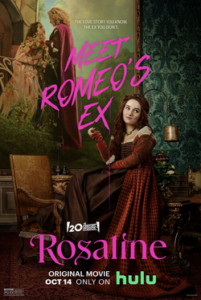
Rosaline

Posted on October 12, 2022 at 9:52 am

B +
Lowest Recommended Age: High School
MPAA Rating: Rated PG-13 for some suggestive material and brief strong language
Profanity: Strong language (s-words, one f-word)
Nudity/ Sex: Mild references
Alcohol/ Drugs: Some alcohol
Violence/ Scariness: Some swordplay and fight scenes
Diversity Issues: A theme of the movie
Date Released to Theaters: October 14, 2022

Copyright 2022 20th Century
Most people do not remember that before he met Juliet at the masked ball and instantly fell in love with her as they communicated not just by iambic pentameter but by sonnet, Romeo was in love with Juliet’s cousin Rosaline. She was also a Capulet and a part of the family of his family’s sworn enemies. It’s easy to forget her because Romeo did. Though the whole reason he snuck into the party was to see the girl he described as “the all-seeing sun ne’er saw her match since first the world begun,” as soon as he sees Juliet, it is as Benvilio correctly predicted: “Compare her face with some that I shall show, and I will make thee think thy swan a crow.” Next thing we know he’s telling Friar Lawrence, “I have forgot that name, and that name’s woe.”

Ever wonder how the story might look from Rosaline’s perspective? Author Rebecca Serle did, with her novel, When He Was Mine, now the basis for a witty romantic comedy starring the wildly talented Kaitlyn Dever (who also executive-produced) as the woman scorned. It is sly, clever fun on its own, but the better you know Shakespeare’s play, the more you will enjoy it.

it begins on a balcony. Rosaline’s balcony. Romeo is telling her about his feelings, in words that will seem familiar. And, as will also seem familiar, their secret tryst is interrupted by a call for her from inside. Like Juliet, she has a nurse/confidant (a terrifically dry Minnie Driver), and a father who is eager to marry her off (Bradley Whitford). Rosaline believes that she and Romeo are meant to be together (though she is not quite ready to say, “I love you”).

And then, while on a boat with one of the suitors her father has foisted on her, she misses that Capulet masked ball, and, well, we know that part of the story. That suitor is Dario, played with full Shakespearian dash, wit, and gallantry by Sean Teale, and in true Shakespearian fashion, when not writing about instant true love, they begin as hostile combatants. He even calls her a shrew. This is a reference, of course, to another Shakespeare play, but no one gets tamed in this one.

But, in this version, Rosaline, the woman scorned, does go all-out “My Best Friend’s Wedding” on her cousin, and tries every way she can think of to get her boyfriend back. She even enlists Dario’s help. Like the recent “Catherine Called Birdy,” much of the humor comes from a very modern sensibility, with contemporary language, pointing up some of the absurdity of the canon.

Juliet is played by sweet-faced Isabela Merced. At first, she is intrigued by what Rosaline has to show her about the bigger world. When she realizes that Rosaline has not been honest with her, she pursues the relationship with Romeo and comes up with a plan to pretend to be dead. Rosaline says what audiences have been waiting to say for centuries. It is a dumb plan. And those audiences will appreciate what Rosaline and Dario work out as a better ending, especially with a mid-credit. sequence harking back to Dario’s description of what he thinks love is. Romeo may be great at poetic speeches on balconies, but you need more than that on life’s journey.

For the record, this movie does not “ruin” or even disrespect “Romeo and Juliet.” The play and its many versions and variations are still with us, from the Franco Zefferelli and Baz Luhrmann films to the Gounod opera and “West Side Story.” They are all still there, intact, and easy to access. What this does is remind us that even minor characters in our stories can have value and agency, that exploring other perspectives can increase our understanding and empathy. And that it can be a lot of fun.

Parents should know that this film includes some strong language and swordplay violence.

Family discussion: What story would you like to re-tell from a minor character’s perspective? What made Rosaline and Dario change their minds about each other? What do you think of Dario’s description of love?

If you like this, try: “Ophelia,” a smart and serious version of “Hamlet” from the perspective of the young woman, “Catherine Called Birdy,” another sharp modern take on a medieval story about a young woman, and “A Knight’s Tale”