
Left Behind

Posted on October 5, 2014 at 12:01 am

“Left Behind” is being marketed as Christian entertainment, but it does not qualify in either category.

It is far inferior to the modestly budgeted but sincere straight-to-DVD starring Kirk Cameron, based on the blockbuster best-selling book series by Tim LaHaye and Jerry B. Jenkins, itself inspired by the Book of Revelations. This version has a bigger budget and a real, Oscar-winning movie star, Nicolas Cage. But what it doesn’t have is any meaningful spiritual content aside from referring to a couple of Bible verses and the underlying premise that people of faith are taken up to heaven while those who did not live Godly lives are “left behind.” All of the significance and context of the book and the original film are swept away for just another disaster movie. This is not a movie about faith or grace. It is a movie about a plane that is in the air when the Rapture occurs, so that children and babies disappear along with some of the passengers and crew, and the sole remaining pilot (Cage) has to keep everyone calm and safe while he thinks about how he should have listened to his wife (Lea Thompson), a believer, instead of being driven away by her faith into a possible dalliance with a flight attendant.

With a musical score that sounds like the music you are stuck with on hold waiting for tech support and cheesy special effects, it feels like a low-budget disaster film from the 1970’s. There was laughter throughout the theater in one scene where a plane crashed in a parking lot because the stock footage used for the explosion was so clumsily inserted. And when Nicolas Cage plays a pilot on a plane in trouble, it is a huge disappointment that we only get one brief outburst. What is the point of putting the Cage rage-monster in a film if he doesn’t blow his top? Instead he just alternates between moping and steely determination, not his strengths.

But the real failure here is the hollowing out of the storyline. It is a sad irony that a movie intended to warn about the dangers of soullessness is itself so empty.  At the end of 2014, it turned up on most critics’ worst of the year lists.

Cassi Thomson (who plays a devout Christian on “Switched at Birth” and a Mormon on “Big Love”) is Chloë, who comes home from college to surprise her father on his birthday only to find out that he won’t be there.  Her father is the heroically named Rayford Steele (Cage), and he is a pilot and he will be flying to Europe.  She waits at the airport to say goodbye to him before he leaves, and rescues a handsome television reporter named Buck Williams (Chad Michael Murray, in the film’s best performance) from a woman who tries to warn him of a coming Biblical catastrophe.  Then Chloë sees her father walking to the gate with a flight attendant.  There is something about the way they are leaning toward each other that indicates a close relationship.  Chloë is devastated.  It turns out Buck is on Ray’s plane, and Chloë gives him a message for her father.

Suddenly, when the plane is over the Atlantic and Chloë and her brother are at the mall, people disappear, taken out of their clothes.  The rest of the film is Ray in the plane and Chloë on the ground, trying to figure out what has happened and why and what to do next.

The book and the original film had provocative notions of how current world events were playing into the predictions contained in Revelations.  There were characters who represented the forces of evil and there were characters trying to make sense of what it meant to be left behind.  This version has none of that.  There is the thinnest gloss of faith-based content, as though the filmmakers are afraid of offending a mainstream audience.  Even worse, it appears they assume that the faith-based audience is so loyal they will not care about cardboard characters, clumsy dialog, painful attempts at humor involving a little person, and poorly-staged action scenes.  I hope that the success of well-made faith-based media this year will make it impossible for the filmmakers here to complain that the criticism of this film, which showed up on most of the 10 worst lists of 2014, is based on bias.

Parents should know that this film has a great deal of peril and violence, discussions of infidelity, sad losses, drinking and drugs, and some disturbing images.

Family discussion: What separated those who were taken and those who were left behind? What would you have written on the ticket envelope Chloë asked Buck to deliver?

If you like this, try: the original film with Kirk Cameron and the book series
Related Tags:


Based on a book Remake Spiritual films

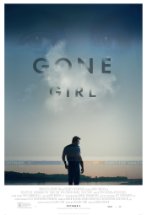
Gone Girl

Posted on October 2, 2014 at 6:00 pm

gone girl

Amy (Rosamund Pike) is watching television, vitally, even viscerally enthralled by what is happening on screen. The look on her face, mingled fascination and calculation, a hint of tooth and claw under her placid, golden girl beauty, is one of the most mesmerizing sights on screen this year.

Pike gives an extraordinary performance in the title role of David Fincher’s film based on the sensationally popular  thriller by Gillian Flynn that was carried by just about everyone riding public transportation last year, many of whom became so engrossed that they missed their stops.

Ben Affleck is perfectly cast as the once-glamorous and smooth, now just slightly seedy Nick Dunne. His face is still handsome but his jawline is softening, his eyes are beginning to get puffy, and his smile, still calibrated for a face a little bit handsomer than the one he has not quite adjusted to seeing in the mirror.

On their fifth anniversary, Nick’s wife Amy (Pike) disappears, leaving behind some disturbing signs of a struggle and the front door open. Nick calls the police and spends the night with his twin sister, closest confidant, and business partner, Go (Carrie Coon). He sleeps in his clothes and does not clean up the next morning. He knows he will be a more compelling vision of a devastated husband if he looks like a mess.

That is the first indication of one of the story’s key themes: the gulf between the way we present ourselves and the way we are. We learn through flashbacks and Amy’s diary about how they met and fell in love, or a reasonable facsimile. They were buoyed by ease and that made marriage feel easy, too.  They had glamorous writing jobs in those last few moments before print publishing collapsed. They had a charming brownstone, bought with Amy’s money, or, rather, the money her parents earned by publishing a successful series of children’s books inspired by their daughter, the Amazing Amy stories. Her parents set aside the profits for the daughter who inspired them. But then there was the recession. Jobs, gone. Money, gone. The economic downturn eroded the golden couple’s notion of each other, of themselves, of success. It is so easy to be in love when you don’t have to blame each other for everything turning out so badly.

When Nick’s mother became ill, they moved back to the small town in Missouri where he and Go grew up, to help take care of her. With the last of their money, they bought a house and a bar for Nick to run with Go. Amy stayed home and wrote in her diary. And now she’s gone.

If there’s one thing television news loves to cover, it’s a missing blonde woman. The Nancy Grace-ish Ellen Abbott (a dead-on Missi Pyle) is all over the story. Is Nick the tragic young husband, longing for his wife to return? Or, as we have seen too often in this high-profile cases, is he a murderer so heartless that he staged the whole thing?  One detective (“Almost Famous'” Patrick Fugit) thinks the simple answer is usually the right one.  His partner (Kim Dickens, nicely wry) believes in complications.  This case has plenty.

No spoilers here. Either you’ve read the book and already know or you haven’t and deserve to be surprised. I’ll just say there are superb performances by everyone, including Tyler Perry as a celebrity criminal defense lawyer and Neil Patrick Harris and Scoot McNairy as Amy’s former boyfriends.  And Fincher keeps the energy taut and the tone deliciously nasty.

Parents should know that this is a crime story with some bloody violence, as well as sexual references and situations, nudity, strong language, and drinking.

Family discussion: What would have happened if Nick and Amy had kept their jobs and money and stayed in New York? What will happen after the ending of the movie?

If you like this, try: “To Die For” and the novels by Gillian Flynn, including Dark Places, soon to be a movie starring Charlize Theron.
Related Tags:


Based on a book Thriller

Hector and the Search for Happiness

Posted on September 25, 2014 at 5:00 pm

hector

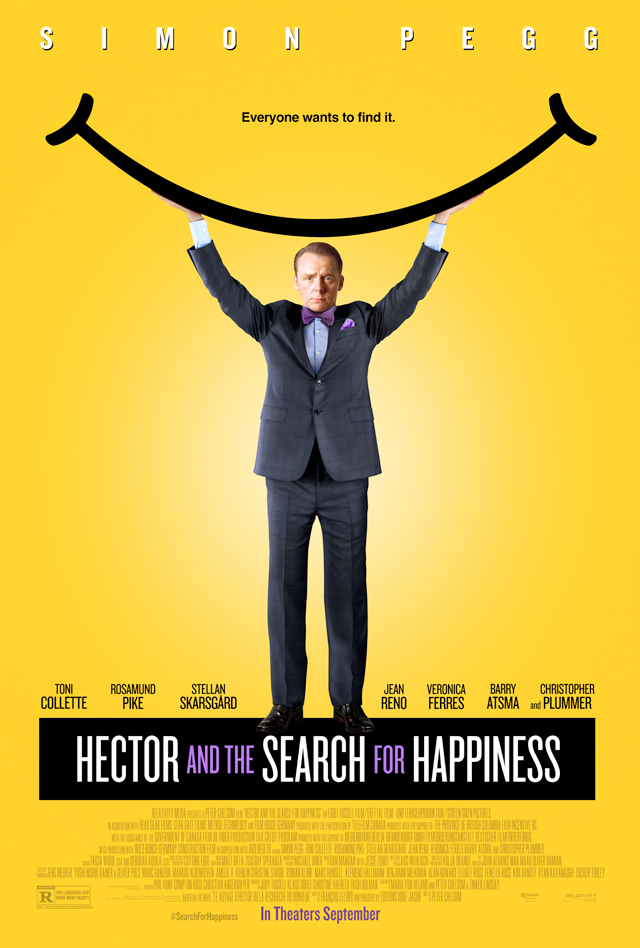
Simon Pegg stars as Hector in this gentle fable based on the whimsical French novel by psychiatrist Francois Lelord.  Like Lelord, Hector is a psychiatrist.  He has a “tidy” life with a nice girlfriend named Clara (“Gone Girl’s” Rosamund Pike), nice patients, and a nice apartment.  But he is missing something.  He wonders if he is really helping people.  And he is not sure what he is helping them toward.  If he is not sure what happiness is, how can he guide his patients toward finding it?
Your level of happiness on viewing this film will vary depending on your tolerance for whimsy and your affection for last year’s The Secret Life of Walter Mitty, as it is almost exactly the same movie, though not as good.

Hector decides that what he needs to do is travel around the world to learn about happiness.  Clara is troubled, and wonders what it might mean for their relationship — especially since he won’t say when he is coming back.  She wonders if “researching happiness” is just a euphemism for “finding Agnes,” the mysterious woman whose photo she found in Hector’s sock drawer (labeled “Hector’s Socks” — he is very tidy).  But she is supportive, and gives him a notebook for his discoveries, directing him to “fill these pages.”  “If you’re going to do this, do it totally,” she says. “Make it worthwhile.”

And so he sets off on a series of adventures and encounters that will teach him something about happiness.  He first meets a genial businessman named Edward (Stellan Skarsgård), who introduces him to one notion of happiness: the kind that can be bought.  Hector enjoys wine, women, and club music.  He enjoys is all so much that he conks out before he can accept the advances of a beautiful “student” (Ming Zhao).  He wonders at first whether it is possible that happiness means the freedom to love two women at the same time, and then discovers to his distress that the interest and affections of the “student” were purchased for him by Edward.  Being rich, being important, believing you are captivating to a “student” — that does not seem to be the answer.  “Sometimes happiness is not knowing the whole story.”

This is the point at which you are either going to go with the premise and tone or you’re not.  It’s either a fairy tale, in which the encounters are metaphors, or it is supposed to be grounded in some semblance of reality, in which case it’s solipsistic, kind of seedy and mired in stereotypes.  For me, it was a fairy tale, and so I gave it some leeway.

Hector’s travels take him to visit an old friend who runs a clinic in Africa, where he runs into a cute sick kid and a vicious but also kind of cute drug lord (Jean Reno), both of whom he helps, and also learns that his friend is gay.  He is captured by gangsters and almost killed until providentially, like a character in a fantasy game who just happened to have picked up a golden arrow and some magic beans, he has the token he needs to get out of jail if not free, at least relatively unscathed.  He meets a dying woman who is philosophical and at peace.  He meets up with Agnes (Toni Collette) and has his brain scanned by a scientist (Christopher Plummer) who is studying the biological basis for happiness.  He takes notes.  He has Skype-fights with Clara.  He learns many important lessons, and, like Dorothy Gale of Kansas, learns that the answer was inside him all along and there’s no place like home.

It is a pleasant little trifle as long as you do not take it too seriously.  If you understand that it is all inside Hector’s head, and that his adventures are more akin to The Little Prince’s planetary hops than to anything resembling reality, it has charm and even some reminders that we get more happiness from what we do for others than from what they do for us.

Parents should know that this movie includes very strong language, scenes of criminal activity including beatings, death threats, and imprisonment, drug dealing, scenes of injured and dying characters, prostitutes, sexual situations, and nudity.

Family discussion: Which of the observations Hector wrote in his notebook do you think were most important? Why did he have to get away from home to understand what he had? Why didn’t things work out with Agnes?

If you like this, try: “The Secret Life of Walter Mitty”

Related Tags:


Based on a book Comedy Drama Romance

Tusk

Posted on September 18, 2014 at 5:59 pm

Copyright 2014 SModcast Pictures

You can make a good movie about slackers, for example “Slackers,” from Richard Linklater and “Clerks” from Kevin Smith. But you can’t make a good movie by a slacker, and Smith does not seem willing to be anything more. There are flickers of interesting possibilities in his latest film, his first foray into horror. Justin Long nails his early scenes as Wallace, a sort of Smith wannabe. We learn later in flashbacks that he was once a sweet, geeky guy who cried in “Winnie the Pooh.” He was conversant enough with literature to recognize quotes from “The Rime of the Ancient Mariner” and Hemingway. But he found out he could make money and attract groupies by being obnoxious and outrageous. Wallace and his best friend Teddy (Haley Joel Osment) host a podcast something between Smith’s own SModcast, Tosh.0 and the skankier sub-reddits. It’s called “Not-See Party,” get it? In case you don’t, Wallace has a sign-off in a fake German accent. What, too soon?

We first see them helpless with laughter over a found video along the lines of the “Star Wars kid,” but this one is a “Kill Bill” wannabe who accidentally slices off his own leg at the thigh. A real laff-riot! This is such a bonanza of a topic for the Not-See Party duo that Wallace decides to visit the kid in person, at his home in Manitoba, Canada. But when he gets there (following a not-funny encounter at the border with an official who warns him not to be flippant about hockey in Canada), Wallace discovers that the despondent kid has committed suicide. Bummer for the podcast! Seeking some other poor slob to make fun of so the trip won’t be wasted, Wallace comes across an intriguing flier in a men’s room, a man named Howard Howe, a retired sailor, who says he has stories to tell. Wallace rents a car and drives two hours into Howard’s remote house (beautifully creepy interiors by John D. Kretschmer, a highlight of the film). He sips at the tea offered to him by the genially eloquent Howard (as he prefers to be called), at first condescending but thinly disguising his snark, then impressed in spite of himself with Howard’s stories of WWII and being shipwrecked, and then, suddenly, very, very, very, very sleepy.

The tea was spiked. Howard has something very gruesome in mind, which we discover along with the terrified Wallace.

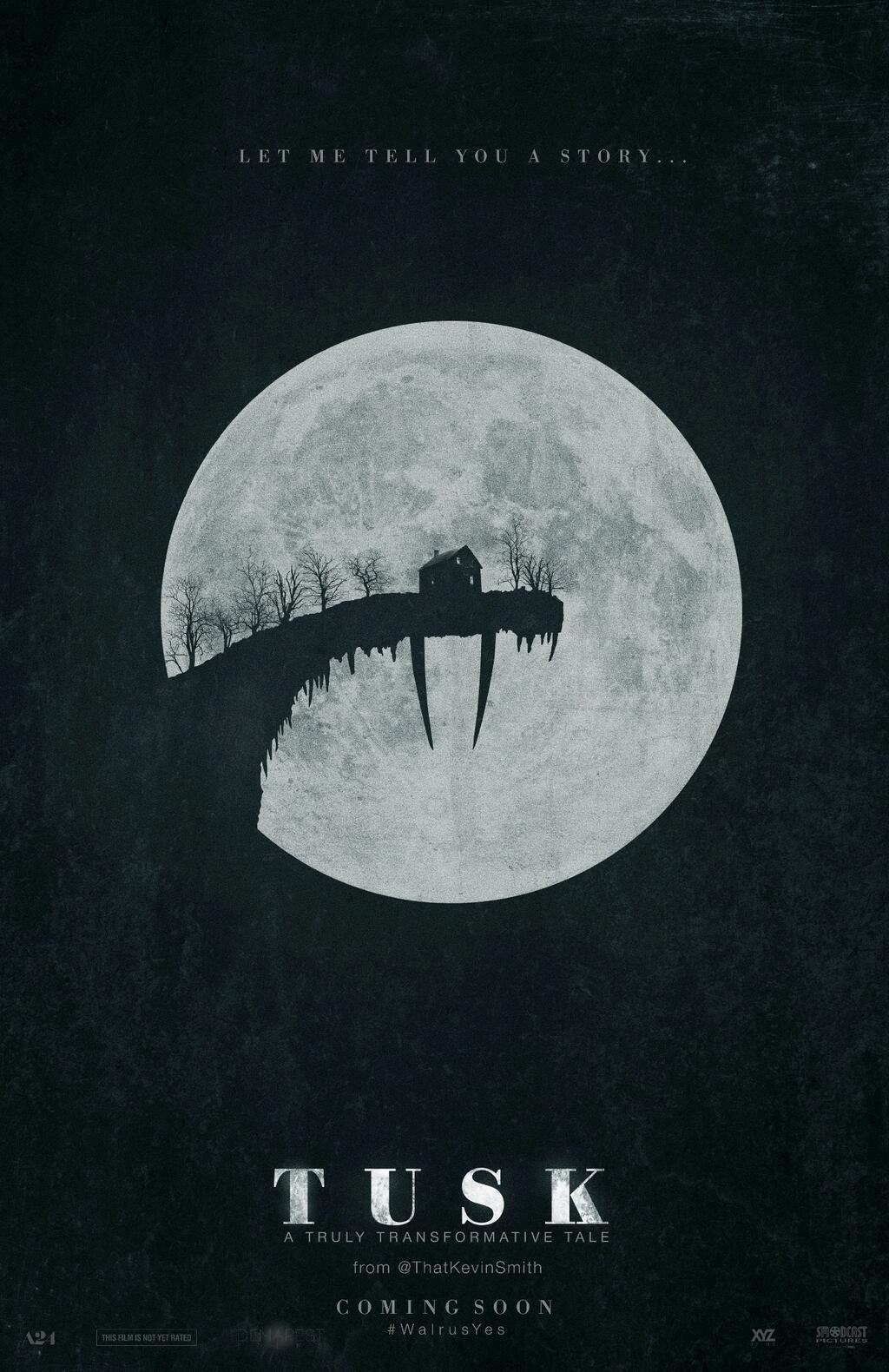
The idea for this film came up in a SModcast conversation with Smith and friend and producer Scott Mosier discussing an ad placed by a homeowner who was offering a living situation free of charge, if the lodger would agree to dress as a walrus. Their can-you-top-this riffs on the possibilities suggested by the ad led to a twitter campaign with the hashtag #walrusyes. And that is why it feels at times as though the screenplay was pieced together by tweets. A major Hollywood star shows up in disguise for a stunt-ish, winking-at-the-screen turn as a Quebecois detective in pursuit of Howard Howe, not nearly as funny or charming as intended. While there are hints of something deeper — the conversation about how Wallace as devolved as a person, with his girlfriend missing the “old Wallace,” the similarities between “Wallace” and “Walrus” — the real possibilities of the storyline about humanity, inhumanity, and what separates us from the animals, are blithely bypassed for random detours and red herrings (maybe red mackerels). It is another disappointment from Smith, who may not write all of his scripts while stoned, but they sure feel like it.

Parents should know that this is a horror film with many graphic and disturbing images of torture and mutilation. Characters are injured and killed. It also includes strong language, drinking and smoking, and sexual references and situations, with brief male rear nudity.

Family discussion: Are we supposed to think that Wallace somehow deserved or asked for what happened to him? How do you interpret the final scene?

If you like this, try: “The Skin I Live In” and “Boxing Helena” — and Eugene Ionesco’s classic Rhinoceros

Related Tags:


Horror Scene After the Credits

The Drop

Posted on September 11, 2014 at 6:00 pm

Author Dennis Lehane writes about a world of desperation, fear, and damaged people inflicting further damage. His novels have been filmed as “Mystic River” and “Gone Baby Gone.” And now his short story, “Animal Rescue,” has been turned into “The Drop,” about a “drop bar,” a dingy place with dingy regulars, a bitter former owner still resentful of the thugs who took it over, a soft-hearted bartender and the dog he rescues from a garbage can, and lots of cash, dropped at the bar by racketeers to be picked up by bigger, tougher, racketeers. You know what that means: colorful, highly euphemistic dialog said by top-notch actors doing their best to play hard, hard men. Very little is said in this world but a lot is understood.
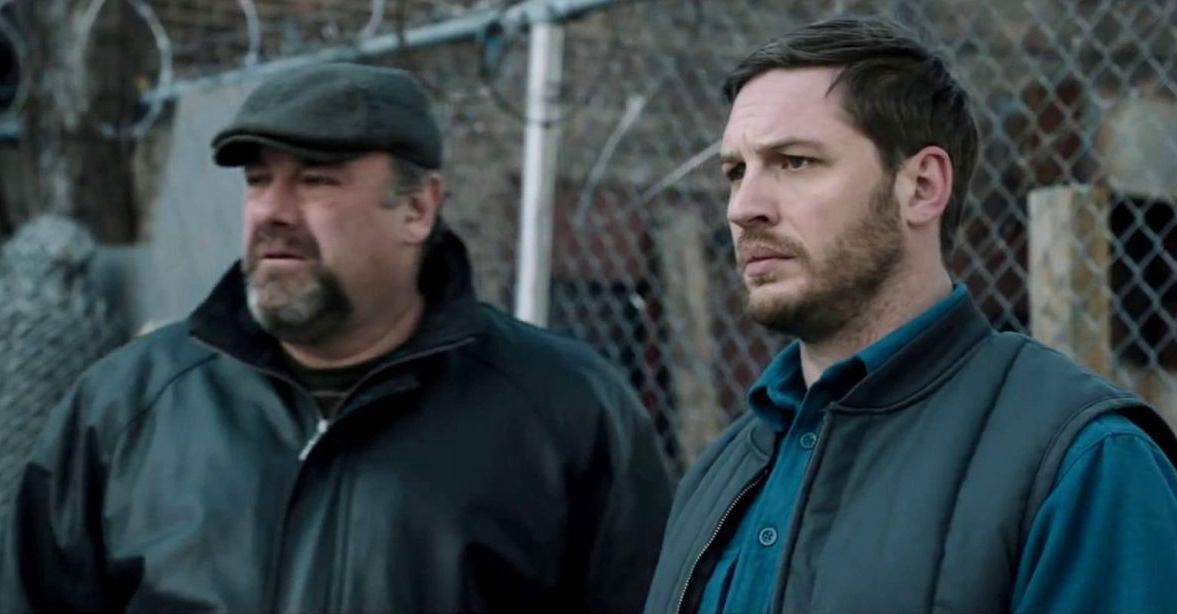
Fortunately, here that means we get James Gandolfini in a beautifully nuanced performance that makes us miss him even more sharply. He plays “Cousin Marv,” whose name is still on the bar, but no longer on the deed. Now he’s just the manager, and he quietly but meaningfully tells Bob (Tom Hardy), the bartender, to take down the Christmas decorations (“It’s December 27th!”) and stop running a tab for the flowsy barfly at the end of the counter. Oh, and no more rounds for the boys at the bar, even though they are observing the 10th anniversary of a friend’s death. We will learn later that there is more significance to the last two items than losing the revenue on a few drinks.

Copyright 2014 Fox Searchlight

On his way home, Bob hears a noise in a neighbor’s garbage can. It is a badly injured puppy. The wary neighbor is Nadia (Noomi Rapace), who insists on taking a picture of Bob’s driver’s license on her cell phone and sending it to four friends before she will even talk to him about the puppy. She helps him clean it up and reluctantly agrees to care for it for a couple of days so he can decide what to do. He adopts the puppy and names it Rocco. And she offers to care for the puppy while he is at work to make some extra money.

For a moment, things are looking up for the lonely Bob. But not for Cousin Marv’s or for Cousin Marv. Marv and Bob are held up at gunpoint by two guys in masks who may not be entirely unknown to them. The owners are tough Chechen gangsters who expect them to get the money back and who give them a glimpse of some guys they are in the middle of torturing just to make sure the message is received. And Cousin Marv’s is set to be the drop bar for the biggest betting night of the year, the Super Bowl. A cop (John Ortiz of “Silver Linings Playbook”) is nosing around. And there is pressure on Bob as well. A very unstable guy in the neighborhood, reputed to have killed a guy, says he is Rocco’s owner and he may have some feelings of ownership toward Nadia as well. Also, there is a body part formerly belonging to someone who was formerly alive, and it will need to be disposed of.

The storyline is all right, but what matters here is the mood, and that is excellent, with Gandolfini, as always, a master class in acting. There are so many layers to his performance, whether he is answering his sister’s question about dinner or refusing to look inside a bag that clearly cannot contain any good news. His expression in his very last scene of the film is particularly compelling.

Hardy’s quiet power is beautifully restrained. Ann Dowd as Marv’s wistful sister and Matthias Schoenaerts as Eric, Rocco’s volatile former owner are also very good. In some ways, Eric is the most revealing character in the story. Asked what he wants, he isn’t sure, except that he doesn’t want Bob to think he has anything over on him. People want money, of course, and power, and to be left alone. But what drives them really nuts is the fear that someone has more than they do and there’s nothing they can do about it.

Parents should know that this plot concerns various crimes and attempted crimes including extortion, robbery, torture, and murder, with many characters injured and killed, as well as some graphic and disturbing images, drinking, smoking, and constant strong language.

Family discussion: The original title of the story this film was based on is “Animal Rescue.” Would that have been more appropriate for the film? Why did Bob stay at the bar?

If you like this, try: “Killing Them Softly” and “Get Shorty,” both featuring James Gandolfini

Related Tags:


Based on a book Crime Drama Thriller
THE MOVIE MOM® is a registered trademark of Nell Minow. Use of the mark without express consent from Nell Minow constitutes trademark infringement and unfair competition in violation of federal and state laws. All material © Nell Minow 1995-2026, all rights reserved, and no use or republication is permitted without explicit permission. This site hosts Nell Minow’s Movie Mom® archive, with material that originally appeared on Yahoo! Movies, Beliefnet, and other sources. Much of her new material can be found at Rogerebert.com, Huffington Post, and WheretoWatch. Her books include The Movie Mom’s Guide to Family Movies and 101 Must-See Movie Moments, and she can be heard each week on radio stations across the country.

Website Designed by Max LaZebnik