Chappie

Posted on March 5, 2015 at 5:59 pm

B
Lowest Recommended Age: Mature High Schooler
MPAA Rating: Rated R for violence, language and brief nudity
Profanity: Constant very strong language
Alcohol/ Drugs: Drinking, drugs
Violence/ Scariness: Intense and graphic violence, characters injured and killed
Diversity Issues: Diverse characters
Date Released to Theaters: March 6, 2015
Date Released to DVD: June 15, 2015
Amazon.com ASIN: B00UC9SOKW
Copyright Sony 2015
Copyright Sony 2015

So, basically, no one here saw “Terminator.” Or “Frankenstein.” But maybe they did see “Robocop?” Or “Short Circuit?”

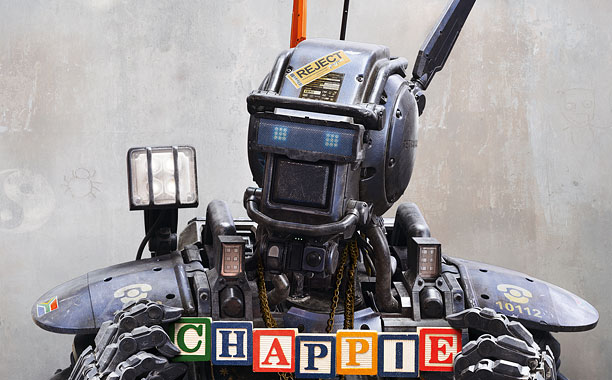
Writer/director Neill Blomkamp likes sci-fi allegories of social and political conflicts, as we saw in “District 9” and “Elysium.” Here he imagines that a couple of years from now South Africa will replace most of its front-line police force with robots from a government contractor. Efficient and just about unstoppable, they bring the crime rate down substantially. They are trusted by the law-abiding population and feared by the criminals. The CEO of the contractor is Michelle Bradley (Sigourney Weaver), who has turned down requests from two of her staff. Deon Wilson (Dev Patel) wants to develop artificial intelligence to see if he can create a form of mechanical consciousness. Counter to his Athenian dreams of a holistic robot spirit that can create poetry and assess the merits of works of art, there is the Spartan, Vincent Moore (Hugh Jackman), whose pet project is a super-powerful weapon called Moose that is all brawn and no brain. It operates entirely under human control, through a helmet that reads its operator’s thoughts. One dreams of heart and brains, one believes in brawn and firepower.

Michelle reminds them that she is CEO of a publicly traded weapons corporation. Her job is to provide powerful but obedient robot foot soldiers to the police force, not to explore existential questions or create military-force destructive capacity.

In brief opening scene set a year before the events of the film, a journalist explains, “Historically, when we look at evolution, it’s not surprising that Chappie’s left turn happened.” So we know from the beginning that Chappie will be a major turning point in human history. Then we go back to see how he is created, as Deon takes a discarded robot with an unreplaceable fused battery that has just five days before it will run down and brings the not-so-failsafe guard key card from the office to his apartment (where of course he has created a cute little wall-eyed home robot with decorative red glasses). He revs up on Redbull and slams down some bangin’ code to, you know, play God.

Just to make it clear, he introduces himself to the robot, who will be dubbed Chappie, as his maker. And just to show you how human sentient consciousness, at least as conceived by human screenwriters, will inevitably be, Chappie’s relationship to his creator is more conflicted than his relationship to the couple he sees as his mommy and daddy. These underground, off the grid, self-styled gangsta characters share the names of the performers who play the roles, Ninja and Yo-Landi (rappers from Die Antwoord) and “America” (Jose Pablo Cantillo), who live in an abandoned building covered with graffiti.

Chappie is caught in a tug of war between the idealistic Deon, who sees him as having infinite possibilities beyond the capacities of humans, and the gangstas, who see him as the key to bigger and better ways to create mayhem and steal cars and money. Deon makes him promise never to commit a crime. But Ninja covers him in bling and promises him a new body before the battery dies.

Blomkamp’s ambition is admirable and the broad scope of his imagination is impressive. The action scenes are vividly staged and the special effects are superb. It is Chappie’s movement that makes him seem human as much as his curiosity and spirit. seeing him gently stroke a dog’s back is so endearing we barely stop to consider whether his “hands” have the sensory capacity to “feel” the softness of the fur or the warmth underneath. When a human character transitions to robot form, the fact that his voice transitions as well makes no sense as a matter of mechanics, but this is more allegory than science. Unfortunately, the fact that the robot is more human than the humans is, to put it in computing terms, a bug, not a feature.

Parents should know that this film has constant very strong language and intense and graphic violence with some disturbing images and many characters injured and killed, as well as drinking, drugs, and brief nudity.

Family discussion: If you had the chance to upload your consciousness to a robot, would you do it? Could robot police ever work? How did Chappie’s innocence affect the people around him?

If you like this, try: “District 9” and “Elysium,” from the same director

Related Tags:


DVD/Blu-Ray Pick of the Week Science-Fiction

The Second Best Exotic Marigold Hotel

Posted on March 5, 2015 at 5:55 pm

A documentary called “Young @ Heart” had a choir of singers in their 80’s performing contemporary rock songs.  The very fact of their age and experience gave an unexpectedly profound meaning to the words.  And in “The Second Best Exotic Marigold Hotel,” a plot that ranges from silly to very silly still resonates, because the people in the silly situations are running out of time.  And because they are played by actors of such superb skill that they give power even to fortune-cookie aphorisms like “There is no present like the time.”  The characters in this film have more romantic complications and far more opportunities than the average teen sex comedy — and a lot more sex, too.  But their situation gives it all grace and poignance.

You could give Maggie Smith “Mary Had a Little Lamb” and she would make it sound like repartee written by Oscar Wilde. Here, she has a couple of very good insults and delivers them with wit as dry as a martini made of gin over which the word “vermouth” has just been whispered.  Just listen to her crisply explain that tea is an HERB requiring boiling water to release its flavor.  No tea bags limply dipped in lukewarm temperatures for her.  “How was America?” she is asked on her return.  “It made death more tempting.  I went with low expectations and came back disappointed.”

In the original The Best Exotic Marigold Hotel, a group of expatriate Brits came to India, mostly because they could no longer afford to live in the UK.  The energetic and eternally optimistic young owner of a dilapidated hotel decided to “outsource old age.”  Just as he saw the beauty of the ancient, crumbling building, he saw the grace, and the revenue stream, of people no longer valued in the place they had lived their lives.

This sequel, with all of the surviving main characters returning, takes us from Sonny’s engagement party to the family party, and then the wedding.  

As it begins, Sonny (Dev Patel) and Mrs. Donnelly (Smith) are driving through California (in a convertible!) to make a pitch for financing to Ty Burley (David Strathairn), so the hotel can expand. Burley promises to send an undercover inspector to check out the hotel. When an American named Guy Chambers (Richard Gere) arrives, Sonny assumes that he is the inspector and lavishes attention on him, ignoring another recent arrival, Lavinia Beech (Tamsin Greig of “Episodes”), who says she is checking out the place for her mother.

Meanwhile, Sonny is frothing with jealousy over another arrival, a friend of his fiancee’s brother who is handsome, wealthy, and very attentive to Sunaina (Tina Desai). Evelyn (Judi Dench), who has not quite managed to move things ahead with Douglas (Bill Nighy), is so successful in her free-lance work as a scout for textiles that she is offered a big promotion. Madge (Celia Imbrie, whose lush figure prompted Helen Mirren’s call for “bigger buns” in “Calendar Girls”), is happily “dating” two wealthy men and having trouble deciding between them. And in the silliest of all of these flyweight storylines, Norman (Ronald Pickup), who is trying out monogamy for the first time, thinks he may have accidentally put out a hit on his lady friend Carol (Diana Hardcastle).  There are some nice, quiet touches, though, as we see our friends more at home in India, including interacting more with the locals for friendship, business, and romance.

The movie gently disrupts all of the happy endings of the first film just enough to allow for some minor misunderstandings, some pithy and pointed commentary, and another round of even happier endings, leaving, I hope, the possibility of a third chapter.  Fans of the first film will arrive with high expectations and come home happy.

Parents should know that this film include brief mild language and many sexual references including infidelity and multiple partners.

Family discussion: Why was it difficult for Evelyn and Douglas to reach an understanding about their relationship? What was Sonny’s biggest mistake?

If you like this, try: the original “Best Exotic Marigold Hotel” and “The Lunchbox”

Related Tags:


Based on a book Comedy Date movie Drama Family Issues Romance Series/Sequel

Merchants of Doubt

Posted on March 5, 2015 at 5:30 pm

B+
Lowest Recommended Age: Middle School
MPAA Rating: Rated PG-13 for brief strong language
Profanity: Brief strong language
Alcohol/ Drugs: Discussion of tobacco
Violence/ Scariness: References to injury and environmental degredation
Diversity Issues: None
Date Released to Theaters: March 6, 2015
Copyright 2015 Sony Pictures Classics

Do you remember the tobacco executives standing up before a Congressional Committee, their right hands raised, each of them swearing that they did not believe that tobacco caused cancer?  That was in 1994, three decades after the US Surgeon General’s report showing the adverse health effects of cigarettes.  Any other consumer product with that much proof of its destructive impact would have been restricted or banned long ago.  But the tobacco industry was able to delay or prevent meaningful government action through a series of  public relations maneuvers and strategic lobbying and campaign contributions.  Ultimately, tobacco consumption was reduced in the United States.  Television ads were banned.  Warning labels were required.  Very big fines were assessed following lawsuits that revealed a history of intentional deception as toxic as cigarettes themselves.

But the legacy of using corporate money to undermine science and thus to undermine public policy as well may be the most devastating effect of all.  As documented in “Merchants of Doubt,” based on Merchants of Doubt: How a Handful of Scientists Obscured the Truth on Issues from Tobacco Smoke to Global Warming, by Naomi Oreskes and Erik M. Conway, corporations have used distraction, delay, and downright deceit to create pretend opposition to scientific findings. Their tactics have included those as sophisticated and complex as the creation of fake “public interest groups” with secret funding by corporations and their trade associations, to those as simple and old-fashioned as releasing the private contact information of the scientists and encouraging a barrage of bullying threats and personal attacks.

One of the film’s most devastating segments deals with a two-year, Pulitzer Prize-winning investigation by two Chicago Tribune reporters about how the tobacco companies thwarted potential regulation by fraudulently shifting the blame for home fires from cigarettes to the failure of furniture to be coated with toxic flame retardant chemicals. Fake experts and fake studies work because no one, neither the journalists who are hard-wired to present “both sides” nor the law-makers and regulators who are often looking for a way to justify the decisions their corporate funders are supporting, ever make an effort to find out the experience, expertise, reputation, or conflicts of interests of these industry-supported “experts.”

The focus now is climate change, with more than 97 percent of the world’s climate scientists agreed that it is a severe, even critical problem and millions of dollars spent by the fossil fuel industries to distort, delay, and deceive. In the film, former Congressman Robert Inglis, who identified himself as having been elected from “the reddest county in the reddest state in the country” (South Carolina), and who considers himself a hard-core conservative, lost his bid for reelection because, after a visit to Antarctica where he witnessed the evidence of climate change, he was considered a traitor, perhaps less by his constituents than by the industry funding anyone who would oppose government action on climate change.

No matter what you think about tobacco, climate change, or fire retardants, this is an essential film because it addresses the key issue of trust. Whatever policies you support, everyone should agree that they must be grounded in the clearest and best-documented facts. Who can we believe? What questions should we ask? As Senator Whitehouse said last week, “You can believe every single major American scientific society, or you can believe the Senator with the snowball.”

Related Tags:


Documentary Movies -- format Politics

McFarland USA

Posted on February 19, 2015 at 5:58 pm

B+
Lowest Recommended Age: Middle School
MPAA Rating: Rated PG for thematic material, some violence and language
Profanity: Some strong language
Alcohol/ Drugs: Drinking
Violence/ Scariness: Some gang-style violence, mostly off-screen, characters injured
Diversity Issues: A theme of the movie
Date Released to Theaters: February 20, 2015
Date Released to DVD: June 1, 2015
Amazon.com ASIN: B00UI5CUSM
Copyright Disney 2015

In 1987, Coach Jim White (Kevin Costner), who had never coached or even run cross country, took a team of kids from one of the poorest communities in California to a state championship. Of course that would have to become a Disney movie. But in 2015, it is near-impossible to make a movie about a white coach and his all-Latino team without falling into one of two equally fatal traps. We are no longer in an era when it is acceptable to have a “mighty whitey” movie has a white savior teaching people of color a better way to live. We are also no longer in an era where it is acceptable to have a “magical Negro” plotline, with a person of color teaching a white person a better way to live. We all have people in our lives who teach us important lessons, but presenting these stories in a sensitive way is an almost insurmountable challenge.

“McFarland USA” comes as close as it can to surmounting that challenge by wisely — and honestly — showing what everyone in the story learns from the experience. That comes from warm, sensitive performances by all involved and by telling details. The best is after the team comes in last in their first meet because the coach failed to check out the terrain. The team had never practiced on an incline and the course of the raise included some steep passages. So, for their next practice, Coach White brings them to a place where he and the audience see enormous piles of something under tarps. White knows only that this is a good place to practice running uphill. The team knows what is under the tarps — millions of discarded almond shells, removed by field workers, so supermarkets across the country can stock shelled nuts in little plastic pouches. The symbolism, and White’s growing understanding not just of the challenges faced by his team but of their dedication, perseverance, and strength is un-sappy and touching.

It begins with White getting fired for an outburst at an arrogant high school football captain, and taking a job as an assistant football coach in the small farm town of McFarland in central California. The entire population is Latino and most of them work in the fields as “pickers,” starting at age 10. The kids and teenagers work before and after school. White is quickly relieved of his responsibilities as assistant coach when he takes a player out of the game because he has been injured. He decides to start a cross-country team, even though the principal tells him ‘That’s a private school sport.  They breathe different air.”  White has no experience.  Also, because this is 1987, it would be about a decade before he could just Google how to do it. No one at the school has the time — or the shoes — for distance running. But he can see that they can run, and he gets them to agree to try to compete.  At first, he does not even have a stopwatch to time their runs.  He uses a kitchen timer.

It is a poor community.  No one in the boys’ families has more than a 9th grade education.  The high school is next door to the prison, with a barbed-wire fence.  The families see sports as “not essential,” a distraction that keeps the boys away from paying work on the fields.  “Every hour with you is food off my table,” says one father.  But White and the community learn to trust each other, even after a scary encounter.

Director Niki Caro (“Whale Rider”) has a sensitive touch and a trust in her story and characters that gives them space to breathe.  The running scenes are vivid and exciting.  By the time we get to the end credit sequence, showing the team now in their 40’s and still running every day in McFarland, we see that more than the state championship has been won.

Parents should know that there are a few bad words, some drinking, and some gang-style violence. It is mostly off-screen, but characters are injured and there are brief disturbing images.

Family discussion: Which teachers have made you see that you were capable of more than you thought? How did White and the team demonstrate that to each other?  When did the team start calling him “coach” and why?

If you like this, try: “Spare Parts,” “Chariots of Fire,” and “Hoosiers” and this interview with Carlos Pratts

Related Tags:


Based on a true story DVD/Blu-Ray Pick of the Week Sports Stories about Teens

The DUFF

Posted on February 19, 2015 at 5:43 pm

B
Lowest Recommended Age: Middle School
MPAA Rating: Rated PG-13 for crude and sexual material throughout, some language and teen partying
Profanity: Some strong and crude language, one and a half f-words
Alcohol/ Drugs: Teen drinking
Violence/ Scariness: Bullying
Diversity Issues: A theme of the movie
Date Released to Theaters: February 20, 2015
Date Released to DVD: June 8, 2015
Amazon.com ASIN: B00WAEEG7M
Copyright 2015 CBS Films

A haiku has 17 syllables. A limerick has five lines. An omelet is made from eggs. And a teen romantic comedy will have our characters visit the mall, a locker room, a classroom, and the school bathroom. There will be a trying-on-clothes montage, a makeover, a house party, and a big school dress-up dance. Nothing wrong with that. We’d be disappointed if they skipped any of these essentials. But because we see those same elements over and over, it can be tough to get it right. For every “Mean Girls” or “10 Things I Hate About You” there are dozens of duds like “Drive Me Crazy” or “Confessions of a Teenage Drama Queen.”

“The DUFF,” based on the book by Kody Keplinger, mostly gets it right, thanks to witty performances and great chemistry from the wonderful Mae Whitman and Robbie Amell (“The Flash”), though they are both too old to play teenagers.

Bianca Piper (Whitman) has two best friends , fashionista Jess (Skyler Samuels), and hacker/jock Casey (Bianca A. Santos), both gorgeous and talented and loyal.  She does not mind too much that she is socially awkward, except when it comes to her inability to say more than two words (literally) to her soulful, acoustic guitar-playing crush, Toby (Nick Eversman).  And then Wes, the handsome boy next door, who happens to be the star of the school football team (Amell), tells her that she is the DUFF (designated ugly fat friend), the accessible gateway between her hot friends and the rest of the world.  She is hurt.  She is humiliated.  She is furious.  She un-friends Jess and Casey in a funny encounter that involves almost a dozen different kinds of social media entanglements.  With no one else to rely on, she decides to ask Wes for advice, in exchange for helping him with his chemistry test.  Cue the trip to the mall with the makeover/trying on clothes montage.

Wes has a “strobe light” (off and on) relationship with the school’s uber-mean girl, named, of course, Madison (Bella Thorne, an actual teenager).  Madison’s greatest goal in life is to become a reality TV star and she has her own DUFF/acolyte, constantly following her around to film her for her YouTube channel.

Seeing Wes with Bianca makes Madison determined to get him back in time for (of course) the big homecoming dance, where the homecoming king and queen will be announced.   Her friend spots Bianca and Wes at the mall, and secretly films Bianca joking about her crush on Toby.  Madison edits and uploads the humiliating video, which quickly spreads throughout the school.

Bianca is crushed.  

But with the support of Wes, she decides to own it, deciding that the experience is like the acid bath that created Batman villain, The Joker.  In a nice touch, even though they are hurt by Bianca’s accusations, Jess and Casey decide to help out behind the scenes by taking the video down.  They really are her friends.  But Bianca is so colossally embarrassed that what had seemed insurmountable humiliations like saying three or more words to Toby seem trivial.  Soon, they have a date for dinner.  And she has a beautiful new LBD to wear, courtesy of Wes.

The adults in the story are played by underused top talent (Allison Janney, Ken Jeong, Romany Malco), but the focus here is on the kids and they deliver their lines with a nice confidence and snap.  It is not as endlessly quotable as “Mean Girls” but it feels fresh and resilient.  There is even a suggestion that a makeover may not be right for Bianca, or, at least, that any makeover should leave her more like herself, in the world of high school movies, positively revolutionary.  Whitman makes Bianca so thoroughly herself throughout that anyone would be glad to have her for a BFF.

Parents should know that this movie includes crude sexual references and some strong language, including one and a half f-words. There is a party with some teen drinking.

Family discussion: How does this compare to your school experience? Why did Bianca believe she was a DUFF, even though her friends really loved her?

If you like this, try: “Nick and Nora’s Infinite Playlist,” “Sydney White,” and “Mean Girls.”

Related Tags:


Comedy Date movie DVD/Blu-Ray Pick of the Week Romance School Stories about Teens
THE MOVIE MOM® is a registered trademark of Nell Minow. Use of the mark without express consent from Nell Minow constitutes trademark infringement and unfair competition in violation of federal and state laws. All material © Nell Minow 1995-2026, all rights reserved, and no use or republication is permitted without explicit permission. This site hosts Nell Minow’s Movie Mom® archive, with material that originally appeared on Yahoo! Movies, Beliefnet, and other sources. Much of her new material can be found at Rogerebert.com, Huffington Post, and WheretoWatch. Her books include The Movie Mom’s Guide to Family Movies and 101 Must-See Movie Moments, and she can be heard each week on radio stations across the country.

Website Designed by Max LaZebnik