The job of the people who make trailers is not to convey the real quality of a movie. It is to get you to buy tickets. io9 has a funny and astute primer on how to spot tricks in a trailer that make the movie look like it’s worth seeing, even when it isn’t. Two of my favorites:
Dog Reaction Shots
If they have to show you a dog’s reaction to the events that are happening on screen, that’s probably a pretty bad sign. They don’t think you’ll know how to react without a dog letting you know.
A pretty woman does an over-the-top pratfall
This is mostly in romantic comedies, but also in other types of films. Comedian Emily Heller describes this one thusly: “Whoooaaaa! She’s clumsy! She has a FLAW! She falls down! That’s the only thing wrong with her though because otherwise she’s a 10.”
As if it wasn’t enough of a challenge to try to create a movie based on a board game — and a board game based on a game that is perfectly adequately played with pencil and paper — this movie has to find its way around the fact that the large armored warships that give the game and the movie its title have been out of commission as everything but museum pieces for decades, replaced by much more powerful ships called destroyers. And yet, director Peter Berg (“Friday Night Lights”) and screenwriters Eric and Jon Hoeber (“Red“) have somehow managed to add some aliens and a lot of explosions to create a good, old-fashioned summer popcorn movie that is good, old-fashioned fun.
They give us half an hour to meet the main characters. Alex Hopper (Taylor Kitsch, thankfully making it possible to overlook “John Carter“) is an impetuous but gallant young man. His brother Stone (“True Blood’s” Alexander Skarsgård), a naval officer frustrated with Alex’s lack of direction, insists that Alex get some discipline and join the navy. A couple of years later, Stone is a commander and Alex is a promising but still-impetuous lieutenant in love with Samantha (Brooklyn Decker), the daughter of the admiral (Liam Neeson). In the midst of an event called RIMPAC that is like an Olympics of international naval operations, just after Alex gets in trouble for a scuffle with a Japanese naval officer (Tadanobu Asano), something happens that is not part of the program. For four years, a program called the Beacon Project has been sending signals to a planet that is similar to earth and capable of supporting life in the hope of making contact. The signals have been seen as an invitation and the inhabitants of the other planet have arrived, like Columbus. And, as a character points out, if they are Columbus, we — all of humanity — are the the Indians. Except it is more like Columbus arriving with an armored brigade and bombs that slice through destroyers like bullets through tissue paper. And they operate a enormous rockets that operate like Decepticons the size of the Chrysler Building in a world with no Optimus Primes.
The Battleship board game involves trying to guess where the other player’s warships are hidden by calling out squares on a grid, and the Hoebers find a witty way to make that a part of the story, and to bring in a real battleship, too. There’s more than just bang-bang. Alex comes up with some clever, way-out-of-the box tactics and Rihanna is a hoot as a determined petty officer weapons specialist. And in a cute variation on the whole “ET phone home” thing, the aliens need to get to the Beacon Project communication center. The only people who can stop them are none other than the beautiful daughter of the admiral and a wounded warrior she happens to have been trying to inspire by taking him for a bit of a mountain climb. He is played by real-life West Point graduate Gregory D. Gadson, a double leg amputee, in a performance adding some nicely quiet dignity to the story. There is not much quiet or dignity in the rest of the movie, but Berg stages the action scenes with kinetic energy and a sure sense of fun. (And be sure to stay all the way through the credits for an extra scene.)
Parents should know that this movie has non-stop action-style violence with aliens, many explosions and military battles, characters injured and killed, and some strong language (s-words, muffled f-words).
Family discussion: How did the qualities that got Alex into trouble also help him? Would you say the same about anyone else in the story who became an unexpected hero?
If you like this, try: “Independence Day” and “Transformers” – and the board game!
No matter how carefully you plan and how diligently you read books like What to Expect When You’re Expecting, pregnancy is guaranteed to be different from whatever you think it is going to be. I wish I could say the same for this movie.
These all-star ensemble cast mash-ups are beginning to feel as thin as the old television show, “Love American Style.” It doesn’t help that there isn’t one pregnancy cliche that is overlooked, no matter how many dozens of movies, sit-coms, and cute greeting cards it has already been done and re-done and re-re-done in before.
There is a celebrity fitness coach and reality dance competition show contestant (Cameron Diaz) who becomes unexpectedly pregnant just a few months into a romance with her dance partner (“Glee’s” Matthew Morrison). There is a loving but financially strapped couple hoping to qualify for an Ethiopian adoption (Jennifer Lopez and Rodrigo Santoro). The husband is nervous about being a father so after his wife offers him a very special sex act to motivate him he starts to spend Saturdays with “the Dudes,” a bunch of stroller-pushing, Snugli-wearing, diaper-bag toting dads whose idea of supporting each other is a Fight Club-style commitment to this decade’s most vapid catchphrase: “no judging.”
Elizabeth Banks plays a woman with ideas about pregnancy so idealized that she has a store devoted to breast-feeding (“The Breast Choice”) and has even written a children’s book about it that is creepier than the infamous Time Magazine cover. She and her dentist husband (Ben Falcone, “Bridesmaids'” Air Marshall Jon) have been trying to get pregnant for years. He is also about to become a big brother. His father is a loudmouth NASCAR champ (Dennis Quaid) married to a decades-younger bride (bright spot Brooklyn Decker) who is pregnant with twins. And there is a pair of rival food truck chefs (Anna Kendrick of “Up in the Air” and Chase Crawford of “Gossip Girl”), whose impulsive encounter apparently did not permit consideration of the importance of birth control.
The movie reads like an extended Caroline Hax “Tell Me About It” column of petty complaints so stunningly self-involved, irresponsible, and selfish that what the movie needs most is a representative of Child Protective Services to take all the babies to better homes. This is one long, loud slog through morning sickness (barfing on live television!), twins, an iPhone app that maps fertility cycles, stretch marks, debates over circumcision, baby names, and combatting the feeling that everyone is doing it better. Serious problems like pregnancy loss and financial concerns are handled as though there is a laugh track and trivial issues like a baby shower are handled as though they actually matter. The big moment comes when Banks’ character confesses to a bunch of future mothers that — insight alert! — “making a human being is really hard.” In yet another tiresome cliche, the clip of her “honest” meltdown goes viral. And then we get to see everyone in labor, making “Exorcist” faces (except for the trophy wife, who sails through labor as she has through the entire pregnancy). “But I typed out my birth plan!” one of them whines cluelessly when it turns out that delivery is not going as she wanted it to. It is another measure of the movie’s disregard of its audience that we go back to the Dudes so they can reverse everything they said the first time. It is not that they have learned anything. The movie is just lazy enough to hope some warm “parenting is wonderful” comments will erase the synthetic waste of celluloid (pixels?) that has gone before. No such luck.
Parents should know that this movie has comic and serious references to reproductive issues including infertility and pregnancy loss and some strong language
Family discussion: Which of these couples will make the best parents? How do you know? Ask your family for some of their pregnancy-related stories.
If you like this, try: “He’s Just Not That Into You” and “Knocked Up”
We mourn the loss of disco diva and five-time Grammy winner Donna Summer, whose anthems like “Last Dance” and “Hot Stuff” helped define an era. She died at age 63 from cancer. Her songs were featured in a number of movies, most memorably in “The Full Monty,” “Roll Bounce,” “Zoolander,” and “Charlie Wilson’s War” as well as episodes of “Sex and the City” and “The Simpsons.” Born LaDonna Adrian Gaines, she performed in the European cast of the original production of “Hair,” sang in a rock band, and was a back-up singer for Three Dog Night. Her powerful voice was perfect for the disco era, when she became the first artist to have three consecutive double albums reach number one on the US Billboard chart. May her memory be a blessing.
Interview: Director Bess Kargman of the Ballet Documentary “First Position”
Posted on May 17, 2012 at 8:00 am
First-time filmmaker Bess Kargman brought her own experiences studying dance to her documentary, First Position, about a crucial, career-defining competition for young ballet artists. The Youth America Grand Prix was launched in 1999 by two former dancers of the world-renowned Bolshoi Ballet, Larissa and Gennadi Saveliev. Its mission is to provide extraordinary educational and professional opportunities to young dancers, acting as a stepping stone to a professional dance career. I spoke to Kargman about how she selected the students she followed through the competition and why classical ballet is still a vital element of the performing arts.
You must be very excited about how well your film has been received.
I am! It’s very exciting, and I never expected anything, so it’s very thrilling.
Tell me how the project got started.
I danced my entire childhood, and this film was one that I always wished had existed. I don’t mean a dance competition film, because actually, I never competed growing up. Dance competitions didn’t appeal to me, and the Youth American Grand Prix wasn’t even around. What I mean is, a film that takes you far behind just the studio and the stage. I was so curious when I would watch dance films (especially dance documentaries) —what else? What do they eat? Whom do they live with? What are their relationships like with their friends? I just was very curious about more of the day-to-day or (some might call it mundane) activities in their lives that I thought maybe could count for a really full and interesting story. I ended up quitting my job to make this film, my first film, and I thought maybe by choosing a topic that was quite dear to me and that I had lived for a number of years growing up—maybe I’d be able to do this story justice.
Is it possible to be a dancer without a very supportive family? It seemed to me that these families were giving up as much as the girls and boys were.
I think in Europe and potentially other parts of the world, it’s possible to make it as a dancer with less support, but in America, where a 12-year old can’t drive him or herself to ballet class, a 12-year old can’t pay for point shoes, a 12-year old can’t pay for costumes, it really requires the whole-family’s buy-in. In Europe it’s more common to go to Ballet boarding school from a very, very young age and in that case the school takes on the burden of the costs.
How did you find the dancers that you focus on?
The story of how I found the first two dancers is sort of magical. A year before we began filming I was walking along the street in lower Manhattan and I saw huge banners for the American Grand Prix. It was the 2009 finals. I had heard about the competition but I really didn’t know all that much about it, so I snuck into the theater and got the last seat, high in the nosebleeds. If I had gone for a coffee I would’ve missed it—out on stage walked the most splendid, itty-bitty baby ballerina I had ever seen for someone so young. She was 11 at the time and I was just blown away by her strength and artistry and technique and maturity on stage. So I got up and walked out, and said, “This has to become my first film, I have to do this.”
I had no idea who it was, but I knew I wanted her to be in the film, and I recall that her name sounded half-Asian, so I went through the roster of 300 soloists that year, and the name Miko Fogerty popped up, and I said, “Oh my gosh, this has to be her.” And then her brother, Jules Jarvis Fogerty, his name was also under hers, and I said, “Oh, this is too good to be true. She has a brother?” So you know interesting things might happen when you have a sibling duo, so they were the first two people.
I then set out to sign a really diverse array of kids. When you’re making a competition film, if you try and predict the winners you’re risking the entire success of your film on factors you have no control over. I just couldn’t live with the idea of shooting for a year, shaping a film which no one would watch because it all came down to who would win—and I chose the wrong one. Instead, I chose kids whose personal stories and personalities and hobbies and families were so unique and interesting that I thought, even if the last five minutes don’t go so well at the competition, and no one takes anything home, that maybe the audience would still have a wonderful time if they fell in love with these dancers and learned who they are as human beings. That’s why the competition really only takes up a third of the film, I focused less on the competition and more on young dancers having a shared dream and being really diverse from all over the world, all different types of personalities and different age groups. Interestingly, when I was getting some advice from some very experienced film-makers they said I was really setting myself up in a bad way if I chose kids from all different age divisions, rather than from one age division. They said that if I didn’t have the kids fighting against each other on the dance floor, that it would lack a lot of drama—and I just thought to myself, well, the whole point is to show how the stakes differ depending upon age and to show how a dream differs depending upon your age or not. Maybe the 11 year olds want it just as badly as the 17 year olds, so I thought even if maybe there wasn’t that backstabbing and there weren’t kids giving each others terrible looks right before they’re about to go on stage because they’re not in the same age division, I was still willing to take that risk because I really did want to show more than just one age division. And what mattered was the individuals, not who they were competing with.
Why did you leave dance?
My advice to young dancers who want to make it as professionals is: Do not do it unless it is literally the only thing that you want to do with your life. It’s really difficult. It’s so demanding both in terms of your time and the way you have to use your body and it’s expensive. So, basically I came to the determination when I was thirteen and half and said, “I love other things just as much.” That signaled to me that maybe it wouldn’t be smart or healthy for me to focus on that exclusively. I became an athlete and I loved sports just as much, and then I wanted to go to high-school and play sports. So, I think what’s good about the age that I left dance was that I never lost that glorious appreciation for it. I think maybe if I had continued to stay in it and pushed myself, full knowing that I liked other things just as much, maybe I would’ve come to resent it or be bitter. I know that sometimes young dancers are hurt badly with ballet, because they’re pushing themselves, like every day is a struggle.
Where did you learn how to make films?
I never went to film school. I earned a graduate degree in journalism from Columbia and in my final semester there, I took a very influential, inspiring class with a substitute teacher named John Alpert who is a documentary film-maker for HBO, and he kind of challenged me to see if I could make a film myself. A couple of years passed before I was willing to take that risk, so I freelanced as a journalist and then I found a subject that I couldn’t not do. I always give advice to first-time film-makers and my advice to them is: you have to do for your first film a topic that is very personal, where you have some sort of area of expertise to compensate for the fact that you’re a first-time director—so I thought, “I know a couple of things, I know hockey and I know ballet,” and thought, “Let’s try ballet.”
How did you get your young performers to be comfortable enough to be honest with you?
One thing I learned very quickly is that dancers are used to expressing themselves with their bodies, not their mouths, so in the beginning they were exceptionally shy which is scary. At first, our cameraman said, “You’re going to have to recast this entire film because they’re not opening up to you.” We then decided to turn the cameras off and really bond with them and to get to know them. We worked to earn their trust. I don’t blame them, you know. If were expecting them to really open up their lives and share their stories, then we should allow them to get to know us as well. I got a skateboard for my cameraman so he could go skateboarding with them and we’d go point-shoe shopping and just do some fun stuff, and then they opened up in a big way, which was essential. I am fascinated by their stories and would love to come back and do a sequel in ten years: “Second Position.”
There are so many great movies about ballet. Do you have favorites?
The one that I watched over and over on repeat growing up, was The Children of Theatre Street – The Story of the Kirov Ballet School, the one that’s narrated by the princess. Forever engrained in my memory are the slow-motion shots of the dancers running, doing grand jetés on the beach. There are also all of the classic ones that I would find—in the days before YouTube. There is now an abundance of ballet content, but some of the things that I would watch on VHS tapes growing up were not translated, they were Russian documentaries—but it didn’t matter because you just absorbed the visuals.
You touch very lightly but candidly on the issue of ballet’s traditional approach of focusing on white dancers with long, thin, slender bodies.
It was important to me on that and other issues to let the people in the film speak for themselves. You never hear my voice, even asking questions. It is a complicated issue because ballet is grounded in traditions that include a very particular body shape and line. But dance has many varieties and opportunities and everyone who loves dance can find a place.
What do you think it is that makes classical ballet so enduring over hundreds of years in a world where people listen to hip-hop, and as you said, watch Youtube videos—why is it that we still go to a live theater to see dancers dance the same dances they’ve been doing for hundreds of years?
I think that there’s something about ballet which is magnetic. When you see people doing things with their bodies that are so disciplined and practiced, and requires so much of both TLC and training. I think that you don’t even have to know anything about ballet to know when you’re seeing something on stage that is incredible. I think that ballet’s focused on lines of the body. It’s just beautiful, it’s really beautiful, and I think that-everyone marvels when people can do things with their bodies that the average human being can’t do.


 involves trying to guess where the other player’s warships are hidden by calling out squares on a grid, and the Hoebers find a witty way to make that a part of the story, and to bring in a real battleship, too. There’s more than just bang-bang. Alex comes up with some clever, way-out-of-the box tactics and Rihanna is a hoot as a determined petty officer weapons specialist. And in a cute variation on the whole “ET phone home” thing, the aliens need to get to the Beacon Project communication center. The only people who can stop them are none other than the beautiful daughter of the admiral and a wounded warrior she happens to have been trying to inspire by taking him for a bit of a mountain climb. He is played by real-life West Point graduate Gregory D. Gadson, a double leg amputee, in a performance adding some nicely quiet dignity to the story. There is not much quiet or dignity in the rest of the movie, but Berg stages the action scenes with kinetic energy and a sure sense of fun. (And be sure to stay all the way through the credits for an extra scene.)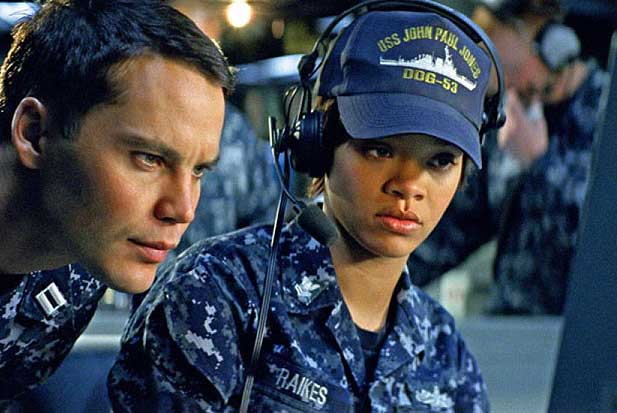
 , pregnancy is guaranteed to be different from whatever you think it is going to be. I wish I could say the same for this movie.

 , the one that’s narrated by the princess. Forever engrained in my memory are the slow-motion shots of the dancers running, doing grand jetés on the beach. There are also all of the classic ones that I would find—in the days before YouTube. There is now an abundance of ballet content, but some of the things that I would watch on VHS tapes growing up were not translated, they were Russian documentaries—but it didn’t matter because you just absorbed the visuals.