
Great Cinematographers on Instagram
Posted on September 19, 2014 at 8:00 am
Indiewire has a gorgeous array of Instagram feeds from Hollywood cinematographers. Be sure to talke a look so you can follow them.
Posted on September 19, 2014 at 8:00 am
Indiewire has a gorgeous array of Instagram feeds from Hollywood cinematographers. Be sure to talke a look so you can follow them.
Posted on September 19, 2014 at 8:00 am
As the sole proprietor of Omni Consumer Products, Hottelet is constantly scanning the pop culture zeitgeist for imaginary items that can be “defictionalized,” as he calls it, and offered to consumers as a tangible product. While prototypes like the crowbar or an audaciously morbid trash bag and knife set inspired by Showtime’s Dexter might invite class-action mayhem and are unlikely to see the light of day, Hottelet has nailed it in other venues. His carbonated beverage based on HBO’s recently wrapped True Blood was a huge hit; Sex Panther cologne, the fragrance favored by Paul Rudd’s news doofus Brian Fontana in theAnchorman films, is the kind of gift that might prompt an eye-roll if it weren’t so well-made. (The box actually growls when opened.)
“You’re not actually selling cologne,” Hottelet says of the reverse product placement. “You’re selling the connection people have with the film.” The trick for Hottelet is to try and anticipate which products will resonate with consumers, feeding nostalgia while avoiding tacky tie-ins. If Hottelet has his way, at least a couple of your friends should have a bag of Stay-Puft marshmallows or Fight Club bar soap on display.
The company’s name itself is de-fictionalized. It’s from “Robocop.” Other products include “Idiocracy’s” Brawndo drink and “Ghostbuster’s” iconic Stay Puft Marshmallows
Posted on September 18, 2014 at 5:59 pm
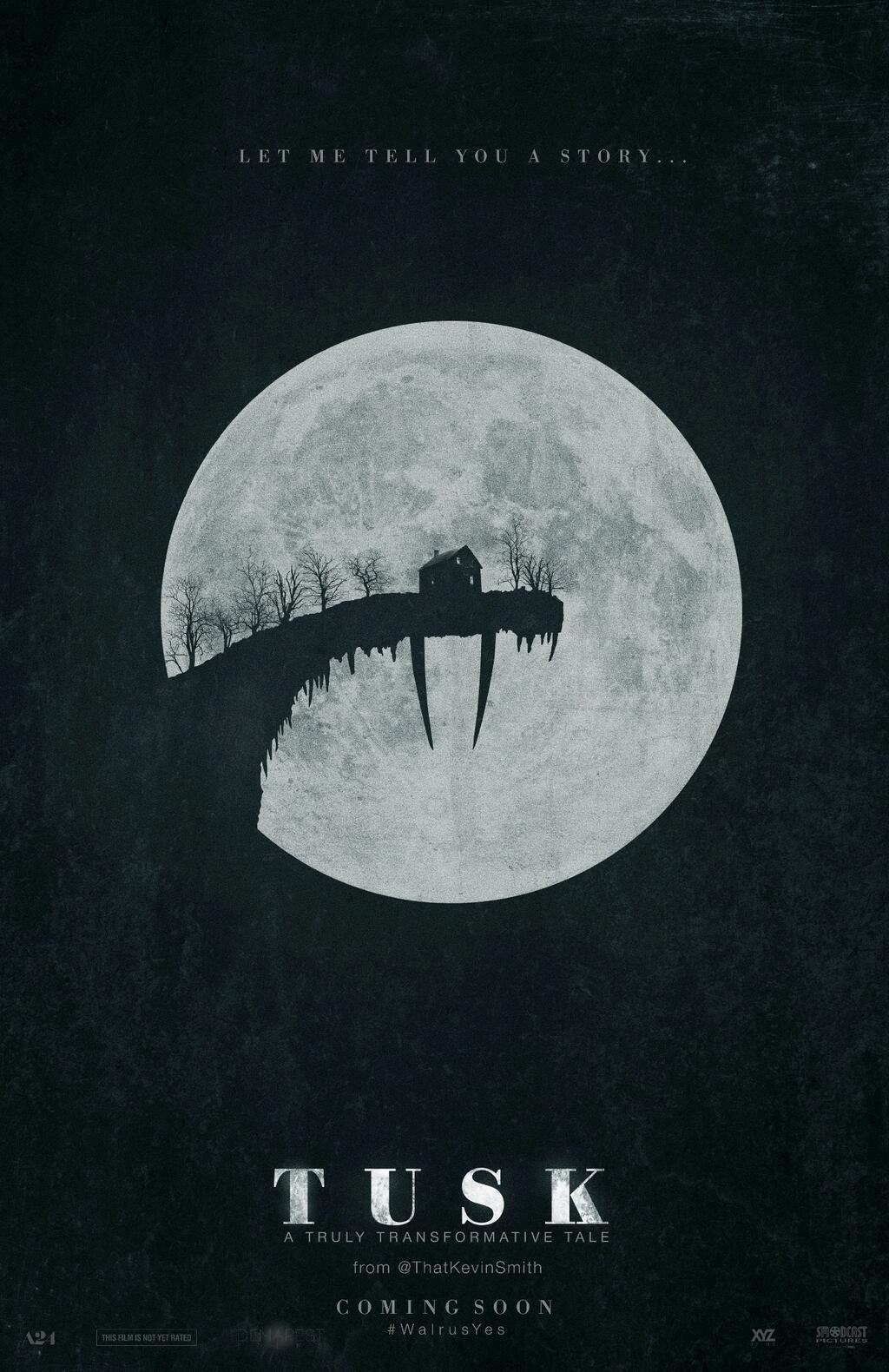
You can make a good movie about slackers, for example “Slackers,” from Richard Linklater and “Clerks” from Kevin Smith. But you can’t make a good movie by a slacker, and Smith does not seem willing to be anything more. There are flickers of interesting possibilities in his latest film, his first foray into horror. Justin Long nails his early scenes as Wallace, a sort of Smith wannabe. We learn later in flashbacks that he was once a sweet, geeky guy who cried in “Winnie the Pooh.” He was conversant enough with literature to recognize quotes from “The Rime of the Ancient Mariner” and Hemingway. But he found out he could make money and attract groupies by being obnoxious and outrageous. Wallace and his best friend Teddy (Haley Joel Osment) host a podcast something between Smith’s own SModcast, Tosh.0 and the skankier sub-reddits. It’s called “Not-See Party,” get it? In case you don’t, Wallace has a sign-off in a fake German accent. What, too soon?
We first see them helpless with laughter over a found video along the lines of the “Star Wars kid,” but this one is a “Kill Bill” wannabe who accidentally slices off his own leg at the thigh. A real laff-riot! This is such a bonanza of a topic for the Not-See Party duo that Wallace decides to visit the kid in person, at his home in Manitoba, Canada. But when he gets there (following a not-funny encounter at the border with an official who warns him not to be flippant about hockey in Canada), Wallace discovers that the despondent kid has committed suicide. Bummer for the podcast! Seeking some other poor slob to make fun of so the trip won’t be wasted, Wallace comes across an intriguing flier in a men’s room, a man named Howard Howe, a retired sailor, who says he has stories to tell. Wallace rents a car and drives two hours into Howard’s remote house (beautifully creepy interiors by John D. Kretschmer, a highlight of the film). He sips at the tea offered to him by the genially eloquent Howard (as he prefers to be called), at first condescending but thinly disguising his snark, then impressed in spite of himself with Howard’s stories of WWII and being shipwrecked, and then, suddenly, very, very, very, very sleepy.
The tea was spiked. Howard has something very gruesome in mind, which we discover along with the terrified Wallace.
The idea for this film came up in a SModcast conversation with Smith and friend and producer Scott Mosier discussing an ad placed by a homeowner who was offering a living situation free of charge, if the lodger would agree to dress as a walrus. Their can-you-top-this riffs on the possibilities suggested by the ad led to a twitter campaign with the hashtag #walrusyes. And that is why it feels at times as though the screenplay was pieced together by tweets. A major Hollywood star shows up in disguise for a stunt-ish, winking-at-the-screen turn as a Quebecois detective in pursuit of Howard Howe, not nearly as funny or charming as intended. While there are hints of something deeper — the conversation about how Wallace as devolved as a person, with his girlfriend missing the “old Wallace,” the similarities between “Wallace” and “Walrus” — the real possibilities of the storyline about humanity, inhumanity, and what separates us from the animals, are blithely bypassed for random detours and red herrings (maybe red mackerels). It is another disappointment from Smith, who may not write all of his scripts while stoned, but they sure feel like it.
Parents should know that this is a horror film with many graphic and disturbing images of torture and mutilation. Characters are injured and killed. It also includes strong language, drinking and smoking, and sexual references and situations, with brief male rear nudity.
Family discussion: Are we supposed to think that Wallace somehow deserved or asked for what happened to him? How do you interpret the final scene?
If you like this, try: “The Skin I Live In” and “Boxing Helena” — and Eugene Ionesco’s classic Rhinoceros
Posted on September 18, 2014 at 5:59 pm
B-| Lowest Recommended Age: | Mature High Schooler |
| MPAA Rating: | Rated R for language, sexual content and some drug use |
| Profanity: | Very strong and crude language |
| Alcohol/ Drugs: | Drinking, smoking, drugs, references to pharmaceuticals |
| Violence/ Scariness: | Scuffles, sad death |
| Diversity Issues: | None |
| Date Released to Theaters: | September 19, 2014 |
| Date Released to DVD: | December 15, 2014 |
| Amazon.com ASIN: | B00K2CI008 |
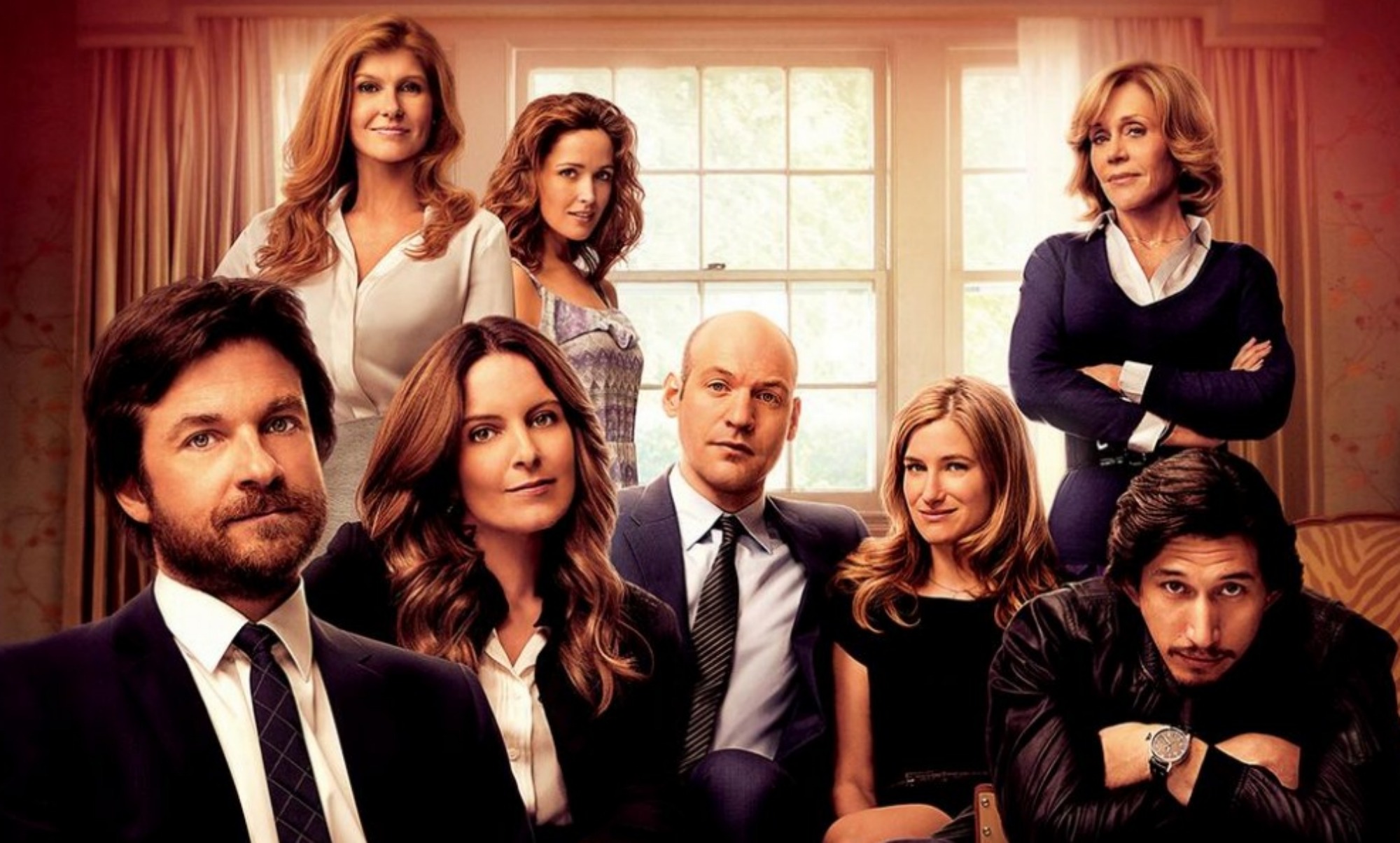
A toddler carries his little potty out in front of the house so he can try out his new-found skill in public. Twice. Plus another time when the contents of the potty are first displayed for the family and then kind of accidentally tossed onto one of the relatives. This is pretty much the theme of “This is Where I Leave You,” one of those estranged relatives gathering under pressure movies that tries to put the “fun” in dysfunctional.” It’s pretty much great actors trying to make sense of characters who are continuously inappropriate, unpleasant, and miserable, with boundary issues that make Russia/Ukraine seem manageable. And they almost succeed.
Jonathan Tropper wrote the screenplay based on his novel
She tells her four children that their father’s last wish was for them to observe the Jewish tradition of sitting “shiva,” a seven-day period of mourning where the family stays at home together and receives visits from those who wish to pay condolences. They understand that “it’s going to be hard and it’s going to be uncomfortable, and we’re going to get on each other’s nerves.” But, Hillary says, they have no choice. “You’re grounded.”
They try to protest, but reluctantly agree. Paul (Corey Stoll) is the only one who has stayed in their hometown, the responsible brother who took over the family business, and married Annie (Kathryn Hahn), who is struggling with fertility issues. Wendy (Tina Fey) is married to one of those guys who is always on his cell phone talking about some big financial deal. She has two children, the aforesaid toddler and a baby. Judd (Jason Bateman) is in freefall, having just learned that his wife has been having an affair with his skeezy boss (Dax Shepard), the host of a shock jock radio show called “Man Up.” And then there is Philip (Adam Driver), the irresponsible baby of the family, who arrives in a Porsche convertible, with a new girlfriend named Tracy (Connie Britton), who is much older and a therapist. You don’t need to be a therapist to figure out that there are some mommy issues there. Everyone but Phillip is aware that Tracy is way out of his league and he does not deserve her.
The three out of town siblings all encounter past loves. Wendy’s is Horry (Timothy Olyphant), who was brain-damaged in an accident and still lives with his mother Linda (Debra Monk), Hillary’s neighbor and close friend. Phillip sees Chelsea (Carly Brooke Pearlstein), who looks, as Tracy notes, like a Victoria’s Secret model. And Judd sees Penny (a terrific Rose Byrne), living back in their home town and teaching figure skating. Each presents temptations as the siblings struggle to make sense of their choices, and struggle even more to communicate. “Deflecting emotion with logistics. Nice.” “It’s what we do.” Some secrets will be revealed (though not always intentionally) while others are protected.
Tropper’s screenplay is better than the book because we are not limited to Judd’s depressed narration and because it corrects what I thought was a mistake in the final resolution of Judd’s relationship with his wife. And it is helped a great deal by performances that give the characters more believability and complexity than the book did. But director Shawn Levy (“The Internship,” “Night at the Museum”) has always been stronger with broad comedy than with narrative, romance, and sentiment, and this storyline plays into his tendency to meander. Are we supposed to laugh at the Altmans because they are so awful or sympathize with them because all families are crazy at times? The bad choices, lack of respect, and wild swings of character keep us distant from the characters, despite the best efforts of the terrific cast.
Parents should know that this film includes very strong and crude language, sexual references (some vulgar) and explicit situations, nudity, adultery, drinking, smoking, marijuana and pharmaceuticals
Family discussion: How are the Altman siblings alike? How are they different? How do you feel about “complicated?”
If you like this, try: “This Christmas” and “Flirting With Disaster”
Posted on September 18, 2014 at 5:59 pm
B| Lowest Recommended Age: | High School |
| MPAA Rating: | Rated PG-13 for thematic elements and intense sequences of sci-fi violence and action, including some disturbing images |
| Profanity: | Some strong language |
| Alcohol/ Drugs: | Underage drinking |
| Violence/ Scariness: | Extended sci-fi action, peril and violence with many disturbing images, including monsters, dead bodies, apparent suicide, and wounds, many characters injured and killed |
| Diversity Issues: | Diverse characters |
| Date Released to Theaters: | September 19, 2014 |
| Date Released to DVD: | December 15, 2014 |
| Amazon.com ASIN: | B00OY7YPGK |
 Yes, it’s another dystopic YA trilogy (actually, there’s a fourth volume, a prequel), and yes, only a teenager with fabulous cheekbones can save the day. But “The Maze Runner” is not a lesser repeat. It is a worthy addition to the genre, an absorbing drama with surprising turns and even more surprising resonance to contemporary conflicts.
Our main character learns what is going on around him at the same time we do. He awakens with a gasp in an elevator cage hurtling to the surface. His memory is gone. He does not know who he is or where he is. When the elevator stops, he finds that he is in a wilderness, the entire population adolescent boys. They call it The Glade. For three years, one boy has arrived by that same elevator every month, along with some supplies in a box marked WCKD. We learn along with the boy, called “Greenie” by the others because he is new, that they have created a society with rules and assigned tasks. The Glade is surrounded by a massive maze that re-arranges itself every night. One group of boys, called Runners,” explore the maze every day to try to map its variations and figure out an escape path. They have to be out of the maze at night because horrible monsters called The Grievers come out. No one who was in the maze at night has ever survived. A “sting” from one of the monsters is toxic, causing madness. The other boys, led by Alby (Aml Ameen of “The Butler”), introduce the greenie to their world and tell him he will remember his name. “It’s the one thing they let us keep.” He does remember. His name is Thomas (Dylan O’Brien).
The boys understand the concept of parents but have no memory of ever having had any. Chuck (Blake Cooper), one of the youngest and most tender-hearted of the boys in The Glade, confides to Thomas that he has carved a little totem for the parents he cannot remember but hopes to be returned to some day.
Alby explains the rules to Thomas. Everyone must do his part. Never harm another Glader. “None of this works unless we have trust.” Never go beyond these walls. But those rules are based on the past. Thomas’ arrival signals some changes. Or did he create those changes? That is an issue that will be debated and then fought over.
“You’re not like the others,” someone says to Thomas. “You’re curious.” Thomas says that if they have not figured a way out in three years, it is time to try something new. Some of the others agree with him, especially after the elevator arrives with someone new — a girl — with a note that says she will be the last one.
A little bit “Lord of the Flies” (boys creating their own society, the struggle between animal instincts and human justice), a little bit “Hunger Games” (teenagers used as pawns by adults), it still manages to bring some imaginative and provocative themes and create distinctive characters. The maze itself is stunning. Production designer Marc Fisichella and the entire sound team have created a maze that is more than an obstacle course or a metaphor. The conflicts as the boys try to maintain some control in the midst of an environment that, like the maze, shifts and constricts are absorbing. The result is a film that you do not need to be a teenager or a YA fan to appreciate.
Parents should know that this film has sci-fi-style action, peril and violence, guns, knives, many young characters injured and killed, suicide, scary and disgusting monsters, some disturbing images, some strong language, and teen drinking.
Family discussion: Why do Thomas and Gally have different ideas about what to do? What was the maze supposed to test?
If you like this, try: the book series and other dystopian films like “The Hunger Games” and “Divergent”
