Tony

Tony

Posted on August 12, 2026 at 4:48 pm

B +
Lowest Recommended Age: High School
MPAA Rating: Rated R for pervasive language, drug use, and sexual content/nudity.
Profanity: Constant very strong language
Alcohol/ Drugs: Alcohol and drug use, casual and to excess
Violence/ Scariness: Scuffles, fire
Diversity Issues: None
Date Released to Theaters: August 14, 2026
Copyright 2026 A24

“Tony” begins with a quote from the late author and chef Anthony Bourdain describing himself at age 19: “a spoiled, miserable, narcissistic, self-destructive and thoughtless young lout, badly in need of a good ass-kicking.” Add in depressed, arrogant, angry, terrified, and desperately crushing on a girl he has no possible capacity to attract, and you’ve got the anti-hero in this, I have to say, delicious new film about a pivotal summer when Bourdain was 19.

Dominic Sessa (“The Holdovers“) gives one of the best performances of the year as Bourdain, still called “Tony.” As the film opens, he is explaining with great confidence but very little substance to an academic committee why he should receive a writing grant for the summer. He is so certain his proposal cannot lose that he tells everyone, including his family, that he has won it. But he has not. With no money, no plans, and no idea what to do, he decides to follow a girl who has shown pretty definitively that she is even less impressed with him than the committee. She mentioned she was spending the summer in Provincetown, on Cape Cod, so that is where he goes, with no job, no place to say, and very soon, no money.

I really appreciate the new style of biographical films that pick one pitival moment instead of trying to cram an entire lifetime into two hours, skipping from some trauma in childhood to meeting a series of significant people to being discovered to letting down people who care about him, etc. etc. Here, Sessa keeps us on the side of Bourdain, still being called by the diminutive “Tony,” behaving very badly, making many mistakes, hurting other people, but, in truly thrilling fashion, getting a glimpse of a future where he will become fully himself, fully “Anthony.”

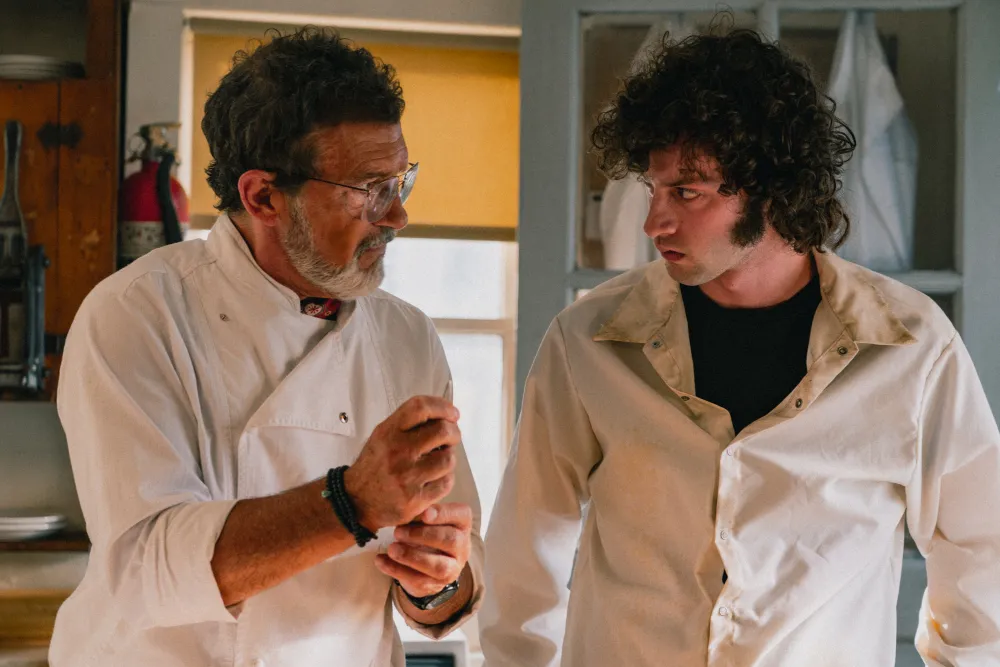
Screenwriters Todd Bartels, Lou Howe, Matthew Miller, and dirctor Matt Johnson sensitively adapted from just a few dozen pages in Bourdain’s Kitchen Confidential, capturing the reality of the emotions and reactions instead of being overly didactic about the details. This means that three years are encapsulated into one summer and the characters other than Bourdin are composites adjusted for dramatic purposes. In the film and in reality Bourdin worked at a low-end Provincetown restaurant called The Flagship. In the movie, he gets drunk, insults the waitress, gets thrown out, and gets robbed. Then the owner (Anonthy Banderas as Chef) takes pity on him, and lets him sleep on his hammock — waking him up every morning by throwing cold ocean water on his head, and then gives him a dishwashing job in his kitchen. It is unlikely any of that really happened.

But that set-up is just a way of making palpable what is going on internally. Leo Woodall, fast becoming one of the most sought-after actors in Hollywood, gives another outstanding performance as Sal, the louche, amoral sous-chef who carves a chip out of the doorway every time he has sex with a woman so he can keep them as souvenirs of his conquests. Chef is someone the Bourdin we meet at the beginning of the film would have dismissed as simple and uninteresting. But like a cartoon character with a devil on one shoulder and an angel on the other, Sal and Chef present two choices that Bourdin will continue to struggle with until his sad death at his own hand in 2018. It is a tribute to the screenwriters and the performers that the film hits the usual notes of a three-act coming of age story and yet every minute is fresh and specific. So it is fitting that the movie ends with one of Bourdain’s real-life friends from the restaurant world, Eric Ripert, playing an instructor at the Culinary Institute of America. We know what happens next. But the part of Bourdain’s story he dismissed in his book as “the less said about that part of my life, the better, believe me,” makes a very fine film.

Parents should know that this film has a lot of adult material and bad behavior including nudity and sexual references and situations, alcohol and drugs used casually and to excess, and very strong language.

Family discussion: How did Tony’s ideas about what he needed to be happy change over the course of the summer? Why? What food tastes like the future to you? If not food, what does feel like future to you?

If you like this, try: Bourdain’s books and television series and “Julie & Julia”

Related Tags:


Based on a book Based on a true story Coming of age movie review Movies -- format Movies -- Reviews Stories about Teens
Driver’s Ed

Driver’s Ed

Posted on May 14, 2026 at 5:54 pm

B-
Lowest Recommended Age: Mature High Schooler
MPAA Rating: MPAA for sexual references, alcohol use, language throughout, brief graphic nudity, and teen drinking
Profanity: Very strong language
Alcohol/ Drugs: Teen drinking, drugs and drug dealing
Violence/ Scariness: Comic peril and violence, crotch hits, car crash
Diversity Issues: Diverse characters
Date Released to Theaters: May 15, 2026
Driver’s Ed
Copyright 2026 Amazon/MGM

Four high school seniors impulsively “borrow” a driver’s ed car from their school and go off on a journey to Chapel Hill in a movie from director Bobby Farrelly that just about makes up for its predictability with its unpretentiousness. This is a “just go with it” movie, with paper-thin characters and contrived situations, but it invites us to go along for the ride.

Sam Niviola (“White Lotus,” and son of Emily Mortimer and Alessandro Nivola) plays aspiring film-maker Jeremy, who desperately misses his girlfriend, Sam (Lilah Pate), already in college. In French class, the teacher catches him texting her and makes his classmate Evie (Sophie Telegadis) read it aloud. The earnest but ineffectual principal (Molly Shannon), more concerned about her job security than educating students or molding their characters, gives him a week’s detention.

An ineffectual but not earnest substitute driver’s ed teacher with both arms in casts (Kumail Nanjiani) takes Jeremy, Evie, and two other students out for a driving lesson. Don’t bother with the explanation of why four 18-year-olds don’t already have their licenses or how contrived it is that they are four ethnically diverse non-overlapping stereotypes who apparently have been watching each other closely since elementary school and have bite-sized story arcs to resolve their issues. Just go with it.

The other two students are Aparna (Mohana Krishnan), the study-all-the-time girl and Yoshi (Aidan Laprete), the apathetic slacker drug dealer. The appealing young actors all do their best to give some life to these paper-thin characters, but struggle with the lightly sketched emotional scenes. Inexplicably, both in terms of narrative and character, the one person who does not get a moment of confession leading to understanding and connection is Evie, whose reason for not having a driver’s license two years after eligibility is that she used to have friends drive her around but she “divorced” them all. This seems ripe for further examination, and failing to give her any kind of depth except for a palpable long-simmering crush on Jeremy might create more of a sag in the storyline if it wasn’t primarily focused on the incidents along the way.

Those include hitching a ride with a high-spirited couple, transporting a refrigerated truck filled with expensive furs they keep insisting have aphrodisiacal qualities, being chased by a determined cop (Bri Giger) who happens to be the former partner of the high school’s thrown off the force ineffectual (do we see a theme about the grown-ups here?) security guard, an encounter with an armed robber/drug dealer, and, in the film’s brightest performance, a. pre-med student (Marley Aliah) bringing an emotional support dog to comfort some sick kids.

It’s difficult to judge this film harshly because it is so soft-hearted that it is even sympathetic to a gun-toting drug dealer and even gives Jeremy a soft landing when he finally makes it to the campus and gets to talk to Sam. If it shifts his obsession with Sam into another relationship as ridiculously quick as Duckie at the end of “Pretty In Pink,” we cannot help but think a happy ending for everyone is just right.

Parents should know that this movie has teen drinking and drug use and two characters are drug dealers. Characters use very strong and crude language, peril and violence includes an armed robber and car chases and crashes and several crotch punches (no one badly hurt), sexual references and brief nudity and a lot of irresponsible behavior.

Family discussion: How did you/will you learn to drive? Why do you think Evie broke up with her friend group?

If you like this, try: a much better teens taking off for a road trip movie, “Paper Towns” and some of the movies Jeremy is inspired by

Related Tags:


Comedy High School movie review Movies -- format Movies -- Reviews Stories about Teens
How to Train Your Dragon (2025)

How to Train Your Dragon (2025)

Posted on June 15, 2025 at 9:32 pm

B
Lowest Recommended Age: 4th - 6th Grade
Date Released to Theaters: June 13, 2025
Date Released to DVD: August 13, 2025

It may be completely unnecessary but this live action version of the terrific 2010 animated “How to Train Your Dragon” is still a great story. The story is heartwarming, the visuals are exciting, and the themes of courage used for a deeper understanding are still worthy. 

How to Train Your Dragon (2025)
Copyright 2025 Universal

I object to the idea that an animated film is just a lesser version until technology develops to create a “live action” remake (the dragons are CGI). Animation has its own artistry, vibrance, and expressiveness. This version is almost a shot-for-shot remake, emphasizing the original’s unsurpassability, yet somehow it is nearly half an hour longer. The original – and its sequels and spin-offs – are so memorable that this remake is like enjoying a cover band version of a classic song more for the memories it evokes of the original than for its own merits. 

Our young hero is Hiccup (Mason Thames), the son of single dad and chief Stoick (Gerard Butler, who voiced the same character in the original). They live in Berk, a craggy, stark, unforgiving, and remote Scandinavian community beset by dragons who steal their food. Status is based on killing dragons and many people in the community proudly sport scars and prosthetics to demonstrate their courage in these battles. Stoick, disappointed by his son’s lack of warrior spirit, reminds Hiccup that his mother was killed by a dragon (though those of us who have seen the animated sequels know that she is still alive). Hiccup is apprenticed to Stoick’s best friend Gobber (Nick Frost), whose prosthetic hand and foot are the result of fighting dragons, and who now provides weapons and teaches those teenagers who, unlike Hiccup, are going to be trained to be dragonslayers.

As in the original, the dragons here are wonderfully imagined, with many fascinating species. Each looks different and poses different kinds of threats. While Stoick has taken all of the warriors in search of the dragons’ nest, Hiccup finds and befriends a wounded Night Fury he names Toothless, hiding their relationship from everyone else until they are discovered by Astrid (Nico Parker), the best young warrior trainee. He takes her for a ride on Toothless and she is convinced that dragons are worthy of respect and affection. 

Very little has changed in the storyline, as noted. But perhaps 15 years distance has brought some changes in our atmosphere and understanding. For me at least, Stoick’s harsh judgment of Hiccup as weak and fearful because he does not want to cut the heads off of dragons felt like a slightly broader statement about masculinity, hierarchies based on community standards, and fear of the unknown than a father’s distorted but genuine wish to protect his son from creatures that were responsible for so much loss. Perhaps that was just because I know the story so well and thought the padding dragged a little.

Thames portrayal of Hiccup is sincere and he allows us to see the teenager sort through his feelings as he allows curiosity to triumph over tradition. Parker, the daughter of Thandiwe Newton and Ol Parker, is excellent, showing us Astrid’s fierceness and, like Hiccup, the curiosity that leads her to question her community’s assumptions, even though by the standards she was raised with, she is at the top. 

Production designer Dominic Watkins skillfully translates the animated world with intricate, textured, settings filled with intriguing details. The ships, the landscape, the workshop, even the doors in the arena that open up to allow dragons to enter for the training sessions area are all gorgeously imagined to bring us into the world. Lindsay Pugh’s costumes and the hair designs by a talented group of artists help define the characters, who dress for battle but show a lot of personality and intention in the way they present themselves. The flying scenes are dynamic, fun to watch, and I’m sure a glimpse at what the new ride at Universal Studios will be like.

Parents should know that this movie has extended peril and violence, though human and dragon deaths are off-screen. We hear about injuries and deaths, including the death of Hiccup’s mother. It also includes a very positive portrayal of people (and a dragon) with disabilities.

Family discussion: Why was Hiccup the first to see that the dragons could be friendly? Why was it hard for his father to accept that?

If you like this try: the animated moviesthe books, and the television series

Related Tags:


Based on a book DVD/Blu-Ray Family Issues Fantasy movie review Movies -- format Remake Series/Sequel Stories about Teens
The Karate Kid: Legends

The Karate Kid: Legends

Posted on May 29, 2025 at 9:57 pm

B
Lowest Recommended Age: Middle School
Profanity: Mild language
Alcohol/ Drugs: None
Violence/ Scariness: Martial arts fighting in and out of the ring, some injuries, character murdered with a knife
Date Released to Theaters: May 30, 2025

More tha four decades ago a teenager named Danny LaRusso (Ralph Macchio) learned to wax on, wax off and balance on one leg, taught by an Okinawan-American handyman, and went on to win a championship. Now, after two sequels, a spin-off starring future Oscar winner Hillary Swank, an animated series, a remake starring Jackie Chan and Jaden Smith, and the very popular “Cobra Kai” series on Netflix, we have the remix, with both Jackie Chan from the remake and the original title character and co-star of “Cobra Kai,” Ralph Maccio, who also co-produced, and it has just the right mix of touchstones for the deep cut fans and combination of classic underdog, a touch of romance, and some great fight scenes powered by awesome skill and emotional heft to bring in the next generation.

This episode starts in Beijing, where Li Fong (Ben Wang of “American Born Chinese” and the upcoming next chapter in the “Hunger Games” series) is studying Kung Fu (note: not karate) with his shifu (teacher) Mr. Han (Chan). His mother, Dr. Fong (Ming-Na Wen) does not want him to fight, and we will learn later about the tragic loss that makes her so determined to keep Li away from Kung Fu that she accepts a job on the other side of the world, in New York City.

Copyright Columbia 2025

Li stars school and meets a classmate who works in her father’s pizza place. (Amusingly, his first attempt to order in their restaurant gives him the nickname ”Stuffed Crust.”) Mia (Sadie Stanley) and Li have an instant rapport and quickly become friends. But Mia’s former boyfriend, Conor (Aramis Knight) is a bully and jealous. He hits Li in the eye and later beat him in a schoolyard fight.

Mia’s single dad, Victor (Joshua Jackson) is a former boxer. When he cannot pay a loan shark, the enforcer goons come after him in the alley outside the restaurant. This time, Li is there and in a nicely staged fight scene he defeats the loan shark’s guys. Ben Wang is a great fighter, fast, smart, powerful with hands and feet, and an astonishing ability to appear almost weightless when he jumps. As someone said about a character in another movie, he has the hang time of a helium balloon.

This leads to a fresh twist on the Karate Kid’s focus on the shifu/sensei mentorship of a young person, as Victor asks Li to train him for a comeback fight, so he can win the money he needs to pay back the loan shark.

But pretty soon we’re back in more familiar but not unwelcome territory as it turns out there is a New York City-wide competition called The Five Boroughs with a $50,000 prize and the only way for Victor to pay back the loan shark is for Li to win it. Again, not a surprise that not only will Mr. Han show up to train him, but sensei (teacher) Daniel LaRusso will arrive from California to give him a week’s worth of karate lessons. Kung fu and karate, it turns out, are two branches of the same tree. Both require spiritual as well as physical training, and both are bolstered by some unusual exercises, because “everything is kung fu.” Every action, every breath, every move, every thought can be a part of a mindset of discipline, courage, and integrity. And this comes in handy when there is no gym to train in. Instead of wax on, wax off, which had young Daniel doing the handyman’s chores, it’s jacket on, jacket off, with Li doing upside-down sit-ups with the jacket on/off at the top.

And, once again, we have our young hero going into the ring against an opponent who does not follow the same rules of honor and fairness. His sensei has taught him that “we don’t fight for points; we fight to kill.”

No surprises here, but sometimes that’s just fine.

NOTE: Stay after the credits begin for an extra scene.

Parents should know that this film includes some fight scenes. Characters are wounded and one is murdered, leaving another character feeling responsible for failing to save him.

Family discussion: Why did Mia date Conor? What should she have said to him? How can someone fight an opponent who does not follow the rules? What other ideas are “two branches, one tree?”

If you like this, try: the other Karate Kid movies and the Cobra Kai series.

Related Tags:


movie review Movies -- format Movies -- Reviews Scene After the Credits Series/Sequel Sports Stories about Teens
Brave the Dark

Brave the Dark

Posted on January 23, 2025 at 5:31 pm

B
Lowest Recommended Age: Middle School
MPAA Rating: Rated PG-13 for domestic violence/bloody images, suicide, some strong language, teen drinking, drug material and smoking
Profanity: Some strong language
Alcohol/ Drugs: Teen drinking and smoking, drugs
Violence/ Scariness: Domestic violence, murder, suicide, abuse, guns
Diversity Issues: None
Date Released to Theaters: January 24, 2025
Brave the Dark

An angry teenager can seem like an immovable object. Most adults have a hard time finding the patience to be the irresistible force that reflects back unconditional support. “Brave the Dark” is based on the true story of a teacher who was that for many students over the years, especially for Nate, a boy who desperately needed a reason to believe that life had more to offer than abuse, trauma, and disappointment. It was made with love by the now-grown boy himself, with three brothers from the other side of the ocean who saw a story that needed to be shared.

The three brothers are the sons of actor Richard Harris (“Camelot” and the original Dumbledore). Damien Harris directed and co-wrote the screenplay. Jared Harris (“Chernobyl” and “Mad Men”) plays teacher Stan Deen. And Jamie Harris plays Barney, the tough probation officer assigned to Nate when he gets in trouble. While the heart of the film is the relationship between Nate and Stan, the scenes with Stan and Barney are among the highlights. The two characters have a history that left them respecting one another but they are very different. Stan is almost preposterously optimistic and Barney is as tough and cynical as you might expect a parole officer whose job is riding herd on acting-out teenagers to be. Jamie and Jared have great chemistry and really spark off each other so well we could imagine a whole other movie about them.

But this is Nate’s story. When we first see him, he’s running track at his high school. We won’t find out why until later, when we learn he has been living in a car after eight years in an orphanage starting at age 6 and failed placements with four foster families. And he has friends who invite him to go along on a break-in. For them it’s fun. For him it’s a way to get some money for food. But he is caught. He gets sent to prison.

Stan Deen cannot let Nate stay there. He is just that guy, as we see when the prison guard explains that only family is allowed to see Nate, and Stan glances at the portrait on the wall and asks to see the warden. This is not some “I need to see the manager” thing. As we will learn, Stan has made the lives of everyone in Lancaster County better, teaching them or their kids, helping them through tough times. Of course the warden is a former student. And many of the movie’s best moments are like this one, when Stan always just seems to know and be loved by everyone.

Stan is a bit of an oddball. He’s a bit awkward but he is incapable of being anything but completely authentic. That, more than anything else, is what gets Nate started on thinking of himself and his life’s possibilities differently. But in order to move forward, he has to be willing to be honest about the past, about the unthinkable tragedy he witnessed as a child. It is something his grandparents insisted he lie about, even to himself. Witnessing Stan’s natural honesty shows Nate that he can be honest, too.

Stan, who once dreamed of being an actor, is directing a school production — tellingly — of “Flowers for Algernon.” That story is the basis for the movie “Charly,” which won an Oscar for Cliff Robertson as a man with low cognitive skills who has an experimental surgery that — temporarily — gives him superior intelligence. The brief moments we see in the play parallel the movie’s themes about increased understanding as Nate’s interactions with one of the play’s leads, the girl who broke up with him after he was arrested. Viewers should know those scenes were shot in the school auditorium where the real Stan Deen staged plays with his students, and that it is now named in his honor.

Stan was feeling stuck after the death of his mother. He is able to move forward by allowing Nate to move into his home, even into what was his mother’s bedroom. There are setbacks and struggles, but that makes the conclusion and the images of the real Stan and Nate at the end especially moving.

Parents should know that this film has strong language, drinking, smoking, and drugs, and a mostly off-screen depiction of murder and suicide witnessed by a small child. The story includes abuse, abandonment, homelessness, and teen crime.

Family discussion: Why was Stan different from the other teachers? What teachers have made the biggest difference in your life? Can you be more like Stan?

If you like this, try: “Stand and Deliver” and “Coach Carter”

Related Tags:


Based on a true story High School movie review Movies -- format Movies -- Reviews Stories about Teens
THE MOVIE MOM® is a registered trademark of Nell Minow. Use of the mark without express consent from Nell Minow constitutes trademark infringement and unfair competition in violation of federal and state laws. All material © Nell Minow 1995-2026, all rights reserved, and no use or republication is permitted without explicit permission. This site hosts Nell Minow’s Movie Mom® archive, with material that originally appeared on Yahoo! Movies, Beliefnet, and other sources. Much of her new material can be found at Rogerebert.com, Huffington Post, and WheretoWatch. Her books include The Movie Mom’s Guide to Family Movies and 101 Must-See Movie Moments, and she can be heard each week on radio stations across the country.

Website Designed by Max LaZebnik