
G.B.F.

Posted on January 14, 2014 at 1:50 pm

Writer George Northy and director Darren Stein manage to subvert and salute the traditions of the high school comedy in this smart, fresh, and funny story that shakes up the classic elements of teen movies but recognizes their eternal verities.  It is fitting that a story about undermining stereotypes slyly undermines expectations of high schoolers and high school movies.  Everything from “Mean Girls” to “Clueless” to “Pretty in Pink” gets shaken and stirred.

High school makes a great setting because it is a universal experience of heightened emotions that lend themselves well to comedy, drama, and identity.  It is the last place where everyone is pretty much stuck together.  The core elements of high school movies usually feature an outcast and often end up at prom.  “G.B.F.,” which stands for “gay best friend” follows that formula.  It is the story of two closeted gay seniors in a school that (improbably) does not have a single out gay student.  While a few years ago, this might have been a touching story about the courage to come out and confront homophobia, and a few years before that a comedy about a student pretending to be gay but really being straight, this film is set in a school with straight students who are desperately hoping for openly gay classmates to come out so that they can befriend them.   It’s hard to have a gay-straight alliance without any gay members.  And not one, not two, but three high school divas are desperately seeking a GBF as an accessory, to tell them how fierce they are.

The three divas are drama queen (really, she rules the theater clique) Caprice (Xosha Roquemore), Mormon goodie girl ‘Shley (Andrea Bowen) and capo de tutti capi Fawcett (Sasha Pieterse).  When Tanner (Michael J. Willett) is accidentally outed via an app on his phone, he all goes from zero to hero as the three girls compete with each other for his attention and favor.  The girls have a few surprises in store as well, as does Shley’s boyfriend.

The tone falters in spots and the acting falters frequently.  The appearance of Natasha Lyonne as a teacher just reminds us of how much better she was as a teen actress (especially in another gay-themed film, “But I’m a Cheerleader”) than many of the cast here.  But the quick, witty dialogue and the good heart of the film make it fun to watch and the heartening message helps smooth over the rough spots.

Related Tags:


Comedy High School Satire Stories about Teens

Contest

Posted on December 16, 2013 at 9:42 pm

CONTEST_KA_R5.indd“Contest” more than makes up for some first-time-filmmaker shortcomings with its sincerity and unexpected strengths in the storyline and cinematography.

Tommy (Danny Flaherty) is a high school loner, often bullied by the swim team jocks led by Matt (Kenton Duty).  Both boys do not have parents.  Tommy lives with his grandmother (“The Good Wife’s” Mary Beth Peil), who owns a pizzeria.  Matt lives with his older brother Kyle (Kyle Dean Massey).

When security camera footage of the swim team throwing Tommy into the pool lets Matt in trouble, the assistant principal tells him that if he can make friends with Tommy and lead the anti-bullying campaign for 30 days, he can be reinstated in his extra-curricular activities.  Tommy is not interested at first, but when he is selected for a television teen cooking show competition and needs teammates to try for the $50,000 prize, he grudgingly accepts Matt’s help.

Meanwhile, the young, arrogant landlord who owns the pizzeria’s lease wants to get her out.  Tommy’s brother Kyle is given the assignment of making sure she cannot exercise her option to buy the property.

The young actors sometimes struggle with the material and the face-slaps from the all-female opposing team are unfortunate.  But the script is absorbing, with some unexpected twists, appealing characters (I especially liked the grandmother and the pretty blogger), and real insights into the origins of bullying and its impact on the bully as well as the victim.

Parents should know that this film concern bullying and includes some rough talk.

Family discussion:  Why do people become bullies?  How are the teens in this story like the adults around them?  What does Tommy mean about “flipping the switch?”  What changes Matt’s mind?

If you like this, try: “Mean Girls”


Related Tags:


High School School Stories about Teens

Black Nativity

Posted on November 26, 2013 at 5:00 pm

B+
Lowest Recommended Age: Middle School
MPAA Rating: Rated PG for thematic material, language, and a menacing situation
Profanity: Some strong language
Alcohol/ Drugs: References to substance abuse
Violence/ Scariness: Teenager threatens someone with a gun, references to violence
Diversity Issues: A theme of the movie
Date Released to Theaters: November 27, 2013

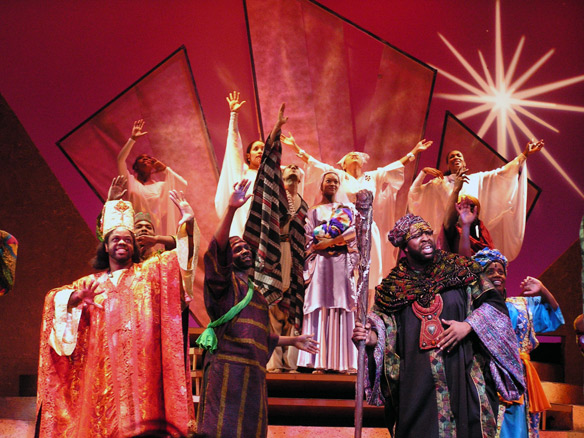
Black-Nativity-by-true-Colors-Theatre-Company-photo-courtesy-of-Soul-of-AmericaThe poet Langston Hughes wrote a play called “Black Nativity,” a joyous African-American retelling of the story of the birth of Jesus with gospel music, and it has become a holiday perennial. Now it has been adapted by writer/director Kasi Lemmons (“Eve’s Bayou”) with a framing present-day story of a prodigal daughter, estranged from her parents for 16 years, brought back home at Christmas as “Black Nativity” is being performed in her father’s church.

Oscar-winner Jennifer Hudson plays Naima, a single mother in Baltimore who has lost her job and is trying everything she can think of to keep her home.  But even with two jobs, she and her 15-year-old son Langston (17-year-old Jacob Latimore), named for the poet, are about to be evicted.  Niama has no other options left.  She puts Langston on a bus to New York to see the grandparents he has never met, knowing nothing about them or the cause of their estrangement.

Langston is hurt, lost, and angry.  He is frustrated that he cannot do more to help his mother and determined to find a way to get her the money she needs to keep their home.  Things go badly when his bag is taken by a kid as soon as he gets off the bus and he is arrested trying to return a man’s wallet because the police think he is trying to steal it.  In jail, he meets Loot (Tyrese Gibson), who jeeringly calls him “Lunch Money” and makes Langston feel powerless and disrespected.

His grandfather, Reverend Cornell Cobbs (Forest Whitaker), is formal and reserved.  His grandmother, Aretha (Angela Bassett) is affectionate but clearly in pain over the past and afraid of being hurt again.  Langston will do anything to feel that he is taking control of what is happening to him so he can return home.

Impressionistically told, with songs that serve as monologues, the movie becomes more powerful when Cornell’s church stages a gorgeous production of “Black Nativity” and Langston nods off to have a gospel-inspired dream that features Nas and, as an angel with white hair sticking up like a dandelion ready to make a wish, Mary J. Blige.  When Langston sneaks out of the service in a desperate attempt to get the money, it leads to a confrontation revealing in ways he could not anticipate.  The concluding scenes of redemption and reunion are tender and transcendent.  

Parents should know that the storyline concerns foreclosure and eviction, family estrangement, law-breaking, teen pregnancy, and abandonment.  A teenager uses a gun.

Family discussion:  Why didn’t Langston’s family want to tell him the truth? What did the watch symbolize to Cornell?  What did we learn from Langston’s dream?

If you like this, try: the poetry of Langston Hughes

Related Tags:


Based on a play Drama Family Issues Holidays Movies -- format Musical Stories about Teens

Ender’s Game

Posted on November 1, 2013 at 6:35 pm

endersgame

Director Gavin Hood (“Tsotsi”) has skillfully adapted the Nebula and Hugo award-winning novel about a boy who leads an interplanetary battle against insect-like aliens, doing justice both to the fun of the sci-fi action and to the seriousness of the book’s themes.   The story has been adapted for film — Ender is several years older in the film than in the book and an extended and astonishingly prescient subplot about his siblings writing something resembling blogs and becoming highly influential political commentators has been dropped.  But it is very true to the spirit of the book and its characters and with special effects technology vastly beyond what was possible when the book was written, spectacularly realizes some of the book’s most thrillingly imaginative passages.

A memorable scene in Kevin Smith’s “Clerks” has its two slacker heroes arguing about one of the most rousing moments in the history of film, the destruction of the planet-destroying Death Star in the original “Star Wars.”  Randall points out that while the Jedi and the audience are cheering the explosion, they are overlooking the fact that the Death Star, still under construction, was not staffed with military but with independent contractors, who are at least arguably innocent bystanders in the conflict and unarmed.  In the middle of a raunchy comedy there is suddenly a more nuanced moral sensibility than is exhibited in the the usual big-budget sci-fi extravaganzas.

That is what makes the Ender’s Game series by Orson Scott Card so compelling.  The original book has been a worldwide best-seller for more than 20 years.  Like “Star Wars,” “The Matrix,” and other YA favorites, it is the story of a “chosen one” of extraordinary skill who takes on the oppressive and vastly powerful but corrupt enemy, and it is filled with exciting action.  But it also engages directly, thoughtfully, and sometimes provocatively with profound questions that are even more apt today than they were in the 1980’s: Should we sacrifice the interests of one person to benefit the rest of the world?   Should we stage a pre-emptive attack by an enemy that is not currently demonstrating aggressive behavior?  What is more important, the ability to win a battle or the ability to feel compassion or empathy?

The setting is at a time in the future when earth has successfully defended itself against an attack by an insect-like race of aliens called Formics and disparagingly referred to by humans as Buggers.  The effects of the war against the Formic were devastating, and the entire resources of the world have been turned to just one goal — seeing out the Formics and destroying them to make sure that they can never return to attack the humans.  They have determined that only a child has the reflexes, flexibility, and singleness of purpose to lead that attack.

All children are fitted to monitoring devices so that the military can see how they behave and find the likeliest candidates for military training.  Couples are strictly limited to no more than two children.  The Wiggins family is permitted a rare third because their son and daughter, while not suitable for training, show extraordinary ability.  The third is Ender Wiggins (“Hugo’s” Asa Butterfield in a considered performance of great dignity and focus), whose deliberate but savage attack on a school bully brings him to the attention of the commander in charge of training, Colonel Hyrum Graff (Harrison Ford, returning to space for the first time since the “Star Wars” trilogy).  Ender is brought to a space station for a series of training exercises called “games.”

A disagreement between Graff and Major Gwen Anderson (Viola Davis, once again speaking on behalf of humanity) is one of the film’s clearest statements of the moral conflict it lays out.  Anderson wants the training to do what is best for Ender.  Graff wants it to do what is best for humanity, and if that means inflicting the kind of trauma and encouraging the kind of brutality that will make Ender a better commander, he is willing to make that trade-off.  Of course it is out of the question to consult Ender or his parents.  Card wisely makes it clear that there are two questions here.  One is whether the ends ever justify the means.  The other is who should decide what ends or means to consider.

The games are fascinatingly constructed and the battles in the weightless chamber with freeze-ray weapons are absorbing and immersive.  It gets more exciting when a new teacher with a fabled history and an impressive Maori face tattoo (Ben Kingsley) takes over.  The climactic battle is as dramatic as we hope, but it is a remarkable twist and a surprising coda that bring depth and meaning to the story.


NOTE: In real life, author Card has demonstrated hateful homophobic bigotry that has led some people to call for a boycott of the film.  Here is my view: I believe that the principles of courage, integrity, compassion, empathy, and service to others that “Ender’s Game” promotes are essential values.  While I regret that the author’s ugly and bigoted statements show that he himself is still struggling to learn the lessons of his book, I agree with the poet Don Marquis that “an idea is not responsible for the people who believe in it.” The best of his vision should be shared with young people in the hopes that the next generation will transcend some of the biases of the previous ones.

Parents should know that this film includes extended sci-fi violence and peril with characters injured and killed, themes of interplanetary genocide, brief mild language, theme of child soldiers and moral conflicts, and bullies.

Family discussion: What does it mean to win “the right way”? Was Graff or Anderson right about the best way to treat Ender?

If you like this try: The book and its sequels by Orson Scott Card and the “Star Wars” movies starring Harrison Ford.

Related Tags:


Action/Adventure Based on a book Science-Fiction Stories about Teens

Carrie

Posted on October 17, 2013 at 5:50 pm

The remake of “Carrie” is not a bad movie; it’s just a completely unnecessary one.  The 1976 original is a horror classic, directed by Brian de Palma and the first film based on a novel by Stephen King, just 26 years old when he sold the rights for $2500.  Both of its stars were nominated for Oscars, almost unheard of for a genre film, and it is number 46 on the American Film Institute’s list of the top 100 thrillers.Carrie poster
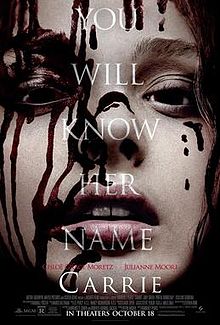
The idea of updating the story of the bullied high school girl to the era of Facebook and YouTube had some intriguing possibilities, especially directed by Kimberly Peirce, whose extraordinary “Boys Don’t Cry” had an insightful authenticity in the portrayal of young people who felt like outsiders.  But there is nothing especially timely, revealing, or surprising in this remake.  The performances are not up to the level of the original and even the special effects do not seem much better than those in the version that came out when Gerald Ford was President.

Less than a moment into the film, we are already immersed in blood.  We hear screams and we see a Bible.  Margaret White (Julianne Moore) is in bed, the sheets all bloody, moaning and praying.  She thinks she is dying and she thinks it is because she is being punished.  But the pains she feels are contractions and she is shocked to find a baby emerging from her.  At first, she wants to kill her new daughter with her sewing shears.  But she loves the newborn too much to hurt her and, as we learn, she sees the baby as another chance for her to be pure, to be kept safe from the predations of sin and the devil.

We then see Margaret’s daughter, Carrie (Chloë Grace Moretz of “Kick-Ass” and “Let Me In”), a shy, repressed, somewhat backward senior in high school and ignored or insulted by the other girls.  She gets her period for the first time in the locker room after PE and becomes hysterical.  Like her mother, she has no idea what is going on with her body and she thinks she is dying.  The other girls are horrified that she is so ignorant and make fun of her, throwing tampons and sanitary napkins at her.  Chris, the ringleader (Portia Doubleday) gets it all on her cell phone camera and uploads it to YouTube.

Margaret seems to think that if she had been able to keep Carrie “pure” she never would have gone through puberty.  She locks Carrie in a small closet under the stairs and tells her to stay in there and pray.

But puberty seems to have unlocked some special powers in Carrie, powers that seem tied to her emotions.  As she sits in the principal’s office, his water cooler bubbles and then explodes. Carrie gets books on miracles and telekinesis from the library and begins to see what she can do and how much she can control.  For the first time, she begins to sense some independence and to rebel against her mother.

Sue (Gabriella Wilde) feels guilty about her role in making fun of Carrie and asks her boyfriend, Tommy (Ansel Elgort, soon to be seen in both “Divergent” and ‘The Fault in Our Stars”) to invite Carrie to the prom.  She says no at first, but then accepts, and his kindness and courtesy make her feel appreciated for the first time.  Until….

And that’s the thing.  Everyone knows what happens at the prom.  It is one of the most famous images in cinematic history.  This replay adds nothing new.

Moretz is a thoughtful and serious young actor, but she is better at playing a precociously sophisticated and capable character like Hit Girl or even the friend of the Wimpy Kid than she is at trying to show us the innocent and vulnerable Carrie.  More at fault is the script, which fails to provide a consistent emotional truth for the character. Like the Hulk, her powers are rooted in fury.  King, even in his 20’s, knew how satisfying that would be for everyone who has been picked on (that is everyone), and Moretz is at her best when enjoying the sense of righteous revenge.  To make the movie work, though, that would need to be balanced by an underlying sense of the character that is never there.  The same goes for Margaret. In 2013, the thoughts of a religious fanatic open up some possibilities worth exploring but Peirce is more interested in re-creating the original than updating it.

Parents should know that this film has extensive and graphic peril and violence with many characters brutally killed, disturbing and bloody images, sexual references and situations involving teenagers, a graphic childbirth scene, teen drinking, and strong language.

Family discussion:  Why were the girls so mean to Carrie?  How has bullying changed since the story was first written?  How did Carrie feel about her powers and why?

If you like this, try: the original film and some of the other Stephen King adaptations like “The Shining” and “Sleepwalkers”

Related Tags:


Based on a book High School Horror Remake Stories about Teens Thriller
THE MOVIE MOM® is a registered trademark of Nell Minow. Use of the mark without express consent from Nell Minow constitutes trademark infringement and unfair competition in violation of federal and state laws. All material © Nell Minow 1995-2026, all rights reserved, and no use or republication is permitted without explicit permission. This site hosts Nell Minow’s Movie Mom® archive, with material that originally appeared on Yahoo! Movies, Beliefnet, and other sources. Much of her new material can be found at Rogerebert.com, Huffington Post, and WheretoWatch. Her books include The Movie Mom’s Guide to Family Movies and 101 Must-See Movie Moments, and she can be heard each week on radio stations across the country.

Website Designed by Max LaZebnik