
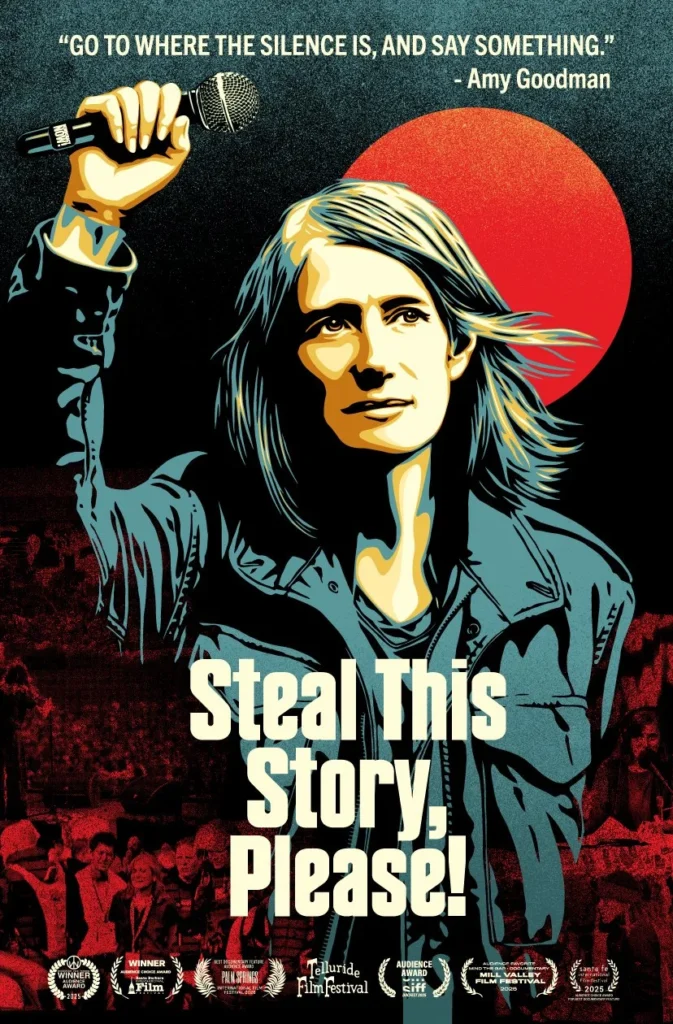
Steal This Story, Please!
Posted on April 30, 2026 at 5:37 pm
B +| Lowest Recommended Age: | Middle School |
| MPAA Rating: | Not rated |
| Profanity: | Mild language |
| Alcohol/ Drugs: | None |
| Violence/ Scariness: | Scenes of real-life violence, people injured and killed |
| Diversity Issues: | A theme of the movie |
| Date Released to Theaters: | May 1, 2026 |
Civil rights activist Bayard Rustin popularized the phrase “Speak truth to power” as a foundational tactic of holding authorities accountable and progress toward a more just society. And H.L. Mencken is often credited with the obligation of the journalist: “To comfort the afflicted and afflict the comfortable.” No one has exemplified that directive with more passion over more time than Amy Goodman of Democracy Now! She has more than earned the exclamation mark at the end of both the name of her organization and the name of this documentary about her life and work reporting the news from the perspective of ordinary people.
As the movie opens, it is 2018 and she is literally chasing after P. Wells Griffith III, then the Trump administration’s climate advisor in his first term, currently Senior Advisor in the Bureau of Political-Military Affairs, at the U.S. Department of State, and one-time a managing director at one of Washington DC’s most powerful K Street “communications” firms working on behalf of the oil industry. He insists that he has to rush to a meeting as she peppers him with questions about what he is doing there. “You weren’t running late when you were just standing there.” He accuses her of harassing him and tells her to set up an interview. But when she tries to follow up with his aide, they literally shut the door in her face.
We then see her asking then-President George H.W. Bush, “What do you say to those who say that you’re a war criminal?” And a provocative question for her, “You’re an activist and journalist. Can you do both?” Stephen Colbert, on “The Colbert Report,” jokingly calls her a communist. Rush Limbaugh, not joking, calls her a radical leftist. And we see her reporting, over decades, from every part of the world where people in power are putting people without power at risk, from Haiti to Gaza and all over the United States. Her reporting helped to free a wrongly imprisoned individual in Louisiana after 38 years. She was beaten and held at gunpoint when Indonesian military fired on civilians at an independence rally in East Timor.
Another journalist admits that some journalists do not ask tough questions because they fear losing access. But Goodman never pulls her punches. Every bit of her is fully committed. She even named her dog after an anti-Nazi group in occupied France.
The archival material from her childhood is illuminating and endearing. When she was growing up, her brother David started a family newspaper, reporting on events in their home. When their mother tried to censor a story about Amy getting a spanking, “he really cried censorship, because he was only eight years old.” The newspaper even had letters to the editor “where the whole family fought about issues,” and one from the Goodman children’s grandfather gently disagreed with David’s position on the war in Vietnam, and David responded, “I love you but your views on the war are stupid.”
Goodman is generally considered left-wing, but that is not entirely fair. Unlike some of her competition, who are selective in framing and choosing stories they report, even to the point of having to pay millions of dollars to settle defamation cases, with “local, independent” reporters who are reciting identical scripts from corporate HQ, Goodman has consistently reported the facts from the perspective nearly all other journalists overlook, the impact of the news on ordinary people. When she gets in trouble, it is not about spin, but about the Rustin and Mencken standards for reporters. This movie is a welcome reminder that it is the irritating, provocative, relentless journalists who are an indispensable foundation for democracy.
Parents should know that this film includes depiction of violence and conflict.
Family discussion: If your family had a newspaper, what stories would it include? What news sources do you think are most trustworthy and why?
If you like this, try: listening to Goodman’s reporting and other documentaries about pioneering journalists, like “Writing With Fire,” “Bad Press,” “The Most Dangerous Man in America,” and “Cover-Up”