

Red Tails Interviews: Terrence Howard, David Oyelowo, and a Real-Life Tuskegee Airman
Posted on January 18, 2012 at 8:00 am
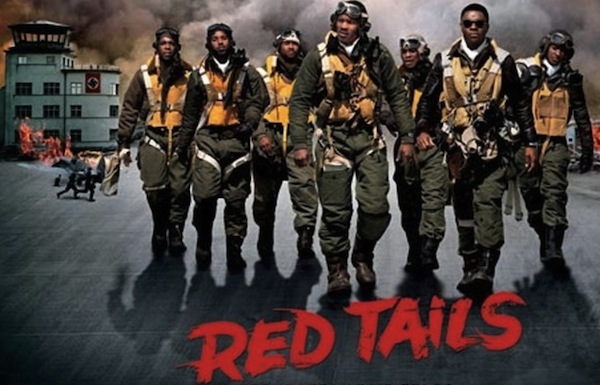
Dr. Roscoe Brown, who flew planes as one of the heroic WWII Tuskegee Airmen, a black man defending a country still cruelly segregated, fighting in one of the most honored military divisions in American history, saw a film made about their heroic missions and last week attended the White House to meet with the first black President and First Lady of the United States. It is called “Red Tails” after the distinctive color painted on their planes. Dr. Brown, who turns 90 this year, earned a PhD, taught at NYU for 27 years, then became president of Bronx Community College, a part of the City University of New York (CUNY). Dr. Brown and three other Tuskegee Airmen were on the set throughout the filming of “Red Tails” to provide guidance and ensure authenticity. With three other critics, I spoke to Dr. Brown, director Anthony Hemingway, and actors Cuba Gooding, Jr., Terrence Howard, and David Oyelowo about the film. We loved meeting the actors, but speaking to Dr. Brown was one of the thrills of a lifetime.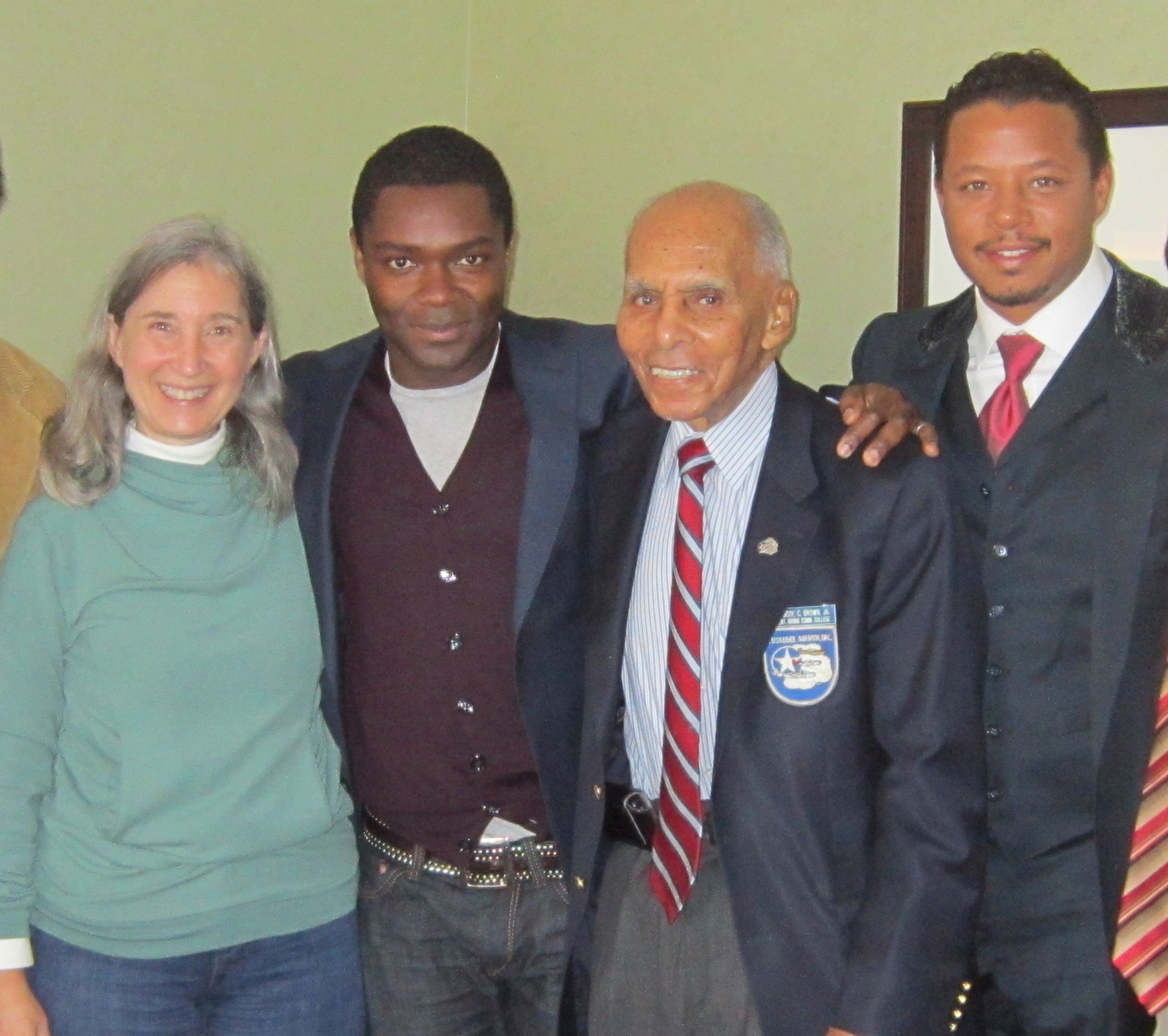
“We were young people, 19, 20, 21, 22-years old,” Dr. Brown told us. “Everybody was in the military at that time. There were 15 million people in the military, 5 million blacks. So it was something you did. You knew you had to do it. You wanted to defend the country. And we felt as African-Americans, that if we did well, the larger society would recognize the stupidity of segregation and de-segregate. Which in fact happened when President Truman signed the executive order in 1948 de-segregating the military, six years ahead of the desegregation of the schools with the Brown decision. It was something that we had to do but something we wanted to do — particularly in the case of aviation because they said blacks could not do it. Whenever someone says you can’t do something, you want to do it! So we said, ‘Let’s be the best we can be.’ And that’s what this film portrays.” He worked for more than 30 years to try to get a movie made about the experiences of the Tuskegee Airmen, originally with the late director Gordon Parks. When George Lucas got involved, he brought them out to the Skywalker Ranch, where he had assembled extensive research. “We sat down in the room and talked to them about how we actually flew, how we used the stick, where we looked, how small the cockpits were — no Tuskegee Airmen were 6’5″ because you had to be small to fit in the cockpit.” It was important to him to honor those who flew, those who supported them on the ground, and those who did not come home. He spoke about the difficulty of losing someone one day and having to get up the next day, put that out of his head, and go up again and focus on the target. And he spoke about what he thought was the real message of the film: “It’s cool to be smart.”
He told us a harrowing story about the time he flew so close to a train he knocked part of the wing off and he was too low to bail out. He thought he had been hit by anti-aircraft but when they got back the ground crew pulled a piece of the train out of his wing.
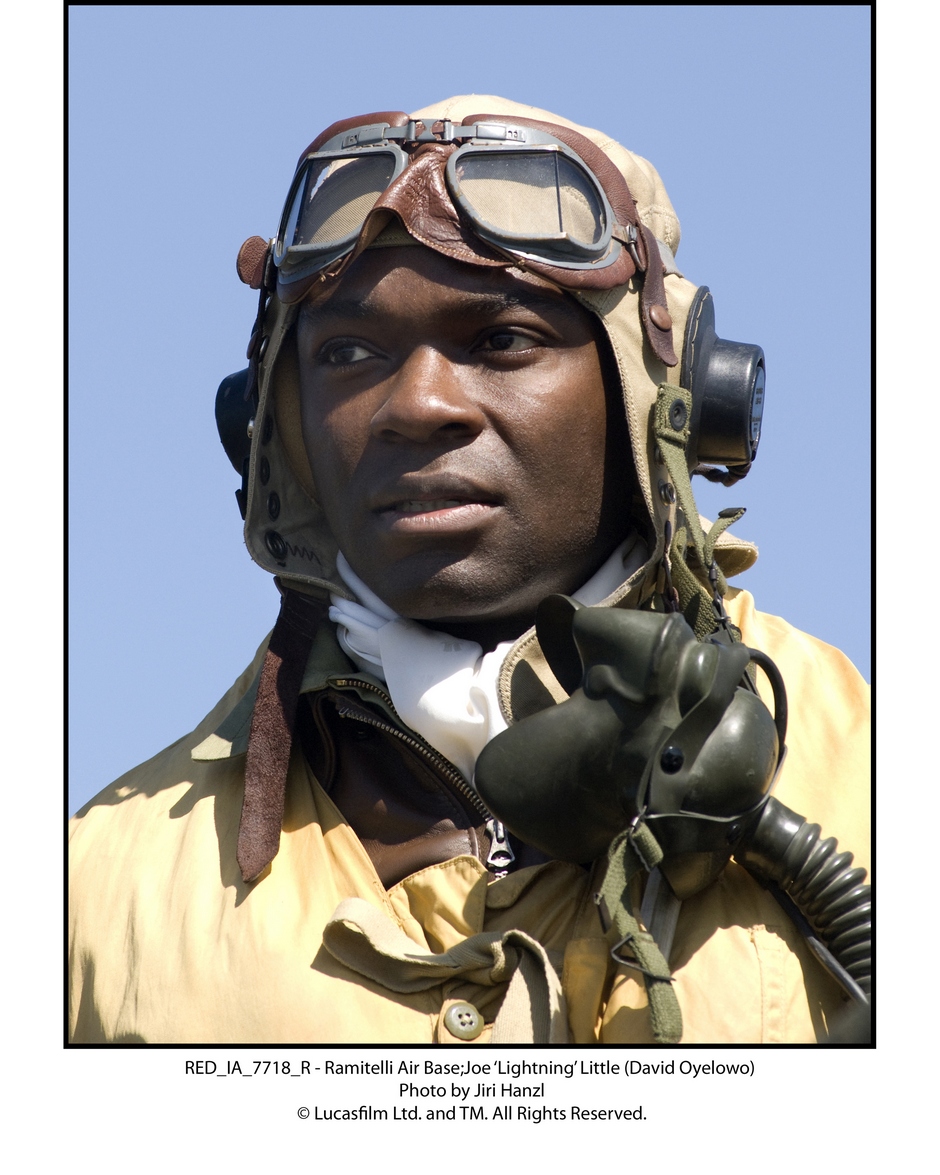
The actors told us how much it meant to them to spend time with the real Tuskegee Airmen and bring their story to life. British actor David Oyelowo plays a brilliant but impulsive pilot with the call sign “Lightning.” “One of the greatest inspirations for me was getting to hang out with Dr. Roscoe Brown and the other Tuskegee Airmen. You look in their eyes and you see that glint, that can-do, that audacity that it had to have taken for them to do what they did. And George Lucas gave us a mandate when he effectively godfathered the movie. He told us, ‘We want to make a film about heroes, not victims.’ The fighter pilots are the glamor boys of any war.” He described his character as “someone who can unashamedly say, ‘I’m the best damn pilot in the whole army!’ That was my mandate for playing the character, really. “So many of the incredible things in the film, blowing up the battleship and the train, these are based on things that actually happened. When we talked to the real guys, it was like ‘Push it! We did more!'” I asked about the challenge of playing a character with so much of the face covered by the oxygen mask. “That was a frustration. One of the gratifying things was finding out that it was a frustration for you guys,” he said, turning to Dr. Brown. “They didn’t particularly like these masks, either. At one point I hint at that, ripping it away from my face. I remember talking to you and you’d say they’d get sweaty and slip. They were an encumbrance. But that’s the job of the actor. That was one challenge. Another was that we didn’t have these hundreds of planes all around us. We had to imagine that in this very controlled environment. It was a great acting exercise because it did that thing you really want as an actor, to have your imagination very active.”
Terrence Howard spoke about having to respond to the racist comments made by a superior officer (“Breaking Bad’s” Bryan Cranston) within the context of a military chain of command and as a man of the 1940’s whose entire life had been spent under segregation. “I learned something very early on. My brother said to me, ‘How do you think God views you? Does he view you as who you are today or as who you will be once His son’s blood has been poured in your behalf and you’ve had time to gain that?’ I think Colonel Bullard, who was the cinematic example of a man named Colonel Ben Davis, who went to West Point. No one spoke to him for four years. He saw them as making mistakes and immature and un-evolved in their understanding of human relationships and abilities. And so he was always able to look at the better side of people. What was beautiful, is that Cuba and I, after battling against each other in films or trying to get the same role, we actually split Benjamin Davis into two and Cuba was Benjamin on the base and I was Benjamin in Washington.” He studied the military people of today to learn how they conduct themselves. “It’s protocol. It’s respect. You see the standard and how people hold themselves, the comportment and that is passed on to you.”
They talked to us about what it was like to bring their movie to the White House. “President Obama was so cool,” said Oyelowo. “And there we were, with some of the Tuskegee Airmen, and the actors, in these rooms so laden with history, good and bad. And then having this untold story of these unsung heroes presented by the first African-American President. There was just something so right about it, and everyone was acknowledging it. It felt like a moment, the moment that the blood and DNA of Martin Luther King, of the Tuskegee Airmen, of Obama’s legacy is in that as well. On these press tours, we all have our photographs taken and we all pose with our best sexy smile. But yesterday, we were all just like this,” he said with a look of dazed bliss. He said he felt like a superhero when he saw himself in the uniform, and told us how much he loved looking through the photographs of the Tuskegee Airmen because their spirit and confidence were so evident in their poses and expressions.
They all emphasized that the story is universal. “It so far surpasses any limitation associated with the hue of any one’s skin color,” said Howard. “Every member of the family can appreciate the contribution that these men made, and the heroics of youth. They didn’t go to school to become pilots. They went to school to become lawyers and doctors. But when the call to duty came, they lent themselves. They showed excellence. They became the greatest pilots of all time. And now every human being on the planet can appreciate it because what one human being does shows us what all of us are capable of. When we see that excellence, we all share in it.” He spoke of how touched George Lucas was to come out of an early screening and see two white children pretending to be the pilots they had seen in the film.
They spoke about the parallels between the challenges faced by the Tuskegee Airmen in the 1940’s and the challenges still faced by black actors today when the subject came up of George Lucas’ difficulties in getting financing for the film. The actors were honored by the opportunity to tell the story and grateful that the heroism of the Tuskegee Airmen created an opportunity for them to do what they love to do.
“I was told by my great-great-grandfather that limitation brings about genius,” Howard said. “When you have limited resources, limited opportunity, and a limited period of time to accomplish something, that’s when the human spirit shines. It has been a difficult struggle but it has made me a much better actor. The Tuskegee Airmen were not initially wanted. They were not allowed to fly so for the first year and a half or two years they had a ton of time to practice and become perfect. By the time they were able to participate they were all seasoned pilots. That’s what happens to the black community of actors. Because we don’t have as many opportunities to play, we play amongst ourselves and get so much stronger, with so much more spirit. None of the other films I’ve done got a screening at the White House,” Howard said. “It was a long time coming and I am glad we were able to participate in it. For me, there’s a scripture in Isaiah, where he says, ‘Ten Gentiles will grab the skirt of a Jew and get into the Promised Land.’ I feel like forever David’s any my legacy will be attached to the legacy of the Tuskegee Airmen. We will always be the face and the voice for their accomplishments.” Oyelowo said, “For me, it means a lot to be part of a large black cast where we’re the center of our own story and its being done on such an epic scale. I hope we can blow out of the water the idea that there can only be one — who’s the next Denzel? Who’s the next Poitier? There’s a lot of talent out there who are worthy of being given an opportunity. Like the Red Tails, we’re not looking to just do this movie and be a footnote. They went on to do extraordinary things. My hope and prayer is that we get to take advantage of this opportunity we’ve been afforded.”
“It’s a great story. All the actors were fantastic, replicating what we did,” Dr. Brown said with pride. I teased him, “And you were all that handsome, right?” “We were better looking!” That’s the Tuskegee Airmen spirit!
“As an African-American who has always been on the forefront of trying to break barriers,” Dr. Brown said, “this was another barrier to break. Hopefully everyone on America will identify with the movie, will identify with the fact that excellence overcomes prejudice, overcomes obstacles. And if we did it 65 years ago, the young people today of all backgrounds can do it now.”


 , out today on DVD and Blu-Ray, In Demand and iTunes!
 , now available on DVD. She spoke to me about the movie and about the way her faith leads her to projects that share her message of faith and God’s love for each of us.
 . It’s a 30-day devotional that invites the reader to dive into the heart of God and discover 30 aspects of His love we might not always see or understand. Each one is on 30 different ways that God loves us. It’s really personal but people really seem to respond to it. I love women and I minister to women and
  it was because I desperately needed to be reminded of who I am in Christ. I needed to assured and reminded of my value and my true worth, not based on what I look like or what I have or how I perform but on how He says about me me. The same thing with this book. I needed in my own life to be reminded of God’s actual, unshaking, immeasurable love for me. As I pored over scripture, I just saw it flying off the page. I started writing down a list of the aspects, the qualities of God’s love, His nature. I thought, if I need this, maybe someone else needs encouragement. When I’m walking through shadow times and in heartache or pain or disappointment, when it seems He cannot see me, when I can’t see His love at all, it is steadfast and always there.


