
Interview: “The Book Thief”

Posted on November 15, 2013 at 8:00 am

Following an extraordinary evening presenting the film at the U.S. Holocaust Museum, with survivors in the audience, some of the people behind “The Book Thief” sat down for an interview.  Director Brian Percival, who introduced the film, joined stars Sophie Nélisse, who plays Liesel, the title character, Geoffrey Rush, who plays Hans, her foster father, and the young Australian author of the book that inspired the film, Markus Zusak.

I began by asking Zusak about the book’s title.  Is Liesel really a thief? “I remember reviews at some point said, ‘She hardly even steals any books!’  I added up one all of the books listed in the novel and there were about seventeen, mostly titles I made up, and I counted how many she actually stole.  I decided she had stolen enough and it was a good title.  It felt right.  The Book Borrower?  It wouldn’t work as well.  It’s also different in the book when you make all those coincidences come together.  But the book had a reason for the mayor’s wife to keep the window of her library open.  She wanted it cold so she could go into that room to suffer and think about her son who died.  In the Portuguese version, it’s called The Little Girl Who Stole the Books, and that sounds so poetic in that language.”thebookthief2
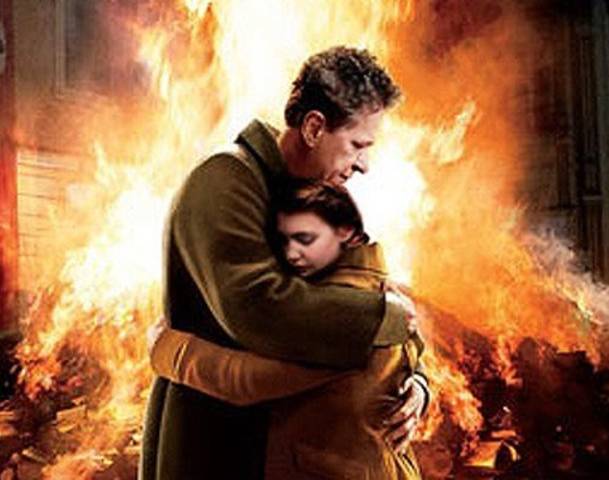
I asked Sophie Nélisse if it was hard to play a character who does not talk very much, especially in the beginning of the film.  “My mom says that my face can say everything, so if I’m bored you can see it clearly on my forehead. I think it came naturally but it was wonderful working with Brian , who always made me feel very special.  If I did a scene badly, sometimes he would go, ‘Oh, can you maybe try this?  Go a bit this way?’  He would give me maybe five corrections but would always end by saying, ‘But it was great’ or ‘It was perfect.’  He wouldn’t say, ‘Do this,’ or ‘I want Liesel to be like that.’  He would let me do it my own way and then he would guide me.”  She has to look much older at the end of the movie — she said that makeup emphasized her cheekbones, and Percival added that they put a ramp and had her in heels to make her taller next to the other actors.  “The Alan Ladd phenomenon,” joked Rush, referring to the notoriously short actor who had to stand on a box for his kissing scenes.

Rush said that for his character, playing the accordion was like a monologue on stage.  “You read a script and look at all those elements — what does this character do, what do the other characters do to him and say about him, build up a portrait of what the personality will be.  It was such a vibrant and wonderful dimension of the character.  If it had been a violin it would have been a completely different experience.  I loved the sound of the wheezing bellows.  They were like lungs.  I finally learned the fingering but my tutor would always say, ‘It’s the breathing and the flow.’  That’s a great image for the internal rhythm of Hans.  There were seven pieces we did.  One didn’t make it into the film, but it was a great way to segue the encroaching hostilities — I was playing somewhat facetiously outside the room when the children were singing the anti-Semitic song that had been taught to them.  But the moments of ‘The Blue Danube’ in the bunker.  You can see he’s brought it in to protect one of the dearest things in his life and it’s his way of keeping calm, being familiar, and it’s a classic German/Austrian piece.  The piece he plays later is very well known to a German audience, an old freedom song, an anti-Nazi song.  You’d like to think that’s his way of rehabilitation.  He will get over the shell-shock and having been injured.  There will be some regrowth in the character.  I could express something about the character that was completely abstract.  I would not say this film had magical realism, but as in the novel there were happy accidents that made it filmic.  You can’t hear music in the book.”

Percival spoke about talking to the survivors following the screening.  He acknowledged the difficulty of handling such sensitive material respectfully and was encouraged by the “incredibly positive” reaction of the people who had lived through the Holocaust, and touched that they wanted to share their stories with him, stories that included some of the kindness of German citizens like that shown by Hans in the film as well as the atrocities inflicted by others.  “People actually sold out their friends and their neighbors in some cases because they coveted their property.  I can’t think of much lower than that.  I can understand if you fear for your own life or were brainwashed into believing something wrong.  But to do it for material gain — that is heartbreaking.  One of the guys I spoke to had been protected by farmers who hid him for two or three years right under the nose of the Nazi occupation of France, putting their own lives in peril, taking terrible risks, a noble act.”  Zusek said, as he had at the movie, it was that which inspired him to write the book, the contrast between the best and worst of human behavior that the Holocaust brought out in people.


Related Tags:


Actors Behind the Scenes Books Directors

Interview: CCH Pounder on “Home Again”

Posted on November 14, 2013 at 8:00 am

Home Again is the story of three people, Jamaican by birth but having lived their entire lives in other countries, are who are deported for getting into trouble with the law.  A mother from Canada, a student from England, and a man recently released from prison in the US are all sent “back” to a country they barely know.  It is now available on DVD and streaming. I spoke with the distinguished actress CCH Pounder, who plays the mother of the student who is sent to the other side of the world.

Why did you want to be in this movie?

I’m really interested in highlighting stories from the Caribbean and it is a good script.  It’s the part of the world that I’m from, a part of the world that I rarely see discussed or not well discussed, certainly not seen in the cinemas. I wanted to be part of something that went beyond ‘The Harder They Come.” And so I’ve been looking out for directors and writers who want to highlight that region.

You took on a part with a lot of challenges.  For important scenes, you’re on the phone with your son, which means you’re responding to someone who is not in the same room.   

Even though the role itself is rather small, and you don’t see much displayed on film,  she has to create a back story of somebody who has raised someone and then she’s going to lose them in an instant. It’s precipitated by her desire to teach him a lesson. Everything kind of goes to hell in a handbasket really rather quickly and completely changes their lives and you have to create that in a few scenes mostly on phone calls.

You are with your son in the scene with the lawyer though, and I thought that was a very, very powerful scene.

I think one of the things that I’m really aware of, is sitting in front of people of authority, particularly one here from the third world country where you give them the benefit of the doubt at all times. So if you sit in front of the doctor and he says, you’re dying of cancer and you have three days to live then you go home, you sell everything. And it’s like that kind of voice of authority.  My character has to kind of illustrate that to her son. “I’m going to fix that mister,” you know, that kind of thing. I think a lot of people know what that is when you do it. And also I’ve been in that situation myself, with my immigration papers. You know having to sit and keep a flat face while bad news is being given to you and some of it is acting and some of it pulling from somebody else’s history.

Where that person has all of the power and you just really need them not to be threatened by you in anyway?

Exactly.

Tell me a little bit about what some of the challenges are for a character like the one you play, where she is an immigrant and she’s trying to raise the child in a different culture and give him a sense of what his own culture is like.

Well actually, she doesn’t give him a sense of what his own culture is like, which is really interesting because I will say that the biggest challenge for most people who immigrate is that they have to hit the ground running, they have to find housing, they have to find a job, and they have to start earning a wage very quickly and that wage probably is not much so they’re going to look for two and three jobs. So you spend a lot of your life just saying “Did you behave today, did you take care of this?” And there’s not much you know, “Ah! How was your day?”, “Let’s watch this, let’s eat together”. There is that pressure of maintenance and so when your kid gets into trouble, you try to slam them hard like you could, “This could really be a problem. This could be this, this could be that”. And I think that the talk would affect lawyer and while all those kids get slapped on the wrist where he’s just part of the joyride, which most teenagers around the world are entitled to do if they belong. That’s what would have happened; he would have had a slap on the wrist and said “You see? If you don’t do that, such and such will happen” but instead, it was “bam”, this happens. And it turns your entire world upside down and that it’s not much different about black children living in United States, black young man and their mother constantly hankering, just hammering home. “Don’t go there, don’t do this, don’t hang with them” endlessly hear it and you know.

What do you hope people will talk about on the way home after seeing this film?

Fantastic question, because, I don’t think that this should be the only film about this story but I think this film opens up a dialogue and it has a kind of a universal flavor to it.  There are Eastern Europeans that are sitting in Mexico, there are Mexicans sitting in America, there are Jamaicans, Nigerians, etc. sitting in all these ports, working, raising children, papers, no papers. There are refugees coming in. Life is changing and migrations are moving, and the world is changing in general and these stopgaps of papers are going to be in the end all of things. I thought it’s really important that people start to have a dialogue about what do you do with your children who are basically, the children of the country, simply without papers? Are you going to take them on? Are you going to give them a drivers license? Are you going to make them legal? Are you going to have them become productive members of the society in which they were raised, the only society that they know?  So it has a long way to go in terms of what the conversation could be and I’m hoping that this tiny little film creates a potboiler. I actually witnessed that we screened at the British Museum in London last week and I was there and you know three or four days later, the feedback was, they are still talking about it and I think the cross section of immigrants who were watching in the room who considered themselves British was, it was quite an eye opener to them.

Once I said yes in terms of participation, for me there was not a huge challenge. This is not an unfamiliar story to me. I come from an immigrant family. I know about who has papers, and who doesn’t, and who forged them, and who didn’t, and who survived and who got to step back. I mean it is really not far from my tree. The apple just barely rolled. And so this is wonderful that somebody wrote it and they interviewed forty to fifty deportees in Jamaica in terms of how they got here and all the things and places they came from. And so this story is weaved together by just three people and some people surrounding them, but just three people were actually representing a myriad of stories and maybe that’s why it seems at time so highly dramatic because you are putting in several stories into one person’s life history.


Related Tags:


Actors Interview

Tribute: Marcia Wallace

Posted on October 27, 2013 at 11:24 pm

The brave, beautiful, and very funny actress Marcia Wallace has died at age 70 after a long battle with breast cancer.  I loved her as the receptionist on the old “Bob Newhart Show” and as a guest on 70’s game shows and talk shows, where her wit and impeccable comic timing made her a stand-out.  She won an Emmy for providing the voice of Mrs. Krabappel, the sarcastic teacher with the world’s most impossible fourth-grade student on “The Simpsons.”  When she was first diagnosed with cancer, she became a spokeswoman for those struggling with the disease and an advocate for education and research.  Her book, Don’t Look Back, We’re Not Going That Way is subtitled: “How I overcame a rocky childhood, a nervous breakdown, breast cancer, widowhood, fat, fire and menopausal motherhood and still manage to count my lucky chickens.” A lot of us counted her among our luckiest chickens, and she will be missed.

Related Tags:


Actors Tribute

MVP of the Week: Chiwetel Ejiofor

Posted on October 20, 2013 at 8:00 am

I have been a huge fan of Chiwetel Ejiofor since I first saw him in the 2004 film Dirty Pretty Things. “12 Years a Slave” may be his breakthrough performance, and I hope it encourages audiences to seek out some of his previous work in films as widely varied as Denzel Washington’s sidekick in Spike Lee’s Inside Man, a sci-fi villain in Serenity, a romantic pianist in Woody Allen’s Melinda and Melinda, and a drag queen in Kinky Boots.

He also plays a musician in “Dancing on the Edge,” a miniseries premiering this week on Starz.

http://www.youtube.com/watch?v=uF5LQY2fvWE


Related Tags:


Actors Breakthrough Perfomers

Interview: Daniel Breaker of “Shrek: The Musical”

Posted on October 16, 2013 at 11:25 am

First it was a book by William Steig.  Then it was a sensationally successful series of animated films, featuring the voice talents of Mike Meyers, Cameron Diaz, and Eddie Murphy.  Then it was a blockbuster Broadway smash hit musical starring Sutton Foster, Daniel Breaker, and Brian d’Arcy James as the ogre.  And now the musical is available on DVD, bringing the Broadway experience into the living room.  I am a huge fan of Daniel Breaker’s work in “Passing Strange,” so it was a thrill to get to talk to him about playing Donkey on stage in Shrek the Musical.

What’s the first thing you did when you found out that you were going to be playing Donkey?

I guess I wondered if this is really happening or not. You know the part really came out of nowhere for me. I was actually on vacation with my wife and my newborn so I guess you wouldn’t call it vacation. My new born, he was only two weeks old when I got the call for that part.  There was actually a lot going on at that point right when I got the call. My wife is a director. She was about to start rehearsals for a play called “Ruined” which takes place in Congo and which later won a Pulitzer and so we were on that path. And then “Shrek” came in and now we have this newborn so that was a very, exciting, and exhausting, and stressful for the first couple of months. But that’s just a part you can’t really say no to. I mean when somebody calls and asks me to play the donkey, that’s not really something you pass on.

It’s kind of a challenge because you’ve got people coming who have a strong idea of who the Donkey is. You want to make it your own but you also want to make them happy. How do you walk that tightrope?

Well, you know, what’s interesting about the version that we did is that the animated movies are very specific, right? And what was great was that when we translated that idea onto the stage, no one was pressuring anybody to make a direct steal from the movie to the stage. I think what we were doing was we’re taking some the benefits that come with live theater and applying that to the iconic story. So there was no pressure to impersonate Eddie Murphy or impersonate Cameron Diaz’s voice. If anything, we were celebrating the story even further by taking it unto a live medium. And then we’re almost coming full circle here by bringing it back to the screen with this DVD which, I think, captures all of the living, breathing excitement of the live stage performance and bringing you just a little closer so you can see certain elements and nuances from the acting that you might not see when you’re watching it on stage. So I think it sort of ups the pleasure of watching the story even further.

Donkey’s got a lot of the best lines in the show.

I think Donkey is such a great part because I think there’s a little Donkey in all of us.  I think he is a little bit of a weirdo. He wants a friend. He wears his heart on his sleeve. I think that’s something that we all strive to be like. So, you know, I find him utterly thrilling. And just from sort of like the theater nerd in me, I feel like he is one of these ancient Commedia characters. I think he is completely honest in every single moment of his life. He does not know how to lie. That doesn’t live in his blood. I find it actually so thrilling to be that open and vulnerable on stage. Every night was so much fun. And also, the cast is just extraordinary. I had such a magnificent time playing opposite Brian d’Arcy James. I think even on those exhausted days when I was sick or I was tired, it was just seeing him up there and his very honest eyes and thinking, “Alright. I’m going to do this anyway. We’re going to have a great time.” So it was a thrill every step of the way.  And Sutton Foster — that girl was a machine. I don’t know how she got through that thing of like throwing the green costume, and taking it off doing a tap number, and then just walking around right after a big tap number as if she was not even winded like she just crossed the street. I mean she is extraordinary. And she also makes everything look so easy. And then Christopher Sieber who played Farquaad, the fact that he is the tallest guy in the cast and he was the one on his knees. I thought that was some form of cruelty.  He was wearing that 50 pound rig on his costume and he was still a trooper the whole way.

I love to see families go to the theater and teach kids about this role of the theater.  What’s it like to perform in front of so many kids with their families?

It’s a thrill because you know that if a family is willing to drop the Broadway money to bring their kids to a show that they really actually want to be there. That’s quite an enjoyable experience to have and to watch, you know because sometimes I feel like a little like “Okay, the dad doesn’t really want to be here. It’s football season. He’s going there because his kids wanted to go,” and then five minutes later, he can’t help but crack a smile at how extraordinary this show is. So it’s a lot of fun to entertain in that respect.  Also I was a dad by the time I started the show so it’s just nice to raise this child while also doing this show that is designed for children.

Related Tags:


Actors Interview Live Theater
THE MOVIE MOM® is a registered trademark of Nell Minow. Use of the mark without express consent from Nell Minow constitutes trademark infringement and unfair competition in violation of federal and state laws. All material © Nell Minow 1995-2026, all rights reserved, and no use or republication is permitted without explicit permission. This site hosts Nell Minow’s Movie Mom® archive, with material that originally appeared on Yahoo! Movies, Beliefnet, and other sources. Much of her new material can be found at Rogerebert.com, Huffington Post, and WheretoWatch. Her books include The Movie Mom’s Guide to Family Movies and 101 Must-See Movie Moments, and she can be heard each week on radio stations across the country.

Website Designed by Max LaZebnik