
Interview: Mark Henn of ‘Winnie the Pooh’

Interview: Mark Henn of ‘Winnie the Pooh’

Posted on July 14, 2011 at 3:43 pm

Mark Henn was supervising animator for the iconic title character in Disney’s new animated feature, “Winnie the Pooh” and for Christopher Robin as well.  He is a Disney veteran, having served in the same role for Princess Tiana in “The Princess and the Frog,” helping to design the character and oversee her animation throughout the film, and worked on Ariel in “The Little Mermaid,” Jasmine in “Aladdin,” and young Simba in “The Lion King.”  He talked to me about the challenge of taking on Winnie the Pooh, a character the audience knows well and feels very attached to but who has been interpreted by many different artists over the years.

I love the traditional look of this film.

One of the great sources of inspiration for me has been the golden age of illustration.  Early in my career here at the studio I discovered people like N.C. Wyeth, Rockwell, Maxfield Parrish, E.F. Ward.
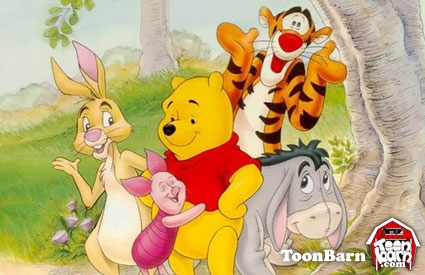
It’s always a little tricky when you’re working with something that’s well-established.  And certainly, Disney’s Pooh is — most of us grew up with these characters, the original three featurettes produced at the studio in the 1980’s, “Blustery Day,” “Honey Tree,” and “Tigger Too.”  We all knew that some of the very best of the studio had the opportunity to animate it.  Now for us it was a great opportunity.  You could tell these guys had a lot of fun with the characters.  It was light, fun, they had these rich characters and charming stories.  We had the same idea now that we had a turn.  And it was important to go back to the original material.  The directors, Steve and Don , went back to the original stories by A.A. Milne to find elements from previously unused stories to put together our current film.  There’s such a charm and sophistication to his story-telling even though it seems very simple.  It’s very elegant.

It was a wonderful chance to stand on the shoulders of what has gone before but John Lasseter also encouraged us to make it our own, bring our own sensibilities as artists and animators as well.  But for me the biggest compliment is to hear people say, “That’s the Pooh I remember.”  Then I feel that I’ve done my job.  After all, that’s the Pooh I remember, too!

I was very captivated by the way the characters interacted with the narrator and the actual text.

Again, it goes back to what had been done.  We screened the originals several times throughout the production and we all loved that, with the narrator breaking the fourth wall and the characters talking to the narrator.  And interacting with the text on the pages — one of my favorites is in “Blustery Day” when the “rain rain rain came down down down” and the lettering gets washed away.  We wanted to build on that and we had the chance with the way the story was structured to take advantage of that.  For me, in one particular instance, Pooh is dejected and he’s walking out of the woods and the narrator is talking and says he didn’t notice that he walked into the next paragraph.  It was just story-boarded that far, with him walking out of the woods.  And he says, “What’s a paragraph?” and he finds the yarn that show’s Eeyore’s scarf tail had come unraveled.  As I was looking at the sequence in a meeting, thinking about animating the scene and thinking about what would be fun, I said, “How about if he picks up the P for Pooh and says, ‘Is there any honey in this paragraph?'”  I liked the idea of his picking up the letter P and looking at it like it might be a box or jar.

It was in everyone’s mind to look at our scenes to see where we could find the entertaining ways to bring these scenes to live within the character and story, which is always the trick.

The backgrounds are beautiful.  Were they hand-done?

Yes, but they use a digital paint system.  It has the same hand-feel as a brush.  It looks like watercolor and the artists still do it by hand but instead of painting on illustration board it’s now done digitally.  You hold the stylus in your hand and all the background painters are terrific painters.  The head of the background department went to the real 100 acre wood in England on a research trip and did a lot of watercolors on site to capture the feel.  They all worked hard to re-create the world that we were so familiar with.

How were you influenced by the original illustrator of the books, E.H. Shepard?

I love his work, I really do.  One of the first things we had to do was settle on which Pooh design we wanted to use, proportions and all that.  When we looked at the films, we realized that each artist that touched the characters had created a slightly different look.  Frank Thomas’ Winnie the Pooh had a slightly different look than Hal Kings, and on down the line.  We all kind of agreed that the work that Hal King did on “Honey Tree” was really the definitive model we should use for Pooh.  So we had our model sheets built around that, but I took it a step further and went back to Shepard to pull out as many images of his throughout the books and created some inspirational model sheets we had all around and in the office so I could always be reminded of what Shepard had in mind and Pooh-isms and poses.


Related Tags:


Behind the Scenes Interview
Interview: Allen Zadoff

Interview: Allen Zadoff

Posted on July 12, 2011 at 8:00 am

Thanks to Allen Zadoff, author of the terrific new book, My Life, the Theater, and Other Tragedies, for answering my questions!

The actors and techies don’t speak to each other in your book, but one character says that in her other school, they are on friendlier terms.  What is the more typical relationship, and why?

There are a lot of variations on the theme.  In my novel, techies and actors are at war. That’s definitely the extreme.  In a perfect world, techies and actors work together as part of the same team. It’s synergistic and there’s mutual respect.  Think about Spiderman on Broadway. The actors’ survival literally depended on the tech crew!  In many theater programs, actors are required to do some tech work, and techies will do at least a little acting. It’s much easier to respect someone when you’ve walked a mile in his shoes, right?  In the real world, my experience is that there’s often a divide between the two cultures.  I’ve been on both sides of it as actor and as stage manager.  There’s tension, even if it’s unspoken. In My Life, the Theater, and Other Tragedies, I took that tension and magnified it.

The perspective of a lighting tech, hidden from the audience and looking down on the show, is something like the perspective of a writer and his characters and story.  How did your experiences as a tech help your observation skills and insights as a writer?

My real observation skills come from being an overweight kid, a subject I wrote about in my first novel Food, Girls, and Other Things I Can’t Have. As a heavy kid, I was a loner and I spent a lot of time watching the world go by and fantasizing about what it would be like to join it. It made for a painful adolescence, but in hindsight, what better training to become a novelist?  I drew on that experience as well as my theater background to create the characters in Life/Theater.

Adam and his best friend Reach have to renegotiate their relationship in the story.  Is that an inevitable part of growing up?

I think when you’re a kid, relationships are on autopilot. (Wait, that’s true for a lot of adults, too!)  You don’t examine the relationship; you just have it.  Then something happens that shakes you up.  Your friend falls in love. You have a fight. You lie. You get betrayed.  Suddenly you wake up to the relationship, what it means in your life, and what you want from it.  That moment of waking up could be called maturity.

What do you like about writing for a YA audience?

The YA audience is passionate in a way no other audience is.  It’s not just the teens. It’s the librarians, the parents, the bloggers, the booksellers.  They’re not YA readers. They’re YA fans and aficionados. I can’t think of a better audience with whom to share my books.  I feel lucky to be a YA author.

What were the books and movies you most enjoyed as a teenager?  

The films of John Hughes were very influential for me when I was a kid.  “Sixteen Candles,” “The Breakfast Club,” Ferris Bueller’s Day Off, even Uncle Buck. (Oh, I miss John Candy.)  Although I was a voluminous reader and could tell you all the novels I read and loved, these films were my YA.  Funny, real, and heartbreaking. I try to capture those same dynamics in my novels.
You and Adam share initials — did any of the experiences in the book happen to you?

Here’s a little secret. I share initials with all my heroes. So I’ll just say this in response to your question.  My first kiss happened in the theater. To everything else, I plead the Fifth.

Why did you choose “Midsummer Night’s Dream” for the play?

Actually, Midsummer chose me. It’s always mysterious where these things come from, and I was in the early stages of planning Life/Theater, trying out different plays, when Shakespeare popped into my head.  I had the image of the lovers in Midsummer running through the forest in the dark, confused by shifting passions, shocked by sudden loss, unsure whether they were awake or dreaming.  Those same themes were the ones I wanted to explore in the book.  Here’s a little inside scoop for readers: Check out the chapter titles in the novel.  Every one is a line (or phrase, or partial line) from Midsummer. I’ve used Shakespeare’s text in a very modern way, something like sampling in hip hop.

Related Tags:


Books Interview Writers

Interview: Nadia Costa of ‘Crime After Crime’

Posted on July 10, 2011 at 12:50 pm

“Crime After Crime” is the story of Deborah Peagler, serving a 25-to live sentence for killing the man who abused her, and the lawyers who fought for her release.  California is the only state to adopt a law that permits the courts to re-open cases if there is evidence of abuse as a factor in the crime.  Peagler was severely abused by Oliver Williams, who forced her into prostitution at the age of 15, beat her with a bullwhip, and abused her daughter as well.  In desperation, Peagler asked friends of hers who were in a gang to beat him up.  They killed him.  She went to prison.  Twenty years later, land use lawyers Joshua Safran and Nadia Costa, with little experience of criminal law but a strong commitment to helping survivors of abuse, took her case to see if the new law would help her to get out of prison.

Costa took time to speak to me about the case, the movie, and mostly about Peagler, whose extraordinary courage, dignity, principle, and wisdom illuminate the film.  Her co-counsel came to the case because of obligation as an Orthodox Jew to “free those who are bound” and from his own experience as a child unable to protect his mother from abuse.  Costa’s connection was less direct but just as personal, based on her experiences as a social worker and her spiritual commitment to helping others.  As she says in the film, she was also inspired by running ultra-marathons, which provided a physical and spiritual level of endurance necessary for what proved to be a six-year process with many devastating setbacks.

The hardest part, she told me, was when the prosecutor’s office reversed its decision to support Peagler’s release.  She dreaded having to tell her client, who was already making plans for seeing her grandchildren and visiting the ocean.  But Costa said that Peagler’s grace, peace, and compassion even in receiving such painful news were a sustaining force in maintaining her own dedication and inspiration.

Related Tags:


Interview
Interview: Brian Stelter and Andrew Rossi of ‘Page One’

Interview: Brian Stelter and Andrew Rossi of ‘Page One’

Posted on June 28, 2011 at 8:00 am

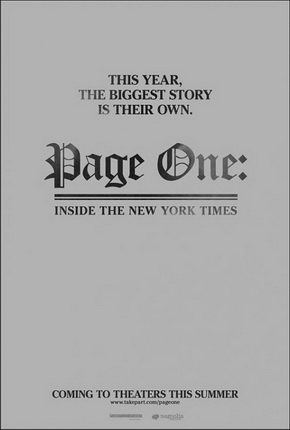
“Page One” takes us behind the scenes at the New York times in a year of turmoil and transition.  We see how its media reporters cover their own industry.  We see the release of the first Wikileaks material and how it competes with and is reported on and interpreted by the main-est of the mainstream media.  We see how the Times buys out and lays off experienced staff and brings on a college student who has been scooping them with his blog about television news.  I sat with director Andrew Rossi and blogger-turned New York Times reporter Brian Stetler in the sunny courtyard of a Washington DC hotel to talk with them about reporting on the reporters and the future of journalism.

A recent law school class was asked how many of them read a paper newspaper every morning and not one hand went up.  What does that mean about the future of newspapers and of news?

Stelter: People get the news in different sources.  They may be getting links on Twitter or Facebook.  As Katrina vanden Heuvel says in the film, there’s lots of information out there. That’s the predicament “Page One” is trying to address.

I thought the most powerful statement in the film was “Daniel Ellsberg needed us.  Wikileaks does not.”  And yet, the movie shows that reader do need  the New York times to digest and interpret and verify the material.

Stelter: In a day where everyone can be a publisher, not everyone can be an editor.  The film fundamentally is about editing. You see reporters and editors figuring out what’s news and what’s not news and in the case of Wikileaks, figuring out how to cover someone who is a publisher, but not an editor.  Wikileaks does sometimes redact material and decide what not to post, but fundamentally they’re not bringing to bear those judgment calls that journalists are.  I love the movie for those scenes with editors where you see them making judgment calls.

We’ve seen new media blow the whistle on failures of old media and old media expose the failures and misrepresentations of new media.  Are we going to be in an endless cycle of “gotcha?”

Stelter: That’s an element going forward, one element of a complicated structure.  It’s good that we can all truth squad each other.  In the film you see the Times trying to decide how to handle a report by NBC news about the end of the Iraq war and eventually deciding not to write about it because it was, I don’t want to say an imagined end but a “mission accomplished” moment.

It was surprising to see in the film the way Brian Williams made NBC’s role a part of the story and fascinating to watch the reaction in the newsroom.

Stelter: It baffles my mind.

How do the changes in media and reporting affect elections and politics?

Stelter: We get more saturated by the day-to-day minutia of the campaigns.  It’s easier to write about and follow along.  What me may lose there is the broader picture.  But the other change is the interactivity.  Citizens now can prod journalists to cover the campaign differently.  Readers, listeners, viewers can push us to do a better job.  We’ve seen some of that already but we will see more going forward.  That’s one reason transparency is such a positive force.  We can talk back in a way we couldn’t before.  I love when readers talk back to me and tell me what to improve on.

I was very intrigued by the use of music in the film.  How did you select it?

Rossi: “Paper Tiger” is the song that plays beneath the credits. It’s by Beck. It has a very sort of somber but driving sound and David Carr’s final lines in the film that drive the song are “The New York Times does not need to be a monolith to survive.” I think that is one of the very important messages of the film. There are multiple voices and there shouldn’t be any Zeus character with thunderbolts saying, “This is the only truth that can be known.” “Paper Tiger,” there’s a double entendre because of the word “paper” but it is also an expression the Chinese have for something that seems scary but really is not. Mao used to use that expression to refer to Russia and England as monolithic powers that were really just made of paper. The song has the right audiophilic quality but also a double meaning. Paul Brill did the score. He’s worked a lot on films that treat very serious topics but in ways that are accessible and have an entertainment value. That is the type of palette we were going for in the film.

You include reporters who cover the business side of the media, but you do not include anyone from the business side of the New York Times. Why is that?

Rossi: There’s a high and firm wall between the newsroom and the corporate side. Bill Keller, the executive editor, authorized the project after various discussions and meetings and it was really done under the purview of the newsroom so we really never butt up against the corporate side. I did request an interview with the publisher and CEO, both of whom declined. The film is really trying to look at the journalism involved, though certainly we treat the financial obstacles.

What’s the difference between writing for the web and writing for print?

Stelter: Paper is so permanent, a one time shot to get it right and there’s a high cost to making a correction. If I write something for the web in the afternoon I can make it better all day and then put the final product in the paper.  Corrections are the first symbol of us opening ourselves up to the public.  This movie is just another form of transparency.

Related Tags:


Behind the Scenes Directors Interview

Interview: Buck Brannaman, the Real Horse Whisperer

Posted on June 23, 2011 at 8:00 am

I loved “Buck,” the new documentary about Buck Brannaman, the real-life horse whisperer who inspired the book and movie.  The film is extraordinarily moving.  Buck’s gift for animals is a wonder, but it is his understanding of people and his own inspiring recovery from abuse that make it so stirring.  It was a genuine privilege to speak with him.

You were training the people on how to deal with the horses, not the horses on how to deal with the people.

Sometimes they don’t realize that when they come to the clinic.  They think we’re going to fix the horse.  But pretty soon they realize the problem is not really about the horse.  It’s really about them.

I love the appearance by your foster mother.

She’s the best.  I can hardly watch the last few minutes of the movie with her in it without crying.  She’s 88 years old now.  And then when there’s a Q&A after the screenings I always go up there crying.  Her and her husband moved to the ranch after WWII.  It’s a small ranch, nothing grand, and they struggled for many many years from one month to the next.  I don’t think they ever had any money to speak of but they always had an open door for kids, long before there was a formal foster care program.  They were the place where people dumped their kids off when they couldn’t get along with them, when they couldn’t get anything accomplished with them, like you might dump off a kitten at a ranch because it could turn out to be a barn cat.  They had four kids of their own and then 17 other boys they raised over 40 years.  I was the last one.

You tell a very moving story about how much it meant to you the first day with your foster parents when your foster dad handed you a pair of work gloves.

I was scared when I met my foster dad because of the horrible experiences I had and the best thing he could do for me was not to put a lot of time into feeling sorry for me.  He knew I needed some direction and a job to do.  I needed something so I could move on.  He knew if we dwelled there too long it was going to be nothing but negative for me.  He did the same thing for me I tell people to do with the horses that are troubled.  We can’t do anything about what happened yesterday or last year but we can live in the moment and do something about it right now.  So we give him a job to do and pretty soon he has something else to think about.

My husband and I are both old enough to remember the TV commercial you made when we were kids.

It’s amazing how many people our age still remember that!  In those days you looked forward to watching cartoons Saturday morning all week long.

Has there ever been a horse you couldn’t handle?

I’ve never found one I couldn’t handle, or couldn’t help.  But occasionally someone will bring a horse to the clinic that is so far out of their league based on their experience.  If they had another couple of thousand horses under their belt than maybe you could do this horse some good.  Sometime the human doesn’t have what they need to help the horse.  It all comes from the horse.   Tom Dorrence, who really was the godfather of this kind of horsemanship, he spent his entire life studying horses and trying to find a way to work with the horse as if he made up the rules how you’d help him to understand, to teach a horse what you’d like him to do.  And being real, it’s not always going to be fuzzy and warm.  Sometimes there’s going to be trouble and struggles but that’s true in all relationships.  It’s true in raising kids.  It’s not always going to be Mayberry RFD.  But you do the best you can.  You try to be as engaged as possible so that when they’re ready for redirection you are there to put them on the right path.

I get everything from Olympic riders and dressage to ranch cowboys to people who ride for pleasure.  The demographic of horse owners spans from one end to the other.  There are places in the country where people still make their living on a horse.  Sometimes the cowboys are the least likely to listen or get advice.  Whatever you’re talking about, the male ego can kind of get in the way.  All of us men have to deal with that one time or other.

And all of us women have to deal with you men dealing with that!  I love the scenes with you and your daughter.  You’re clearly so close and have such a loving, trusting relationship.

I never get tired seeing that.  I always had an idea of the dad I hope I would turn out to be, nothing like my own dad, and I always figured these things applied to people as well as horses.  Even before I had kids I would draw that analogy to people because they could relate to it.  In the back of my mind I always thought, “I sure hope this applies the way you say it does!”  And sure enough it did.

What do you hope people will take away from the movie?

The big picture is that these things apply whether you’re talking about people or horses.  It’s about taking responsibility rather than shirking, that’s true whatever you might be talking about.  And, to be honest, I’m hoping that of all the people who might be seeing this, maybe there will be a handful that might get the idea, “I don’t care so much if I can be like Buck, but I sure would like to be like Betsy and step up and give a kid a home, someone that nobody cares about and nobody wants.”  If that came of it, wouldn’t that be cool?

Related Tags:


Documentary Interview
THE MOVIE MOM® is a registered trademark of Nell Minow. Use of the mark without express consent from Nell Minow constitutes trademark infringement and unfair competition in violation of federal and state laws. All material © Nell Minow 1995-2026, all rights reserved, and no use or republication is permitted without explicit permission. This site hosts Nell Minow’s Movie Mom® archive, with material that originally appeared on Yahoo! Movies, Beliefnet, and other sources. Much of her new material can be found at Rogerebert.com, Huffington Post, and WheretoWatch. Her books include The Movie Mom’s Guide to Family Movies and 101 Must-See Movie Moments, and she can be heard each week on radio stations across the country.

Website Designed by Max LaZebnik