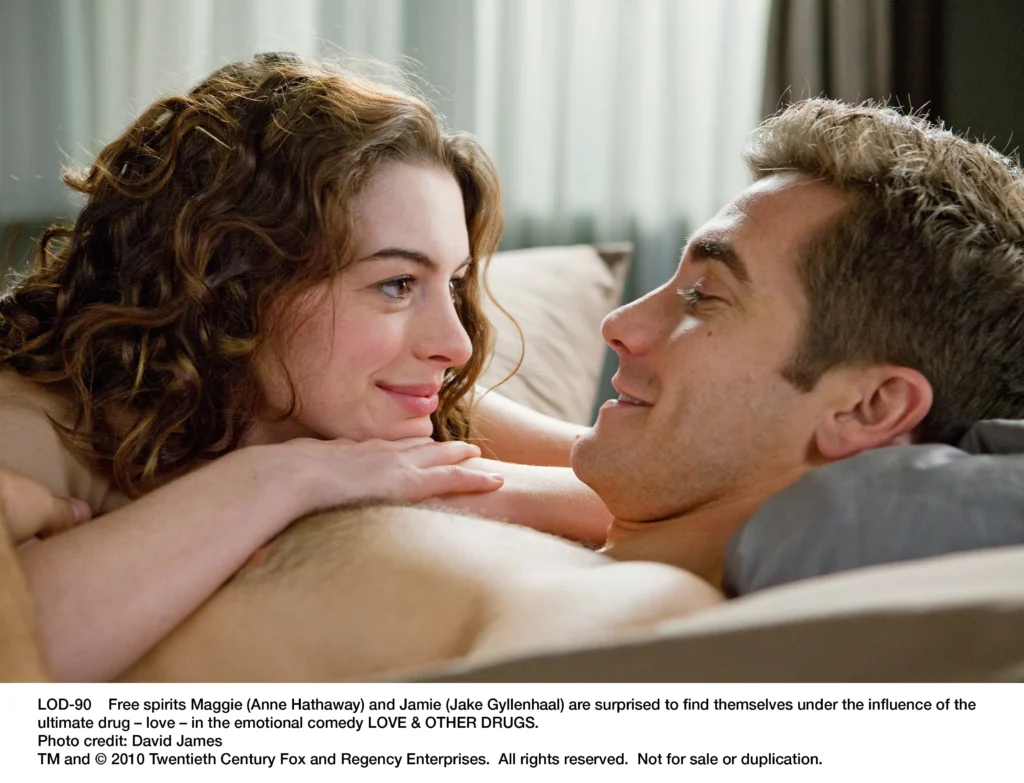
Edward Zwick can create grand spectacle (“The Last Samurai,” “Glory,” “Defiance”) but he is unsurpassed in creating honest moments of intimacy in couple relationships, from “thirtysomething” to “Once and Again” with his frequent partner, Marshall Herzkovitz. Zwick is co-writer and director of “Love and Other Drugs,” a very sexy romance set in the 1990’s world of pharmaceutical sales and health care challenges. Anne Hathaway and Jake Gyllenhaal, who played an unhappily married couple in “Brokeback Mountain” reunite in this film as a pair who are less naked with each other in the literal sense as they become more open to each other emotionally. I last spoke to Zwick about “Defiance” and was thrilled to have a chance to meet with him again to discuss one of my favorite films of the year.
Where did the movie come from?
Jamie Reidy wrote this book, Hard Sell, which doesn’t have a lot to do with the movie, but it is about his experiences as a pharmaceutical rep at the time of the introduction of Viagra. And a very talented guy named Charles Randolph wrote a draft of the script and it talked a lot about the Viagra experiences but it didn’t talk about the relationship that much. And then Marshall and I took that, keeping a lot of stuff that was Charles’ that was really good but also trying to add stuff we felt it needed.
It was a very interesting moment in American cultural history. Suddenly the FDA said they were relaxing the rules on advertising drugs to consumers. And consumers were going to their doctors and saying, “I want this.” Ad sales skyrocketed and drug sales skyrocketed. It was a go-go time in the 90’s. Everything was about making money and the character seemed to embody that to me.
We finished the script and then said, “Who is out there right now that really enchants us as actors?” I’d known Jake a little bit. His parents are in the business. I’d seen his work grow and grow and grow and I felt there were parts of him I knew that I hadn’t seen, that I felt I could show people and surprise them with. And Annie’s work was already great, and I saw her in “Rachel Getting Married” and especially Shakespeare in the Park and I said, “This girl is really great. She wants to take risks.” I said, “That’s who I want to do this movie.” I thought, “That’s a very sparkly, very sexy combo, and I went after them.”
They each had very interesting things to say about the script. They’re both very smart, intellectually smart and actor smart. We got to know each other very well. You have to gain a real level of trust to make a movie like this. Can we be both truthful and funny about squirmy personal things? Can we find moments that are relatable beyond just these two? It evoked all sorts of things in my own life and for other people, I hope. It’s contemporary not just about the relationship but about somebody not being able to get their meds.
I was glad to see one of my favorite actors, Hank Azaria, in the film and I thought he was superb as the doctor. He has a difficult part because he has to create a very full character while delivering a lot of information about the medical profession.
He can do anything and do it so effortlessly you don’t see him working. Doctors are kind of this shibboleth in our society. We know what they do and we depend on them but we don’t know a lot about what it feels like from their side. The fact that this guy’s life could be morally ambiguous in certain degrees or that he would have complaints or frustrations or a cynical view of certain things was an opportunity within his character to reveal certain things. It was intrinsic to who his character was as opposed to being a mouthpiece for a movie. The key to write him was to understand what his circumstance was. And Hank is so good he rounds that out and makes it organic.
And what a surprise to see Jill Clayburgh and George Segal, a blast from them 70’s past.
Just to sit on the set with George and Jill was like bathing in the 1970’s movie culture. It was so important to me. They had each done Paul Mazursky movies, “Blume in Love” and “An Unmarried Woman,” those were touchstones to my childhood. And they were generous and fun and we hung together.
One of my favorite scenes in the movie is the Parkinson’s patient group meeting. Those were actors, weren’t they?
No, those were real Parkinson’s patients. I’ve known Michael J. Fox for a long time and I talked to him a lot about this. He said to me, “You have to understand. You can’t make it funny enough.” I said, “I got it.” We got a lot of patients and I gave them a lot of things to say, and then I asked them to tell me about their experience. These are good-hearted funny people reflecting on their experience. Yes, illness is serious, but the indignities are also funny. And that defines my world view. There is nothing that is so serious that you can’t also see its comic side. Comedy is a way of talking about the most serious things. I’m interested in the word “and,” not the word “but.”
How do you market a movie like this?
By showing the movie, by word of mouth. It’s about letting the movie sell itself, by showing the film to people and letting them talk about it. It’ll be interesting because it’s not one thing. It’s not a sequel or a remake or a superhero. It’s not a conventional rom-com. I’m going to a bunch of cities to get the word out. It’s a harder time to make original, less conventional movies. But God, we need them!
Interview: Roger Nygard of ‘The Nature of Existence’
Posted on November 21, 2010 at 8:00 am
The Nature of Existence is a new documentary from Roger Nygard, who visited people all over the world to ask them the hardest and most important questions he could think of, about our purpose and the nature of existence. His interviews included Indian holy man Sri Sri Ravi Shankar (The Art of Living), evolutionary biologist Richard Dawkins (The God Delusion), 24th generation Chinese Taoist Master Zhang Chengda, Stanford physicist Leonard Susskind (co-discoverer of string theory), wrestler Rob Adonis (founder of Ultimate Christian Wrestling), confrontational evangelist Brother Jed Smock, novelist Orson Scott Card (Ender’s Game), director Irvin Kershner (Star Wars: The Empire Strikes Back), Stonehenge Druids Rollo Maughfling & King Arthur Pendragon and many more. The DVD will be released tomorrow.
He was kind enough to take time to answer my questions:
Why are we here?
It took me four years, interviewing over a hundred experts, collecting hundreds of hours of footage,and tons of airline miles to find my answer. The most common answer I got from people was religious, variations on, “To serve God,” “To know God,” “To praise God,” etc… But then that begs the question, what is God? I found that definitions varied widely. As Gandhi said, “there are as many religions as there are individuals.”
We also seem to have this notion that as a goal in life we should be pursuing happiness. But as Julia Sweeney told me, happiness is a false goal, you can’t pursue an emotion — happiness comes as a byproduct of having a purpose in life. So the real question is, how do we find purpose? You can’t give somebody else a purpose, they have to arrive there themselves. But you can give clues; you can help show people where to look, which is what my film is about. I believe the answer is in the film — it’s part of the experience, the journey we’re all on. In the film, you get to see my journey; you see what I learned from Christians, Muslims, Jews, Jainists, Buddhists, Hindus, Sikhs, Confucianists, Taoists, Atheists, Pagans, Native Americans, Baba Lovers, Satanists, everyday people, scientists, and more…. And now I have collected in one movie all their answers to the biggest questions.
What unexpected similarities did you find in the different ways people have of making sense of the world?
I was surprised to discover that religious and scientific motivations stem from the same drive within us. We all share a curiosity about the world, and the Universe. Where we look for those answers is what’s different. I’ve heard the religious describe it as being born with a God-shaped hole in your heart. As you grow and mature you fill that space with something…religion, spirituality, drugs, adventure, sex, or some other pursuit, God being the most perfect fit. The scientists fill that space with questioning and learning. They describe humans as pattern-seekers making connections between things in their environment as they attempt to exert control in their lives. But control is an illusion. There is an old joke, if you want to make God laugh, tell him your plans. Quantum mechanics has made it even clearer that we exist in a Universe that is variable and unpredictable. But we have made great strides in the thousands of years that our species has existed. Where religion used to be the exclusive holder of cosmic explanations, science has been encroaching on religion’s domain, providing more and more answers for how things are the way they are. Who’s right? Whenever I asked a scientist, “Why do we exist?” They would often correct me and say the proper question is, “HOW did we come to exist?” They leave the why question to the religious and the philosophers. I think conflict between religion and science occurs when the “why” and “how” domains get confused as the same thing. To each it’s own. Render unto Caesar….
Did you find some approaches more hopeful than others?
Some approaches are more tolerant than others. I find proselytizing to be destructive. Our best hope for the future is to accept the fact that we will NEVER all agree. Given that, our most hopeful course is to allow others to have different beliefs. Jesus (and others) preached the Golden Rule: do unto others as you would have them do unto you. This is somewhat invasive, however, in that it assumes that everybody else would want the same thing as you. Confucius is known for a negative version of this, also known as the Silver Rule: Do not do to others that which we do not want them to do to us. Essentially, live and let live. To quote Julia Sweeney again, I also like her rewrite of the Golden Rule: Do unto others as you would have them do unto you, but ask them first if it’s okay.
What do people understand least well about those with other beliefs?
Most people (including myself before I began this journey) are unfamiliar with the fact that there are so many other belief systems. There are over a thousand active religions on the planet. How do you know that you were lucky enough to be born into the right one, unless you investigate the others? The whole point of this journey for me was to get to know people with different beliefs, ask them what they believe and why they believe it–without trying to change them into what I think they should believe. I found there are more similarities than differences. As Mark Twain said, “Travel is fatal to prejudice, bigotry, and narrow-mindedness.”
What have you learned about the importance of laughter?
Even though The Nature of Existence deals with some very serious subjects, to me they are comedies. People are fascinating, surprising, and funny. Life is absurd and if you don’t laugh you go insane.
What are some different ways people have of dealing with grief?
Grief, sadness, and loss are necessary to know joy. As one young man says in my film, “We exist to experience emotions.” There has to be a balance, you can’t have only happiness in life. But when we are in the downward part of the cycle, laughter is our strongest tool for coping with setbacks, for combating the infinity of death. The more serious a topic, the more jokes we tell about it.
What inspires you?
I am inspired by great art, great movies, great writing, great musicians, great speakers, great teachers, greatness in human endeavor… And on the contrary, bad movies, bad television, bad art, bad music, I find it depressing that somebody at some time thought that terrible work was good. If you want to be inspired, expose yourself to greatness.
How is your journey continuing? Where will you go next?
I have continued to learn from people at question and answer sessions and post screening discussions. This movie makes people want to talk. A lot. Only half kidding I sometimes announce before a screening, “I should warn you all not to see this film because it will mess with your mind. — But if your mind is already sort of messy, you’ll be fine. If your mind has everything stacked in nice neat piles, they may get jostled though.” Taking on the most challenging questions is a self-perpetuating process, because the result is so rewarding. After finishing the film I was faced with a bit of a dilemma, however: what to do next? What topic could be even more challenging than the very nature of existence itself? I finally found one, a topic even more perplexing and inexplicable: The Nature of Marriage. Check back in a couple years for some answers on that one….
“Client 9: The Rise and Fall of Eliot Spitzer” is a documentary about the New York state attorney general who took on Wall Street, was elected governor, and then, in one of the most spectacularly scandalous falls of the last decade, resigned following charges that he was a customer known as “Client 9” of a high-end escort service that provided expensive prostitutes for wealthy men. Alex Gibney, who has made powerful documentaries about falls from grace: Enron, disgraced lobbyist Jack Abramoff, and post 9/11 torture by the US military, spoke to me about this film. (“Client 9” is now available at xfinity On Demand)
Why did Spitzer agree to do the film?
He wanted “final argument.” he wanted the ability to have his say in a film that was going to be all about him. He knew Peter Elkind from before and he knew we were going to do a rigorous and factual job. So, better to have his story told than not. We made a powerful argument that he was going to have to reckon with his past and that cooperating with us would be a way of dealing with it and then maybe he could move on.
You made an unusual decision for a documentary in having an actress play the role of one of the key players — and not be revealed as an actress until the end of the film. Can you talk a little about that?
She didn’t want her identity exposed, for obvious reasons. There’s a standard way to do that in documentaries — put the person in shadows and mechanically alter their voice. We experimented with that. It was terrible. It turned her into a cliche like a mobster, a monster, like she was in the witness protection program. It created an aura of criminality about everything she did, a cheap stereotype. So I thought, as long as we disclose it, let’s transcribe the audiotapes and then cut them down and that’ll be the script that an actress performs. It will be true to what she said, and more truthful by presenting her as a human being. I found her not just truthful but very affecting, not like the stereotype of prostitutes that we think of, smart and funny and tough. For all those reasons it seemed like the more truthful thing to do. At the end of the day, each film sets its own rules. Our obligation is to let the viewer know what those rules are and that can be accomplished any number of ways.
How do you decide what your rules will be in a given film?
I was very influenced by “The Thin Blue Line.” I heard a wonderful radio interview with Errol Morris where he said, “The only version of the truth I didn’t show was the version I thought happened.” I thought that was a very interesting rule and so I made it my mission from then on to come up with rules that I thought made sense from my standpoint and in terms of the overall presentation of the story. With “Angelina,” we show her two or maybe three times before we disclose that she’s an actress.”
I wanted her to be shocking and I wanted you to be saying, “Oh, my God, we’re really getting inside here” and to experience her as a person without thinking about the device. And then I reveal it but by then hopefully you’ve developed an affect with her as a person. And then you roll with it even though you know it’s an actress.
The movie digs in by having a whole bunch of false starts. It’s a movie all about about things that you think you know and you don’t know know. When you first see that guy in the cowboy hat at the beginning, you think “Why are they putting this painter up front?” And then you learn that he was the booker and he knew Ashley. And then you think that Ashley is at the center of the story and it turns out that she’s not. Nothing in this film is quite what it seems initially.
Why did Spitzer foe and business big shot Ken Langone agree to be in the film?
I think he wanted to be in the film because John Whitehead told him that I was a good listener and he enjoyed talking to us. I found it very refreshing talking to him. There were no handlers, just Ken Langone telling me what he thought. People talk when they’re emotionally invested in talking. As you can see in the film, he is invested in talking. All you have to do is say the name “Elliot Spitzer” and smoke comes out of his ears. He literally foams at the mouth. He is the essence of the “winner take all society.”
Do you think that Spitzer underestimated not just the power and fury of his opponents but his own ability to take on the very different job of being governor?
Spitzer was not comfortable with the culture of the legislature which was one of the great bogs of corruption, a system of greasing. He had a commitment to the power of argument to carry the day and was much more high-handed. I have sympathy for that idea in principle. But Spitzer had a great deal of difficulty in letting other people take credit for his ideas. That would have been smart. Weird rules, double-dealing, entrenched favors and interests. It’s so sclerotic; it’s terrifying.
What would you say that this film is about?
Unlike the film I did just before this, “Casino Jack and the United States of Money” where you could come out of that and say, “Take the money out of politics or we’re done,” this one is harder to summarize. It asks some fundamental questions about human nature and how we judge our public officials. Do we judge them as vehicles through whom we live vicariously or by what they do as public officials? Are we being blinded by scandal in a way that prevents us from seeing stuff that really affects us as individuals?
Marc Erlbaum wants to make films that touch people’s souls. He is the man behind Nationlight Productions, a film and television production company focused on creating inspiring, meaningful content for mainstream audiences of all backgrounds and affiliations. He was nice enough to take some time to answer my questions about his company and his films.
How did this project get started?
I’m a film-maker. I had made a couple of small films that I wrote and directed and about a year and a half ago I formed this company, Nationlight Productions, with an explicit mandate to make more positive and uplifting films. That was what I was doing already with my projects but I thought the time was right to create a more structured company focused on that mission. So we went out and raised money from some philanthropists who were interested in affecting the world through positive mass media. We made this film “Cafe,” an ensemble drama that we shot here in Philadelphia, that tracks intersecting stories of the patrons and workers in a little cafe, all of whom are dealing with life challenges. It’s infused with spirituality, but most of my work is about putting that in a subtle way.
One of the characters is a guy who’s always sitting in the cafe on his laptop and a young girl appears on his computer screen one day and informs him that he and everyone else in the cafe are avatars in a virtual world she has created. And of course he doesn’t believe her at first. But then things start to happen exactly as she says it will. Ultimately, it becomes a conversation with the Creator, an allegory. She wants him to do something and he asks her why she doesn’t make him and she explains she has built free will into the program. There’s nothing explicitly religious or spiritual but ultimately it is a meditation on a conversation with God.
What is your background? Have you studied theology?
I am a religious Hassidic Jew myself. I was not born that way but got into it in college and became very committed. But our goal, as someone who grew up very mainstream and very secular, my goal is not to preach to the choir but to create content that is going to appeal to people who are more like those I grew up with and instill some thematics without being heavy-handed or didactic.
Why do mainstream films stay away from spiritual themes?
Appealing to people’s baser natures is an easy way to make a buck. It’s easier to seduce people than it is to challenge them. What’s happening in recent years is that people are saying, “We’re not as ignorant as you think we are. If you do challenge us and provide us with messages of hope and redemption, that will appeal to us more than all the thrillers and genre stuff you’ve been feeding us.”
What films inspire you?
The films that don’t preach but that have inspiring themes without being heavy-handed, like “The Matrix,” which has a real message that this reality we’re living in is only superficial and there’s something much deeper. A similar thematic was developed in “The Truman Show.” And others, obvious but just as powerful, “Freedom Writers,” “Pay it Forward,” “The Blind Side.” That’s a great example of a mainstream film with positive values at its core.
What makes your company different?
We are unabashed in our mission. When I started writing, I wrote something with a clear moral framework. I was put in touch with a producer who demoralized me and told me that any art with an agenda is not art at all. I studied literature and I certainly have experienced that intellectual elitism. But we do have a mission and we are not afraid to say that. Great art has the ability to inspire. The images people expose themselves to will affect their outlook and their conduct. If we can participate in that, don’t we have a responsibility to do that in a positive way?
Michael Medved’s book Hollywood vs. America: The Explosive Bestseller that Shows How-and Why-the Entertainment Industry Has Broken Faith With Its Audience inspired me early on. He says if you’re telling me that visual images don’t affect people’s action, the advertising industry should return all those billions of dollars. “The Passion of the Christ” really proved that there is a huge audience that really wants these films. There was a story in the Wall Street Journal: “They’ve seen the light and it is green.” So Hollywood is following the money trail.
Anybody who has strong beliefs or opinions will have to face people who don’t agree with them. You can either go through your life backing off or taking a stand. Even before I was religious I was always raised to take a stand. My personal and religious beliefs are that you don’t try to force anyone but if you act with kindness, the majority of people will respond with kindness.
What is the status of your films?
“Cafe,” with Jennifer Love Hewitt and Jamie Kennedy, won the Crystal Heart award at the Heartland Film Festival. “Everything Must Go” stars Will Ferrell as a guy who loses his job and his wife and hits rock bottom before he can pick himself up and start over again. It co-stars Rebecca Hall and Michael Pena. That will be released this spring.
How can people stay in touch with what you’re doing?
We’re really focused on building up a community of people who are interested in our mission and our content. So we’ve launched a community page for Nationlight on Facebook. We want people to come on and say “We want more positive fare.” It’s really a call to action. The more people we have on this community, the more we’ll be able to do.”


 , which doesn’t have a lot to do with the movie, but it is about his experiences as a pharmaceutical rep at the time of the introduction of Viagra. And a very talented guy named Charles Randolph wrote a draft of the script and it talked a lot about the Viagra experiences but it didn’t talk about the relationship that much. And then Marshall and I took that, keeping a lot of stuff that was Charles’ that was really good but also trying to add stuff we felt it needed.

 inspired me early on. He says if you’re telling me that visual images don’t affect people’s action, the advertising industry should return all those billions of dollars. “The Passion of the Christ” really proved that there is a huge audience that really wants these films. There was a story in the Wall Street Journal: “They’ve seen the light and it is green.” So Hollywood is following the money trail.