Interview: Davis Guggenheim of ‘Waiting for Superman’

Posted on October 17, 2010 at 2:00 pm

Waiting for Superman” is the stunning new documentary from Davis Guggenheim about the failures of our public school system and our failure as a society to support outstanding teachers. You can help by pledging to see the movie — if you buy tickets online you will get a free download of “Shine” from John Legend and the Roots album “Wake Up,” and the film-makers will donate five books to kids in need. Guggenheim is the son of pioneering documentarian Charles Guggenheim and the husband of Oscar-nominated actress Elisabeth Shue. I spoke to him about the public schools, what he recommends, and his own favorite teacher.

Did you have a favorite teacher?

My 10th grade history teacher, Harvey LeJure. There’s an animated film where I talk about how he changed my life. I was a terrible student, a C- student, and there were a couple of teachers who pulled me out of my funk and taught me that I had something to say. I would not be a film-maker without them.

A Conversation with Davis Guggenheim from TakePart on Vimeo.

Why is it that most of us have just one or two great teachers in our lives?

All it takes is a couple. That magic won’t happen with every teacher. But the movie is about how we have to have really great teachers in every classroom.

Do we put too many administrative burdens on teachers that interfere with their ability to teach?

What we need is a pipeline of great teachers. We need to recruit the very best, train them really well, develop the good ones, reward them really well, and the few that are ineffective, we have to find them another job. We don’t do any of those steps very well. We tend to treat teachers like widgets, just plug them in like they are all the same. Countries like Finland who are kicking our butts, number one in every category, they have a great program for great teachers. And that’s the exciting thing. It’s not some magic; it’s about having a commitment to making great teachers in this country.

What can we do to make teaching a more prestigious job?

We do have a prestige deficit. In Finland, teachers are held in the highest regard. We need to start treating teachers like a profession, holding them to the highest standard, rewarding the really good ones, we can make a difference. Teachers will feel better about themselves and we will feel better about them. Unfortunately now we have a factory mentality; anyone who wants to get a credential can. We have to hold them to a higher standard and then they will get more respect, more money, and more prestige.

Your film features Geoffrey Canada, whose extraordinary success is in part based on his ability to get the support of the parents. How important is that?

A big piece of the puzzle is parent involvement, and teachers will tell you they need parents to be good partners. But this new generation of reformers says, “We can no longer use parents as an excuse.” Yes, it’s a problem and we should give schools and neighborhoods more support. What you can see in these schools is that even in the toughest neighborhoods we can go in and send 90 percent of those kids to college. The exciting thing is that it is possible.

Do we ask too much of teachers by giving them students with such widely different levels of achievement and learning styles?

The problem of our system is that it is designed to educate a few. Even in the white suburban neighborhoods where you buy a million dollar house to get into the good school district, those schools are built for the top 10-15 percent. We now are in an economy where everyone needs the education and skills to be a good worker. The big truth is that our skills are built for a 1950’s model where you’re only going to educate a few.

How do you create a system with enough flexibility to be performance based in evaluating teachers but not too much to allow for abuse and favoritism?

We tend to swing from one extreme to the other. We’re in the extreme now where we don’t evaluate our teachers very well at all. The other extreme is just looking at scores and blind to the nuance and art of great teaching. But there is a big, thoughtful discussion on how to do that. Maybe 50 percent on test scores and another chunk of how the other teachers see you and another from a principal visit. But the other alternative is no evaluation at all and keeping everyone in the job. We have to have a thoughtful way of assessing our teachers with scores a piece of it but other observations another piece.

Your film features DC school head Michelle Rhee, who announced her resignation this week.

I’m worried about the kids in D.C. Just because the mayor and chancellor change doesn’t mean the kids change. I hope whoever replaces her continues to make the tough choices that put kids first.

Why are documentaries having such a flowering? There are several this year on education alone and many others that are attracting a lot of attention.

The other genres of movie-making seems to be stuck in a rut, but documentaries are exploding. They’re growing, they’re blossoming, many different types. People are turning to documentaries because they are not getting answers elsewhere. They’re frustrated with the mainstream press. They’re frustrated that these stories are not being told. These movies speak to them. They are inspired by the stories of the families in the movie, and by buying a ticket to become part of a movement that is changing our schools. They can disagree with some of what we say, but it is a catalyst for real change.

Related Tags:


Directors Documentary Interview
Interview: Tracy Trost of ‘A Christmas Snow’

Interview: Tracy Trost of ‘A Christmas Snow’

Posted on October 6, 2010 at 8:00 am

A Christmas Snow is a touching film set at Christmas time. Catherine Mary Stewart plays a woman still in deep pain over her father’s abandonment of the family one Christmas when she was a little girl. She ends up snowed in with a motherless young girl and a homeless man with a secret (Muse Watson). Tracy Trost, the film’s writer/director, answered my questions about the movie’s themes and the importance of inspiring stories for families.

What is the hardest part of forgiveness?

I think for most people the thought of forgiving another can many times make them feel like they are lost. It’s almost as if there is a standoff and if you extend forgiveness, the person you are forgiving will win and you will lose. The truth of the matter is that forgiveness leads to peace in one’s life. If you carry around unforgiveness and hold in bitterness it becomes a way of life and you start to look for the bad in any situation and you close yourself off from others. In doing so you really limit who you could be, or who you should be. For me the hardest part of forgiveness is taking the chance that you might get hurt again. But without taking those chances you never really learn how to live life to its fullest.

Why was the story of Simeon so important to Sam?

Simeon did not see the Christ child until his last days. His faith carried him up until that point and once he saw the child his life was complete and he was willing to leave this Earth and be with his Creator. In many ways Sam was the same. He went through life not knowing the truth and in his last days he saw his Savior. At that point he came to a sense of Peace. Being able to share this story with his daughter was the same as looking into the babies eyes. Once he did that he was ready to go.

How did having to return to the pleasures of a simpler time affect the characters in the movie?

In today’s world we have filled our lives with so many things that we do not have a moment to reflect. As a child I only had 5 TV channels to choose from and we did not have the internet or cell phones. Life was much simpler then and you spent more time together as a family. Just being together and working on crafts or talking. When the snow storm hits they are forced into a situation where they do not have all of the gadgets to take up their time and occupy their thoughts. They are forced to communicate as people and in doing so they are able to work through some issues that they were dealing with. Without going back to the simpler way of life they would have abided their time together and then split up and gone on with their lives. I think it is a good practice for all of us to turn off all of the electronics and communicate on a regular basis.


Were s’mores and “Break the Ice” taken from your own childhood memories? Do they have symbolic value in the story?

Yes, both were a part of my childhood. I wouldn’t say they were symbolic other than triggers to memories of the past for our characters.

How did you find Cameron ten Napel and what was it that made you realize she was right for the part?

We did casting calls in several cities and online. The Casting Directors had set up a session in Dallas for me. Over all through the entire process I think I saw about 200 kids. When we did the session in Dallas on a Saturday I think we saw about 40 kids. Cameron was the 5th or 6th kid I saw. I knew there was something special about her from the moment I met her. She could pop in and out of character with little effort. She took direction and applied it without blinking an eye. After my session with her I found myself comparing every other actor to her. She is an extreme talent and I know she will be a household name in no time. I consider myself a better person knowing her and her family.

Why is it important to have spiritual themes in movies?

I think movies are the most influential form of communication in today’s world. People love movies. They love to escape reality for a while and get lost in a story. I have no issues with those who make movies for the sake of entertainment only. For me, there has to be more to it. I believe if I have your attention for an hour and a half I have a responsibility to leave you with something that is of value. Something that you can apply to your life and hopefully learn and grow from. My movies have a purpose to them other than entertainment. It is the purpose to affect those who watch them in a positive way. My goal would be that those who watch one of my movies would see life just a little bit differently afterwards. That they might want to make a change in their life that would bring a positive outcome. I love telling stories. I love touching people’s hearts. I love introducing people to a different way of thinking.

What are the stories that have most inspired you?

For me I love to read about people who overcome. People that have had something happen to them where others would write them off and then they invent something or do something that changes the world around them. Seeing the human spirit rise above circumstances and overcoming obstacles is what it is all about for me. I love to read about history and see how the small acts of everyday people can change the world. We all have the ability within us to make a difference. The question is will we do it.

What do you want families to know about this movie?

At Trost Moving Pictures we take family seriously, which is why we say we are, “Putting the Family Back In Family Movies.” This movie will entertain and inspire people of all ages. I have gotten letters from 6 year olds as well as 80 year olds. “A Christmas Snow” is one of those stories that people can relate to and enjoy watching. It also inspires you to be more than you are and be willing to take a chance on letting go of a past hurt and forgiving. Forgiveness is the key to peace in life. “A Christmas Snow” shows how this is true. If you are open, it can show you how to change your life for the better.

Related Tags:


Directors Interview Spiritual films

Interview: Randall Wallace of ‘Secretariat’

Posted on October 5, 2010 at 3:59 pm

Randall Wallace, seminarian-turned-film-maker, knows how to raise the spirits and fill the hearts of the audience. In “Braveheart” and “We Were Soldiers,” he gave us some of the most inspiring screen heroes of our time. And now, as director of “Secretariat,” he takes one of the greatest 20th century stories of faith, determination, and unmatched achievement with the saga of the Triple Crown champion owned by a self-described “housewife” named Penny Tweedy who won him on a coin toss.IMG_8677.JPG
What makes a champion?
The victory occurs inside the champion before it occurs outside the champion. The task before the story-teller is to inspire and you can’t do that unless you are inspired. You have to change the story until it inspires you, until you have to shout it from the rooftops. Every warrior wants a battle worth his blood and Penny found that for herself. That’s what I love about being a story-teller, finding those defining moments. There are stories I heard as a child about a deceased ancestor that told me everything I needed to know about who they were and who I was supposed to be. That’s what you look for in a story. In this one, Penny not only declares who she is, she discovers who she is. Everything logical around her was saying, “You must do this” and she said, “No, I will do that.” It gave me goosebumps!
It is such fun to get a glimpse of the real Penny in the film.
She’s one of the people I not only admire the most but am most captivated by. She is really striking and uplifting. You can’t take your eyes off her. She’s magic. And she puts up with no nonsense. She’ll tell you exactly the way it is. Part of her was, “If this is done, I want to be around to see it, and have my say.” What she told me is that the right people finally came along and were willing to put the money into it to make it right.
I was very happy to see such a terrific movie with a family-friendly PG rating.
“Family movie” sometimes means mediocre. But this is a story that will speak to a person of any age or gender and confront you with the power and excitement and force you to consider what courage means. I found myself writing in my own journal “Belief is a stronger word than no.”
There’s a prevalent attitude in movie-making, politics, religion, education, certainly in entertainment that’s a sort of contempt for the audience. So many movies by the approach they choose to have indicate a lack of faith in the audience and assume they are attention-deficient. No they’re not! They’re craving something that matters, and you’re not giving it to them. When you just turn up the volume and substitute noise for excitement, you are admitting defeat and you’ve broken the covenant.
How did you make the film exciting when you had to show so many different races, all with the outcomes already known?
That is exactly what the challenge was. The audience says “I’m here, show me.” We can’t show them the same events from the same perspective over and over. I had to structure the architecture of the events. The first race is a build-up and we cut away from the moment to a freeze-frame. The next is the first time we’ve ever seen him run and he is so far behind and then he wins. Then there was the one that was 1000 frames a second as the horse has all four of his legs off the ground at once. That shot replaced a whole montage sequence. It’s far more fascinating to see it articulated in this way. That stood for six different victories. And then the Derby and the Belmont each had their own structure. The Derby we build up forever, slower and slower, and then there’s the silence which is in a way the loudest moment in the movie. And then the Belmont was going to go the other way, slow leading up to the race and then boom, what’s he doing?
You took a risk showing one race from the perspective of the people watching at home on television.
The Preakness was problematic. How is it going to look different? I had two enormous advantages. I had the actual footage which looked good. But the greater one to me was that the story was screaming for an answer to the question about the family. In the beginning, Penny makes a choice that seems to be moving away from family. Her family was there; she was somewhere else. And as a person who’s gotten on a family knowing I would not see my family for months. On my first film, I kissed them goodbye as they were sleeping at 4:30 and then again after they were in bed asleep at night. I only saw them asleep for months.
The pull you feel to show my sons as hard as it is for me and for them that a man takes care of business. I am loving them and that is defined by how I do it, not what I do but why I do. The most powerful thing I could show is what the family is feeling at home when they are watching this, to see her husband “as if the scales have fallen from his eyes.” And I got to show that in a scene that was about a horse race.
What do you look for in your projects?
People want to work on a movie that matters. And they look to the director. The speech I gave everybody was this: I’ve seen all your resumes and there are might be five films, there might be fifty. But the ones that stand out, the movies like “Chariots of Fire” or “Dances with Wolves,” this is one of those. We had a limited budget but what we did not lack was passion and imagination. We had the finest people in the world working on this film because it mattered to them.
What makes the story of Secretariat so captivating?
The story, ultimately, is about transcendence, about going beyond what anyone thought was possible, even the horse. His commitment to run that fast, and it was his choice, was what made it possible, and also what made it dangerous. He was running not against the horses in the race, but about every horse who ever ran, and then, after he rounded that corner, for the glory.

Related Tags:


Behind the Scenes Directors Interview
Interview: Chad Troutwine of ‘Freakonomics’

Interview: Chad Troutwine of ‘Freakonomics’

Posted on October 3, 2010 at 8:36 pm

Who could have imagined that economics would become cool? Often referred to as “the dismal science,” economics has long been associated with formulas filled with little Greek letters and articles that propose valuing human life at x. But Freakonomics: A Rogue Economist Explores the Hidden Side of Everything, by economist Steven D. Levitt and journalist Stephen J. Dubner, has become a blockbuster best-seller with a sequel and now a major theatrical release documentary with top documentary makers each taking on a different chapter of the book. I would not be surprised if the next development is a Broadway musical or a PlayStation game.

The Steves had a couple of great ideas to capture readers’ attention. First, there’s that “rogue” idea, right there in the title of the book. We’re always interested in rebels; even if they’re wrong, there will be some fights to sort it all out, and even intellectual battles are fun. And second was chutzpah; they were willing to take on conventional wisdom and widespread assumptions and back up their controversial findings with data and hard-core analysis. That extends even to the marketing of the movie itself; they are experimenting with economic incentives like a “pay whatever you want” screening and an unprecedented simultaneous release in theaters, on demand, and on iTunes.

Producer Chat Troutwine is a lawyer and entrepreneur, and I had a blast talking to him about making the film.

What is different about the way economists look at why we do what we do?

Steven Levitt is not the typical economist. There is not anything unique about his tools; what is fascinating is the things that interest him. He has applied his lens to areas that have mostly gone ignored, and he struck a chord. He’s an odd bird. He brings a playfulness to his work, but he is respected as an academic. He has captured the popular fancy with the books and blog and radio show and he maintains a deep respect from his colleagues. He was recently called the most influential and powerful voice among the esteemed group at the University of Chicago.

There are a lot of different kinds of economists. What category would you say Levitt is in?

He really is in some ways an applied or empirical sociologist. He just tends to use the tool kit that you typically associate with economists. He loves big pools of data and using regression analysis, seeing if he can shine a light into areas that were previously darkened.

Probably the best example of that was his rigorous analysis of the data on sumo wrestlers. As in many other cases, he was able to bring clarity to a counter-intuitive conclusion.

That’s right. It was an inescapable conclusion that there was collusive behavior, match-rigging, and rampant cheating in sumo culture. He showed an almost statistical certainty; there was no mathematical likelihood of those results if they were randomized. As soon as those results came out, they created a bit of a scandal in Japanese culture. Generally speaking, the reaction was, “That can’t be accurate.” But within two years there were several investigative reports proving abuse and match-rigging phenomena. Had Levitt not done his investigative work, we might still think that sumo culture was as pristine as Shinto culture.

I think that’s what’s compelling about his work, uncovering perverse incentives.

If you don’t, then you reap what you sow and you will be surprised because you did not understand what you were sowing. You’ve created an incentive scheme that will lead to what in hindsight should have been predictable results. There were also some surprising conclusions. That’s the great thing about Levitt and Dubner; they will devote a great deal of time to learning about these things and they don’t shape the facts to fit what they hope will be revealed.

Given the rigor of their analysis of incentives and options, how did you persuade them to turn over their work to someone they had never met?

Handing over their baby, all their work to someone they had just met — it took some months to win them over. I reached out to them within a few months after the book was published. I wrote them a long, personal note describing almost exactly what, four years later, we produced. They wrote back warmly and told me to work with their agent. The agent was a little chillier and said I should keep an eye on the trades because they were close to a deal with a studio. But that didn’t materialize so I circled back and won them over.

What they had to trust me to do was make the material engaging and entertaining but still take the same position they do, as a kind of intellectual referee. Levitt and Dubner do not take sides. People try to assign a slant or position to them, but I don’t want a label on it at all. The work speaks for itself.

Each of our directors is strong-willed and has a point of view. Occasionally our film diverges, subtly or sometimes even more aggressively veers away from the book. One example is the sumo wrestler segment we were just talking about. Alex Gibney sees real parallels between the financial services community and investors and the way the sumo culture let down the Japanese culture. But Levitt had not done the research to back that up, so that’s a more speculative association.

With Morgan Spurlock , who did the baby-name segment, he actually went to another economist, who has been a critic of some of Levitt’s work, and it goes in both directions; Levitt has in a nice academic way taken apart some of his work as well. But Morgan thought it was important to bring it into the film. We weren’t afraid to bring into the film not only people who are closely allied with Levitt’s work but those who come up with some contrary conclusions.

Why did you decide to use different directors for each chapter?

As I read the book the chapters were disconnected but with similar themes about incentives and better decision-making and looking inside Levitt’s mind. I thought perhaps it would be fun and the best way to understand the material to bring on different film-makers to each take on one subject. I wanted to keep people engaged and entertained without dumbing down the material in any way and I thought the different visual styles would help make that work. Each segment will be completely different and visually arresting. And the interstitial material is some of the best of what’s in the film. I always cringe when I see the comparisons in reviews, but it is very satisfying that each segment has been highlighted by at least one critic as the best. But it was a challenge! I don’t want to say it was like making five movies but in terms of the resources and time and stress, it was more challenging than making a single feature.

You had some of the top documentary directors working on this film, each with a very individual style — how did you decide which director did which segment?

It worked out perfectly. I met Morgan Spurlock socially when I was getting close to getting the rights to the book and asked him if he would be interested. He said, “I’m in!” We just shook hands on it. That enabled me to pluck up my courage and go to Alex Gibney, the dean of non-fiction film-makers. He was in immediately and had a fondness for the sumo segment. He had lived in Japan. No one understands cheating and corruption and bringing that to life on film than he does. Heidi Ewing and Rachel Grady had some interest in the abortion and crime segment. Eugene Jarecki had a full-developed pitch for that one; he said he saw parallels to “It’s a Wonderful Life.” We can go back and imagine a world had their not been legal abortion. He wanted to do it animated to soften the emotionalism of any discussion of abortion. That gave Heidi and Rachel a chance to do what they do best, verite, with the new material on the experiment in Chicago for giving kids cash for good grades.

You are using economic principles and theories to help you design an unprecedented distribution model for this film.

Most of my family comes from very rural parts of Missouri. One reason I wanted “Freakonomics” to be available on many different distribution platforms is I wanted to democratize the process as much as possible. This is the first time a movie has been available on iTunes before its theatrical release. For people who read the book, there is a great section about a man who sells bagels in offices here in Washington DC. He leaves a wooden box and people pay what they want, the honor system. He has tracked it meticulously at different locations every day, every year. And people in the most expensive offices pay less. Radiohead made their album “pay what you want.” A lot of people thought it was a failure because they made two pounds, a little less than four dollars, per download. But there were no middlemen, and they are convinced that they were able to reach dramatically more consumers and expand their concert sales. We gave people the chance to buy their tickets online in ten cities on a single night, one screening. You logged on and filled out a very short survey and bought a ticket for anything from one penny to $100. We sold out of seven cities in three hours. The most popular choice? One penny. That was mostly for fun. I think some of the other parts of the experiment will have a more lasting impact, the fact that we made the film available on demand and on iTunes, that will be an important legacy.

Since the film focuses so much on incentives — how do you define your goals for this movie?

I had three goals for this film. First, I wanted it to stand alone artistically, to have people look at it and think it was a wonderful film as a work of art. Second, I wanted it to be financially successful so that I can continue to make other films. I put up half the budget personally and so I have a real financial stake, real skin in the game. Third, I am a total believer in this way of thinking. I am convinced that if we have the right data it will allow us to be better decision-makers. That doesn’t mean that we omit our moral compass or experience or other things that go into what we assign to intuition.

For example, the State of Illinois wanted to improve child literacy so they sent a book to every family. But the program failed. It based on good intentions but not on good data. It is very sweet and a bonding moment to read to your child, but it helps inspire him to read if you get him to read to you. Very often the conventional wisdom is accurate or at least consistent with the data. But sometimes it isn’t. Correlation is not the same as causality. I wanted to start that conversation.

Related Tags:


Behind the Scenes Documentary Interview
Interview: Amy Ryan of ‘Jack Goes Boating’

Interview: Amy Ryan of ‘Jack Goes Boating’

Posted on September 27, 2010 at 11:10 am

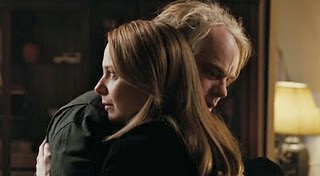
jack-goes-boating-trailer-9-7-10-kc.jpgAmy Ryan gave my favorite performance of 2007 as the mother of a missing girl in “Gone Baby Gone.” And it has been a pleasure to see her since then in roles as varied as Holly the human resources manager and love interest for Steve Carell in “The Office” and a journalist stationed in Iraq opposite Matt Damon in “The Green Zone.” She is now appearing in “Jack Goes Boating,” the first film directed by Philip Seymour Hoffman, who also appears in the title role. Ryan plays Connie in this story of two loners who try to reach out to one another. I spoke to her about this film and about her just-announced return to “The Office” for several episodes of Carell’s last season.
You came into a movie with three performers who had played those characters together on stage. Was that a challenge?
The challenge would have been bigger if I had joined them in the stage production. In this case there was about two years from the stage play to the screenplay and Bob Glaudini, the writer reworked some of the scenes and the characters. So they were re-discovering it while I was discovering it. We had a two-week rehearsal process in a room with our DP and script supervisor where we set out on it together.
You’ve now worked with a couple of actors turned directors, Ben Affleck with “Gone Baby Gone” and now Philip Seymour Hoffman, who was your director and co-star. What does an actor know that helps him as a director?
Two things that come to mind. One is truly a shared language. The bigger thing is compassion for knowing what’s it like to go to certain very dark or vulnerable places. Although I’ve had great support from non-acting directors, there’s just a shared experience. Phil never asked us to go places that he wasn’t going to himself. He had to be very vulnerable, especially those love scenes. He’s say, “You need to go there but don’t worry, I’m going to be right behind you — or I’m leading the way.”
This movie respects its audience enough that it doesn’t feel it has to give us explicit explanations for the characters’ behavior by telling us about their past. But do you need to create that for yourself in developing your performance?
Absolutely. Discussions with Bob and with Phil. I flat-out asked Bob: “What’s her story? Why does she use this language? Why is she so shy but why is she so vocal about what she wants, romantically and sexually?” He just kind of shrugged his shoulders. He really let me find it, which was at times frustrating. I wanted the answers. I knew they knew. But it was very generous in saying, “It’s okay for you to make it your own.” It’s easy to jump to the conclusion that something terrible happened to Connie. We don’t see characters like her in a love story very often. She’s in her 40’s and not good at love. She doesn’t have confidence in her workplace. She’s alone in New York City, and that’s enough. She’s an awkward person. Getting out of situations is never going to be a smooth thing.
She says very clearly, “Don’t hurt me.” She thinks too much. She says to herself, “This doesn’t feel good yet, but I’m going to keep trying. I wanted it to be like this, I wanted it to be like that, but I’m going to let go of what I imagined. But now I’m here with you. So overcome me.”
I was delighted to hear that you’re returning to “The Office!”amy ryan steve carell.jpg
Me, too! It’s good fun. That whole group, as you can imagine, truly is a barrel of laughs. I love working with Steve Carell. He is so generous. He never sets the tone of “Keep up with me or out of my way.” He really just says, “Come with me.” He is really, really fun.

Related Tags:


Actors Interview
THE MOVIE MOM® is a registered trademark of Nell Minow. Use of the mark without express consent from Nell Minow constitutes trademark infringement and unfair competition in violation of federal and state laws. All material © Nell Minow 1995-2026, all rights reserved, and no use or republication is permitted without explicit permission. This site hosts Nell Minow’s Movie Mom® archive, with material that originally appeared on Yahoo! Movies, Beliefnet, and other sources. Much of her new material can be found at Rogerebert.com, Huffington Post, and WheretoWatch. Her books include The Movie Mom’s Guide to Family Movies and 101 Must-See Movie Moments, and she can be heard each week on radio stations across the country.

Website Designed by Max LaZebnik