
Interview: ‘No Impact Man’ Director Justin Schein

Posted on September 25, 2009 at 10:00 am

How much impact can you make through a year of no impact? Colin Beavan and his wife Michelle Conlin decided to do their best to minimize their impact on the environment and as if that was not enough of a challenge, they did it the hard way, in New York City, with Isabella, their two-year-old daughter. And exposed to withering scorn from readers of the blog documenting the effort and a New York Times article that seemed to reduced the entire project to the toilet paper question. And they did it all in front of a camera.
It was a stunt, sure, but more than that a statement about what is possible and what, in the most profound and global sense, is necessary. And more than a statement, it is a series of questions, starting with this one: what do we really need and how much does it really cost?
I spoke to director/cinematographer Justin Schein about what it was like to follow this family for a year.
NM: What steps did you and the crew take to reduce the environmental impact of the film-making?
JS: Colin made us promise that we had to do it in as sustainable way as possible, so even before we picked up the camera, we were challenged to do that, everything from not buying a new camera, to no lights, no cars. All the bicycle footage was shot from another bicycle, a newly developed skill I have. Most documentaries have a much smaller footprint than fiction film-making but there’s always another step you can make, and that’s at the heart of this project. You have to ask yourself these questions. It is pretty easy to be stuck in a habit, and making this film carried over into my home life. You can’t spend a year with these guys without asking yourself about the food you’re eating and the garbage you’re creating. We started composting, we use cloth diapers, things like that.
NM: How do you draw the line between what is meaningful and what is going too far for too little benefit?
JS: Part of the process and the arc for Colin was about letting go of the rules a little bit and seeing that yes these individual actions are important but there is a bigger picture. For Michelle it was a different arc, learning that she wasn’t happy living the way she was living.
NM: Yes, she goes from someone who describes herself as addicted to reality television to someone who at the end of the year does not want the television back in the apartment.
JS: It was very clear to me that she really appreciated the benefits of not having the TV, in terms of being a mother, their parenting was dramatically impacted by the closeness that this brought to their family. That was an unintended benefit but it will be the lasting benefit. The time they spent together, eating and cooking, getting out of the house because they didn’t have air conditioning was really important. As they question their disposable consumptive lifestyle, those questions are going to benefit Isabella.
NM: And how did Isabella feel about it?
JS: Colin speaks eloquently about how Isabella was teacher as much as benefactor. Adults are stuck in habits they learned as children. She was not as entrenched. Turning off the lights was an adventure for her. Gardening was a whole new world. And she doesn’t have a caffeine problem and now may well avoid it.
NM: You were privy to some very intimate moments as this couple had some painful conversations about whether they should have another child. How do you establish the kind of trust that allows them to be so open with not just you but your eventual audience?
JS: The work that I do is verite and creating a relationship is at the heart of that. A big part of that is empowering my subjects to ask me to turn off the camera, Once they have that power they are much more comfortable opening up their lives to us. Laura is an old-time friend of Michelle’s from high school. We came into this with a certain level of trust and that started us off.
My wife Eden is the producer of the film, She had met Colin and Michell through Laura, Eden and Laura had worked together in the past. About a week before the year was going to start we had dinner with Michelle and learned about the project. As a film-maker who is interested in issues of the environment and prefer character-driven films, I liked the way it would be told through the story of a family rather than just the issues. In the wake of “An Inconvenient Truth,” we were looking for a solution-based project.
NM: One event you document is the burst of media attention the project gets following a rather snarky New York Times article.
JS: The media attention that exploded was unexpected and it was fascinating. Colin was being attacked by both the right and the left and applauded by both the right and left. The individual-based approach drew a lot of appreciation from the religious right, so we knew we had touched a nerve in a way that was interesting.
That Times article was at first very disappointing to Colin because the issues that he was trying to bring to the front were trivialized. There’s a contingent that really focuses on the stunt, as though we were trying to hide that. It was an experiment in order to bring about attention to the issue.
NM: What elements of the no-impact year have they kept in place?
JS: They don’t have air conditioning, they did not get a new dishwasher, they still eat from the farmer’s market largely. The biggest thing is that Colin has dedicated himself to educating people about this issue and started a foundation around the no-impact project. They are designing no-impact weeks for college students, to use this as a teaching tool.

Related Tags:


Directors Interview

Interview: Anne Fontaine of ‘Coco Before Chanel’

Posted on September 24, 2009 at 2:48 pm

The foremost fashion designer of the last hundred years is Coco Chanel and her life story is almost as fascinating as her timeless designs. As its title indicates, this most recent film is a look at Chanel from her childhood until the moment when, with the help of some money from her lovers, opened her first business, designing hats. In this film, as Coco cuts up her lovers’ clothes to make creations for itself that were simple, elegant, wearable, and instantly classic. Amid all the flounces, corsets, and enormous hats, it was like watching the 20th century walk into the room. At the end of the film, when we get a glimpse of one of her fashion shows, every single item is as chic today as it was when she designed it.
Anne Fontaine, who co-wrote and directed, spoke to me about the endless interest in Chanel and how she selected an American actor to play a British character who spoke French.
NM: Why focus on Chanel’s youth and relationships instead of her work?
AF: She is the 20th century by herself, it is about fashion of course but deeply it is about a new way to be for a woman, very physical. She was not beautiful, she was very thin, very androgynous, she was not at all the criteria of beauty for this period, she was like a little boy. You can’t understand Chanel unless you know that she has a very different body. Because she was so different, because she was poor, it gave her freedom to move differently, physically and through society. She was creating clothes for herself that were less confining not just for the style but so she could do what she wanted to do.
NM: You cast one of my favorite actors, the American Alessandro Nivola, to play a British man who speaks fluent French. How did that happen?
AF: When I was looking for an actor to interpret Boy Capel, as you say he was a British businessman, who was the most important love of Chanel’s life. She always said he was the first and the most deep relationship she had, I tried to look in England, if there was a young man who could play the part in France. Many actors when they lose their language — it can be awful. If he does not think through the language and only thinks through the sounds he can lose all the qualities he had because it is very difficult to play a part in another language. In England, I didn’t find an actor who has the charm, the qualities that the part requires and they didn’t speak French at all. I was doing some casting in New York and someone mentioned Alessandro Nivola. I knew he had played an English part in a Kenneth Branaugh film, but that was not the reason. I made him a little exercise before the audition: “Can you read one scene of the script in French?” When I spoke with him on the phone I knew he could speak French, not fluently, but he was not afraid. I did a test with him to see how the face moved with the French and it was not only good but also very different from the other man who played the aristocrat. They were so different. The two men she was involved with showed different things and affected her differently.
Alessandro said it was very hard to be directed in French because I was always at his shoulder telling him to be careful with this word and that word. I wanted him to have an accent of course but not too much.

Related Tags:


Directors Interview
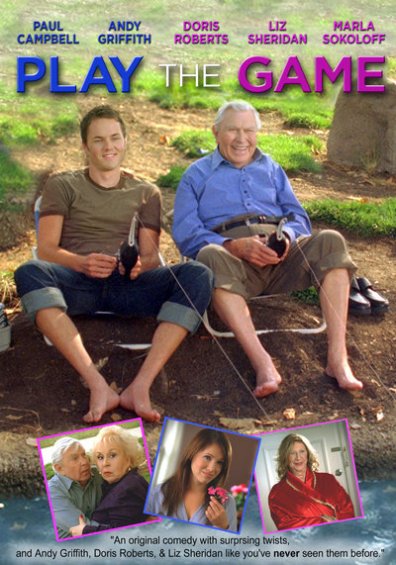
Interview: Marc Fienberg of ‘Play the Game’

Interview: Marc Fienberg of ‘Play the Game’

Posted on August 27, 2009 at 2:00 pm

“Play the Game” has many elements that are often found in sexy romantic comedies — a hero who thinks he does not want to fall in love and a heroine who teaches him that he does not know what he wants, a pair of couples whose romantic ups and downs complement and balance each other, and the usual comic mis-fires before the happily-ever-after ending. But it also has some very unusual elements: the sexy humor about the romances of the elderly and the fact that the important relationship in the film is between a devoted grandfather and grandson. Another surprise: the grandfather making the Viagra jokes is played by Andy Griffith. 148pzf8.jpg
The movie’s title comes from the games played by the main characters in order to maintain control of their romantic relationships.
So I began my interview with writer-director Marc Fienberg by asking him about the worst game he ever played during his dating days.
It was a trick that appears in the movie, “planned spontaneity,” arranging a chance encounter, or what looks like a chance encounter, even though you planned it out meticulously.
I tried to seduce my wife for seven years. Some might call it stalking — any other woman would have called the police. I drove up to Madison after four years and told her I was in town for a consulting gig, even though I was there just to see her. It didn’t work. My friends who helped me develop these tricks of the trade, it worked like a charm for them. I wish I was as suave and debonair as the guy in the movie.
So, despite the “planned spontaneity” ploy, it is not autobiographical?
It is not so much autobiographical, as a reflection of my life. In my case, only three years later, I just put it on the line and told the truth. I took my own advice and it actually worked. Lying in general is not good.
So I’ve heard! It was nice to see Clint Howard in this film, and of course he has that connection to Andy Griffith going back to his guest appearances with his brother Ron Howard on the old “Andy Griffith Show.”
Clint Howard was the first actor to sign on board. I always wanted him for this part. We had actually gone out to Andy Griffith but he said no at first. We were on a short schedule and he worried that he didn’t have time to learn his lines. And he was concerned about the sex scenes. He is a religious man and he wanted to be consistent with his values. But he said he couldn’t stop thinking about it. The bedroom scene showed older people in a nice, honest, realistic light. And very important — he didn’t die in it. There are not a lot of parts for older characters that don’t have them dying at the end. This movie was all about passion and living life to the fullest and holding out hope that there’s love and companionship at all ages and he liked that.
Griffith and many of your other actors have a television background — Liz Sheridan on “Seinfeld,” Doris Roberts on “Everybody Loves Raymond,” Marla Sokoloff (“The Practice”). Was it an adjustment to work on a feature film?
TV and movies are similar enough from an actor’s standpoint. It’s always hard but the actors brought something even I didn’t see.
What’s next?
“The Machine,” more of a family comedy about a young goat herder who dreams of doing bigger things with his life. Then the internet comes to town and he is forced to save his village. I’m also working on another romantic comedy and doing commercials now, too.
How did your own family influence this story?
My grandfather started dating when he was 89 years old. The more time I spent with him, the more I appreciated different things in life and what was important. When you see these vibrant, passionate lives you more easily focus on what matters in the world.
My father was my first inspiration. He was a closet writer. And I had teachers and read authors who have inspired me to follow my passion. Giving up a safe, secure career, the hardest part was taking that leap to a career that had enjoyment and fulfillment and could make the world a better place. I studied business and started a million dollar e-commerce company that got sold. I wanted to make people laugh, affect people. One of the main things that gave me strength was my kids. It was important to have them see me doing something fulfilling, to set an example for them. We realized that our concern about the financial risk of trying to make a career in movies affected me and my wife much more than the kids.
In the movie, the father is the bad influence and grandfather is the good influence. It was when he started working for his father that he started being less honest. And it is when he starts trying to teach his grandfather not to be honest with women that he learns how important honesty — with himself and others — really is.

Related Tags:


Behind the Scenes Directors Interview Writers

Interview: Ramin Bahrani of ‘Goodbye Solo’

Posted on August 25, 2009 at 2:59 pm

In 2009, film critic Roger Ebert declared “Ramin Bahrani is the new great American director.” I’d say he’s a great new American writer as well. I heard him speak at Ebertfest (his second time presenting there) and was moved, enthralled, and inspired. Only 34 years old and with just four feature films, he has already had a retrospective at the Museum of Modern Art and has been awarded a 2009 Guggenheim Fellowship. It was a thrill to get a chance to talk to him about his brilliant film, “Goodbye Solo” (rated R for language, drug use, and sexual references and situations as well as some very sad moments) which is released today on DVD. Cinematical says “it may be the best DVD you rent this summer.” NPR’s David Edelstein said:

So much of a movie’s appeal comes down to whether you enjoy staring at the actors’ faces. In Ramin Bahrani’s “Goodbye Solo,” there are two you’ve most likely never seen before — two tantalizing maps to pore over…It’s a film of overflowing humanism, yet it acknowledges, in grief and wonder, that some things can never be reconciled.

It is the story of Solo (Souleymane Sy Savane), a Senegalese cab driver with a young family and a fare named William (Red West), an old man who once hung out with Elvis and is now alone.

The first thing I want to ask you is how you achieve the extraordinary intimacy of your films, the way we feel we are eavesdropping on real life.

I’ve done the same thing with a plastic bag! My short film opening in Venice has this incredibly expressive bag that I hope you’ll fall in love with.

The most important part of directing is casting. I was deeply involved in casting in all three of my films. Finding the right person for the part, the person you can communicate with, some mysterious qualities that can be articulated in front of the frame — if the performance is not good it doesn’t matter if anything else is good, the camera, the lighting, the music, because the audience will check out immediately. I really like to get to know the actors in advance. We know one another for a few months or at least several weeks before we begin filming. I really like to things not with a lot of cuts, very few cuts; this allows the actors to perform against one other, which they enjoy a lot. It lets them bring their best work.

Then there are little things I like to talk to them about or trick them. Often times the actors don’t really know what the film’s about entirely. For example in “Goodbye Solo,” only William and Solo knew the entire story. Other people only know their scenes.

Is the film completely scripted? It is so natural it feels improvised at times.

It is completely scripted. I oftentimes do not show the actor the script. William and Solo were trained actors but nobody else saw a script. We have rehearsals where they learn what their scene is about. If they want to change certain words because it is easier to say, as long as it is okay with the structure of the film, that is all right. But there is not a lot of improvisation.

Here’s a story. The actress who played the young girl, Alex, had no idea what the movie is about and did not know why they were going to the mountain. When Solo came back alone, she was not at all in anxiety and assumed William had gone home with a friend. As we were rehearsing the final scene, she pulled me aside and said, “Why is he so sad in this moment?” I asked, “Why do you think?” “I think he’s sad because he failed his exam,” she said. I said, “Why don’t you encourage him to pass it?” She was so full of courage for Solo and that enhances his performance and encourages his character and the audience to move beyond what has happened.

What kind of training did you have in film-making?

I never had a class on directing or acting. No one told me how to make film; I just started.

You said you were deeply involved in casting. What do you look for?

People who kind of resemble the part. Souleymane Sy Savane is naturally kind of a friendly, charming guy, also very meditative, very thoughtful. He doesn’t talk that much or that fast or use those terms that Solo does. He talks at a much slower pace. I had to accelerate him so it is really a performance and an amazing one. The first thing is the face, you could just look at those faces for a long time and be engaged. That’s critical. Bergman was very good at finding faces you want to look at for a long time. There’s a mystery to a person’s face that the camera must respect. In literature you can’t look at someone’s face. You can can go into their mind, in theater, poetry, book, music, you see a lot but not the face the way you see it in a movie.

That is why I don’t like to cut when the scene is supposedly technically done. I let it run to see what they are thinking about what just happened, to wait to see what they do. Those are important moments. The people who say “Oh this is slow,” I don’t really believe they think that, I think they’ve just seen too many of the other kind of film.

I remember at Ebertfest you caused a bit of controversy by telling people there not to see some big blockbuster. I think it was “Wolverine.” Do you think people are diminished by watching films like that?

Of course I think that people are diminished by those films. Independent does not mean slow or boring or slow or obtuse or in a museum that no one can understand without a book on semiotics. I think a child could understand and enjoy my films and an adult could enjoy them in a different way.

I was just asked if I want to make a “big film.” I don’t know what it means to make a big film. Someone called “Man Push Cart” a “nice little film.” What does “nice little film” mean? It’s just as big as “Mission Impossible 3.” I actually think MI3 is a microscopic film. It provides nothing to the world or the universe or humanity except an extreme waste of money and talent. It is a massive waste of resources. The reason people think they are big is that they cost a lot of money.

Film is an expensive financial venture, to try to engage the audience in a good story that anyone can understand. Important to keep the budget at a level where you can still do what you want do. If you’re going to spend $80 million you will have to do what they want you to do. You have to ask yourself, “Do I want to be in that position.” I don’t.

So, what do you want to do next?

Of course I want to work with known actors as well as unknown. If Viggo Mortenson wants to play the part, fine, he’s a talented actor. And having him in the film can help get more resources. But these films get caught up in big/small instead of important/important.

“Goodbye Solo” is set in your home town of Winston-Salem. Were you interested in film when you were young?

I was born and raised in North Carolina. I developed an interest in cinema as a teenager. Before that I was painting and drawing, then literature Camus, Dostoevsky, Kafka, Faulkner, then renting “Aguirre, Wrath of God, “The Enigma of Kaspar Hauser.” Herzog, Buñuel, Fellini, Bergman, Rossellini –“The Flowers of St. Francis” was very influential, I love Ken Loach, Kurasawa, these are the ones I really respond to.

What about performers?

The great American actor is James Stewart. You really see that in the Anthony Mann westerns, and “The Man Who Shot Liberty Valance.” Not all directors knew how to access what he had to offer, of course Hitchcock did later in “Vertigo,” his qualities of being unnerving and and mysterious and violent. He had the widest range, with all respect to Brando, Newman, Depp. Monica Vitti is in her own category, one of the great female actors.

Now tell me about the plastic bag movie!

It’s premiering at the Venice film festival, a 20 minute film, and it will be online in early 2010. It is about a plastic bag in an existential crisis looking for its maker. It encounters strange creatures, brief love in the sky, and then to be with its own kind it goes to the Pacific trash vortex to try to forget about its maker. I cannot tell you who it is, but the voice of the bag is extremely special. It is not an agenda film, but like “The Red Balloon,” it will make you care about an inanimate object.

Related Tags:


Behind the Scenes Directors Interview Writers

Interview: Sophie Barthes of ‘Cold Souls’

Posted on August 21, 2009 at 10:00 am

One of my favorite films of the summer is “Cold Souls.” Paul Giamatti plays an actor named Paul Giamatti who is anxious and depressed as he prepares to play Chekov’s Uncle Vanya. When he reads in the New Yorker about a place that stores souls, he decides to try it. The immensely inventive writer-director Sophie Barthes has concocted a world just slightly off-register from the one we know and Giamatti’s literal and spiritual journey is funny and provocative and always surprising. So was talking to Barthes.
I have some bigger questions, but I want to start with one small one. We see Paul Giamatti rehearsing “Uncle Vanya” under very different conditions — with his own soul, with a borrowed soul of a Russian poet, and without any soul at all. How did you and he work together to create three very different versions of Vanya?


That was the trickiest part of the film in terms of acting but we were nervous for different reasons. He thought he could act badly but not play Vanya well. I could certainly imagine him playing it well but thought it would fall flat to play it badly. It shows you how modest and humble he is. We had both seen “Vanya on 42nd Street,” and he knew his version would not be like Wallace Shawn’s. He doesn’t like rehearsal much. He is very intuitive. But when it came time to do it badly, for those we took time and rehearsed them. I said, “Let’s not make it robotic, but let’s be the opposite of whatever is called for. Confidence is something Vanya doesn’t have, so show confidence. Take directions very literally.” On the DVD extras we will have some other versions. In one he starts to mimic the wind, taking the direction he is given very literally. The one he does with Elena, he did unconsciously a William Shatner interpretation.

That is the beauty of working with such a talented actor. He is not someone to talk about technique and method. You roll the camera and he delivers and he is excellent — in a different way — in the first three takes.
I read an interview where he says he is always being asked to play the anxious man.


Directors keep asking him to play the anxious man because he is so good with it, so vulnerable, such a sad sack, so funny. Jerry Lewis says that comedy is a man in trouble. That’s what Paul is. He always looks like he is carrying the weight of the world on his shoulders. He is very human and vulnerable and has the skills of a comedian. He can go from total slapstick to very melancholic. As a film-maker he is like a grand piano. You can play any note and he gives you this performance. We didn’t know how to choose from the takes. They were all interesting in a different way. He can do deadpan and ultra-emotional.
One of your other actors, David Straithairn, who plays the man in charge of the soul storage, was in a role that was quite different from his usual characters.


David was a bit anxious. He has not done much comedy and this is a melancholic kind of comedy. How much larger than life should this doctor be? It was very different from “Good Night and Good Luck.” But he and Paul had played in a Chekov play together and had chemistry like old buddies on set, very playful.
One of my favorite moments in the film is when Paul looks into his own soul. One of the images he sees is of a toddler, walking and crying.

It is a completely absurd moment and it came about by accident. We had a part in the movie that was a dream I had a long time ago about a baby factory where babies are manufactured. I’m going to put that in another film because it did not work out this time. When the casting agency came with the babies I was expecting four or five month old babies. But they brought toddlers who could walk, so we gave up on the factory idea and used the set next door with the white space.
Tell me about shooting in St. Petersburg.


Russia was a very surprising and pleasant experience. We had heard it was tough but from a logistical point of view the crews were super-professional and we never had a problem. Aesthetically, we decided not to shoot it as a postcard and turned the camera the other way.
Now a bigger question, maybe the biggest. Paul Giamatti is very distressed in the film to find that his soul looks like a chick pea. What would your soul look like?


My soul would change every day, maybe liquid. I go through all those moods.

Related Tags:


Directors Interview
THE MOVIE MOM® is a registered trademark of Nell Minow. Use of the mark without express consent from Nell Minow constitutes trademark infringement and unfair competition in violation of federal and state laws. All material © Nell Minow 1995-2026, all rights reserved, and no use or republication is permitted without explicit permission. This site hosts Nell Minow’s Movie Mom® archive, with material that originally appeared on Yahoo! Movies, Beliefnet, and other sources. Much of her new material can be found at Rogerebert.com, Huffington Post, and WheretoWatch. Her books include The Movie Mom’s Guide to Family Movies and 101 Must-See Movie Moments, and she can be heard each week on radio stations across the country.

Website Designed by Max LaZebnik