Interview: Joseph Gordon-Levitt of “Don Jon”

Posted on September 25, 2013 at 8:00 am

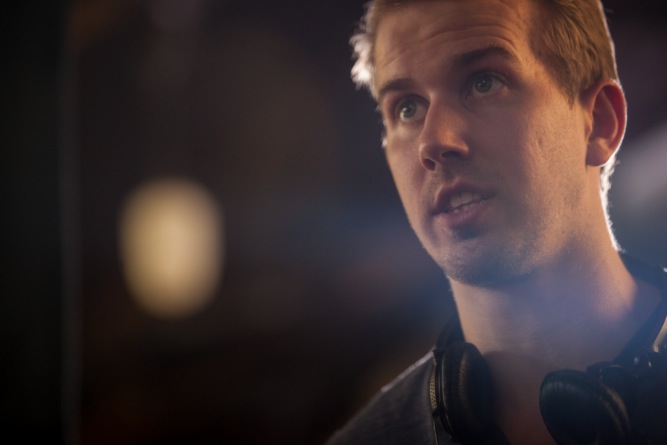
Joseph Gordon-Levitt met with a small group of journalists to talk about the film he wrote, directed, and stars in, “Don Jon.”  Gordon-Levitt, who has appeared in edgy independent films (“The Mysterious Skin,” “Brick”), teen romances (“10 Things I Hate About You”), ambitious, big-budget special effects films (“Inception,” “The Dark Knight Rises”), and prestige dramas (“Lincoln”), began acting as a child, first appearing in the popular sit-com “Third Rock From the Sun” when he was 13.  His grandfather was also an actor-turned director whose films included the classics “Cyrano de Bergerac” and “Pillow Talk.”donjon3820132
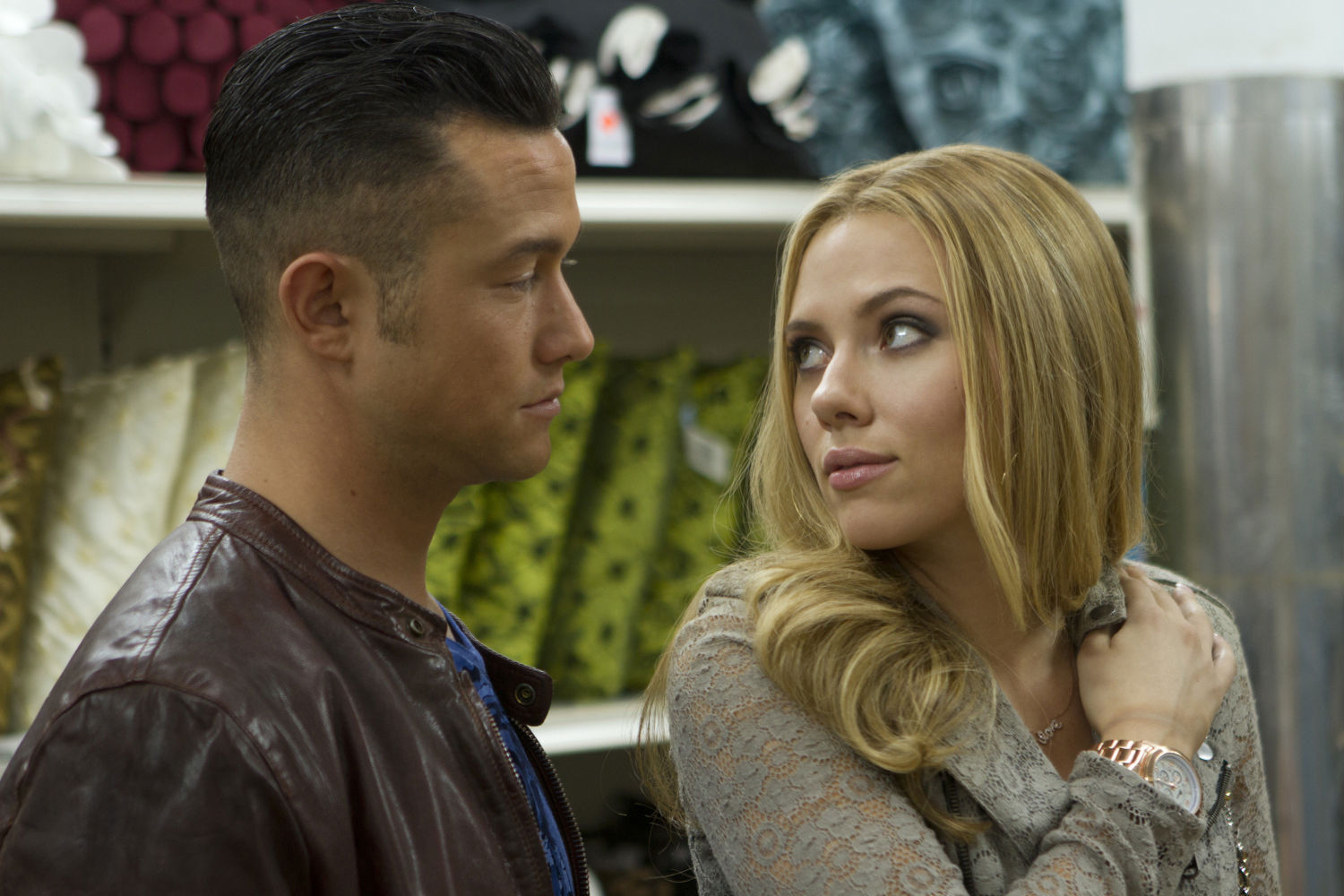
In “Don Jon” Gordon-Levitt plays Jon, a New Jersey guy who prefers pornography to real relationships, indeed to pretty much everything else.  He starts dating Barbara, played by Scarlett Johansson.  “This is a guy that everything has to be in the right place. He has very rigid expectations of what a man is supposed to look like and the hair is certainly part of that. And he keeps control. So he has got a pretty extreme version of it, and a lot of gel in his hair.  Both the Jon character and the Barbara character are people who are very intent on fitting into the conventional idea of what a masculine man is supposed to be and what a feminine woman is supposed to be. They are both very concerned with their looks and they put a lot of effort into their looks.  They use their looks to get what they want, and are disappointed with life because if you are so busy trying to fit yourself into a mold, you’re going to miss what’s actually beautiful about life, which is what makes people unique, not what makes everybody the same.”

Jon, Barbara, and many of the other characters in the film struggle to find a way to connect.  “Everything in Jon’s life is sort of a one-way street. He is not connecting or engaging with anyone. That goes for the women in his life, that goes for his family, his friends, his church, even his own body.  It’s an item on a checklist. He doesn’t listen; he just takes. At the beginning of the movie, he is finding that dissatisfying because there’s the sequence where he brings a young lady home from the bar and he is comparing her to this checklist that he has got of what he likes to see in a pornography video. Obviously, a real human being is not going to map onto that because there is a fundamental difference between a human being and an image on a screen. So he looks for what can satisfy him. The first thing he tries is the sort of conventional moral high ground: what your parents would want you to do, what his parents would want him to do – which is find the prettiest girl in the room and make her your girlfriend, your quasi-wife. So he does that and he follows all the rules and does what he is supposed to do. But he is still not satisfied because, again, if he is just doing what he is supposed to do, if you are just fitting into the mold, you’re not connecting.  They don’t listen to each other. They are not really paying attention to who each other is. They are sort of projecting onto each other what they think the other is supposed to be. And she is doing it to him just as bad as he is doing it to her.   I want to talk about how people treat each other more like things than like people sometimes and how media can play into that. And I guess this comes from my own personal experience of growing up working as an actor. Actors in our culture do get stigmatized and treated like objects on a shelf sometimes. But I don’t think it’s just actors; I think everybody experiences this. I’m sure you all have. I have, you have. You are talking to someone and you can tell they are not listening. You can tell they have already decided what you are and put you in a box with a label on it. This is what I was trying to make fun of. And I do think that the media contributes to that. That’s where I came to the idea of a relationship between a young man who watches too much pornography and a young woman who watches too many romantic Hollywood movies. They’ve both got these unrealistic expectations that they’ve learned from these kinds of media that they consume and it leads them to objectify people or to not connect. That’s the origin of where it came from.”

He talked about what he learned from the directors he worked with and how he used three different styles in this movie to create different moods. “The year leading up to shooting Don Jon, I worked with Rian Johnson on “Looper” and Chris Nolan on “Dark Knight Rises and Steven Spielberg who made “Lincoln.”  So I had a lot to go on. I was certainly watching carefully. But I’ve always loved watching. I spent my whole life on sets. I started working when I was six. I’ve always paid a lot of attention to what directors have done and what everyone else has done: what they are doing over here in the camera department or how they put together the set or what the script supervisor is up to, all those notes that they take, how is it, what is that.  I really like being a part of that team, being a part of something larger. I really wanted this movie to have a flair to the filmmaking. Especially comedies, it seems, often stay pretty conservative and just leave the comedy to the writing and acting and the rest of the filmmaking is very standardized. I didn’t want to do that. I wanted the filmmaking to reflect what was going on with the character and the evolution of the character. We divided it into three acts, which is the standard story structure in a 90-minute movie.  In the first act, when you meet Jon and his kind of world, the camera was all very kinetic, a lot of camera movement. The cutting was really fast and the music was all made of these big shiny synth sounds. Then, in the second act, once he is getting involved with the sort of traditional romance, the cameras are on dollies a lot. There is a lot of sweet, gentle movement. The cutting is very traditional Hollywood cutting, Frank Capra/Steven Spielberg-style classic Hollywood editing style. And the music is classic Hollywood orchestra.  And then, in the third act, when he is broken down and starts to get more curious and break out of his mold, the camera is almost all handheld, there is a lot less cutting, and the music gets really sparse and it is just played on a few guitars. So that was the idea to have the filmmaking move along with the evolution of the character.”

He especially appreciate the support he got from Christopher Nolan.  “I told Chris that I was going to direct a movie, and he, first of all, was encouraging. And that, just in itself, just him saying, ‘That’s great, I think you would be good at that.’ And taking it seriously really meant a lot. He would start asking me important questions like, ‘What kind of budget are you going to have? How many days are you thinking about, ballpark?  Where are you going to shoot?’ He asked me if I was sure I was going to act and direct at the same time, which is funny. Several journalists on this tour have said, “I heard Chris Nolan told you not to act and direct at the same time.” No, not at all. That’s not what he said. He just asked a question. People love to print negativity. He was really supportive. He even came on the set one day. We shot one day at the Warner Bros backlot and he was mixing sound for “Dark Knight Rises” at the time and he came by. He didn’t have to do that. That meant a lot. It goes to show why a lot of people really love working for him and he really cares about people that work for him. That’s why people do a really good job for him, I think.

“Rian Johnson was also super-encouraging. Rian was the first guy I showed my first draft of the script. Up to that point no one else had seen it. I was just writing this thing alone. I thought it was good. I was having fun writing it; but you never know sometimes. You can lose perspective. So him saying that, ‘I think you have something here. This feels like a movie. You have a complete story. I get it’ was encouraging. He also had important feedback and plenty of notes. But just him giving me the go-ahead was really a big turning point for me.”

These days, most movies are made digitally, but Gordon-Levitt worked with film.  “First of all, it actually is easier to shoot on film at this budget level. It is not a micro-budget movie, but it’s a low-budget movie. This is like half the budget of “500 Days of Summer” and probably like a tenth of the budget of the lowest-budget movie that a studio like Warner Bros would make. So shooting on those professional digital cameras is expensive. You need more tech, you need more crew, you need more time to set up, they are harder, they are more complicated machines, they break more often, etc. So there were actually a lot of practical reasons to shoot on film and the cost of developing the film and buying the film stock is outweighed by the cost of all that other stuff that comes along with like the digital cameras. But also, I still think it looks different. Look, digital cameras have come a long way and they look gorgeous. There are some movies that are shot digitally that I think look amazing like “Life of Pi” last year, one of the prettiest movies that came out. You could tell it wasn’t film. It looked great. But I wanted to shoot this one on film. I wanted it to have that classic look of like ‘this is a movie with a capital M.’ It’s a movie that is about movies and media. So I wanted it to really send all those signals, like this is a movie. Yeah, I always wanted it to be on film.”

The title is a reference to the literary character Don Juan, an elegant, sophisticated man famous for seducing many women.  But Jon lives in suburban New Jersey.  “I don’t think it’s singular to any particular place or culture. He is Don Juan. Don Juan is an old classic literary figure. I did want to make it just a normal guy. I’m from the suburbs of LA and New Jersey is the suburbs of New York. I didn’t want to set it in like a cosmopolitan affluent setting where a lot of romantic comedies are set in Manhattan and London. I wanted it to be like normal, middle-income, suburban America because I think everybody knows people like this. We all are to a degree people like this.”

One challenge Gordon-Levitt took on and handled with exceptional grace was the depiction of the pornography.  He had to find a way to indicate what Jon was experiencing without distracting the audience.  “There are clips that are licensed from real pornography videos but very carefully selected, cut, cropped, and worked into very highly stylized sequences with voiceover and music and lots of cutting. The idea was to try to get inside his head, not to show you from an objective standpoint what it looks like. I think that would really be awkward and kind of dark. I wanted to make an entertaining comedy. It’s really more about getting inside of his head. So you don’t really see it. It’s all really close-up and it’s more about kind of his point of view. And he is an unreliable narrator. He is sort of assessing the situation the best that he can and telling how he sees it; but I think he is wrong at least as much as he is right. That was how I felt like we could approach it in a way that wouldn’t be alienating for people because it be funny and snappy and entertaining, and again, putting you inside the head of this protagonist.”

Another challenge was the portrayal of Jon’s sister, played by the very talented Brie Larson, who appears to be texting throughout the film and never speaks until the end.   “She didn’t talk, but she is listening. She is in those scenes, and a crucial part of those scenes. We talked all about her character. The backstory we came up with was: here’s a girl, a young woman who is three steps ahead of her brother even though she is the younger sister. This evolution that you begin to see Jon start, I feel that’s an evolution that she probably went through when she was like 16 or something. She realized, ‘You know what? My parents expect me to be this, I’m not that and I’m out of here. No one listens anyway, so why should I talk? So that is my feeling about that character…but she is listening, and that’s the thing, and we talked about that. We didn’t want her to just be like, ‘Oh, the ditsy girl is always on her phone.’  I feel like she is talking to colleagues about something they are working on or something like that. That’s an input/output device. That’s not just a one-way street.  We talked about Buster Keaton and how much you can do without saying anything. And I think she does. She kills it. Even before she speaks, she is crucial in those scenes.”

Gordon-Levitt cast his 1994 “Angels in the Outfield” co-star Tony Danza as Jon’s father. “That was a blast. Tony is such a good-natured, sweetheart of a guy which was funny having him play this character because Jon’s dad, Jon senior, has a short temper. He doesn’t listen to anything his family says and he is sort of a lecherous dude. It doesn’t come naturally to Tony because on screen, his instinct is to be likeable because that’s just how he naturally is. So I kept having to tell him like, ‘No man, I like you too much, you have to be willing to be a little less likeable’….But if the dad character was just a demon, it would be off-putting. I think he still has to have that charm and that’s important.”

His HitRecord collaborative production venture has just announced a new partnership with the Pivot channel.  “I have really grand, fanciful ambitions for all sorts of things that aren’t ready to be articulated probably yet. I’m just a very grateful man. I have been doing this for a long time. On the one hand, I never necessarily thought that I would have such fortunate opportunities. But on the other hand, I have got to say that part of doing well at anything, I think, is believing that you can do it. I always had parents that told me I could, told me I was good at what I was doing and supported me with what I was doing. I think you have to have that balance between the humility of not being too full of yourself; but on the other hand, believing in yourself and recognizing. There is a quote that I think is attributed to Nelson Mandela. He said that our light is more frightening than our darkness because if you look at the darkness within yourself, you can make excuses and shirk the responsibility of having to do anything and say, ‘Well, I’m not capable.’ But if you recognize the powerful light that is in yourself, that we all have within ourselves, that’s scary because with that light comes a certain responsibility to live up to it and do something. I love that quote. I think about that a lot. I don’t know, I might be avoiding your question or something. I guess my answer is you ain’t seen nothing yet.”


Related Tags:


Actors Directors Interview Writers

Interview: Will Bakke of “Believe Me”

Posted on September 22, 2013 at 3:59 pm

Will Bakke I really enjoyed talking to Will Bakke of Riot Studios about his new film, “Believe Me.”  I’ll post information about the movie’s release when it is available.

Tell me a little bit about this project.

I’d love to. Well, “Believe Me” is the story of four college seniors who start a fake Christian charity in order to make the money that they need for tuition for college. In the process of throwing this big fundraiser to tell people that they’re donating wells in Africa, they end up being asked to be the keynote speakers for a summer-long evangelical tour. And so they kind of get little into their heads and they decide to sign on and do it and just sort of study the Christian culture in order to get away with it. I think people would sort of expect some big altar call at the end but this is a very different story and we’re excited to tell it.

Where did the story came from?

Michael Allen and I have actually produced two documentaries together before we wrote this.  We were in college when we made “One Nation Under God.” He and I and two buddies of ours road-tripped around the United States just asking people what they believed about God. We were both from Dallas, Texas. We kind of grew up in the Bible belt and realized that our faith, we only had it because our parents had it and because that’s what we were kind of raised to have. And we just wanted to get out of that bubble and just find out what other people believe and really challenge our own beliefs in the meantime. And as a result of that, it kind of brought us to make a second documentary called “Beware of Christians.”  Michael and I and our other buddy Alex Carroll who jumped on board with us created that film really as just a way of solidifying what we believe and how that would shape our lives and what we would lack, especially in college. I think both of those films really were kind of the jump-off point for “Believe Me.” We made these two films that were probably labelled as Christian films, because we’re Christians ourselves but it was about us. And so we were excited to take a look at the industry and kind of see the ins and outs of it and we just realized how many funny things there are about Christians out there and so the idea of “Believe Me” came out of this: what if somebody really wanted to take advantage of that?  What would Christianity look like to an outsider? That was kind of a starting point for the film.

What were some of the challenges of going from documentary to feature film?

There were a lot of challenges. When we made the documentary, we had a couple of notes written down on like a napkin on what we wanted to do while we were Europe or while we were touring around the United States. There was no real planning to it beforehand. With a movie like this, we spent about two years writing the script and polishing it and just working out every character arc, every story arc, every theme to the movie and two years of writing transitioning into directing for me.  And there’s a lot of people involved.  It was no longer just me holding the camera running around filming as much as I could and just throwing a story together at the end. We had a very precise story that we wanted to tell and it was a lot of people involved so it was a completely different experience. It was so rewarding and humbling and I was very excited. We actually just wrapped yesterday at 6:00 AM so I’m still winding down from the experience as you can imagine. At some point you start to feel like everyone is playing with paint brushes when you’re directing because it’s such a collaborative effort.  And I loved it for so many reasons because I didn’t have to be thinking about what writing was like or exactly what the camera shots were going to be because I’d worked that out beforehand with my director of photography so on the day that we’re shooting, my mind was just fully into the story and fully into the characters and I had just this incredible team behind it that was making everything look ten times more amazing than I could have ever imagine. So it ended up being a surprise, just being able to really focus on just one aspect of filmmaking which is the directing side and much less the technical aspects because those were already worked out in pre-production.

Do you consider this one a Christian film and who do you think is the audience for it?Believe Me Poster

With this film specifically, Christianity is the backdrop to the story but I would never label it that. We didn’t want it to be that. We weren’t shooting for that. We believe this story is all about the idea of truth which is an universal theme which we’re very excited about because it doesn’t matter really where you’re coming from on the line of faith whether you’re for it, against it, whether you have it, whether you’re a part of a religious culture or not. Anyone can walk into this movie and get it and really understand the desire that we’re going after. It’s all about the idea that truth is relative and that what works for you works for you and what works for me is best for me. We start to see that there are a lot of different characters that are really good people that live with that mentally; they kind of get in their own way. And when those different wants and needs clash, it’s compelling as a viewer to see that. And so it’s not a Christian film. We’re pretty excited to tell people that just because we don’t want to have any kind of pre-conceived notions in people’s minds coming into it .  One of the tough things about being labelled that is a lot of times people believe there is going to be some sort of agenda to the story which we don’t have. We just really want to tell a compelling story. There’s no secret motive or agenda behind it. Although, we are guaranteeing a 100% conversion rate with this movie; I hope that’s not confusing at all. We promise there is going to be conversion. We’re not positive on what religion it’s going to be on by the end of the show but we’re promising a 100% conversion-rate.

What effect do you think it has on people to try to live up to other people’s expectations?

It’s not so much I think for these guys to live up to expectations as much as I think it is based on themselves as a whole. They just committed to becoming the speakers on this major evangelical tour and as a result, they had to sort of adapt and they ultimately don’t want to go to jail for what they’re doing.  I think a lot of it has to do with beliefs and why do you believe what you believe. It is because someone stood up on the stage and told you that something was true or is it because you have investigated and researched and really looked into what someone says and is claiming and for me alone, with this movie it’s just so interesting because Alex Russell, we was the star of the movie “Chronicle” last year. He plays the lead in our movie and in the film it was so interesting to shoot with him because there’s just some amazing scenes where he is preaching up on stage and all the credit to him because he’s an incredible actor but he just sold it so well that it made the rest of us kind of look back and be like, it’s really freaking me out how well he can sell this.  And I know personally that Alex Russell doesn’t identify himself as a Christian. I think he’d be comfortable telling anybody that, he actually has. But you know, it’s very interesting to see just the words come out of someone’s mouth that seem so compassionate and so compelling and yet at the same time, isn’t what they believe.

That’s why they call it acting.

Exactly. So it really made me rethink what my youth leaders taught me back in the day. Like, ah, I wonder if they were really genuine in all of this. That’s just what gets serious about it when it has to do with religion and faith and putting your chips on something that could change your entire life, not knowing if it’s coming from a genuine place or not.

When you were writing this script and you were working on, as you said, the structures and the characters and all that, what were some of the resources that you relied on? Did you look at other movies? Did you look at books about script writing? What did you do?

We read plenty of books on screenwriting. I was a film student at Baylor University and took screenwriting courses. It was a great education in terms of like what it looks like to tell a good story and I think for the two years that we were diving into script; story was the most important thing to us. And like I said earlier, without having an agenda, that’s what we wanted to make for ourselves in the first place is compelling characters, compelling stories, even tell the stories of characters that don’t line up in the same world-view as us.  We love the idea of college students just getting in over their heads and how they react. It’s just such a pivotal time of life in the way that’s going to shape you later so we love playing in that sort of age range.


Related Tags:


Directors Interview Writers

Interview: Stuart Blumberg, Writer/Director of “Thanks for Sharing”

Posted on September 17, 2013 at 3:59 pm

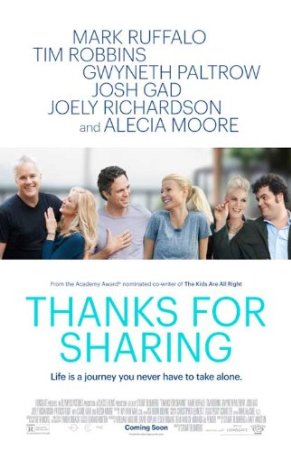
Stuart Blumberg wrote or co-wrote some of my favorite films, including “Keeping the Faith” and “The Kids are All Right.”  His new film is “Thanks for Sharing,” with Mark Ruffalo, Tim Robbins, Josh Gad, and Pink (billed as Alecia Moore) as people who struggle with sex addiction and sometimes other addictive behavior as well.  Gwyneth Paltrow plays a woman who dates Mark Ruffalo’s character.  I spoke to Blumberg about directing and co-writing the film.thanksforsharing

You very powerfully show us how your characters feel that they are immersed in distracting sexual stimula wherever they go, on the street, in the subway, in cabs, online.  How do you show that without distracting the audience?

I think it was very purposeful. I wanted the audience to sort of be in the character’s skin and understand the stuff they were coming up against, especially in New York City, trying to deal with the kind of triggering environment. I wanted to really get the audience to empathically feel sort of what they were going through.

But how do you put those images up on the screen without risking the audience being distracted?

It’s the risk you take. If you’re going to do a movie about alcoholism, you might have to show a bottle.  It’s kind of a homeopathic remedy where you’re going to have to have a little of what kills you. The only thing is that it can’t be gratuitous. It has to actually make sense and be grounded in some kind of reality.

We follow three characters at different stages of their recovery.  What were you trying to show?

I was just trying to show the range of the experience of recovery and how simultaneously people can be at different stages of recovery with different levels of maturity and commitment. But I also wanted to show that despite however many years one could be in a program for addiction, it’s only a one day reprieve and you can just sort of, you can return to the darkness pretty quickly.  It’s a program that requires a constant kind of spiritual maintenance. I kind of wanted to get that across too.

I liked the way that you addressed the issue of spirituality.  One character spoke to a lot of people by saying, “I’m just not really into the God thing.”  I really liked the response: It’s just about connecting to something bigger. How do these groups help people feel like they’re connected to something bigger?

My sense is that what helps people is not having people who don’t have the problem preach to them.   Caring people who are going through the same things that they are, sharing their stories, the darkness, but also the ways that they’re dealing with it, the light of it. It’s like soldiers swapping war stories. Whenever you hear somebody who’s like you telling you their story to you, you feel kind of belonging and a kind of healing that comes from feeling like you’re not alone.  Someone is also going through this with me. I think that’s where a lot of the healing happens. It’s that people are going through this process together.

So if one thing we’ve learned from these programs is that people who are in it with you can help you in a way that all the experts in the world can’t, how do they form relationships with those who are not a part of that world?  How do you think this movie will try to explain that world to them?

Through sort of showing what these guys are going through and what these women are going through but in their addiction and in their recovery and hopefully in kind a non-preachy way, people will get a better sense of what it actually looks like.  And when they get a better sense of what it looks like, hopefully they’ll get a better understanding of not only what those people are going through but in some ways sort of what we all share and how addictions are sort of a more extreme form of what we all do.  We all try to kind of go towards pleasure and avoid pain. We’re all about short-term symptom relief. And so I think if people understand, oh that’s what they’re talking about when they’re talking about that, judgement is replaced by understanding like there are many things that people are sort of unclear about.

I was particularly interested in the conversation between the characters played by Joely Richardson, as the long-time wife of a sex addict and Gwyneth Paltrow as someone newly in a relationship with one. There was a level of truth there about the friends and family of people who were dealing with this. What kind research did you do to lead to create that moment?

I’ve gone out on those meetings myself,  I just find it all very fascinating and I couldn’t quite understand how one could be addicted to a person who’s addicted, meaning you’re addicted to fixing them.  That itself is its own pathology. In sort of going through that,I found this very helpful in my own life, this whole idea of you’ve got to keep the focus on yourself. You’ve got to keep focus on yourself and let the other person take care of them. And that’s sort of what I was trying to get through in that scene. As soon as you think you’re in control of somebody else, you’re out of control.  And so Gwyneth Paltrow is sort of trying to hold on to Mark Ruffalo’s character and make sure he doesn’t veer off into the dark side and that’s causing her to act out. That’s causing him to do weird things. And so I just wanted to tackle that side of it.

Why did you want to make it about sex addiction versus all the other kinds of addictions?

I think sex is very interesting. People love sex in movies and people love sex and it’s just an integral part of our lives and it was an addiction that I feel like was never really explored.  It was just one that hadn’t been tackled very well. And also, I also felt that recovery almost in any movie hadn’t really been shown well. So it was the combination of two of those things I wanted to put together. I started thinking about this when there were a lot high-profile cases of people coming out of sex addiction. Okay, this isn’t a joke. Let’s delve in here and see what this is about.

I particularly want to thank you for leaving out the one scene that is in every made-for-TV movie about addiction which is where the character tries to explain how it all happened, which is always so simplistic and reductionist and in its way, it takes us further from understanding because it allows us to separate ourselves and feel smug about our differences.

It’s a lot of things. It’s genetic. It’s environment. The other thing that I think is really true is like the Buddha once said, once shot with an arrow, are you going to just go, oh what’s this arrow made out of? Is it made out of wood? What poison is it made out of? No, you take the arrow out. You can worry about why you are that way and there is something to it but let’s deal with what’s to it and how you work with it.

Another thing that I appreciated is it’s actually a funny movie. So can you talk a little bit about why you felt that that was important?

Most of my movies are like some mixture of comedy and drama. I’ve never made a drama and I’ve never fully made a comedy. I love that space in between. Those are the movies I like to go to see. And the other thing is that when I would go to watch, research, a couple guys I knew came up to me and they said would you just give me a favor when you’re portraying this? Don’t make us seem like it’s really serious guys all the time. There’s so much humor between us. So it’s in the meetings and outside and you really need to capture that or else you’re going to miss it.  And I felt like they were right. And that needed to be a huge part of it.

Do you think humor is important for recovery?

Very much so, otherwise people just shoot themselves. I think humor is important to anybody trying to get through this life.  Otherwise we can just get pretty grim.


Related Tags:


Behind the Scenes Interview

Interview: Katherine LaNasa of “Jayne Mansfield’s Car”

Posted on September 12, 2013 at 7:54 pm

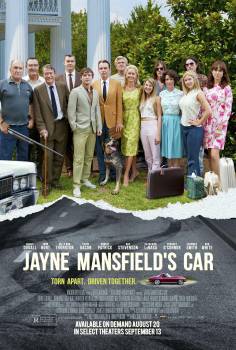
Katherine LaNasa stars in “Jayne Mansfield’s Car,” a new 1960’s Southern family drama co-written and directed by Billy Bob Thornton.  LaNasa, Thornton, Kevin Bacon, and Robert Patrick play the children of a World War I veteran named Jim Caldwell (Robert Duvall).  When their mother dies in England, her British second husband (John Hurt) and his children (Frances O’Connor and Ray Stevenson) bring her body home to Alabama for her funeral.  The conflicts between and within the two families are sometimes comic, sometimes romantic, and sometimes painful.  LaNasa’s character, Donna, is a former beauty queen, the sister of three World War II veterans with varying physical and emotional scars, affectionate with her family and children but not very satisfied in her marriage.  The title of the film comes from Caldwell’s fondness for examining the scenes of car wrecks.  Jayne Mansfield's Car poster

Tell me how you first found out about this project.

Well, actually I was in Cannes with my son who was starring in Gus Van Sant’s movie, “Restless.” And I thought, well, this is what this comes to, I’m the mom of a well known actor.  I got a call about it and I decided to leave early. Henry was having a big time partying with Mick Jagger while I was sitting in my hotel, so I thought perhaps – oh he was about 20 at the time – so he was old enough, but I thought, oh I’m going back and audition and I’m so glad I did. And that’s how I came to find out about it. I was actually up for a smaller role – but the role just had scattered lines here and there, so Billy had me read the role of Donna in order to audition for the smaller role. He was actually being pressured to cast a movie star in the Donna role. So I just got really lucky.

How did you work on the Alabama accent to develop an authentic feel to it?

I am southern, from Louisiana, so that helped.  And I just based a little bit off of Lucas Black, from “Slingblade” .  There was something in the character of Donna that reminded me oddly of the boy character in Slingblade.”  There was a kind of unabashed sense of self – like his whole self was just very forward. I don’t feel that either of those characters had any shame. They just sort of were exactly who they were. And there was just that made me think about that kid in “Slingblade” when I started to work on the character of Donna. I kinda tried to morph that into Donna.  Then of course when she’s flirting turns into this whole other thing – with the voice down low – which my grandmother has a bit of that, and I also kinda wanted there to be this “hickiness” to the accent at times, like when I speak to my husband.  I’d say “Oh Jimbo” not that it was oh so grounded and soft and finished like people sometimes do when they do a Southern accent. I wanted it to have some of that twang that you hear in Lucas’ accent and a lot of the accents in the Deep South.

Your character had long and complicated histories with the other characters that were not always reflected in the dialogue.  What did you do to develop the family relationships and the back story with the other actors?

Billy said something to me at the beginning about the shooting that I thought was so informative and great which was “I think Donna is probably more herself in this town, where she has got to be a big star, because, seriously, she was Miss Alabama – she’s from this tiny town –I mean everybody’s gotta know Donna. Plus, sides the fact they are probably the richest people in town. And everybody liked her.”  And I thought – oh wow – how great it is to play a character that everyone loves. So, that was in my brain. It gave me permission to just have fun. And to just be well liked and just step into Donna the whole time that we were shooting. So the funny thing is that the relationships just started to become that while we were there. It’s like I was really the only female that was always around.  All the men would look to me to do the social planning. It got to the point where Billy’s wife was calling me to ask, could I take Billy’s son under my wing – into the fold – it’s like hilarious. I said, “You know, I’m not actually Donna.”  Ducall would refer to me as Donna.  I love to work that way because I thought, “My only job here is to just get to know my brothers. It’s to have a good time, be the well-liked center of attention and get to know these guys.” And I thought that that would read on film, the more that I got to know them. Billy is a very together-y guy. When he’s shooting, he likes for everyone to do stuff together and go listen to music together or have some beers and pizza together – he likes a lot of that.

When I first met Robert Patrick I died – he is so scary looking – he is a scary looking man. He has a cigar and he rides a motorcycle and in real life he mostly just wears black t-shirts.  If I had just shown up on the set to do that role with him, I think I would have played that scene completely differently. I would have felt like I had to stand up to him, which in a way – would make him look like he has more power.  When I realized that he was a sweetheart through hanging out with him so much I realized there’s this kinda soft inside to him – in his character as well – and that Donna wouldn’t be intimidated by him. Donna would just tell him to shut up.

I just let things come to me.  I personally like to hang out with people if I’m playing their mom, I’d like to go have lunch with the kid and I want to try to spend as much time with people that I can while we are working together if we’re supposed to have a familiar relationship with them because I think it reads.

My favorite scene with your character was the one where you were in bed with Philip because Donna has a lot more willingness to be honest than you normally see in a scene like that. So tell me a little bit about how that scene came together. 

That’s what I’m talking about, that same vibe that I got off that kid in “Slingblade.”  It’s really all so raw.  That complete, sort of unabashed lack of shame, there’s no dancing around it.  I really wanted to hit it –  to be pronounced.

Related Tags:


Actors Interview

Interview: Jerusha Hess and J.J. Feild of “Austenland”

Posted on August 22, 2013 at 8:00 am

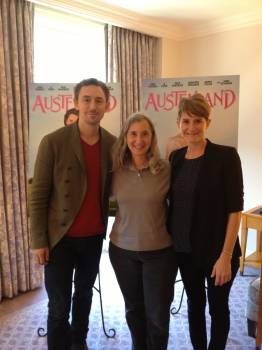
austenlandNo movie this year made me laugh more than “Austenland,” based on the novel by Shannon Hale. The film has Keri Russell as a Jane Austen fan who visits an immersive Jane Austen theme park/experience.  It was a lot of fun to talk to writer-director Jerusha Hess and actor J.J. Feild, who plays the brooding but dashing Mr. Nobley — and who played Mr. Tilney in the version of Austen’s “Northanger Abbey” that was shown in the US on Masterpiece Theatre.  This is the first directing gig for Hess, who co-wrote “Napoleon Dynamite,” “Nacho Libre,” and “Gentlemen Broncos” with her husband, director Jared Hess.

Tell me a little bit about the place where the movie was filmed and what it was like to be there?

JJ: It’s one of the great British estates.  I’ve filmed there three times!

Jerusha: It’s called West Wycombe. And there’s even a lord named Lord Dashwood . It’s very steeped in Austen.  It’s been used in many films, but not in its entirety and we shot the inside and the outside and used every nook and cranny.  The inside is very gaudy. It’s a little naughty inside. There’s a lot of portraiture.

JJ:  Slight sexual innuendo with the portraits there, but that’s the home of something called the Hellfire Club, which is a very, very old society in Britain, that was known in Charles II’s time, but it goes back beyond that and who knows what else.  It’s the home of that society that supposedly no longer exists, but I have heard that Prime Ministers and Cabinet members are still members.

Jerusha: We used that gaudiness to our benefit.

Tell me a little bit about the wardrobe.

Jerusha: The costume designer, her name is Anne Hardinge. She’s done “Shaun of the Dead” and “Hot Fuzz.” She’s really comedic costume designer, which was right up my alley. She was a joy to work with. She was like fabulous Geena Davis. She was just floating with her red lip and kind of fabulous.

JJ: Mostly with her costume designed just looked good.

Jerusha: She just couldn’t wait to get her hands on Jennifer Coolidge and design these gowns that matched the curtains and the bedspread. Yes, she had a lot of fun with it and we all did, because a lot of just a very straight regency costumes that we just rented from the houses, but some of it we got to make and have fun with.

The dress that her friend made was very funny, the idea of someone who really does not know the period and is just piecing something together, with good intentions but awful results.

Jerusha: The cheap, renaissance get on that.

I also loved it when Keri Russell’s outfit just felt apart when you were carrying her around there. I thought that was very well done and surprisingly shocking.

Jerusha: It was shocking to see a leg! You’ve never seen a leg in these stories. We made it a little saloon girl. We played up on many elements because everything is just very covered and the tights are very thick and heavy. And then to have it  all fell apart, absolutely, we wanted to see the leg!

It was also very shocking to see the scenes by the pool, where you see some of the men in modern clothes, but Nobley was still in his full period dress.

Jerusha: Yes, absolutely and Martin because we couldn’t reveal too much. That was really fun to just have guys in the pool with the wig on.

How did you and “Twilight” author Stephenie Meyer, who produced, and this book by Shannon Hale all come together?  Tell me about Stephenie Meyer and how she got to be involved.

Jerusha: Stephenie was a friend of Shannon Hale previously, because they’re both girls in the writing world and Mormon girls to add to that. They were buddies and they always talked about making a movie together. Apparently, when I came on it became real which I laughed at. I was just another girl adding to the mix. There was a time where we went on a little trip together and we just like giggled, like, “It’s going to be so fun to make this movie and think about all about the handsome men.” We were just such chicks making a movie. She was great. She’s powerful woman. I met Shannon Hale through some friends and family.  I was interested in her book called Princess Academy, which is just a very sweet, Newbery-nominated fairy tale for young readers. She was like, “Oh, actually I have something else for you.” She gave me Austenland. The next morning, I’m sure I called her and I was like, “Let’s make this movie.” It is so fun. It just felt so girly and great and a great vehicle for the weird Hess comedy.

The weird Hess comedy has mostly been more boy-oriented.

Jerusha: Absolutely and very young boys. I was just ready to make a movie for the girls.  It was just really fun to write for a girl. It was really indulgent and sweet. The whole movie feels indulgent, doesn’t it? It’s such a romp in England.  And our experience in England was that. It was a delight. I had never even been to England and I got to spend five months there in a beautiful estate and just party with these gorgeous men and women and poke fun at their beloved genre, which they all loved. We teased it, but it’s so gentle, that you’re still swept away the whole time.

What’s the difference between playing a real Austen character and a fake Austen character?

JJ: One is a comedy and one is not. Playing this part in “Austenland,” for me it’s the man who doesn’t want to be there, who’s there by accident and he’s feeling deeply embarrassed.

Which is very Darcy.

JJ: Exactly. Then you just take the world of British costume drama and trying to send up as much of it as you can.

Why is that such a perpetual romantic fantasy?

JJ: It’s the outspoken, funny, poor thinking woman who can actually soften and tame someone like Mr. Darcy. It’s the fantasy that perhaps some men are misunderstood.

What was the biggest challenge that you had as a first time director?

Jerusha: It was just so cushy — like the time frame. I had 41 days to shoot. I had amazing comedians at my fingertips. I had this very cool Director of Cinematography who shot all the Stanley Kubrick films. I had all the staff at my fingertips, amazing talent and I’m like a nice to a fault whoever wanted to raising me up, like, ‘We’re going to make you look really good.’ I don’t have to do much. What I was surprised at and the challenge was that dealing with an ensemble cast who are in scenes together everyday all day, that is a challenge. It’s a challenge to make sure everyone get as much coverage and attention, it got just kind of competitive. I loved it because it made it funnier, but the improv went nuts. People were like, “Oh wait. I have something better to say.” “Now, I’m going to say…”

JJ: We needed six cameras.

Jerusha: It got hard to juggle the funny on set and then even harder in post-production.

Fortunately you had the credit sequence where you could throw in some of that stuff, which was great, great fun. I thought that was just too sweet. What about you, what was the biggest challenge of doing it for you?

JJ: Keeping a straight face. It’s not easy to have a grouchy face in front of Jennifer Coolidge and Bret McKenzie and Georgia King and it’s just hilarious. Jennifer Coolidge’s improvisation could be very physical or one line. James Callis when he started talking, he would talk an entire roll of film out. I don’t know how you can extemporize that amount of dialog, because he doesn’t prepare it. It’s just sort of flows. He’s extraordinary.

If you could enter a theme park of a book, what book would you pick?

Jerusha: I would do Winnie the Pooh. We would live in the tree house. We would hunt for honey.
JJ: I just got a new son and my childhood was made magical by Narnia, so if I could take my son to a wardrobe that would be it.

Related Tags:


Actors Directors Interview Writers
THE MOVIE MOM® is a registered trademark of Nell Minow. Use of the mark without express consent from Nell Minow constitutes trademark infringement and unfair competition in violation of federal and state laws. All material © Nell Minow 1995-2026, all rights reserved, and no use or republication is permitted without explicit permission. This site hosts Nell Minow’s Movie Mom® archive, with material that originally appeared on Yahoo! Movies, Beliefnet, and other sources. Much of her new material can be found at Rogerebert.com, Huffington Post, and WheretoWatch. Her books include The Movie Mom’s Guide to Family Movies and 101 Must-See Movie Moments, and she can be heard each week on radio stations across the country.

Website Designed by Max LaZebnik