Interview: Heitor Pereira, Composer of “Despicable Me 2”

Posted on July 5, 2013 at 9:00 am

Heitor Pereira is a Brazilian musician and composer who has gone from Simply Red to Hollywood, creating movie scores for films like “Madagascar,” “The Holiday,” and “Bee Movie.”  He talked to me about the challenge of scoring a sequel with a very distinctive original theme, creating new themes for the new characters, which classic movie he’d like to have scored, and why it is important to “tease the ears.”

How did your conversation about this movie begin?

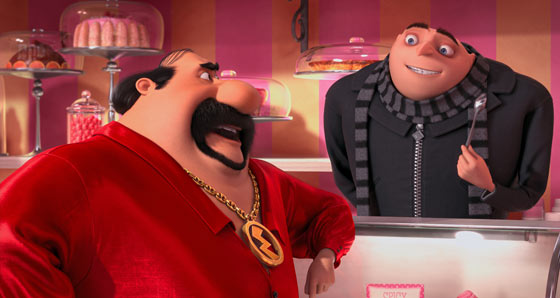
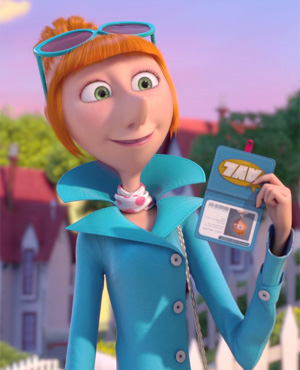
In the lines of, “Let’s not forget what we’ve done so far. Let’s pick it up from there and go with it. Musically, it means that the melodies for Gru and the girls that existed in the first one became slightly different because the emotions of those characters are different. That’s one of the beautiful things that fascinated me the most — you can keep creating new versions of the same thing. You can let the picture tell you what the style is, it will never end. And there were new characters. El Macho had the influence of Mexican music. Lucy had more of a tango. And the minions that become bad — their theme had to become more threatening and menacing.

I was glad to hear “Prettiest Girls” from the original again in the sequel. It’s perfect for the scene.

That’s how I got this movie. Pharrell had asked me to do an arrangement of the song to see how we could stretch it. This will be forever the melody of the girls. Every melody can be made different, kind of new to the ears, even though we are in the same movie, with the same notes. I love the way the melody can become so many different things.

Tell me more about creating new themes for the new characters.

ElMacho-Eduardo-BenjaminBratt-DespicableMe2El Macho being like a Mexican wrestler, definitely I had to bring all that Mexican music with a bravado, him being a villain, it had to be strong and powerful and big. When Gru means business, he means business, and the villain has to be very strong to fight him. The music had to give us that strength. Mexican music is so colorful. It can be sad and in one second it can be completely joyful. And animation — that’s one of the things it asks from you most as a musician. You have to be able to turn sadness into laughter and happiness into tears.  Characters like El Macho and Lucy give you enough emotional area to draw from because they change a lot in the story-telling.  All that has to be told with the same melody but several variations.  If you pick styles of music that have their essence — Mexican music you have mariachi, you have Veracruz, you have banda.  For Lucy, I chose a tango.  But a tango doesn’t necessarily have to be all serious, calculating.  It can be emotional, in love, comedic.

Is it a challenge to integrate songs into the score?

Unless there is a reason in the story, you don’t want it to be a surprise, so you have to tease the ears with what is going to come in the song before it begins.  That’s why I love collaborating with pop artists, like I did with Jack Johnson in “Curious George.”  It’s something I understand from my time with Simply Red and working as a session musician.  It’s such a beautiful thing, it just completes the movie in such a special way, a special moment in the story-telling, not just plugging an artist.  You have to feel that it is only that artist, only that song, that belongs in that moment and tells that part of the story.  I love my job!

If you could go back in time and write a score for any classic movie, what would you pick?Despicableme2-lucywilde-kristenwigg-300-01

I would pick a hard one.  I would like to rewrite “The Mission.”  It was from the perspective of the Jesuits and the conquistatdores.  I would love to do it from the perspective of the indigenous peoples, because I am Brazilian.  Or “The Third Man.”  It was so minimalistic.  What if it was done in another way?

How early do you get involved in a film like this?

Very early, I come in from the script onwards.  I love seeing the process and how it evolves.  We collaborate from the beginning on the score itself.  I really appreciate the comments and suggestions and the yeses and nos from the producer and directors.  I don’t fear comments.  I expect them to have an opinion about what I’ve done and how can I make it better. The great bands are the bands that if you close your eyes you can visualize the musicians listening to each other. If the director is very open and very “what if?” and open to whatever can make it better, that is like working with a band.

When I am performing, I am fascinated by looking at the audience, thinking, “How is it affecting them.” Now, when I write in my lonely chair, in my dark room, I’m thinking, “this chair right now is one of a thousand chairs in the movie theater. If I was to look to my side, I would see the audience who have gone to the theater to see the movie and listen to this music that I’m adding to it.” You never forget that you are there to be part of this entertaining moment, for a family or a romantic story or a drama or to scare the hell out of people in a horror movie. Then you’re not lonely. You think about who you are making the music for. You’re writing for those ears and eyes six months later in the audience, in the crowd. A person should never forget that because you never run out of ideas.

Related Tags:


Composers Interview Music

Interview: Jim Rash and Nat Faxon of “The Way Way Back”

Posted on July 3, 2013 at 3:59 pm

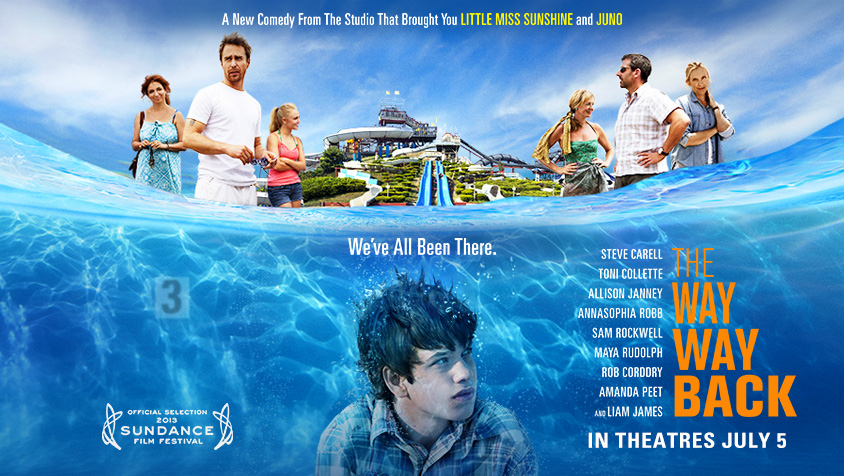
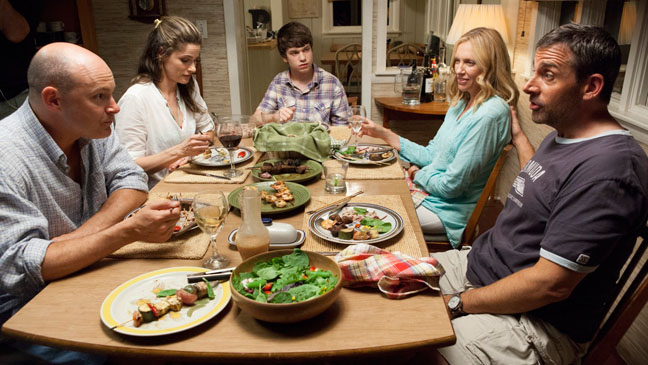
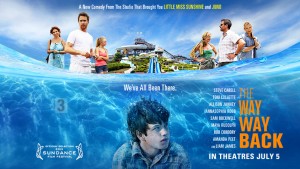
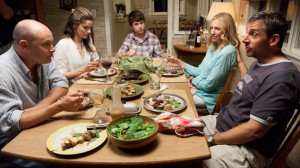
the-way-way-backNat Faxon and Jim Rash won a screenwriting Oscar for “The Descendants” and won the next day’s headlines by imitating Angelina Jolie’s leg-out pose when they accepted it.  I talked to them about “The Way Way Back,” which they wrote, produced, directed, and appear in as actors.  It is a coming of age story about a 14-year-old boy named Duncan (Liam James), reluctantly staying at a summer home on the beach with his mother, Pam (Toni Collette), and her new boyfriend, Trent (Steve Carell).  To get out of the house, he takes a job at a local water park, where he is befriended by the manager (Sam Rockwell as Owen).  Faxon and Rash play some of the other employees.  I talked to them about casting Steve Carell as a bad guy, using Spotify to find songs for the film, what acting has taught them about directing, and the very important task they forgot on the first day.

Do all teenagers look for a new family?

NF: You’re always saying, “I don’t belong here! Where is someone who understands me?” We all go through that.

JR: Except me! My family was perfect. (Laughs)

What do we look for?

NF: We think there’s something better, someone who’s not going to tell us what to do. We hope there’s always going to be a cheerleader who will give us independence. And then we realize — hopefully — that the place we were in was good for us in the long run.

Adolescence is such an excruciating time of life and yet we keep being drawn to those stories.

JR: The vulnerability that you have at that age, the innocence that is transforming, a rite of passage, becoming more of a free-thinker, more opinionated about what your views are and what you like and don’t like as emblems of who you are — there’s something very relatable and very honest in that transition time. With the help of someone else or on your own, you’re making that leap and that’s universal no matter where you come from.

NF: And once you’ve been through it, you have a context, and you can look back and remember it and understand more than you could when it was happening. You’re endeared to these characters pretty instantly because you know exactly what this is.

Who thinks of nicest-guy-in-the-world Steve Carell as a bad guy who is a liar and a bully? Where does that come from?

NF: We went against type for a lot of reasons and he came to mind pretty fast. Steve’s character, Trent, is difficult. He’s a jerk, but he’s more complicated than that. He’s a tragic male character, stuck in a cycle. But we needed that innate likability. His girlfriend, Pam , where she is right now, she is scared, so she needs to see the attractiveness in this protection he offers. We see him with his friends. We see what he’s like with them, and how he is appealing. We needed an actor who understood that Trent’s not on a typical arc of change. He’s in a circle of non-change. Some people who have seen it a second time start to feel some sympathy for him. Not that they want to hang around him, more like, “I hope you get better,” or “I hope you wake up.” He’s also needed for Duncan and Pam to allow them to have this moment of awakening. So Steve was perfect because he embraced that.

And Steve Carell was probably thrilled to play a role like this.

NF: He wrote us a very nice note saying that he loved the script. And then there was this phrase…

JR: He said, “I love this, but, lest I become a Trent to my own family, I have to decline.” We were shooting during the summer and he spends a lot of time on the east coast with his family. He didn’t want to be on location away from them. So we wrote back and said, “What if we shoot where you’ll be?”

That’s how you found your location?

JR: And so he said all right. We were originally planning North Carolina, which is where I’m from. But the East Coast experience is the East Coast experience. East Coast destination vacations are completely different to me than West Coast, where we are now. We were like, “We can shoot in your back yard.”

NF: We lucked out in terms of locations. We were so fortunate because our scouting literally took one day. We had two locations that were central in the movie, the water park and the house. We found one in the morning and one in the afternoon. We wanted the place to feel local and not one of these enormous, corporate, Six Flag-y type water parks. We also didn’t want it to be so sad and pathetic that you would never go there. It had to be fun and sort of Oz for our movie. And this place really exists, it’s really named Water Wizz, off of Route 28, and it really is a family-owned establishment. It’s the perfect size, it’s the perfect look, it had everything that we needed. We shot there while the park was open, and so a lot of those people were just water park go-ers.

What have you learned as actors that helps you work with actors as directors?THE WAY, WAY BACK
NF: Because we know this material and we are actors and have had the fortune to work with good directors, we know that for actors it is nice to talk about the character, what makes them this way. There are directors who are more technical. We are more about how we know the script, we know the intent, we know the performance, we know actors. We put that angle on it, and we try to keep those conversations with the actors about that. These people are fantastic. All you need is to give them any kind of clarity about what is happening now, what’s it about, where we are in the story. And then you just let them have a little free reign to explore that. And we’re all in a tight time line, so we have to do it in four takes! Some of these bigger movies, they’re shooting two pages a day, and so that’s different — we have to shoot six to make our time line. And we had a lot of one set-ups, maybe two set-ups. We had walks along the beach that was basically one shot, sitting and waiting for Trent at one point, all in one shot. So we did a lot of those for time and for the aesthetic of feeling in the moment, feeling that we’re voyeurs, eavesdropping on this moment. Both creative and logistic decisions.

JR: Trying not to micro-manage, letting the actors trust their instincts, trying not to over-note them. That’s something that feels more comfortable when you’re not thinking about the twelve things the director just told you but just one or two adjustments that might help.

What guided you as first-time directors with camera placement and all the technical stuff? Who influenced you?

NF: Being first-time directors, it was important for us to surround ourselves with very experienced, talented department heads, like our Director of Cinematography, John Bailey, whose list of films is incomparable.  We had a lot of discussions with him about the look and feel — that was something we could speak very confidently about.  It’s important while Duncan is in the house that he feel very isolated and claustrophobic.  What’s the best cinematic way to achieve that?  Should we put the camera down low to feel a little bit of the closing in?  Then when we get to the water park it would be great to have it more open and fluid and vast and colorful, use steadicam more.  When it got super-technical, lenses and all that, we would just say, “That looks great!”  “You got it!”  That’s the benefit of having someone like John Bailey, who you can trust with all of the little, important, specifics.

And you worked with one of the greats in costume design!

JR: The legend, Ann Roth.

NF: Our producer had worked with her on “The Hours” and a bunch of other movies.  He reached out and she read the script and she loved it and wanted to be a part of it.  We were so incredibly fortunate.  You don’t have to work with her to know what a legend she is, and to work with her is really fun because she is such an incredible personality and you want to spend as much time with her as possible.

JR: Just for the soundbites!

NF: She is brutally honest and she wants you to be brutally honest but terrifies you!  The actresses showed up and it was fantastic.  We would talk about the characters and as soon as they knew it was Ann Roth, they said, “Fine.  She’ll tell me what to wear.”  They trust her so completely.  That type of care and confidence.

She’s so intimidating.  She had an idea for a shirt for Duncan in the opening scene.  In our eyes it felt slightly too Midwestern, maybe like a farm boy look.  I worked up the courage to say, “Ann, I just want to let you know, we might want to go another way with the shirt, look at some other choices….”  and she goes, “All right…” and calls the co-designer, Michelle Matland, and says, “THE DIRECTOR DOES NOT LIKE THE SHIRT.  THE SHIRT WILL NOT PLAY!!”  And I was like, “I’m so sorry!  Is that okay?”  “I PREFER THAT YOU TELL ME WHAT YOU WANT.”  She’s very intimidating, but very collaborative.  She wants to know what your opinion is and respects you more if you are able to tell you that.

JR: She was so excited because the pants Allison is wearing the first time you meet her, these tight pants with a rodeo on it, she has been trying to get that into a movie forever.  Shirley MacLaine wore them many many many years ago, and she’d been saving them.  She pulled them right out and did not miss a beat.

NF: She is a love and a joy to work with and so is Michelle, who is a wonderful counter-balance.

I thought the music was exceptionally well chosen, too.

JR: We had Linda Cohen. We were on a budget and music is not cheap.  We wanted to make sure the film had a cross-section of music to represent both the characters  — Trent probably had CDs he left at the beach house year after year — and we needed some more modern stuff for the water park, with a blend of what Owen would love.  Imagine his Shuffle.  We wanted to make sure it had a timeless feeling.  When you’re a kid at first your taste relates to your parents’ music, and then it evolves.  We had to get creative.  Linda sent us tons of great music and sometimes we would put bands we loved into Spotify and that’s how two songs came, from Trampled by Turtles and The Apache Relay.

NF: My father-in-law is this legendary drummer, Steve Gadd, and he knows an incredible amount of artists.  I said, “if there’s anybody you can think of, we’d love your help in any possible way.”  He had been playing with Edie Brickell and he made the connection.  She watched the movie and really liked it and wanted to be a part of it.  She sent us song after song after song for ideas for the movie.  She was so sweet, so collaborative, so creative, an amazing wealth of music.  Two of those songs bookend the movie.  They fit so well and we were so fortunate.

How did you cast yourselves?

NF: We knew we needed a great-looking guy…we played against type, really stretched ourselves.    I was a little stressed out about it to do both.  We didn’t have the technology to make it a little easier, playback, monitors, so you could see what you’re doing.  So it was a bit of a challenge.  But we started writing together because we wanted to write parts for ourselves that Hollywood had decided we didn’t play.  Not these particular roles, but it was frustrating because you go through these fazes with casting and movies, any actor, even a star.  It’s really upon you to say, “No, no, I can do other things.”  Sometimes you have to fight to audition for those things and hopefully you can prove that you’re right.  Even though this is not exactly an example of that, that was our intention.  It’s important for us always nurture the performers in ourselves.   We’ll have smaller parts, and we’ll work cheap, save a few bucks, and we’re pretty easy to work with.

JR: We had rain the first few days and we didn’t have a lot of rain cover in terms of what else we could shoot.  So we sort of pushed our acting debuts in the movie until near the end, but we were forced to do them on the first day because of the rain.  There was one particular moment when we were in a scene and the scene just sort of ended and we’re looking around, “Hmm, somebody’s not saying ‘Cut.'”  then we heard our producer, saying, “Um, cut…?”  And we’re like, “Yes! Cut!”  We had completely forgotten.

Related Tags:


Actors Directors Interview Writers

Interview: Jeff Allen of “Apostles of Comedy: Onwards and Upwards”

Posted on July 1, 2013 at 8:13 am

The very funny Jeff Allen answered my questions about his new DVD, Apostles of Comedy: Onwards & Upwards.

When did you first know you were funny?

I thought I was funny when I started stand up comedy in Chicago; the audience thought differently. My first big laugh came when I started screaming about my junky VW bug. That’s when I knew I could make people laugh at a club.

Did being funny get you in or out of trouble?Jeff-Allen

Yeah, you learn quick as a young man, you are either a fighter or a talker. I was a talker and a smart aleck. My mouth got me in all kinds of trouble until I got my timing down.

Do audiences respond differently in different parts of the country?

Earlier in my career I found that to be true. But now, I have kind of honed in on marriage and kids, they aren’t much different universally, so it is pretty consistent now wherever I go.

What’s the toughest part of being on the road and the best part?

The toughest is the travel and being away from my friends and family, the best part is the people I get to meet as well as some of the golf courses I get to play that I never would have, had I not traveled there.

What’s the best advice you ever got about doing stand up?

Someone told me to take care of the only thing I have control over and everything else will take care of itself. The only thing I have control over is my act, what I say.

What or who makes you laugh?

Slapstick in movies and (comedian) Brian Regan in stand up.

What kind of welcome do you get from Christian audiences?

They seem to like me, have you heard otherwise?

Why can we hear truth through comedy that we don’t in other ways?

Most times when people talk about truth it comes off as preaching, most people don’t like to be preached to and put up walls. Comedy knocks those walls down and it opens people’s ears up and they hear a little better.

How do you make the frustrating or scary aspects of every day life funny?

It’s just how I process life, when I am stressed all the people around me suffer. So rather than put them through the ringer, I will try to make a joke about it and it is like a release valve. I learned this early in life. It helped me survive growing up.

Related Tags:


Comedy Interview

Interview: Greg ‘Freddy’ Camalier, Director of the Music Documentary “Muscle Shoals”

Posted on June 26, 2013 at 5:29 pm

I sat down to watch an early screener of “Muscle Shoals,” the new documentary about a tiny Alabama town and the two music studios that produced some of the biggest records of all time.  Ten minutes later, I stopped it to go get my husband.  “You’re going to want to see this,” I told him, and we watched it together, exclaiming over and over, as Aretha Franklin, Mac Davis, Tom Jones, Paul Anka, the Rolling Stones, Lynyrd Skynyrd, the Allman Brothers, Wilson Pickett, Percy Sledge, and Alicia Keyes came on screen, “and that song, too?”

I spoke to first-time director Greg ‘Freddy’ Camalier about the movie.  His plan was to direct a feature film, but “this one picked me.”  He fell in love with the story and the people.  It was a daunting task to shape decades of material into a linear narrative, and he assured me there will be much more of what was left over on the DVD.  The heart of the story is Rick Hall, a man whose life reads like a country song, or several country songs, with a series of devastating losses.  “It affected him on a molecular level,” Camalier told me, and was certainly a source of the gut-wrenching emotion he brought to the music he produced and engineered.  Even in comparison to the small town of Muscle Shoals, Evans grew up in isolation.  His mother left when he was young and his father moved where the jobs were.  He never saw an African-American until he was in his teens.  His only exposure to music was at local gatherings.  But he had an extraordinary ear and a passion for music.  As the movie shows, he invited a performer named Arthur Alexander to record in his new studio the first time he heard him and it became a nationwide hit that was later covered by the Rolling Stones.  Another of his songs was covered by the Beatles.

Camalier was a musician himself.  He smiled as he said he could recall exactly how Lynyrd Skynyrd’s cardboard album cover smelled — and how he memorized every line of the lyrics.  But he cannot explain the mysteries of Muscle Shoals: first, the apparently endless local musical talent and second the freedom from racial strife at the studios, even in the midst of the Civil Rights era, where the Alabama governor was insisting on “Segregation forever!”

I asked him how, after Hall’s first group of studio musicians, The Swampers, left to start their own studio, he was able to almost immediately replace them with an entirely new rhythm section of equally talented players.  He shook his head.  “I don’t know,” he said. “Music is a way of life there.”  And no matter what struggles were going on outside the studio, the inside was a space where only the music mattered.  He laughed as we recalled the exception noted in the film — the mixing of the races in the studio did not attract nearly the negative comments that “long-haired hippies” did — when Duane Allman joined in.

“Why didn’t they leave?” I asked.  “I am sure they could have had more opportunities and made more money in Los Angeles, New York, or Memphis.  “It is their home,” he said.  “They like it there.  Their families are there.  And the world came to them.”

Related Tags:


Directors Interview

Interview: Henry Jackman, Composer for “Turbo” and “This is the End”

Posted on June 25, 2013 at 8:00 am

It was an absolute delight to talk to British musician/composer Henry Jackman about his two very different assignments in creating musical scores for the comic end-of-the-world movie featuring the Judd Apatow crew, “This is the End,” and the adorable animated movie about a snail who races in NASCAR, “Turbo.”  He brought the same commitment to both — to make a score that would showcase the excitement and tension of the storyline, to provide both foundation and counterpoint to the comedy.

How do you create the right tone for a comedy about the end of the world with a meta-narrative that has the co-writer/director and his actor friends playing versions of themselves?

The interesting thing from the film composer perspective is that it was a really unique invitation — as soon as I heard about it I wanted to get involved straight away.  Often comedies from a score perspective are not necessarily an invitation to write an epic score.  It’s a dangerous concept but they pull it off — self-referential without being pretentious.  And the hidden ingredient is the Biblical rapture, the apocalypse that is going on at the same time.  And not goofy sinkholes and goofy monsters.  It’s like a Roland Emmerich thing.  It ends!  So we figured out very quickly that I needed to write a full-on rapture theme like “Indiana Jones and the Temple of Doom” or “The Omen,” with demonic possession.  I told Seth Rogen that my reference should be Jerry Goldsmith in “The Omen” or “The Exorcist” and commit.

One of the quickest ways to ruin this film would be a goofy comedy music.  I had to support the apocalypse, this big melodramatic rapture symphonic theme, no holds barred, huge choir, massive orchestra.  I was thinking about “Ghostbusters.”  It has all this fun stuff, the Ray Parker, Jr. song, but when it comes to the score, Sigourney Weaver being possessed, that’s actually a really high-brow, mystical sounding score from Elmer Bernstein.  It elevates the film.  If you back off a bit and say, “Well, it’s a comedy.  It’s not really the apocalypse,” it would be a huge mistake.  It makes the comedy more comedic if every time you get a shot of the burning ruins of LA and the huge sinkhole, it should be no different from a horror film.  I’d meet with Seth and Evan every week and those meetings were great.  The guys were extremely focused.  Because they know each other very well, and have worked with the music editor on a bunch of films, they knew their angle, they knew their shtick, and they were really productive.  On top of that, they’re actually hilarious guys in real life.  I can’t remember a music meeting being that fun.

Sometimes you can get some dissonance between a producer and an editor or a producer and a director, but these guys have been working together for so long and have such a partnership that it was like working with a band.

So, tell me about “Turbo.”

It’s about a snail who wants to race, which of course is preposterous, and in that respect had a story arc similar to “Babe,” and movies like that.  What’s great about it is to get that story arc from A to B it has the classic superhero transformational moment at the end of Act One, like the spider-bite for Spider Man.  I don’t want to give too much away, but he has a physical experience which forever transforms him.  Even that part of the movie is like a superhero movie.  The camera goes inside his body and you see all the platelets and the DNA helixes twisting and morphing into like a turbo creature.  Later on he hooks up with a snail posse, heralded by Samuel L. Jackson and one of the other characters is played by Snoop Dogg.  And since we had Snoop Dogg, we had him to a song for the end credits.

Animated films take a very long time.  Have you been involved for three or four years?

There isn’t a lot of difference in how long you spend on an animated or live action film as a composer.  The difference is how much longer you are aware of it.  “Turbo” started three or four years ago.  With “This is the End,” the first time I got involved I got to see a rough cut of the whole film.  With “Turbo,” I met with the director in this big idea room with storyboards everywhere and he basically walked me through the movie, basically outlined the whole film.  So by the end of the day, even though I’d only seen a few minutes of actual footage, and even that was not completed, I had a really strong sense of the film.  As a composer, the first thing you have to figure out is the themes and the character arcs.  You don’t need all the color corrections and final touches.  You can be starting to think about the story and the themes.

We needed a dreamer theme, a whole underdog, “Rocky” idea of someone who is dreaming of something completely outside his physical and psychological capability but he won’t let go.  It’s aspirational.  That’s more of a character theme.  Then I had this whole racing theme.  We came up with a theme for the snail posse.  The director, David Soren, asked for a sort of “90’s hip-hop meets western Tarantino.”  And I said, “Hell, yeah!  We’ll put all those elements in the mix and see if something decent comes out the other end.”  When we finished all the cues we called in this really great D.J. to do all the scratching.

And for the racing, you wanted something exciting.

The other great thing about it being racing was that I could incorporate elements other than orchestra.  You’re going to need the orchestra for the story-telling.  You can’t just have a rock track.  But the racing elements also included dubstep stuff, electronic, a whole distorted drum kit going on, a whole lot of aggressive drums.  There’s a whole lot of elements that are not symphonic. But you still need the symphonic elements even during the racing.  There’s still a lot of story going on.  There are moments of self-doubt and moments of inspiration, and the end is not what you expect.  All of that requires story-telling effect.  For racing you need the visceral, rhythmic aspect.  But for the story and characters you need something else.  And the real denouement of the film is not a racing moment but a character moment.

David’s directorial approach was so ruthlessly authentic — you could be tempted to think “oh, it’s just a racing story or a fantasy.”  Even though there’s this amazing animation and exciting racing scenes, it’s really all about the story, and that’s what makes a movie satisfying.  Because he’s got Dreamworks Animation, he has the best of both worlds, a great story and great animators.  And the voice talent is awesome.

If you could go back in time to score any movie ever made, what would you pick?

Maybe “Bridge on the River Kwai,” or “Gandhi.”  Or “Alien!”  I’m not going to say “Star Wars,” because that’s sacred territory.  It’s the reason so many people even care about film music.

What was the first film you scored?

The first full-feature film I did was “Monsters vs. Aliens.”

How is scoring for animated films different?

The rate at which story points are happening is more compressed.  In a movie like “X-Men” you could have three minutes when the tone and the feeling and the psychology of the music could stay consistent for maybe two minutes.  In an animated film, all sorts of things have happened storywise in that same three minutes so you have to be compositionally more flexible.  Three minutes of animated score equals about ten in live-action in terms of the narrative demands.  In an animated film you are inventing everything.  In a movie like “Heat” there’s an eight minute conversation with just one idea, the hunter and the hunted,  two sides of the same coin.  It would need to be a abstract, invisible, out of the way, textural kind of a cue.  But eight minutes in a movie like “Turbo,” things would have changed, things would have moved, all of which needs supporting in the score, which is allowed to be more demonstrative in its story-telling, where in live-action it can be more like wallpaper to not get in the way of a psychologically credible conversation between two characters.

What’s the best advice you ever got about composing a film score?

it was from Hans Zimmer.  When I first met him, I was perhaps indulging myself and waffling on about the intricacies of music.  He interrupted me and said, “Let me tell you something about film music.  It’s not about can you write music.  It’s about can you tell a story.  All the composing and mechanics skills you have are important.  But they are in the service of telling the story.”


Related Tags:


Composers Interview Music
THE MOVIE MOM® is a registered trademark of Nell Minow. Use of the mark without express consent from Nell Minow constitutes trademark infringement and unfair competition in violation of federal and state laws. All material © Nell Minow 1995-2026, all rights reserved, and no use or republication is permitted without explicit permission. This site hosts Nell Minow’s Movie Mom® archive, with material that originally appeared on Yahoo! Movies, Beliefnet, and other sources. Much of her new material can be found at Rogerebert.com, Huffington Post, and WheretoWatch. Her books include The Movie Mom’s Guide to Family Movies and 101 Must-See Movie Moments, and she can be heard each week on radio stations across the country.

Website Designed by Max LaZebnik