
Interview: Margaret Talbot on The Entertainer

Posted on May 15, 2013 at 3:28 pm

I loved Margaret Talbot’s book about her father, actor Lyle Talbot, The Entertainer: Movies, Magic, and My Father’s Twentieth Century.  His career spanned the full range of entertainment from the traveling shows of the 1920’s to movies in the golden age of Hollywood co-starring with Bette Davis, Mae West, Carole Lombard, Mary Astor, Ginger Rogers and Shirley Temple.  He escorted starlet to glamorous nightclubs and visited William Randolph Hearst’s legendary San Simeon.  He helped found the Screen Actor’s Guild, he played Ozzie and Harriet’s neighbor on television, and he appeared in films directed by the notorious Ed Wood.

Here is a trailer for one of his films.

http://www.youtube.com/watch?v=Kox3loxojR0

And you can glimpse him at a barbecue with the Nelson family in this Coke commercial.

I’ll be interviewing Ms. Talbot at a screening of her father’s best film,  “Three on a Match,” on June 7, so if you are in the Washington, DC area, come join us.  And she took time to answer some of my questions about her father and the book.  

You had every biographer’s dream — a subject who kept everything in an extensive and detailed series of scrapbooks.  What prompted him to keep this record and was it something he shared with the family?  Or did you really go through them for the first time when you were working on the book?

Yes, I was so lucky in that respect. Although my Dad was not a writer—so he didn’t leave behind a stash of letters or a wonderfully dishy diary—he did, from the time he was a teenager, keep scrapbooks full of newspaper clippings, theatrical programs, menus, train tickets, snapshots, caricatures and poems by fellow actors. I think that as a small-town boy from Nebraska who left home to join a carnival, became a matinee idol in travelling theater troupes and ended up in Hollywood at the dawn of the talkies, he had a sense that his life was a real adventure, and he wanted to chronicle it. That impulse was so helpful to me in recreating not only the events of his life, but also what I was even more interested in getting at—the texture of the times he lived through. Sometimes I wonder what it will be like for future biographers, writing about people from our own era and beyond, when we are keeping less paper and writing fewer letters. (There will be plenty of tweets and e-mail of course, and they constitute their own kind of record—more granular in a way, but not as deep as the best letters.)
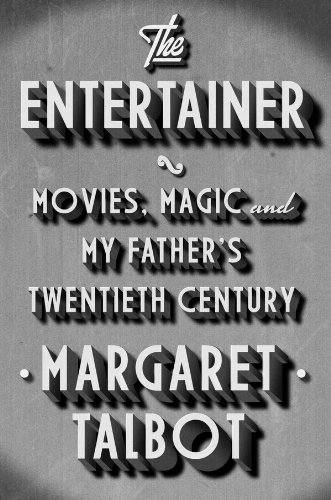
the entertainer cover

What were some of the other sources you used to research the productions your father was in?

Well, I watched a lot of movies, of course, which was great, and I spent time at libraries and archives, from the Nebraska State Historical Society to The Margaret Herrick Library of the Academy of Motion Picture Arts and Sciences in L.A. The Herrick Library was a favorite of mine, as I’m sure it is of anybody doing research on the history of film. I particularly loved their extensive collection of old fan magazines

 Your father was one of the guests at San Simeon, the Hearst Castle, where William Randolph Hearst’s extravagant property included a private zoo.  What were those visits like?

Kind of like a fairy tale, it always seemed to me when my father told stories about it. He’d get an invitation—more like a summons, really—to come up the next weekend, say. A limousine would pick him up and take him to the train station to board a train called the Midnight Lark where he’d have his own compartment. A limo would pick him up at the train station in San Luis Obispo. On the drive up to the mansion, he’d see the animals from Heart’s private menagerie. And my father loved that as a guest you were free to wander the grounds and do whatever you wanted; your only obligation was to be present at dinner, and dressed elegantly for it. Very Downton Abbey. Only with more drinking—some of it furtive, since Marion Davies, Hearst’s charming mistress and co-hostess, had a problem with alcohol.

Your father’s career spanned everything from traveling shows to movies, radio, Broadway theater, and television.  Which did he like the best?

He loved theater—almost all theater—the best. He was one of those actors who really thrived on the reactions of a live audience.

He worked with Hollywood greats and with Ed Wood, often called the worst director in history.  Who did he respect the most, and what did he think of Wood?

He had a great admiration for William Wellman, whom he called by the nickname Wild Bill. The way my father described him, Wellman was a tough and cunning but fundamentally decent guy. He liked to get authentic looking fights and action scenes, and for a movie called “College Coach,” in which my Dad played a football player and the extras were all real football players from USC, Wellman took the college players aside and told them my Dad had played football for Nebraska, so they didn’t have to hold back; they could tackle him for real. My father was nearly knocked out but he told the story with a chuckle: Wellman had chutzpah. As my father always remembered about him, Wellman had been a flyer with the Lafayette Escadrille in World War I, been shot down, and had a metal plate in his head. So you didn’t mess with him.

As for Wood, my Dad hadn’t talked about his experience with him much—it was kind of embarrassing to him, even though he was a never-turn-down-a-job journeyman actor—until the Tim Burton biopic about Wood was in production, and renewed interest in Wood’s weirdness led reporters to my Dad, who had been in “Glen or Glenda” and “Plan Nine from Outer Space.” Then my Dad started talking about “Eddie”—how sweet he was, how sincerely he’d believed in what he was doing. Also how he’d pay my Dad at the end of each day of filming with a wad of crumpled up small bills he took from his pocket; how he never had permits to film anywhere and the crew was forever having to pack up the set and scurry away when the cops or a building owner showed up; and how, once when my Dad allowed a soused Eddie to sleep over, Wood had showed up at the breakfast table wearing my mom’s negligee, which he’d found hanging on the back of the bathroom door.

Which do you think were his best performances and why?

I think he did some excellent theatrical performances late in life, when he really got to inhabit character roles; he did a great run as a wheel-chair bound head of a Klan-like group called “The Knights of the White Magnolia” at the Alley Theater in Houston, for instance. But on screen I like him best in a couple of his early pre-Code movies from Warner Brothers—“Three on a Match,” and the afore-mentioned “College Coach.” He was good at playing weak-willed, vain or hedonistic—but not wholly bad characters. He wasn’t a tough guy but I don’t think he was a really commanding, sweep-you-off-your-feet romantic lead either, like Clark Gable, whom the studio was always trying to make him into the second coming of. He wasn’t that macho; he had a kind of softness.

How did he feel about shifting from leading man to character parts?  Why did he pride himself on never turning down a role?

For a moment, when he was first signed by Warner Brothers and brought out to Hollywood in 1932, it looked like he might break through to star status. One of the film magazines I came across had a spread in 1933 on the future stars of tomorrow, one female, one male. The female being touted was Katharine Hepburn and the male was Lyle Talbot. It didn’t work out that way, of course, and I’m sure at some level that was a disappointment. You don’t get that close and not feel some sense of loss when you don’t make it into the stratosphere. On the other hand, he had a very healthy and realistic sense of how hard it is to make it in Hollywood at all, and over the years, he came to see himself as very lucky. Chose to see himself—with my optimistic mother’s help—that way. He loved to act, loved to work and wanted to be working as much as he could. He felt very lucky that he could make a living and a life, support a family, as a working actor and never had to take another kind of job.

What was his role in the founding of the Screen Actors Guild and why was that important to him?

He was one of the 21 original members, a founder of the Guild, and very proud of that all his life. He came from the theater world, where he felt there was more solidarity among performers, and where they had had a union, Actors Equity, much longer. For him, the main issue was the hours that studios demanded at that time, and therefore the control they exerted over your life. It’s interesting to me that Hollywood remains one of the few sectors of American society where unions are still quite strong.

What was the biggest surprise to you in learning about his life before he married your mother?

The whole Midwestern magic and hypnotism circuit that he worked in was a fascinating revelation for me. He had certainly talked about it, and as a kid I loved the story he told of his first job in show business: as a hypnotist’s assistant having rocks broken on his chest while he was supposedly in a deep slumber. But I didn’t know much about that world, the fact, for instance, that there was a hypnotism craze in the first decades of the 20th century. It was sort of the popular counterpart to the discovery of the unconscious at that time, and hypnotists were blamed for all kinds of things—misbehaving teenagers, runaway wives, bad investments. My research into that subculture really plunged me into what the critic Greil Marcus calls “the old weird America.”

Also, while my siblings and I certainly knew my Dad had been married before, we didn’t know how many times! It turned out to be four. My mother was his fifth wife, and though she was 26 years younger, and for that and other reasons, theirs didn’t seem at first like a promising union. In fact, it turned out to be a wonderfully happy one, which produced four children, allowed my father a whole second life, and lasted until my mother’s death. In many ways, this book is their love story.

Related Tags:


Actors Books Interview Writers

Interview: Maiken Baird and Michelle Major of “Venus and Serena”

Posted on May 9, 2013 at 10:07 pm

“Venus and Serena” is an enthralling new documentary about two of the most acclaimed athletes of our time.  Their story is even more extraordinary because they are sisters.  Venus and Serena Williams have won world trophies and broken records since they were teenagers.  Both have come back from daunting health issues.  I spoke to directors Maiken Baird and Michelle Major about the three years it took to gain the Williams sisters trust and how what they thought would be a documentary about competition became an even bigger story about and even bigger triumph, fighting their way back to the top.

How did you get the Williams sisters and their family to trust you?

MB: It took perseverance and not taking no for an answer.  We just kept pushing.  We began in April of 2007 and it took a good three years.

MM: In ’07 we came together with the idea and began to approach them.  It was countless meetings and hundreds of emails later when they finally agreed.  We started filming in 2011.   

In retrospect, from a dramatic standpoint, that was perfect timing.  You could not have anticipated a more tumultuous year. venus and serena

MB: It was not a great year for them.  From the point of view of the movie, we were extraordinarily lucky.  Serena had a near death experience, a pulmonary embolism.  She couldn’t walk.  We didn’t know if she would ever play tennis again.  And Venus had an auto-immune disease we discovered during filming.  It was a remarkable comeback story from a really bad place.

MM: We were planning on following tennis players playing tennis.  We didn’t know what was going to become of the film, what it was going to be.  We thought we would be on tennis courts and we found ourselves in medical facilities.

One of the most striking moments in the film is archival footage of the girls’ father interrupting a reporter, very upset at the questions he is asking Venus when she was a young teenager. Did he try to control your story?

MM: Venus actually saw the film after we completed it and she said, “I wish you had left more of that interview in the film so everyone could see that the reporter was badgering me.  I was happy that my father came to my defense.”  Richard loves them fiercely and is very protective of them.  But now they’re older and can do what they want.  He’s a live wire.  Sometimes he left us alone and sometimes he wanted us to go away, as you see in the film.

What will be most surprising to people who see this film?

MM: One of the most surprising moments for me was when Serena was on the treadmill after the third round of the U.S. Open.  She felt even though she didn’t drop a set that she had played really poorly — which I didn’t even understand.  And she was incredibly frustrated with her hitting partner and felt that he wasn’t training her hard enough for the match.  It’s like everybody dropped away.  The cameras weren’t there for her.  It was just the two of them and she was going to let him have it.  The most important thing to her was winning the tournament and playing excellent tennis.  She really ripped into him very honestly.  And her honesty in that moment, how in the zone she was, that was remarkable.

She wanted him to to be better to make her better.  That’s what it takes to be a champion.

MM: Absolutely.

You had some surprising fans in the film.  How did you get Bill Clinton?

MB: I pursued him for about a year.  He was President when Venus won her first Open, when she was 19.  He called to congratulate her and she told him that his motorcade made her late to her match!  And that he should lower the taxes in Florida.

Were they born to be champions or was it their father, who coached them continuously from the time they were preschoolers?

MM: In every situation, nature and nurture are always combined.  It helps that they are tall.  And in the film Serena even says that she has natural muscles and does not want to lift weights to make them bigger.  But we witnessed how hard they work to stay in top physical condition and hit for hours, take their lunch on the court, and keep hitting, the most unpleasant workout you can imagine, every single day.  Richard devised incredibly clever training methods, using the techniques of football players and basketball players, boxers, male athletes, techniques that had not been used for tennis players.  And their mother instilled in both of them this incredible strength of character and determination never to let anyone get you down.  So I would say more nurture than nature.

Do you think they are held to a different standard in arguing with the line judges than the men?

MB: Yes.  I love the scene when John MacEnroe tells Serena to apologize.  She has looked up to him her whole life and thinks that if he can do it, she can do it.

MM: She definitely gets into the zone.  You’re so in the moment that you’re going to go off every once in a while.  It happens to many players.  But she is tough-looking, imposing, African-American, and so her particular style of yelling receives a certain kind of pushback from the world, and it’s not equal.

What do you want people to get from this movie?

MM: We started out with the idea that this story would be inspirational.  It’s the American story — triumph over adversity of every single kind — it’s about how to maintain a close loving relationship with your sibling even if you have the ultimate rivalry.  There’s nothing you can’t do or accomplish if you set your mind to it and if you have the support of the people around you.


Related Tags:


Directors Documentary Interview Sports

Interview: Tina Gordon Chism of “Peeples”

Posted on May 9, 2013 at 8:00 am

Peeples_5It was a delight to talk with”Peeples” writer-director Tina Gordon Chism, who instantly made me feel like an old friend.  She wrote a movie I love, Drumline, (featured in my new book).  And now she is a first-time director with a movie produced by Tyler Perry, starring Craig Robinson as Wade Walker, who meets the family of his girlfriend Grace (Kerry Washington), including her terrifying father, a judge (David Alan Grier).  Gordon Chism is as beautiful and charismatic as any actor in her all-star film.

I was so happy to see Diahann Carroll in this film!

To write a cheeky comedic grandmother and give it to Diahann Carroll — she’s so specific about the roles she takes and we’re having fun with her in this way — I’ve never seen her do anything like this before.  My casting director ran down the hall yelling, “SHE SAID YES!!!”  I owe her quite a lot because the first day of shooting was her day, with Melvin Van Peebles (who plays her husband), and I’m just thinking, “Oh, God.”  It was tough to face that on my first day.  And it was set outside but it was snowing, so I had to move everyone indoors.  Then it stopped snowing, so I could move half of the scene outside.  My head was spinning out of control.  I was just out of my body with first-day jitters.  And Diahann Carroll made a speech, saying she was very excited to play with this new group of actors and she was very excited to play this grandmother who was a little risque and funny.  That settled me.  It brought me down for a moment so I was able to do my job and think.  She blessed the Peeples movie and all of us were just in awe and grateful and kept the vibe going from there.

I heard there was a special culinary benefit from having Tyler Perry as a producer!

In Tyler Perry’s studio, there is a woman who makes exquisite honey-baked biscuits.

Your movie is about a situation we all suffer through — the daunting introduction to the family of our significant other.  

I was dating a guy who seemed so perfect and his family seemed so gorgeous and perfect — the “chocolate Kennedys,” like the way Wade describes the Peeples in the movie.  Then when I met them, I was like, “Do you ever talk about the fact that your father is this and your mother is that?”  No.  My family is like Wade’s, more accepting and grateful and open, encouraging everyone to be honest with each other and with themselves.

You assembled a very impressive cast.

More than anything, I wanted everyone in the cast to be very intelligent and witty.  I was looking for something real and alive behind their eyes, where I know someone’s home. With Kerry Washington, I admired her social activism and came from a high achieving family like the one in the movie.  After she came on, I worked around her to find the mix. Craig Robinson is a classically trained musician and just so lovable as a man. And for the younger brother, I could have picked a rapper with a huge fan base but Tyler James Williams brought an openness and lack of self-consciousness.  And Kali Hawk as the sister — she would not give up.  After we did not initially pick her, she did another audition tape and showed she could improve.

There are two key songs in the movie — Wade sings a silly potty training song to kids and later does what was supposed to be a 70’s disco hit called “Turn You On” that sounds like the B-Side of a forgotten Donna Summer record.

Stephen Bray is an amazing musician, and he understood we needed comedic tones but genuinely catchy tunes.

It is still very rare for a woman to be a director.  Was it a big challenge for you? 

I really think females are more suited for directing, and it baffles me that you still have to push the boys club to see that.  We want the same things they do, but we are natural multi-taskers!


Related Tags:


Directors Interview Writers

Interview: Craig Robinson of “Peeples”

Posted on May 8, 2013 at 8:00 am

Craig Robinson is one of the funniest people alive and his performances have been the highlights — and sometimes the only bright spots — in films like “Hot Tub Time Machine,” “Miss March,” and “Pineapple Express.” It is a lot of fun to see him in his first leading role in “Peeples,” the story of a music teacher who meets his girlfriend’s very intimidating family for the first time. And it was a lot of fun to get a chance to talk to him when he came to Washington to host a screening of the film. peeblesdinner

When did you first know you were funny?

I was a kid, and we would ride in the car. My father is an attorney and his father died when he was 12, so he was the man of the house ever since he was very young, a “my way or the highway” kind of thing. To make him laugh was the — what’s the Monty Python thing? — the holy grail. When we would be in the car and I’d be in my corner and acting silly, there was this natural thing that came out. I never acknowledged that I was funny but there was definitely something that felt good about making my parents laugh.

That’s a lot like what happens in the movie, where your character has to impress a very stern, “my way or the highway” judge.

Exactly!  David Alan Grier, who is fearless, amazing, funniest man on the planet it my eyes.  Going up against him was one of the best things I’ve done in my career.

You got to bring some of your experience as a music teacher to this role, not just singing a funny toilet training song to kids but performing a 70’s R&B disco number in a headdress.  How did you develop those moves?

For the dance number, there’s a musician-singer from back in the day called Sylvester, very flamboyant, a huge gay icon.  I watched what he did and was inspired to go with that kind of vibe, to perform and go for it and not care. It was fun to go into that little mindset of dancing and being free and being so hypnotized by the headdress.  And they only made one, so when I got  little carried away, it went “CRUNCH,” but they were able to salvage it and make it work.

Was it a big challenge to take on a lead role for the first time?

I couldn’t have asked for a better cast or a better director to step out.  We all had each other’s back.  And I couldn’t have asked for a better role.  I had to fall in love with Kerry Washington.  Check!  I had to learn from David Alan Grier, show him stuff I’ve stolen from him.  Check!  Tina Gordon Chism, first-time director, so we’re leaning on each other.  Check!  It was all these wonderful challenges as we all worked together to push that boulder up the mountain called “Peeples.”  And we just had a blast doing it.  The biggest challenge was not allowing the pressure to get to me.  Okay, it’s your first leading man — but not allowing that to get in.  It was there every day biting at me but I’m not going to let that pressure come in and mess with me.  I’m just going to do the work.

I liked the way your character didn’t go to the easy silly place of insecurity.  He knew who he was.  

He’s a “kounselor with  k,” and he loves his girl.  He keeps it real.  The family has all these secrets but he keeps it real.  He knows he’s lovable, so let’s go meet the family and get this marriage going.

What do you hope audiences will take away from this film?

To laugh and be closer.  And to just learn to be yourself, and own that.

How did you and Kerry Washington work out the chemistry of your characters’ relationship?

We went on a couple of “dates” to figure out who this couple was.  She’s such a natural in everything she does.  And she’s brilliant, an amazing person all around, and the more you know her, the more you love her.  She can speak different languages, she can dance, she can sing.  You’re just going to be a bigger fan once you meet her.  She’s super-fantastic.  I could not have picked a better leading lady.  I would do anything she says.

What’s the best advice you ever got about acting?

Every scene is a love scene.  No matter if you’re fighting or whatever, why else would you be there if you didn’t love each other?


Related Tags:


Actors Interview

Interview: Brian Bosworth of “Revelation Road 2”

Posted on May 7, 2013 at 8:00 am

Football star-turned actor Brian Bosworth spoke to me about his new role in Revelation Road: The Beginning of the End, the second in an end of days series from Pure Flix Entertainment.  He spoke to me about how making the movie was a critical part of his own faith journey.

http://www.youtube.com/watch?v=RQ_KNZ4ADGQ

Let’s start by having you describe your character, a biker named Hawg.

Not a guy you want to bring home to mama.

I think that’s fair. I’d add angry to that too. I felt a lot of anger coming off of Hawg.

The second one describes in great detail why I’m so vengeful and angry. And it was important that we were able to get that out because I was in fear what when I read the script originally that there wasn’t enough definition behind the purpose behind Hawg and his vengefulness towards God. And the way I wanted to play it I needed to have that purpose and what I  did was I substituted my own anger and my grudge with God for the last 25 years into to something that I think people have the ability to identify with because it happens every day in our lives. When people that we love are taken from us and we don’t have control over it.

It feels like the easier choice to go with the anger rather than be honest with ourselves?

It’s a human choice. And it’s the test and as I’ve learned and as I’ve gone through the process and now that I’ve been saved and released all that anger and I’m starting to study the Word and understand the history of what the lesson is. It’s a lesson from day one. In time and it resonates. It doesn’t matter where you are and what era the same challenges occur for humans 5000 years ago to today to whatever time that we do have left. It’s just a matter of how you deal with those challenges and the instructions are clearly written in that Book.  You just accept that fact that you don’t have control of what happens in your life. Only God has control of that. It’s a temporary thing that we are experiencing in this thing that we call life. And there are things that happen that are beyond or control. And of course we are going to get angry. I know if my child was taken from me unexpectedly and without reason or cause, the first thing to do is to be angry. But there’s instructions on how to deal with that and know that your purpose.  Now I understand I don’t own every soul. Just because they are my kids, they are not my souls. I don’t own them. I’m just their guardian and I have to give them instructions that I am given so that I can pass on the ability that one they’ll make that choice independently that they will fill their heart up and be saved themselves but I can’t save them.revelation-road-620x320

Just like nobody could save me. And I had to make that choice. Life is hard. Life is tough. And it was not easy and the thing that I replaced in the movie of my character’s wife being killed was my career. When I lost my career I felt that was God breaking his promise to me because I made a promise to him when I was young. Give me this because I need this in my life and yet without purpose at least in my mind he took that away from me. It was more clear now than it was then. It’s hard to deal with things.

At the moment.

At the moment it is.

In the case of being a professional athlete you kind of feel like you make a bargain because you give up so much to achieve that level of skill and you’re entitled to get that success in return.

Well I think entitled that’s one of the words that I might not use unless you act entitled. And I think you know when I go back and describe my change and my demeanor when I was in college. When I give testimony about it. To me there’s a direct correlation to what you’re blessed with and what you feel you are entitled to. And I felt like I was blessed with a God given ability to play football and that was when I was Brian Bosworth. But then when I turned into the Bos and the Bos took me over I allowed things to happen in my life then I started to follow a different path. That’s when the entitlement so to use that’s really when God stepped in and said you know what you’re not entitled to anything.  You’re blessed with everything but you’re not entitled to any of it.

Isn’t that the difference between pride versus humility?  When you feel blessed you have a sense of humility when you feel entitled you have a sense of pride.

There’s no question, yeah. The way I describe it is I took my training wheels of my relationship with God off and I said, “I got it from here, thank you for the push.” That’s my pride saying that I don’t need you anymore. And lack of humility to me is the mistake that we all make when success is abundant in our life and we have the audacity to think that we’ve done that on our own. That’s just all our doing. And unfortunately is really the key ingredient to our undoing.

What do you want people to think about as they walk out of this movie?  What do you want them to say to each other?

It’s not what they say to each other it’s when they go back home and they look at themselves in the mirror. When I did a screening in Oklahoma, I said, “If this event were to happen today or tomorrow or next week, are you ready to go?”  You can’t fake God out. That’s one thing. We can fake each other out. And I’ve done that before and I’ve seen that happen. You can talk about it in a lot of different ways. But the one thing you can’t do is you can’t lie to yourself because your heart knows the truth. When you do something wrong your heart inherently knows “I’m doing this and I know I shouldn’t.” No matter what it is. No matter if it’s small or big. Your heart tells you whether it’s right or wrong. And that’s God’s way of talking to you. So when you look in the mirror and say, “Am I a Christian? Am I walking the walk? Am I doing it the way Jesus would do it?” Only you can answer that question so when the rapture comes — and it is coming — are you going to be able to say with 100 percent certainty when you raise your hand, “I’m going; I have a ticket” or “I’m not sure.” You can fix that but you have to do that now and don’t wait until tomorrow or think you have until tomorrow because God is the only one who has our clock.

For me the most moving part of the film was when the Jesus figure says, “Have you asked?”

Yeah, it’s the most important question. For me in my journey I chose to turn my back. It wasn’t a question of whether I believed that God was there. I felt that he was there and either he or I or we broke a promise and therefore I am choosing to not engage him. I already know the answer to the question of where my heart is. If I ask the answer is going to be no because my eyes aren’t ready to see, my ears aren’t ready to hear and my heart isn’t ready to receive him. Not only until I get to the bottom of where I am to where I have to be on my knees begging and asking. I can’t do this alone.  And I know without Your help I can’t get home.  Are you ever going to be able to ask that question and then hear that answer?

Do you feel that some of the same discipline and focus that you brought to being an athlete was helpful to you in becoming an actor?

It’s the only thing I know how to draw from. I wasn’t trained as an actor and I never really wanted to be an actor, to be honest with you. That’s part of my anger that I had to let go. All those movies that I ever did back in the past was somebody else vision, somebody else’s vehicle, somebody else’s choice and I had to take ownership and allow somebody else to choose a path in my life. Should I then take credit for it? So I consider this really my first movie because it’s the first movie I sat down and I read and even though I was reluctant I looked at it and it spoke right to my heart and it said “this is exactly who you are today.” And it was a godsend because it was like I know that I am this dark vengeful angry man because I choose to be. Hopefully through the process it will stir up something and it will bring me back to me knees and make me ask, “Do you want to still be that person” because you can be or you can choose not to be. But only you can decide that.  But yeah from a discipline standpoint I only know how to work in the way in which I was trained. And I go through a routine disciplined and when I know I’m working I turn and shut everything else out. So every day you are working is like game day. You go and you prepare and you discover and every play is not exactly the way it is drawn up on the board. You have to be open to allow the play to develop. And then you have to be instinctual about your responses to that. You have to be real you can’t fake your way through it. It actually comes from a place that you know is real.

So I’m getting the feeling from talking to you that the very process of playing this character was a part of your journey.

It’s the quintessential part of my faith. I wasn’t even really acting in this movie. That character was exactly who I was. I didn’t have to draw from anything other than my own anger. And it was the triggering point to find my salvation because if I hadn’t accepted that movie I wouldn’t be standing her today talking about being saved. I would still be standing here angry, mad, and vengeful and not at peace with where I am knowing that the journey I’m on now has an ending point of a place called home.

Do you have a favorite Bible verse?

I have several different bible verses that I love but the one that spoke to me the most is Isaiah. It spoke to me on the day that I got saved. And I just happened to be reading it.  Isaiah 1:18-20 “Come now let’s settle this lord though your sins are like scarlet I will make them white as snow.  Although they are red like crimson I will turn them white as wool. If ye be willing and obedient, ye shall eat the good of the land: But if ye refuse and rebel, ye shall be devoured with the sword.”

It’s exactly the last 27 years of my life.

And it’s right there. Until I was ready to listen and hear it those were just words and they could have been in Mandarin it wouldn’t matter. It’s clear. It’s like the picture of your life. It’s like “Wow, that’s it.” It’s exactly what I have chosen to take that path and because I decided not to obey Him he’s taken and devoured everything. But He will turn around and give it all right back to you just like  Job. And that is a man who deserves to be angry at God. Here’s a man who has every blessing you could want.  

And did nothing wrong.

He was the best subject for Satan to prove man’s faith. He still sits down and says thank you Lord. Even though you take everything away I still love you.

Will you be a part of Part 3?

If we get to do a Part 3, yes. I would like to do it.  And you saw at the end I’m just kind of sitting there. We shot that last scene and this is how providential the whole movie was. I told them before I took it I’m getting married on May 5th. You guys are starting this movie on April 2nd. And I know how movies go. There’s going to be run over days. You’re not going to get all your shots. I’m leaving on May 2nd because I got to get my marriage license so if there’s any issues with that I guess I can’t do this movie. And back in that time I was kind of hoping for them to say, “Okay, yeah let’s pass on you.”

They waited til the very last day to do all those stunts and they waited until the last day to get my most emotional scene. That scene isn’t written in the script. David, the producer, and the guy that plays Josh in the movie is aware enough of where I was. The sun was down. We were in the desert and it was dark. And he said, “Let’s stop the rest of the shooting. Brian is leaving tomorrow and we got one shot to get and I know what he has to do to end this scene correctly.” So we never rehearsed it. We didn’t do any dialogue changes.  There was no dialogue. I said, “Just roll the camera and I’m just going to let it run.” And it came out at one time. And I was hoping at the end that they would finish it the way they did because it leaves something for the audience to go, “Okay, he has at least let go of his anger, not for his daughter and not for his wife, but he’s let go of the anger for Him.” And when you finally relinquish that and you do it for Him then that’s when your life begins.  It at least gives Hawg a moment of redemption.  I have told people this whether you walk the walk or think you’re the most righteous person in the world and you read the scripture that doesn’t give you an automatic ticket to heaven and just because you may have done the most abominable things known to man and you might be the worst human being on this planet it doesn’t mean you don’t have a day of redemption.

Turn around and ask. And that’s all that I did that day. I stopped and I asked.


Related Tags:


Actors Interview Spiritual films
THE MOVIE MOM® is a registered trademark of Nell Minow. Use of the mark without express consent from Nell Minow constitutes trademark infringement and unfair competition in violation of federal and state laws. All material © Nell Minow 1995-2026, all rights reserved, and no use or republication is permitted without explicit permission. This site hosts Nell Minow’s Movie Mom® archive, with material that originally appeared on Yahoo! Movies, Beliefnet, and other sources. Much of her new material can be found at Rogerebert.com, Huffington Post, and WheretoWatch. Her books include The Movie Mom’s Guide to Family Movies and 101 Must-See Movie Moments, and she can be heard each week on radio stations across the country.

Website Designed by Max LaZebnik