Interview: Director Joe Wright of “Anna Karenina”

Posted on November 14, 2012 at 8:00 am

I spoke to one of my favorite directors, Joe Wright (“Pride and Prejudice,” “Atonement,” “Hanna”) about his sumptuous new film, “Anna Karenina,” starring Keira Knightley.

One of my favorite scenes in the film reminded me very much of one of my favorite scenes in “Pride and Prejudice,” using intricate choreography of dance and camera movement to tell the story. So tell me a little bit about how you put that together.

I really loved doing the dance in “Pride and Prejudice” and I haven’t had an opportunity to do it again and perhaps, further what I did in “Pride”—so I really took this film on as an opportunity to kind of create a ballet with words. And the dance in the ball especially, I wanted to push further than I had. With “Pride,” some things happened by accident, the moment where everyone disappears in the dance and Elizabeth and Darcy dancing by themselves was an accident.  So there were lots of things that happened there that I kind of had touched upon that I wanted to return to and explore more fully. I like dance a lot and I go and see a lot of dance in London, and one of the choreographers I most admire is a guy called Sidi Larbi Cherkaoui, who’s a Belgian/Moroccan choreographer. I’m a huge fan of his work, and so I asked him to come and collaborate on this movie, and really handed certain sections of the film over to him.

We had a three week rehearsal period and probably a good week of that (if not two) were spent doing physical workshops and thinking about the performance and the characters and the physical context. So all of that I found fascinating and then Labi and I worked on—well, he worked on the choreography for a long period and I’d go and visit him in Antwerp and we’d discuss. One had to be kind of telling that story. One couldn’t just kind of go off into pure formalism, it had to be at the service of the story. So I was always keeping an eye that were were telling a story, and he was coming up with his gorgeous ideas.

A lot of the music was composed prior to shooting, music that is involved in the dances but also what would be called the score, and so it allows the performers and the camera operators a sense of the rhythm, and I particularly asked Dario Marianelli, also, to reference Stravinsky and the composers who were more influenced by Eastern atonal harmonies and stuff, partly because I have a love of that music, but also to give a sense of the breadth of the nation, of something not entirely what we think of as being European.

The costumes are not just beautiful and very striking and distinctive.  They help to define the characters.

You know, the first thing that Jacqueline Durran and I decided was that we weren’t particularly interested in creating historically accurate costumes. I like the silhouette of the 1870’s dresses, the big bums at the back and all of that stuff, but I didn’t like the detailing of them. They’re very fussy and prissy, lots and lots of lace and lace and lace and ribbons and all of that stuff—which I find I don’t like very much. So we took the silhouette but we also looked at, in particular, some Christian Dior dresses from the 1950s and noticed that the silhouette was very similar. So we really kind of created a style of dress that was somehow working with both of those influences. And obviously with Anna, you wanted a sense of her wealth and her sophistication.  Keira is a little bit younger than Anna is described as being in the book, here, I think, 26 or 27, Anna is 28 and Anna is a mother so we wanted to kind of give her a status in the costumes as well, a little bit of age. And also this sense of—I like the kind of drapery of it, the dresses are quite draped, they feel like they could kind of almost fall off on any moment. And you also work with what an actor has got, and Keira’s got this exquisite back, and so the green dress in “Atonement” and the dresses here show off her back.

We wanted to avoid the scarlet woman so we didn’t use too much red in her costumes. She becomes more flamboyant as the affair goes on, and so do her clothes. It’s almost like she gets involved—I kind of think of Princess Betsy, Vronsky’s cousin, as being like the Kate Moss of the period. So although she’s been moving in this very kind of high society prior to her affair, it’s the society that’s almost like a political society, it’s quite a conservative society that she’s been moving in. So it’s almost like she’s been hanging out in Washington and suddenly discovers New York club scene or something. And so she becomes more kind of flamboyant and risky in her costume. So, you know…I also really love in the film what Jacqueline did with the costumes of the lower-class characters. A lot of those are influenced by quite Eastern design, sort of even as far as India, and that, to me, we did that to suggest the breadth of the country as well, of Russia at the time, so you had the Parisian influence with the high-society dresses but also the Eastern influence with some of the peasants.

I liked your more nuanced portrayal of Vronsky, who is often seen as just callous and superficial.

Vronsky’s one of the only characters in the book whose age isn’t specified, but he’s described as being a kind of boy soldier. He’s described as a kind of golden youth, and the way in which he falls in love is a very young kind of way. It’s very kind of, sort of puppy-doggish almost and reckless and open. He declares his feelings straight off. He’s never been hurt by love. And so it seemed appropriate to me to cast him younger than Anna, so that he’s, you know, 20, 21, and everything is fine until it’s not, and when Anna becomes frayed, he gets out his depth, you know? He doesn’t know how to handle this situation, it’s beyond his experience and his abilities and so he can’t really help much. Needless to say, though, he does love her, and he is honorable and he doesn’t leave her, you know? He sticks with her and personally, my opinion, he’s not having an affair with the princess. I think he probably thinks about it, but doesn’t, which is probably more honorable than not even thinking about it. And so I think he’s a good man, I just think he’s out of his depth.

The theatricality of the film is so well handled, illuminating, not distracting.

Thank you. The theater concept gave me a limitation and I find limitations quite liberating, creatively.  At the end of the day, this, as much if not more than any other film, relied on the close-ups of the actor’s faces, and when you’re in close-up, it doesn’t matter where you are, you know? The background is soft focus, and you’re engaged directly with the emotions of the characters…and I think probably 50 percent of the film is told in close-ups.  It feels to me like we’re in a period of new romanticism, where emotion is prized above all else.  Sometimes I like to have my critical faculties engaged when I’m watching a film, and people kind of, often studios, really, think that if you take the audience out of the emotion, then that’s some great taboo that you’re not allowed to do, that they have to have their suspension of disbelief there at all times. And I’m not sure that’s true, I think that’s underestimating an audience. I think an audience enjoys something perhaps a little bit more playful.
 

Related Tags:


Based on a book Directors Interview

Interview: Composer Angelo Badalamenti of “A Late Quartet”

Posted on November 12, 2012 at 3:59 pm

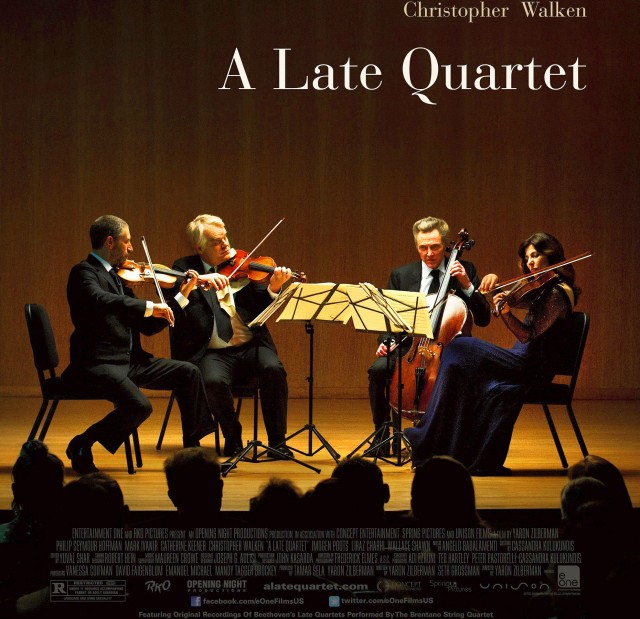
Composer Angelo Badalamenti, who describes his music as bringing “beautiful sadness” to film, was kind enough to answer my questions about his work on “A Late Quartet,” the story of a classical string quartet starring Christopher Walken, Philip Seymour Hoffman, and Catherine Keener.

What are the special challenges of writing a score for a movie about music and musicians?

“A Late Quartet” was certainly a challenging opportunity as a composer. It’s a film about music and musicians, so we had classical music and on-screen performances to consider. Given that, the score needed to serve the drama in key moments, without clashing with the pre-existing music. You have to know where you’re coming from and where you’re going. It’s a challenge that I enjoy.

How does the score work with or contrast with the quartet’s performance pieces featured in the film?

The orchestra we recorded for the score is still quite classical so it doesn’t take you out of the mood of the film. We hear a chamber string ensemble with a woodwind quintet; and harp, classical guitar, etc.. The strings are like a blown-up string quartet with a more diffuse sound and the winds represent the souls of the characters. I also tried to incorporate some motifs that were inspired by the Opus 131. So, the score keeps us grounded within the world of music that the quartet members inhabit.

Does it make a difference in working on a film when the director, Yaron Zilberman, is also the writer?

It’s actually quite helpful. The insight that a writer has is special, and this understanding can be very productive in working with a composer. When we sit together and discuss where to place music (we call this “spotting”) the director may have very specific notes to give.

When you first met to talk about this film, what did you discuss about the mood and the goals for the score?

Yaron and I agreed that the score should emote passion and pain. The characters are beset with a series of hardships which are all very personal. We needed to feel this.

Of the directors and performers you’ve worked with, which one taught you the most?

David Lynch is a creative genius and a dear friend. I’ve learned more from him than any other single person in film, tv, or music. But it’s a great mutual relationship.

How have movie scores changed since you began working on them?

There’s less melody these days. I still write music with a beautiful sadness, and with a memorable theme at its heart. I think that’s a timeless approach.

What movie scores from the movies of the 40’s and 50’s do the best job of telling the story?

Laura is a fantastic score with a single, outstanding theme. Brilliant.


Related Tags:


Composers Interview Music

Interview: Arnon Goldfinger of “The Flat”

Posted on November 1, 2012 at 8:00 am

After documentary filmmaker Arnon Goldfinger’s grandmother died at age 97 in Israel, he brought a film crew to her apartment where she and his grandfather lived from the time they immigrated to what was then called Palestine just before World War II.  He was fascinated by their home, which seventy years later looked as though it had been transplanted from their birthplace in Germany.  The books on the shelves were in German.  They always spoke German in their home.  Most of their lives were lived in Israel, but they lived as though they were still in Berlin.

Goldfinger thought he would learn something about his grandparents as the family sorted through their belongings.  But he could never have imagined what he would find or where it would take him.  His grandmother had saved issues of one of the most virulently anti-Semitic newspapers distributed in Nazi Germany.  This discovery led to a journey that illuminated one of the strangest friendships imaginable, represented by an artifact that is almost unthinkable — a coin with a Jewish star on one side and a Nazi swastika on the other.  The movie also focuses on the strain this inquiry put on Goldfinger’s relationship with his mother, who was almost as passionate about not finding out the answers to his questions as Goldfinger was about seeking them.

I spoke to Goldfinger when he was in Washington, D.C. to show the film, which opens tomorrow.

What did you think you were going to film?

To be honest, I just wanted to be there with the camera and document the world I knew was going to disappear very quickly.  I thought it would be an even quicker process.  I knew this flat all my life and I had an ambivalent feeling toward it.  On the one hand, I had an attraction to this world, to this culture, to those books, to the secrets, the mystery.  On the other hand, as an Israeli it was so foreign, so German, so connected to the tragic happenings in the Holocaust.  It was only later I had an idea to make a film, but even then the idea was just something very short.  People would ask, “What can you learn about someone from what they leave behind?”  This shows you can learn a lot.

What does your mother think about the movie?

I was very afraid of course.  Our relationship was close before and if it would stay like that, it would be fine.  But I was surprised.  It brought us closer.  She was very supportive of the film.  After the first screening, when she first saw it, she said she saw it was important for her, too.  When her friends saw the film, they said to her, “We didn’t know, either.  We didn’t ask.”  She felt that she was not alone.

Why was your mother reluctant to know more?

She was really raised in a German house.  I remember as a kid, hearing her argue with her parents in German.  But when she went out of the flat, she was in Tel Aviv, the Mediterranean combined with bohemian, a place of vibrance.  She lived two lives.  But like all of the people of her age, she wanted to leave the past behind her, as you see when you look at her flat, not even any dust from the past.  Your house is the place you want to live in.  And she wanted to live with with barriers to all the historical items.  Before I made the film I thought it was her character.  But now I understand it’s a barrier from all the pain and sorrow.

You met with Edda, the daughter of the Nazi couple who were your grandparents’ friends.  Tell me something about your impressions.

They were lovely people, very friendly, welcoming, warm.  That made it harder.  If they were nasty it would have been easier for me.  During my research I would think, “Maybe it’s not possible, maybe it’s not right” that this friendship existed between my grandparents and the Nazis.  If I called someone out of the blue and said “My grandparents knew your parents, I would not recognize one name.” But the way she recognized it so immediately, the way she knew and was so glad to hear from me in such an open way and with such memories — I don’t remember even one gift my parents’ friends gave me — but for her, she remembered so much.

What about her father, the man who was your grandparents’ friend while having an important role in the Nazi party?

I found much more about him than what is in the film.  It was important to say that he did not live the Nazi party.  He was involved in anti-Semitic propaganda.  But he wanted to stay in contact with Jews.  I found all kinds of other things about him, nothing that would change your mind, no smoking gun, but you could ask yourself, “Did he have an alternative?”  The way to describe what happened was this.  Nobody knew what Hitler wanted, but everybody knew if they did something Hitler did not want, it’s the end.  It was a classic regime of terror.  There’s a book called Alone in Berlin that described life in the war. It’s horrible.  I am a Jew; I don’t so much identify with them, but still I can understand and ask the question, “Could he do something?”  If you look at his career, you won’t find him in the concentration camps.  He is in the headquarters, spying, thinking.  For me, it’s enough.

One of the most shocking moments for me was when Edda told me that she knew my family had lost someone in the concentration camps.  She did not have the details right.  She thought it was my grandfather’s mother, not my grandmother’s mother.  She’s a little mistaken with the details but it shows that she and therefore her parents knew some of what happened.  That means my grandparents were sitting over there in the garden where we were, discussing the death of someone from their family with a man who was a Nazi.  Did they ask him if he received their letter asking for help?  Did he tell them he could not help them?  There were a lot of lies over there.

My favorite character in the movie was your grandmother’s friend.  What a beautiful face.  I felt I knew your grandmother by seeing her friend.

She was my grandmother’s closest friend and like an aunt to me.  When I first approached her, she did not want to be filmed.  She was the only one, and I could not understand why.  It took me almost a year to persuade her.  But she said, “I will give you half an hour, but you come alone.”  I told her I had to bring a cameraman and a sound man, and she said, “No, no, no.”  In the end, it was only me and the cameraman.  I figured she would see it is not threatening and she would let me stay longer.  The cameraman said, “Be careful.  Remember who you are dealing with.  Ask the questions you want in the beginning not as usual at the end.”  After 32 minutes she told me it is enough.  Three months later she passed away.  Her daughter was so happy that I captured her in her beauty.  There’s such elegance in those characters.

Why did your grandmother keep the Der Angriff newspapers even though they were filled with anti-Semitic propaganda?

There was something emotional about it, a memory from a very, very important event in their life.  The idea was to keep an eye on the Nazi and push him to include more Zionist material in his story.  There may be a possibility my grandfather even edited the article.  It was something very vivid at the time and maybe she forgot about it.  She never opened it again.  Maybe she forgot about it.

What are you going to do with them?

I think maybe give them to the Zionist archive in Jerusalem or to Yad Vashem.

Why does this movie touch people so deeply?

The film is telling an amazing story about a Nazi and a Jew, but really it is a movie about family, what you know about your family, what you want to know, what you can know.  Those questions anyone can identify with, especially in America, a place of immigrants.  Some people who see the movie tell me, “I want to ask my parents more about our history.”  And some say, “I need to get rid of a lot of the things in my house!”

Related Tags:


Directors Documentary Interview

Interview: Allen Zadoff of Since You Left Me

Posted on October 26, 2012 at 9:38 pm

I last talked to Allen Zadoff about his book, My Life, the Theater, and Other Tragedies.  He was kind enough to give me another interview about his new book, Since You Left Me.  Once again his hero is an unhappy teenage boy who feels isolated (and who shares his author’s initials).

Your main character’s internal and external struggle is exemplified by his name: Sanskrit Aaron Zukerman.  How do his feelings about his name tell us about him? 

Poor Sanskrit. The battle lines of his life were decided at birth.  His Jewish mother is a yoga practitioner and named him after her favorite thing, Sanskrit, the ancient Indian language used in yoga practice. Now in his teens, Sanskrit attends a religious school in Los Angeles because his grandfather left money in a trust for him to get a Jewish education. So Sanskrit is caught in the intersection of family tradition and contemporary life.  The teachers at his Jewish school call him by his middle name “Aaron” because it’s familiar to them. Outside of school people call him “Sanskrit”. In a real sense, my hero doesn’t know who he is—Sanskrit or Aaron—and it’s the journey of this novel for him to find out.

Why did you decide to tell the story in the first person?  What can you do in that voice that you cannot do any other way?

The first person narrator brings you directly into a character’s thinking process, and with my characters, that’s usually a funny and embarrassing ride.  At one point in Since You Left Me, Sanskrit is hiding behind an expensive gift basket while his parents fight, and he has a realization and says, “My family is less painful when viewed through cellophane and foreign chocolate.” That’s the kind of experience you only get in first person.

Also because Sanskrit is on a spiritual journey of sorts, the first person allows me to reveal the twists and turns of his thinking in an immediate and exciting way. We are on the journey with him, understanding what he understands, and experiencing his revelations in real time.

Sanskrit has experienced a lot of loss and disappointment.  How has that affected his view of the world?

He’s jaded at sixteen and wondering if God exists.  It’s a classic situation—Life doesn’t go your way, and you start to wonder if there’s anyone or anything in charge. As things get more out of control in his life, Sanskrit does what many of us do, he tries harder to make it work out the way he thinks it should be. For example, his mother is threatening to leave the family because she believes she’s found her true love (in India of all places), and Sanskrit’s determined to find a way to make her stay. It’s a dilemma I understand from my own life. When should I apply my will and effort to change a situation, and when should I relax, let go, and accept things as they are? It’s not always easy to know.

What made you decide to write a story set in a religious school?  What are some of the most significant struggles teenagers have with spirituality?

I don’t know what struggle teens have, only the struggles I had as a teen. My novel Food, Girls, and Other Things I Can’t Have was based on my experience being overweight in high school.  And Since You Left Me is based on some of my spiritual struggles in high school and also as an adult.  When I was young, I went to Hebrew School once a week on Saturdays and I was bar mitzvahed, but I had no real relationship to something greater than myself. Frankly I didn’t think I needed it. I thought being smart, talented, and hardworking would get me where I wanted to go in life.  I didn’t think I needed help from God, and I didn’t understand the idea that we might ask God what he wanted from our lives, rather than deciding for ourselves what we want or what might feel good. It’s what Rick Warren calls The Purpose Driven Life.  As with many people, my own spiritual journey grew out of hardship. In my case it was an eating disorder that nearly took me out. At 28 years old I was in serious trouble, and I had to find a new way to live in the world.  I tell the story in some detail in my memoir Hungry: Lessons Learned on the Journey from Fat to Thin.

Your characters often have to deal with parents who behave more like children than their kids.  As a writer, what possibilities and themes does that present to you?

It’s true that kids in my novels are often struggling with absent or neglectful parents. Sadly, I have some experience with that—parents who were doing the best they knew how, but who weren’t always there for my brother and I. Often in a novel I’ll take a kernel of my own experience and magnify it for dramatic effect. I also feel it’s an author’s job to understand and have compassion for every character. In Since You Left Me, Sanskrit’s mother is incredibly selfish, a fact that has inspired many readers to write me letters and tell me about their own kooky parents. But as the author, I really understand why this mother does what she does. She tells her children, “How can I love you if I don’t have love in my own life?”  It’s twisted logic, but it makes sense in a way.  I can imagine a character neglecting her own children while chasing love, thinking all the while she’s doing something positive for her family.

As for the theme, you might say that Since You Left Me is about the moment when we realize our parents are just people, and they are fallible. How do we deal with that realization and what it means for our lives?

Why does Sanskrit have such a hard time trusting or being honest with the people around him?

I think he’s been hurt. By his parents’ divorce. By his mother’s self-involvement. By the feeling that he’s different from the kids in his school, in particular his best friend Herschel who seems to live a faith-based life very easily, while it’s an enormous struggle for Sanskrit.  He’s also hurt because the love of his life in second grade seems to have forgotten that he exists. When you get hurt, it becomes hard to trust people and believe that things will work out for the best. This is where faith comes in for many people. Without faith, it’s just you battling your past experiences that have conditioned you to deal with the world in a certain way. But with faith, I think healing is possible. Faith and therapy. I’m a big believer in both things.

What inspires you?

I’m very inspired by music.  I listen to music when I write, probably 4-6 hours of it a day. I have mixes on Pandora, Spotify, Songza.  I listen to everything from indie rock, to punk, to international hip hop, to jazz, to religious music.  I’m all over the map. I have enormous respect for musicians and the joy their work has brought me.

What makes you laugh?

Girls on HBO. Not being a girl in my 20s, I thought I would hate it. To the contrary, I think Lena Dunham is brilliant, and I love her voice, the frankness and humor with which she captures her characters’ lives. And of course Judd Apatow, her fellow executive producer, has a lot to do with that, too. I think it’s an amazing collaboration.

Do you have an e-reader or do you still prefer books on paper?

I’m all digital, and I get some flack about it from book lovers. I understand their appreciation of the physical book, and I share it. But as I’ve grown towards middle age, my vision has gotten worse, and e-books have become a godsend.  So I guess I’m in the camp of people for whom e-readers are an accessibility device and not just a luxury item. I’m looking forward to further innovations that will capture more of the artistry of book design (internal and external) in the digital form.  I think Kindle’s new “Publisher Font” setting is a step in the right direction. Readers can now opt to read an e-book in the font the publisher has selected for the work. It seems a small thing, but it’s a very important decision that publishers, authors, and designers make. It communicates the story of the book on an unconscious level, and sadly, it’s one of the many things that had gotten lost in the rush to the digital format.

Related Tags:


Books Interview Writers

Interview: Frank Manno of Spiritual Sobriety

Posted on October 20, 2012 at 3:57 pm

I was very moved by Frank Manno’s new book, Spiritual Sobriety: Freedom & Recovery from Cultural Christianity. He says, “The purpose of Spiritual Sobriety is to reveal and release what the Bible describes that it takes to be a true disciple of Jesus Christ in contrast to the benign and oft-anemic “pop dedication” that has pervaded the church, especially in the past fifty years. Spiritual Sobriety is the inviting and tangible story of my journey from being a cultural Christian to an intimate follower of Jesus Christ. This book will take readers by the hand and lead them on a scripturally based, real-life journey by a path that winds from tearing down the stealthy façades of man-made religion, around the potholes of legalism and busyness, toward a destination of a grace-filled, authentic, God-empowered Christian life that walks in daily, hand-in-hand intimacy with a loving Father.”

He was kind enough to answer some of my questions about the book.

What is “cultural Christianity?” How does it differ from spiritual sobriety?

Cultural Christianity is what we are left with after centuries of authentic Christianity being sifted through pop-culture values, watered down thought political correctness and conforming the church to more of a business paradigm rather than an organic, living organism, which is how it is described in the New Testament. In many churches and denominations, the Pastor is viewed as a CEO and is evaluated on his performance to grow the church numerically rather than on his spiritual integrity. The congregation has been reduced to consumers needing to have their preferences appeased as opposed to sheep that need to be lovingly shepherded and spiritually nurtured.

Cultural Christianity often purports an “easy-believeism”. If you would only “walk the isle” or “sign a membership card” you’ll be on your way to heaven. I’m not saying that either of those actions are bad in and of themselves, but sadly, that’s where the church stops. There is no development or discipleship. Did you know that nowhere in the Bible does it say that Christians are to make converts? The Bible says that we are to make disciples – literally little pupils – of the teaching of Christ. This is often referred to as discipleship. It is time intensive and requires a transparency and intimacy that most shy away from.

I know I’ve painted a pretty bleak picture so far, and I’m not saying that these things are true of every church. But, in my years of pastoring, church planting, counseling and doing consulting work with churches across the country, I have found this to be the case to at least some degree a good part of the time.

On the other hand, spiritual sobriety is an awakening. It’s a realization. It’s in many ways the Reformation of our generation. It is simply, yet profoundly, getting back to what the Bible teaches about Christianity; both what it is and what it isn’t! When a person searches the Scriptures and realizes what the Bible says it takes to be a Christ follower and then you hold that up to what Christianity has become in our culture, we discover a stark contrast. It’s that contrast that I report about in my book, as well as how to receive and enjoy the loving, life-giving relationship that God desires with us. Unearthing this truth is liberating in so many ways! Yes, there is a personal cost to follow Christ, but how freeing it is when the light bulb goes on above your head and you realize that being a Christian isn’t a list of rules, isn’t dependent on your works or how “good” you are and that you are loved unconditionally by a divine parent we can call Father. It feels so good to be sober!

Why is it hard for us to acknowledge the cost of faith?

Either consciously or subconsciously, we want a god on our terms. Like a potter throwing clay, we want to shape and personalize our deity’s attributes, personality and motus operandi. It’s inescapable that most people feel (whether we are willing to admit it or not) that God is there for us. He is there to bless our plans, heal our illnesses, find us jobs, find us partners, meet our needs AND wants, etc. Even thousands of years ago, in Genesis chapter 11, we read about a group of people building a tower who were basically trying to create a god according to their specifications.

The truth is that we exist to worship God. He owes us nothing; we owe Him everything. If God never lifted a finger to redeem our souls from sin and the devil via the sacrifice of Jesus Christ on the cross, He would still be God and still worthy of our worship. This line of thinking so contradicts what might be considered simple human logic. That is why we have trouble with the cost of faith.

So, when we approach God or religion with that consumer sort of mindset, it’s very disturbing to think that I must sacrifice some of my personal desires and, dare I say, sacrifice my own will to follow God. You can see how churches might significantly shrink in size if this sort of message were preached. This is just one contrast between cultural Christianity and spiritual sobriety.

How do we learn to relinquish our pride?

This can be so hard, especially if we approach it from the wrong perspective. So many people fear giving up their pride and being humble because they envision humility as something lowly and embarrassing; leaving them frighteningly vulnerable. Pop psychology has made such a significant issue of blaming a majority of our personal problems on a lack of self-esteem. I don’t think that is true. When you look at what is happening on the world stage, the escalating divorce rate, and dare I say, the abortion issue, I think some may have too much self-esteem!

I feel the real issue is not that we lack self-esteem, but rather, we lack God-esteem. If people got to the point where they saw themselves through the eyes of God and how He sees them, so much would change personally and globally. If people realized how much they are loved, valued and treasured by almighty God Himself, it would be easy to let go of pride.

Pride and self-esteem say, “This is who I am… check me out… value me for what I’ve accomplished… I survive on your admiration and approval…” God-esteem says, “This is who I am… loved and cared for by God Himself, who desires a personal relationship with me… I’m created in His image… I don’t need to prove myself to you for I am already fully accepted and unconditionally loved by my heavenly Father… I am content…”

How does fear become an obstacle to our connection to God?

The answer is found in this simple but pregnant equation:

-The root of fear is the loss of control.

-Control is the opposite of faith.

-Without faith, it is impossible to know God or please God.

I think we see this formula laid out much more elegantly in Scripture. Hebrews 11:6 tells us, “And without faith it is impossible to please Him, for he who comes to God must believe that He is and that He is a rewarder of those who seek Him.”

If a garden hose is our relationship with God, then fear is a hole in that hose draining off water and diminishing pressure. When I am fearful, I am basically saying, “God, I love you and all, but I don’t fully trust You”. Now, imagine saying that to a close friend or spouse. What would that do to the relationship? It wouldn’t end it, but it would certainly hinder the intimacy and the quality once experienced. This does not mean that God loves us less when we are fearful. God is immutable; He doesn’t change. We don’t lose our salvation when we are fearful. However, that object of fear in my life becomes the hole in the garden hose of my relationship with Him, draining off the intensity of my connection with God and diminishing the joy and contentment I experience with Him.

What do we learn from pain?

Whether it is emotional, physical or spiritual, “pain” is something to which all people can relate. Pain is the great “sifter” – dividing what really matters from the frills of life. I think one of the greatest (but not only) lessons learned from pain is that trials and suffering force us to take inventory of our lives, our relationships, our values and our choices. It can bring focus and clarity in ways that nothing else can.

One of the great promises of God toward His children that is so comforting during these times is found in Romans 8:28: “And we know that God causes all things to work together for good to those who love God, to those who are called according to His purpose.” It doesn’t say that all things that happen to us in life are good, but that God can take a bad situation and use it for our good and His glory. To know that your pain, despite the source, can be used for good, both in the physical and spiritual realms, is a very comforting lifeboat to be in during the storms of life.

(more…)

Related Tags:


Interview Writers
THE MOVIE MOM® is a registered trademark of Nell Minow. Use of the mark without express consent from Nell Minow constitutes trademark infringement and unfair competition in violation of federal and state laws. All material © Nell Minow 1995-2026, all rights reserved, and no use or republication is permitted without explicit permission. This site hosts Nell Minow’s Movie Mom® archive, with material that originally appeared on Yahoo! Movies, Beliefnet, and other sources. Much of her new material can be found at Rogerebert.com, Huffington Post, and WheretoWatch. Her books include The Movie Mom’s Guide to Family Movies and 101 Must-See Movie Moments, and she can be heard each week on radio stations across the country.

Website Designed by Max LaZebnik