
Interview: Nicholas Jarecki of “Arbitrage”

Posted on September 10, 2012 at 8:00 am

Documentary-maker Nicholas Jarecki wrote and directed his first feature film, “Arbitrage,” with Richard Gere giving one of his best performances as a hedge fund manager hiding massive losses who gets caught up in an even bigger cover-up when he and his mistress are in a car accident and she is killed.  Susan Sarandon is superb as his wife and indie darling Brit Marling plays his daughter and CFO of the hedge fund.  Gere and co-star Nate Parker give two of the year’s best performances.  I had a chance to interview Jarecki following a screening of the film in DC.
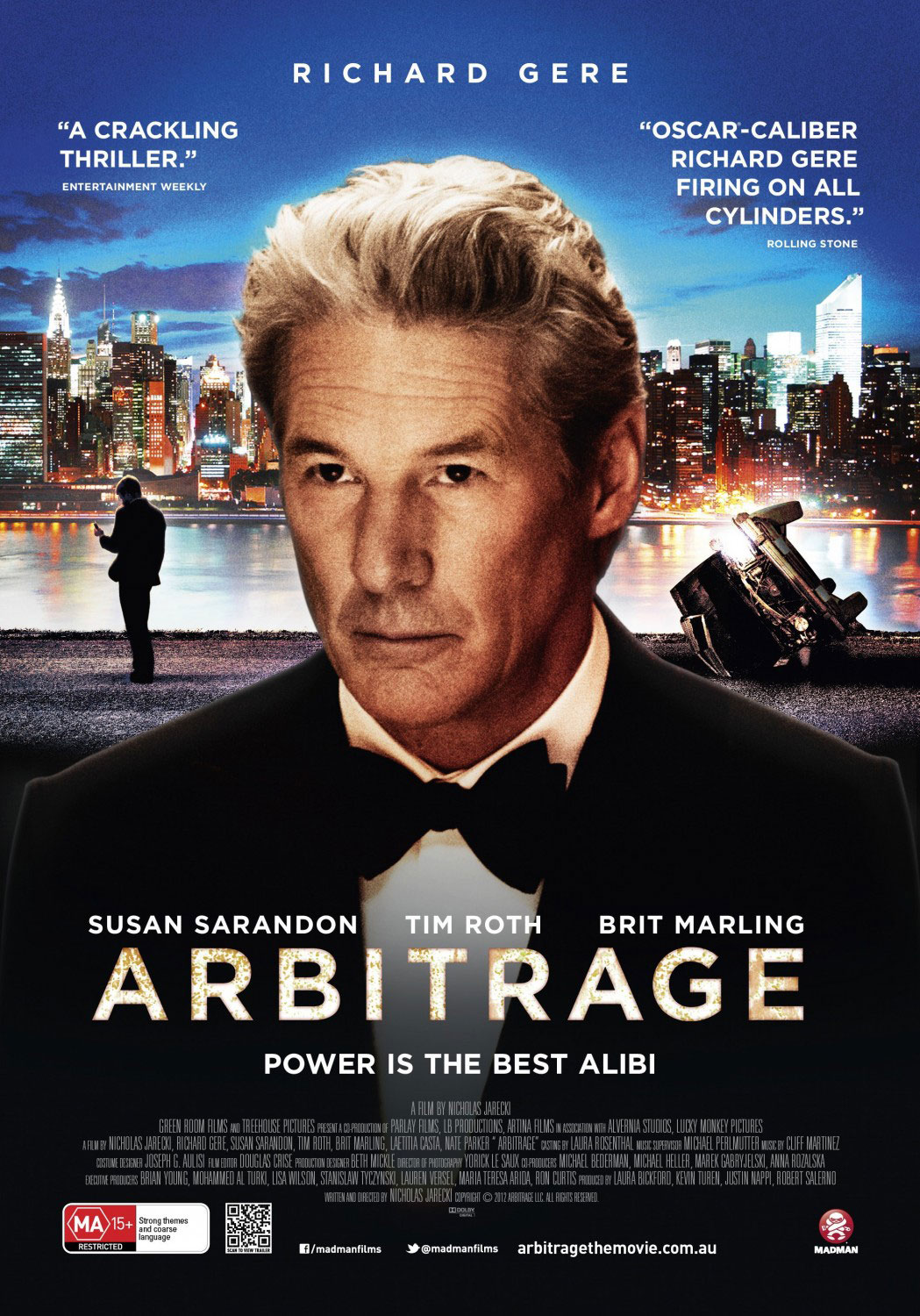
What could you say in a feature film that you could not say in a documentary?

I think they are actually pretty closely related arts. What you can do is create a world, whereas in a documentary you document a world.  In a documentary you shoot for a year and a half and you have got to find the story as you go along, but with a film you design the story in your mind first, and then you work with the group to unlock which you could not see alone in a room, and make it all that more sweet – so there is a real collaborative element to it. You get to make use of many different, exciting, artistic disciplines — set design, performance, music, staging, lighting, you combine all of those things. In the documentary you document reality, though to an extent you bring a stylistic component to any documentary (the good ones do in my opinion) so it is fake. Documentary is fake, too, but maybe less fake.

The music was extremely well-chosen in the film.  Tell me a little bit about it.

We have for the score the wonderful Cliff Martinez, who I did not know before I began working on the film.  We would put in temporary music,  contemporary score pieces.  Every time I would say, “What is that?  It is great!” it was Cliff.  He had been Steven Soderbergh’s composer, “Solaris,” which is just a beautiful score, “Traffic,”a lot of great film scores, and he had just done “Drive.”  It was just amazing to get to work with him and we worked very closely together, I played some piano so I drove him nuts pretending that I knew something. He was very tolerant…he said I made him write more cues for this film than his last three films combined.

I think that’s a compliment!

I’m not sure he meant it as a compliment by the end.  Then for the other stuff, it was finding the right feeling for a scene, so I just thought, “What would be in these characters’ world? What would his mistress listen to?” I love Stan Getz and that kind of stuff. So I put some of that in there, and in the car crash sequence. There is this wonderful Billie Holiday song from the end of her career.  That one was not easy to find.  My music supervisor had evaluated 1100 songs, scores, and he actually said at one point “the song doesn’t exist, you are insane, no song will satisfy you.” And I said “no, we have to keep looking,” and so we did, and I must have listened to four or 500 of them and it was the last one he found. It was number 1100. That is kind of how I operate.  Billie was expensive, so we ended up getting a great deal on that because it was one of her lesser known songs, which I even like more, it was a bit of a discovery.  We wanted something romantic, nostalgic, kind of cocoon-ish feeling of embrace, and yet had some lyrics that resonated with what was going on. Bjork does the closing credits song, and she is one of my favorite artists forever, never licenses for music for film. I just wrote her a letter and she said “yeah, go for it…” So it was great.

You cast two of my favorite young performers, Nate Parker and Brit Marling.

For both of those parts. I saw 40 or 50 people over the course of a year and Brit I met really towards the end. I met Nate very early on and then I had to do a silly process where I did not realize immediately that obviously, the part was his, so I had to go all around the world to come back and understand that it was Nate, but he would write me these great e-mails.  He would give me a book to read, I would read it, I would say, “Hey, have you read Pictures at a Revolution?” and then he would write me some five pages about the book and it was really great. Brit we met through Skype, video Skype and she told me very quickly that she had gone to Georgetown and been an economics major and then was offered a job at Goldman Sachs, so once I heard that I was like, “Really? Okay, well, can you come to New York and meet me and Richard,” and she said “when?” And I said “now.” And she left that night and showed up the next morning and we went to my loft and we rehearsed for about 15 min., the three of us, and we all kind of looked around and it was “Yeah, okay, let’s do it!” That was it. So, they were just a joy to work with. I think they’re both really gifted, emerging people, unique, you know? They have something…Britt’s got a look like she kind of looks like everybody else, but not at all, so it’s kind of the movie-star quality, and then Nate has an intense physicality, strength…Britt said about Nate that he radiates integrity.

He does, that’s what’s so unusual. You don’t expect that in his character, and that’s what keeps you interested in him.

Yeah, he brings some humanity to it.

All the other people are very compromised and in his own way he’s the most honest person in the movie which I think is great. How do you continue to make us root for Richard Gere when he keeps doing so many terrible things?

Well, it’s a combination of, obviously, Richard’s incredible performance and his incredible charisma, you know? He’s so charming…what did my mother used to say? He could talk a dog off of a meat wagon, but I think also the design of the film helps.  I’m a big fan of Aristotle, he wrote a book called The Poetics a couple of thousand years ago, which is pretty much a  manual for dramatists, and I try to follow his paradigm of a tragic hero. It’s not a Madoff where, excuse my language, but he said from jail “f*** my victims.” That to me was a sociopath, and I wasn’t interested in exploring that character but I thought, “Can we do in the Aristotelian way, a good man who was great and got a little carried away?”  And then bought into a kind of irresponsibility, but because you can sense that he was good at one point, I think you want it to work out for him.

What’s next?  Do you want to do more documentaries, now? You want to do more feature films, you want to do both?

I would say everything. I might actually even make a commercial, which is something I’ve always wanted to do. So, I like that format, the 30 second idea, to do something beautiful, find an emotion in 30 seconds. That’s interesting to me.
Related Tags:


Directors Interview Writers

Interview: Jamie Bradshaw of “Branded”

Posted on September 5, 2012 at 8:00 am

Jamie Bradshaw and Alexander Doulerain are advertising executives and brand specialists who have written and directed “Branded,” set in a dystopian future where corporate brands have created a disillusioned population and one man’s effort to unlock the truth behind the conspiracy leads to an epic battle with hidden forces that control the world.

I spoke to Bradshaw at Comic-Con about the movie and how advertising permeates our consciousness.

How do you bring what you know as an advertiser to getting the word out on this movie?

Well, the first thing you do is you find yourself a really awesome movie distributor who has great marketing people who work at it, because you need them to help you shepherd with the kind of distance from the movie they can offer you, a campaign.  I’m really grateful a bold company like Roadside Attractions is taking on such a film, because it’s a visionary film, but it’s also a film that, because it’s visionary, is very different from anything in the marketplace and easily could’ve fallen into one of the black holes of distribution, and those guys are awesome. They’re really great at marketing and they’ve come up with a very signature vision of the marketing of the movie.

Do you think people are more anti-corporate right now?  Do you think people are more willing to think of corporations as bad guys?

Nope, I actually think people are kind of lukewarm on brands, I think people believe brands and corporations are things so fundamental to our life that—why would you criticize them? And I think that’s exactly why I want to make a movie like this because ultimately, when you turn a blind eye—ultimately, nothing if not critical, because if you turned a blind eye to the things that fundamentally define the world and not think about them, that’s how they get you.

There are studies showing that children recognize logos for products more often than they recognize Jesus or the President.

It’s just awesome how they manage to get you, too. I remember taking my son to McDonald’s as a kid because he demanded to go, and we were writing this film at the time, and I kept thinking, “Oh, the irony,” but he would go and he didn’t want the food, he wanted the toy.  I would make him eat the food because I paid for it, for God’s sake. And sure enough, five years later, after five years of telling me, “I don’t like that food, it doesn’t taste good,” but he wanted the toy for five years; five years later, now he likes the food because the food, the taste of the food has become part of his psychology, and as we all know—that’s what marketing is—marketing is fundamentally sculpting and shaping the identity of people.

Yes, that’s right, by making you feel bad about yourself and that you need something that you will get from spending money.

Right, exactly, and over time, changing, truly, and defining, truly, what your taste buds are, how you physically react to everything from sex to buying things to death; everything about life is defined around that kind of consumption experience.

All the brands come to Comic-Con to appeal to these very passionate fans.  What do you hope to get from bringing this movie to Comic-Con?

I hope we get awareness of the film at Comic-Con.  Obviously I believe the film tells an original story and it has some truth-telling kind of power to it, so perhaps I sound naïve, but I’m hoping people will become more and more aware of it, because if people are not aware of your product, then they can’t consume it.  So on some level, the irony of it all is that I’m here like everyone else, obviously trying to sell something to the world in the same way everyone else is. I think the difference is the extent to which this film is actually telling the truth about the world that we live in; it’s a film fundamentally defined by the truth and I don’t think that most of the films that I see are very truth-inspired these days. I think that they’re copies of films that I’ve seen before and there’s something deceitful about that, deceitful in the packaging of themselves as well, because they try to trick you (obviously) into thinking they are stories you haven’t heard—that’s the whole idea of selling a movie these days, right? You have to make it look like it’s something compelling and new that you haven’t seen before, and then—you go and they told a story I’d heard a thousand times before.

A lot of people who want to go see exactly the same movie they saw before.  That’s why remakes and sequels are so popular.

Exactly, and it’s very historical and historically traceable, the way in which people can be sculpted over time to believe the things they believe about the world. In the case of movies, sure, Sumner Redstone 20 years ago decided the Blockbuster didn’t need to have anything besides a new-release section. At that point, movies became over about a 15 year period something that most people don’t know very much about at all. Who knows the history of movies? Who’s seen “Citizen Kane” these days? Very few people. Very few people see anything except new films, consumable so that you forget about them the next week or the next moment after you’ve seen them.  How better to make a consumable film of that sort than to make a film that’s just new packaging of a story you’ve already seen before? It’s the easiest thing to sell in 15 seconds to an audience because it doesn’t require any story-telling effort. “Oh, I remember that person, that thing I’ve seen before, I know what that is, okay, I’m aware of it, I can go and get it from the kiosk.” But that kind of film-making is doomed to its own deceitful unoriginality.

Netflix exists in exactly the same kind of continuum and packaging space that Blockbuster did. 95% watch what they’re aware of, because how else could you watch anything else? And they’re aware of new-release movies that have saturated the marketplace with their own awareness because they spend tons of money on advertising.  People watch the same stuff they watched at Blockbuster and Netflix will be gone at some point very soon, replaced by more sophisticated VOD platforms that target you on a much more psychographic level that allow you to get inside the head of what prepackaged thin you can easily consume even better that they could—it’s all going to be new stuff.

Is there a case where you can think of where branding worked, really I would say, to the betterment of society?

One would think that the 20th century was about the rise of Marxism and socialism and all this kind of stuff. I think the Soviet Union was one of the best brands ever created.  It was a pretty powerful vision of the world in stark contrast to everybody else’s view.  I don’t know that the tyranny of choice has left us feeling very good about ourselves.

The world is the world for good and bad.  The world exceeds ethics to me because the truth exceeds ethics; the truth is what it is. Ontology would always—any philosopher would tell you, any ontology or fundamental vision of the world—ontology would take precedence over ethics, so if you want to understand the way things are, you’ve got to look at what they are, first, and then marketing is what is; so I think the first thing we have to do is look at what is for what it really is and experience it as such. I hope that what we’ve been able to do is provide the emotional journey that will allow you to see the world for what it truly is and feel it for what it really is.

Tell me about the hero in the movie.

The hero is a brilliant Russian advertising executive, who through various supernatural circumstances was given this brilliant gift for advertising, a gift he does not understand, believes is a curse for a lot of the time, uses it at some point to make a lot of money and live a very powerful life that he then has to, at some point, at one point or another is taken from him by a conspiracy that destroys him, and ultimately it is the gift and technology he uses to turn into a weapon to fundamentally change the world forever. By the end of this film he has used as a weapon things you’ve never conceived of could be weapons, and has fundamentally turned the world into a completely different looking place.


Related Tags:


Directors Interview Writers

Interview: Mike Birbiglia of “Sleepwalk With Me”

Posted on August 28, 2012 at 8:18 am

Mike Birbiglia‘s stories about his experiences with a rare form of sleepwalking became a part of his stand-up routine, a book, monologues on This American Life, and now a movie.  He came to Washington for a screening of the film and was one of the friendliest and most open and engaging people I have ever interviewed.

Were you raised in a religious family?

Iwas raised in Massachusetts in a small town where basically everyone was Catholic.  I was raised Catholic and then I kind of wandered away, somewhere in high-school. I never got confirmed which is a big deal.

Then I moved to New York, and my wife is Jewish.  When I was growing up, I didn’t know who Jewish people were, what it was to be Jewish.  I’ve been thinking a lot about religion and beliefs recently…toying with doing a show about religion.  I used to toy with a joke where I’d say, “I was raised Catholic,” and people go, Catholic guilt…and then I married a Jewish women, and it was “Oh, Jewish guilt!” And I’m like, “well, maybe people just have guilt…maybe that’s just human, maybe it’s not specific to religion.”

Was religion important to your parents?

My mother is very religious, goes to church every week, sometimes two or three times a week and my grandparents were very Catholic, they went to Latin Mass, so they were pre-Vatican 2.  And I went to Catholic grade school, grade 1 through 6, and so whether I like it or not, I’m very much a product of Catholic teaching. At its really stripped-down elements, I love it. I love the Golden Rule; I think fundamentally, that when applied to all things, I think I would be very religious. I think when you get into the minutiae of the specific religion, I just tend to fall away.

How does something go from being a monologue to being a movie?

I studied film in college.  I got into comedy because it was no overhead — literally, sometimes I was performing outside.  When I had the show running off Broadway for about eight months I was called by a lot of people who said, “This could be a movie!” I think that’s sort of a standard thing.  If something is sort of successful, “Now this should be in the king of media!” Find something successful and, now that it’s doing well in the minors, we could bring it up to the major leagues.

At the time I was working on the screenplay called “Waking Up Ben,” that was about similar issues but had a different story-line.  It was about a guy sort of sleeping through his life who had a hard time waking up in the morning and it was metaphoric in a lot of things. And then Ira Glass and I were becoming friends by that time, we were working on This American Life.  I said to him, “What do you think about this for a movie?” and the way Ira tells the story, is that I tricked him into making it.

 Of course he would.

He says that this is how I deal with everyone, like my crew, actors, my cinematographers, I just have a way of just being like, “oh, it’ll be fun!” And the next thing you know, I’m climbing up a mountain, we’re in winter-gear.  Cut to: disaster.  And of course, it comes from Ira, the king of persuasion — he says, he’s never been so entertained by a pledge drive before…but yeah, so anyway, it came out of that and Ira said, “yeah, that seems like we should do that,” because they were getting into the business of making movies.  A lot of movies had been made from their stories like “The Informant” with Matt Damon.

So, he’s interested in producing some stuff.  It was very hard to translate the monologue.

What made you decide that you would not only talk to the audience but that you would really lead off by talking to the audience, and sort of break the fourth wall that way?

That was always in the script. That was the thing that Ira had always emphasized, to note that “you really ought to talk to the camera because that’s what you do.”

This is kind of an interesting story. I had written the camera monologues within the scenes in other words, we’d be talking like right here, and then I’d look at the camera which was here and I’d go, “well this didn’t go very well” and then I’d get back to talking to them.  It was kind of like “Ferris Bueller.” What we found in the edit was that that wasn’t working because it was taking away from the reality of the theme.  It needed to be in the future or I should say, the present, when things were okay. Here we have him driving the car, and here we see him in a good mood, because there’s something about the movie where it really rides the line between comedy and tragedy.  So we found in the edit we had to go back and re-shoot them.

You’re making comedy out of getting glass picked out of your leg.  How do you do that?

Oh, I know. I like comedy that is also tragic. One of my favorite comedies of all time is “Terms of Endearment,” that’s my pace.

You cast the wonderful actress Lauren Ambrose in a difficult role.  She is so lovable your heart breaks for her.  She is a very experienced actor, so what did you learn from her?

The audience loves her so much, they think: is she going to be okay? This is horrible! The whole movie is building up to this break-up and she goes off and we don’t know what happens to her? And we needed to not have to deal with that repercussion with the audience, so working with her was fascinating because that is home for her, you know? She’s very comfortable on a set, she’s very professional, she puts in the hours and she’s entirely unique.

One thing that is unusual about the film is that the take that it gives us in the life of a stand-up comic, just touring and dependent on the agent and being paid so little. Was it important to you to include that milieu and to make that a part of the story?

I think that was something that I lived in my 20’s in a very real way, and was able to describe in my book, in the film, in a pretty vivid way, and I didn’t even mean for it to become such a noted aspect of the film.  Mark Maron, who has the WTF podcast about comedy and appears in the film, said, “No one has made a film about a road comic, no one has nailed it the way this one does.”Yeah, it just seems  that I accidentally wrote a unique story. I guess I just lived it.

You re-enacted some painful and embarrassing real-life experiences — was that difficult?

You know the expression, “You’re only as sick as your secrets?   I believe that, and I think I try to have my work live by that to a degree. I think that when you open up to people—or kind of when I’ve opened up to people, I’ve opened up to audiences, assuming that it’s funny, the connection with the audience is incomparable, from anything that I’ve experienced in my life, and that’s why I’m drawn to it so much.


Related Tags:


Actors Interview Writers

Interview: Matt Bondurant of “Lawless”

Posted on August 27, 2012 at 8:00 am

The Wettest County in the World is writer Matt Bondurant’s book about his grandfather and great uncles, who sold illegal moonshine during Prohibition.  The Bondurant brothers were legends in their own era, reported to be un-killable.  Bondurant spoke to a small group of critics about adapting his family’s story for the new film, “Lawless,” starring Tom Hardy, Shia LeBoeuf  and Mia Wasikowska(as Bondurant’s grandparents), and Jessica Chastain.
“There’s not much of a story-telling culture in my father’s side of the family,” he told us.  “A lot of these things were not talked about ever.  We didn’t know that my grandfather and his brother had been shot on that bridge in 1930 until my father uncovered a newspaper article.”  He went to his father and asked about it, “and my grandfather just lifted up his shirt and showed him where the bullet hole was.”  He said he did not know whether it was because their activity was illegal or they didn’t want to air dirty laundry.  “So many people were complicit in their community that I don’t think that was it.  I think it was just their tendency of not saying much to begin with.  There’s a kind of conservative rural attitude of things you talk about and things you don’t.  What I ascribe it to is back in the day it could get you into a lot of trouble.  You just don’t talk about moonshine.”  He said he got his interest in stories and story-telling from his mother, an avid reader.

“There definitely wasn’t anything glamorous about it.  About 20 years ago we started to uncover articles talking about them as the Bondurant brothers like this notorious gang, this scary group of guys, and then it gets a little exotic and romantic, the shoot-out, and stuff like that.  But I had no notion of that until I was nearly 20 years old.  I think I did hear the story about Forrest getting his throat cut from ear to ear.”  His father became interested in the family history “and we both started discovering the history at about the same time.  If there’s a researcher I owe the greatest debt to, it’s my dad.”  His understanding of his family deepened and widened as he learned about them.  “It’s amazing to uncover all this stuff.”

He spoke of the “pervasive silence” that still exists in his grandfather’s community.  “I grew up near Washington D.C. and when I would go there I was always an outsider and had to struggle to understand” the Franklin County relatives.  This movie is, in part, the result of that wish to know more about his taciturn family, who seemed so different when he knew them from the newspaper stories about the bootlegger days.


Related Tags:


Interview Writers

Interview: Writer-Directors of “ParaNorman”

Posted on August 16, 2012 at 8:00 am

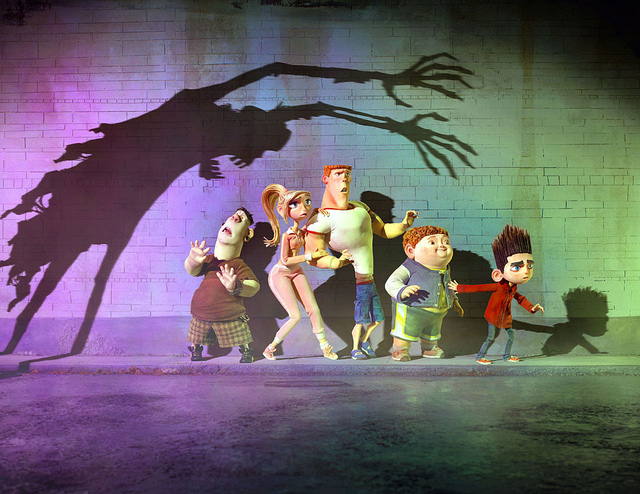
I loved seeing the “ParaNorman” panel at Comic-Con, so I was especially excited to get a chance for an interview with writer-director Chris Butler and co-director Sam Fell, and I had a blast talking to them about why kids and grownups like scary movies and the challenges of stop-action animation.

You really pretty much made a list of everything that is impossible to do in stop-motion and did it.  I mean, tossing toilet paper around? 

Chris: I know, that was certainly…

Sam: It was a real trick, there, and I remember when I first wrote that scene I thought, “What would work so well in stop-mo would be toilet paper kind of sculpting forms of zombies…” and then when it came to do it, it was like the most difficult thing you could ever do.

Chris: It was long-time that Brian worked on that toilet paper, it was his specialty, and he was doing it for like a year.  He’d come up with these, almost like these platters of toilet paper styles and techniques…

Sam: And we’d go to see it, and he’d say, “Look at this,” and you’ll hold up to the light and you’d say, yeah, I can’t see the wires…And you’d go, oh, that’s pretty good…and you’d make his day because you’d like his toilet paper.

What were some of the other big challenges?  At Comic-Con you said no one had ever done stop motion characters with thick necks before.

Chris: Normally with a puppet you want a separate head and then a neck between the two and you can articulate them all around and especially with our technique where we change the faces so there’s a natural line under here, so you can change the faces…but with a fat neck character, it’s very hard to articulate and…

Sam: It does not move the way skin does…

Chris: And there are horrible bulges, and it’s very hard to know how to separate the face from the neck, and this is one shape, so…

Sam: Technically a nightmare.  We all knew it was very dangerous territory.  We sat around and discussed, “Should we change the design of this character?” And it was like, no, no, because that’s him, and so let’s find a solution to make it work.  That’s the approach at Leika and it was the approach on “Coralline.”  We took it even further on this.  It’s easy to see stop-motion as this little bit of nostalgic history, it’s this cute charming thing from old TV shows.  And it’s a beautiful hand-made thing and we loved that aspect of it, but that’s no reason to not take into the future with all the innovations that we have at our disposal.

Chris: We have a visions effects department now integrated into the studio, you know? And it’s all just on desktops, now, so it’s relatively cheap and it’s not like having to go to some big, expensive post-house any more.  They’re there, so when you’re designing your shot, you can be, “Hey, come on down,” and they tell us how things should be done or how many passes we need or make suggestions.

Sam: So you can plan a shot around them is what you’re saying, as much as anything.

Chris: It’s very efficient.

If you could take home one of the props for the movie and live with it in your house, what would it be?  I know I’d pick the alarm clock!

Sam: Everyone says the alarm clock or the tooth brush.

Chris: I like the van, I guess, or the station wagon.  I love those vehicles.

Sam: It’s actually not a prop, but I think it’s a thing of beauty: the dead judge’s cape is so beautiful, it’s a work of art because it’s not just a cape that’s been designed correctly, it’s a cape that’s been designed correctly and then has the asymmetry of the design style, plus it’s animatable, plus it’s got all the rottenness of being in the grave for 300 years.  It’s an amazing thing.

Chris: A lot of construction to it.

You tread a very fine line there between scary and reassuring and funny and I love narratively the way you resolve that, but visually, how do you calibrate that and what do you look at?

Chris: The zombies were possibly the scariest thing, they have to play both ways.  One thing we knew is that they’ve been in the ground a long time, so we weren’t going to do gore, but I think it was just going through that whole ensemble of zombies and figuring out how they were rotten in the different ways, and that gave us goofy and scary.

Sam: And I think that’s the benefit of telling a story like this in animation—is that you’re already one step removed from reality, so the very process of charactering in the first place is a safe distance, I think, for kids to be, you know…

Chris: To be dealing with a rotting body!

Sam: Yeah, if we’d done this in live-action, it would’ve been more gratuitously gruesome, more grotesque, and I think doing it this way you can design those zombies so that they are cool images…

Chris: and you can have the idea, as well, like we figured out how his face fell off, you know? So his jaw is still flapping, he’s got that flapping bit?  But because it’s stylized, it’s sort of art…

Sam: It’s taking advantage of cartooning, if you like, that aspect of animation, whereas I wouldn’t say this movie is a cartoon, because there are real things at stake; you think of the characters as real people, but certainly it’s useful to be able to stylize in that way…

Caricature.

Sam: Yeah, exactly.

(more…)

Related Tags:


Directors Interview Writers
THE MOVIE MOM® is a registered trademark of Nell Minow. Use of the mark without express consent from Nell Minow constitutes trademark infringement and unfair competition in violation of federal and state laws. All material © Nell Minow 1995-2026, all rights reserved, and no use or republication is permitted without explicit permission. This site hosts Nell Minow’s Movie Mom® archive, with material that originally appeared on Yahoo! Movies, Beliefnet, and other sources. Much of her new material can be found at Rogerebert.com, Huffington Post, and WheretoWatch. Her books include The Movie Mom’s Guide to Family Movies and 101 Must-See Movie Moments, and she can be heard each week on radio stations across the country.

Website Designed by Max LaZebnik