Oh, George Lucas. Please stop diluting the franchise.
This latest all-animated iteration of “Star Wars” has a relationship to the original somewhere along the lines of the relationship of a homeopathic ingredient to the ultimate concoction. It has been diluted so that its atoms are barely detectable. The saga suffers in part because so many have taken what Lucas did in the 1970’s and 80’s and taken it further in terms of technology as well as story. All that remains here is from the weakest part of the original trilogy, especially the cardboard dialogue, without the screen charisma and acting ability of Harrison Ford and some of the others to make it work. The animation is below the level of most video games.
Worst of all, the movie diminishes the story arc of the original trilogies by taking the key character of Anakin Skywalker in a direction unrelated to everything we knew about him. What should enrich and expand on the stories just erodes further our sense of the original characters.
Po (voice of Jack Black) is a soft, sweet-natured cuddly panda. He works as a waiter in his father’s noodle shop but dreams of being a kung fu champion. He studies kung fu history and cherishes his action figures of the Furious Five, the country’s top martial arts masters: Tigress (Angelina Jolie), Crane (David Cross), Monkey (Jackie Chan), Viper (Lucy Liu), and Mantis (Seth Rogen). They are trained by Shifu (Dustin Hoffman) under the guidance of the Master (Randall Duck Kim).
The great villain Tai Lung (Ian McShane, providing the obligatory deep voice and English accent), guarded by 1000 soldiers, breaks out of prison and the Master must select a new Dragon Warrior to defend the people. The whole town gathers to see which of the Furious Five it will be. In what appears to everyone — including Po — to be a mistake, the Master points to the panda as the chosen one. And it is up to Yoda, I mean Shifu, to train him.
The Furious Five are, well, furious. Like a group of middle school mean girls, they tell Po he does not belong. Shifu is frustrated and impatient, insisting that the panda cannot be trained. He does not have the grace or balance for martial arts.
The panda is part teddy bear, part Pillsbury Doughboy, part Cookie Monster, all soft, sweet, and cuddly. Like Santa, he has a belly that shakes like a bowl full of jelly, a long way from a lean, mean fighting machine. He is also unsure of himself, ashamed of his clumsiness. He is afraid to try for his dreams — afraid to upset the father he loves (Po never seems to notice they are of different species) and afraid he does not have the ability to do better. When he fails in training, he says dejectedly, “I probably sucked more than anyone in the history of kung fu…more than anyone in the history of sucking.” He admits to Shifu that he only stayed “because I thought if anyone could change me, make me not me, it was you.” But Po will learn that the source of his strength is what no one can teach him — his sincerity and humility. Po will find within himself the strength, focus, and resolve to face Tai Lung.
As wise and experienced as he is, Shifu has some lessons to learn as well. He has to find a whole new way of teaching — it turns out the way to a Dragon Warrior’s heart may be through his stomach. And he has to explore some regrets and mistakes from his past.
All of this is handled very lightly — the film spends more time on the pratfalls than on the brisk training montage and the fight sequences are well within the PG range. The sweet-natured lumbering bear with the big tummy trying to achieve the grace, discipline, and balance of kung fu gives the animators a lot of opportunities for offbeat variations, sight gags, and contrasts, a cartoon tradition going back as far as the ballet-dancing hippos in “Fantasia.” And the scroll-inspired landscapes and colors are spectacularly beautiful.
The fortune cookie-like “everyone is special” lessons of the film get a little murky, though, and parents will want to talk to children about alternatives to violence, safe participation in martial arts, and telling the truth. But the film’s unpretentious sweetness, the striking visuals and fresh settings, and strong voice characterizations by Black, Hoffman, Rogan, and Cross make this satisfying family entertainment.
It begins with a zippy credit sequence that dispatches with the backstory Ang Lee’s lumbering 2003 version took more than an hour to slog through. And we’re off! Who cares what kind of gamma rays turned Bruce Banner into the Hulk? We just want to see stuff blow up and crash!
You need to know that while I am a Comic-Con-attending fangirl, Hulk never did much for me, so keep that in mind when I tell you this is only a pretty good superhero movie. I like a superhero who is smart as well as strong. David Banner is a scientific genius, but when the Hulk is hulkified he’s too beasty. On the other side he mostly fights a lot of soldiers with a lot of guns and artillery, not as interesting as one worthy adversary.
There’s the obligatory cameo by Stan Lee. There are the obligatory cameos from former Hulk portrayers Bill Bixby (glimpsed on television in “The Courtship of Eddie’s Father”) and Lou Ferrigno and a cheeky variation on Hulk’s signature line. As always, Hulk has to deal with the bursting seams problem and find some stretchy pants. And as often happens with Marvel heroes, a cure seems within reach just as a greater evil based on the same transformative power requires him to get his Hulk on.
In movies like these there is usually a moment where the hero and heroine have to consult some scientist and Tim Blake Nelson is terrific as the professor who is “more curious than cautious.” Edward Norton is fine as Banner, who must plot and run while keeping his heart rate down to avoid an untimely Hulkization. Liv Tyler is lovely as the love interest but as is customary in these films she has little to do. There are some terrific action sequences. I particularly liked it when the Hulk used a car broken in two as boxing gloves. But it all seems a little antiseptic and over-CGI’d. There are echoes of current events — a reference to Homeland Security, some anti-government talk, and echoes of stories like “King Kong” and “Beauty and the Beast,” but they seem derivative and uninspired. Overall, it’s a forgettable popcorn flick with a too-brief appearance by Robert Downey, Jr. as a reminder of what a great superhero movie feels like.
Parents should know that the film has a lot of action violence, crashes and explosions, firing of weapons, bombs, brief non-sexual nudity (side view in shower), a brief non-explicit sexual situation, and some strong language.
Family discussion: What are the advantages and disadvantages of being “more curious than cautious?” Should Banner allow himself to be “cured?”
Indiana Jones and the Kingdom of the Crystal Skull
Posted on October 14, 2008 at 8:00 am
Some things are different. No more Nazis — it is now a Cold War and the guys on the other side are the Soviets. And there may be enemies at home. A harmless-looking professor could be a Red. Or maybe it is the agents of the U.S. government who are the bad guys when they see enemies who are not there. And teenagers are acting wild. Some of them speed by in jalopies and some of them slick back their hair, drop out of school, and ride motorcycles.
But some things are the same. Indiana Jones (Harrison Ford, for the fourth time) still packs a mean punch and carries a bull whip. He still has a way of getting himself into and out of trouble. He still hates snakes. And he is still a lot of fun to watch.
As always, we start right in the midst of the action. A motorcade of soldiers is approaching a “Hanger 51” Army base in Nevada that is shut down for a test of an atomic bomb. But it turns out not to be what it seems. They are Soviet spies and they want Indiana to find something in storage there (Indy fans will enjoy seeing a familiar item in one of the crates). This time, the artifact everyone wants is a crystal skull from South America that, according to legend, will grant great power to whomever returns it to its home. The Soviets are led by Irina Spalko (Cate Blanchett, severe in an impeccable uniform and a ruthlessly aerodynamic bob), a specialist in the paranormal.
Instead of being congratulated for escaping from the Soviets, Indy becomes a “person of interest” to the FBI due to “this charged climate” and is suspended from his job. When he gets a message from a young man on a motorcycle who looks like he just rode in from the set of “The Wild One” that his old friend Professor Oxley (John Hurt) has been captured, Indy and the young man (“Transformers'” Shia LeBeouf) set out to rescue them.
Ford brings it. He is vitally and vibrantly present every moment on screen. He gets the a-word issue out of the way early on with a wry response to “we’ve gotten out of worse before” — “We were younger then.” He can still throw a credible punch and he has an even better and deeper sense of who he is as an actor and who Indy is as a character dealing with his own issues of aging. Moving the characters forward in time provides many opportunities for fresh and intriguing details that are instantly evocative of the past and lightly resonant for today’s circumstances as well. LeBeouf, Ford, and Karen Allen, who makes a welcome return as Marian, Indy’s best leading lady, have terrific chemistry. The stunts are thrilling and brilliantly paced, and the script, the first three-quarters of it, anyway, if not up to the level of the first Indiana Jones film, is at or better than the other two. The old-school effects are far better than the brief CGI. The unscripted real-life bug swallowed as an ad lib by Rene Belloq in the first movie was far more effective than an army of man-eating ants made from pixels in this one. John Hurt is underused as the addled Oxley as is Ray Winstone (“Beowulf”) as a fellow traveler in more than one sense of the term. And it is a little too long, but that is understandable. Ford, Allen, producer George Lucas, and director Steven Spielberg enjoy spending time with Indiana Jones and don’t want to say goodbye. We feel the same way.
With its first self-financed production, Marvel has produced one of the best superhero movies ever made, pure popcorn pleasure for its special effects, its story, its villain, and its hero. Director Jon Favreau, star Robert Downey Jr. and a first-class screenplay mix electrifying action, a compelling drama, and top-notch performances. Plus there are the best robot-type characters since R2D2, C3PO, and Hewey, Dewey, and Louie.
Downey plays international weapons dealer/super-brain/playboy Tony Stark as a rock star. He is an industrialist who appears on the cover of Rolling Stone and dates cover girls. He has an answer for every possible question or criticism about the company he runs: “The day weapons are no longer needed to keep the peace I’ll start building beams for baby hospitals.” But he does not have an answer for himself. His own conflicts would haunt him if he would slow down for a moment to think about them. That moment comes when he is captured by jihadists on a sales tour of American armed forces in the Mideast, using his own weapons. Told to recreate his company’s most powerful weapon for them instead he creates something for himself. The mastermind of cutting edge technology reaches back to the oldest of old school combat and creates for himself a high-tech suit of armor so that he can escape. It becomes the first stage in what will transform him into Iron Man. And the more he is protected by his Iron Man suit, the more he begins to open up to himself and others about who he really is and take responsibility for the world he has helped to create.
Downey superbly conveys Stark’s vulnerability and brilliance. He makes every line of dialogue feel improvised and natural, a great counter to the over-the-top special effects and fight scenes. In this middle of this great big movie he gives a subtle performance that is every bit as compelling as the most jam-packed action footage. He evolves as the suit does, trying out new things, coming alive for the first time as he is encased in metal.
The themes of the story has some powerful resonance about America’s role in the world without being heavy-handed. There’s no time for it — everything moves quickly as Stark continues to develop his suit and is attacked by bad guys and good guys and, well, there’s another category I am not going to give away. There is strong support from Terrence Howard as Stark’s military contact and friend, Gwenyth Paltrow, who gives some snap to her role as the indispensable aide de camp, and Jeff Bridges (with his head shaved!) as Stark’s closest business associate. The visuals are bracing and powerful and the action scenes are fanboy heaven. Watch for quick cameos from director Favreau, fan Ghostface Killah, and Iron Man co-creator Stan Lee. But don’t get distracted. Downey is the literal heart of this movie, and like the appliance that keeps Stark alive, he is a power source whose potential seems limitless.

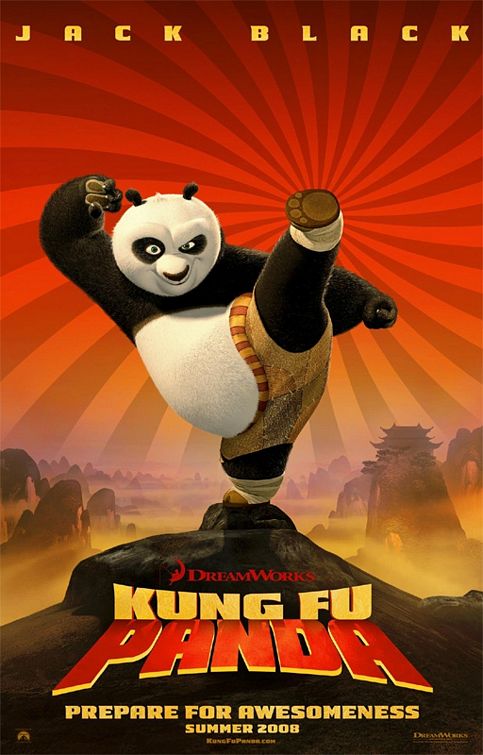 Po (voice of Jack Black) is a soft, sweet-natured cuddly panda. He works as a waiter in his father’s noodle shop but dreams of being a kung fu champion. He studies kung fu history and cherishes his action figures of the Furious Five, the country’s top martial arts masters: Tigress (Angelina Jolie), Crane (David Cross), Monkey (Jackie Chan), Viper (Lucy Liu), and Mantis (Seth Rogen). They are trained by Shifu (Dustin Hoffman) under the guidance of the Master (Randall Duck Kim).
 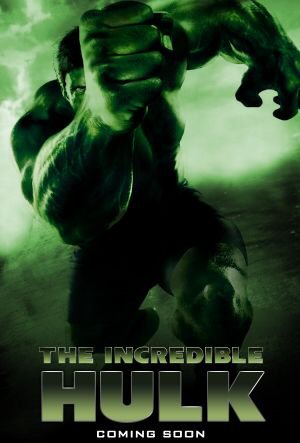 It begins with a zippy credit sequence that dispatches with the backstory Ang Lee’s lumbering 2003 version took more than an hour to slog through. And we’re off! Who cares what kind of gamma rays turned Bruce Banner into the Hulk? We just want to see stuff blow up and crash!
 and
and  . And the Hulk always makes me think of the classic anger rampage scene from Woody Allen’s
  :
: