Silver Linings Playbook

Posted on November 15, 2012 at 6:01 pm

B+
Lowest Recommended Age: Mature High Schooler
MPAA Rating: Rated R for language and some sexual content/nudity
Profanity: Constant very strong language
Alcohol/ Drugs: Drinking
Violence/ Scariness: Assaults and fighting
Diversity Issues: Respectful treatment of mental illness
Date Released to Theaters: November 16, 2012
Date Released to DVD: April 29, 2013
Amazon.com ASIN: B00A81NFAS

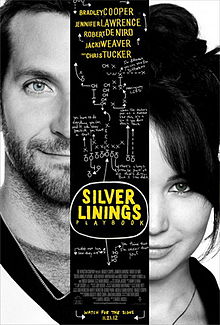
When Bradley Cooper appeared on “Inside the Actors Studio,” the first graduate of the program to be featured, they showed a clip from Robert DeNiro’s appearance on the show, with then-student Cooper asking him a question about his performance in “Awakenings.”  DeNiro was clearly impressed with the perception and sincerity of his young questioner.  It was only a few years later that Cooper was acting opposite DeNiro in “Limitless.” Now they are together again as father and son, Pat Sr. and Pat Jr., in “Silver Linings Playbook,” based on the novel by Matthew Quick.

Pat Jr. has been in a mental hospital being treated for bipolar disorder, the result of a plea bargain following “the incident,” we will only learn the details of later.  His mother brings him home though it is not at all clear that he is or will ever be ready.  Pat has impulse control problems, especially when he hears a particular Stevie Wonder song or does not like the ending of a Hemingway novel.  But he is absolutely determined to get his life back.  And his wife back.  This involves a lot of physical conditioning and finding away around the restraining order that forbids him from contacting her.

He meets a troubled young widow named Tiffany (Jennifer Lawrence of “Hunger Games”), the sister-in-law of his best friend.  Pat is fighting so hard to be “normal” again that he is disturbed, annoyed, and a little scared by her outspoken, socially inappropriate behavior.  But she offers the same directness and shared experience he had with his fellow patients.  He struggles with the competing impulses to reject and accept her overtures of friendship.  Their exchange about the effects of various mood and anti-psychotic meds is a gem, the mental illness equivalent of Romeo and Juliet speaking to each other in alternate lines of a sonnet on their first meeting.  And Lawrence is sublime in her summation-to-the-court-style argument with Pat Sr. about the factors that go into an Eagles win.

They agree to help each other, and this gives Pat purpose, discipline, and direction.  And we learn more about “the incident” and about Pat’s relationship with Pat Sr., a professional gambler and bookie whose passion for the Eagles provides some context for his influence on his son.

Director David O. Russell, who adapted the novel, and his cast fill the story with engaging, believable characters, especially Jackie Weaver as Pat’s mother, John Ortiz as his stressed-out best friend, and Anupam Kuhr as his therapist.  It is a great pleasure to see Chris Tucker, who is outstanding as a mental patient, though I wish they had found him more to do than the usual “black it up” (that’s a direct quote) pep talk.  Pat is so upset by the end of Farewell to Arms (on his wife’s assigned reading list for the high school class she teaches) that he has to wake his parents in the middle of the night to tell them why stories need happy endings.  The ending here is abrupt and a bit cheesy.  But these damaged and vulnerable and anxious characters love and want to be loved and we want it for them.

Parents should know that this film includes a lot of very strong and profane language, sexual references (some explicit), family dysfunction and mental illness, drinking

Family discussion: How are Pat and his father alike? How do Tiffany, Ronnie, and Cliff help him? What makes Pat change his mind?

If you like this, try: “Inside Moves” and “Garden State”

Related Tags:


Based on a book Drama DVD/Blu-Ray Pick of the Week Family Issues Romance

The Twilight Saga: Breaking Dawn, Part 2

Posted on November 15, 2012 at 6:00 pm

The “Twilight” series comes to a close with the fifth film based on the four-book supernatural love story from Stephenie Meyer. This one is for the fans, with a loving farewell that includes a romantic recap series of flashbacks and final credits bringing back all the stars of the series.  It will be less satisfying for non Twi-hards, who will have a hard time ignoring the ludicrousness of the storyline.

In the last chapter, Bella (Kristen Stewart) at long last (well, not too long, she just finished high school), married her one true love, Edward (Robert Pattinson), a vampire.  They had a wonderfully romantic but bed-breaking wedding night, and she got pregnant, a surprise to everyone because it was thought to be biologically impossible.  The pregnancy left Bella so frail that childbirth would have killed her if Edward had not kept her alive by turning her into a vampire.  “Breaking Dawn, Part 1” ended with her eyes opening, vampire-ified to electrified amber with a kind of permanent mascara.  “I didn’t expect you to seem so..you,” Jacob says. “Except for the creepy eyes.”

In the past, we saw the “other” world of vampires and wolf-people like Jacob (Taylor Lautner) through Bella’s brown human eyes.  Now we see everything through the hyper-charged senses of the ultimate predator.  Ironically, it is only as a vampire that Bella feels most purely herself — strong, confident, capable.  This is the fork in the road where the fans will stay with it but everyone else may take a detour.  One reason for the sensational popularity of the books is the way they so perfectly capture a young teenager’s fantasy.  That works better when the characters are themselves teenagers.  Trying to project them into the adult world, even one as skewed as the vampire world, is a tougher stretch.

Bella and Edward have an idyllic existence of eternal adolescence, with a life free from work, struggle, and parents.  They do not have to eat or sleep.  They do not have to do anything but have wildly energetic sex and conversations about who loves who more, with banter like “We’re the same temperature now.”  You may ask, “Wait, isn’t there a baby with some kind of nutty name?”  Yes there is, and her name is Renesmee (after the two grandmothers, Renée and Esmé).  When Jacob calls her “Nessie,” Bella gets angry because that’s the Loch Ness monster’s nickname, though it seems likely that it is just another of Jacob’s protective instincts, her birth name being something of a burden.

Bella and Edward-style parenting is not very demanding.  The baby has a full-time staff of loving vampire relatives and an imprinted wolf-guy.  And it turns out that vampire/human children grow in dog years.  The movie, unfortunately, moves rather slowly, with a lot of time bringing in 18 new vampire characters from all over the world to help persuade the vampiric governing body, the Volturi, that they have not broken the law and produced an “immortal child” who could put the community at risk.  All of this leads up to a grand battle across a snowy field, the motley crew of good guy vampires and the robed Volturi.

The endless procession of new characters gets tedious except for a Revolutionary war veteran played by Lee Pace (“Lincoln,” “Pushing Daisies”), who talks about his time with General Custer and has far more electricity on screen than the vampiress who catches his attention with her super-tasing power to jolt anyone.  I also liked Rami Melek (“Night at the Museum,” “Larry Crowne”) as a vampire who can control the elements.  But the sheer volume of new characters made having to remember each one’s special talent like trying to keep track of the Smurfs.

We’ve spent a lot of time with these characters and it is good to see a satisfying resolution to their story.  But I couldn’t help feeling that Meyer had run out of ideas and just tossed in everything she could think of.  My primary reaction at the end was relief that this was the end.

Parents should know that this movie includes vampire violence with battles that include graphic decapitations and other disturbing images, characters injured and killed, sexual references and situations with some nudity, and some language.

Family discussion: What are the biggest changes in Bella’s outlook and abilities from the first installment to the last? How much should she tell Charlie? If you could have one of the special gifts of the characters in the film, which would it be and why?

If you like this, try: the other “Twilight” movies and the books by Stephenie Meyer

Related Tags:


Action/Adventure Based on a book Drama Fantasy Romance Series/Sequel

Anna Karenina

Posted on November 15, 2012 at 6:00 pm

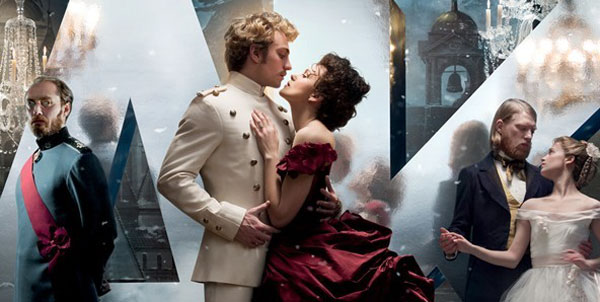
Director Joe Wright and his favorite star, Kiera Knightley (“Pride and Prejudice,” “Atonement”) have produced a ravishing, highly theatrical version of Leo Tolstoy’s classic “Anna Karenina.”  It is deeply romantic but has more focus on the social and political context than many of the previous versions of the story.  It literally opens with the rise of a curtain over a grand proscenium stage, and throughout the film the story flickers from movie-style reality — not documentary but an integrated dramatic narrative — to something resembling a live production of a play or ballet.  At one intensely dramatic moment, the story literally and metaphorically spills over the edge of the stage for a shocking denouement.

Anna (Knightley) is a young mother married to the stiff but not unfeeling husband Karanin (Jude Law).  He cares for her but is very caught up in legislative and governance issues.  When we first see her, Anna is preparing to leave her home in St. Petersburg to go to the aid of her brother, Stiva (Knightley’s “Pride and Prejudice” co-star Matthew MacFadyen) and his pregnant wife, Dolly (“Boardwalk Empire’s” Kelly Macdonald), who is devastated when she learns he has been having an affair with the governess.  Anna hopes she can help the couple reconcile.  And she is not unhappy about spending time in Moscow, going to parties and concerts and mingling with members of society.

There she meets the dashing officer Count Vronsky  (Aaron Taylor-Johnson of “Kick-Ass” and “Savages”).  Vronsky is a bit spoiled by a life in which everything has come easily to him — good looks, money, women.  He is flirting with Dolly’s sister, an innocent young princess named Kitty (an excellent Alicia Vikander).  Stiva’s close friend Levin (Domhnall Gleeson), a shy but true-hearted landowner, loves Kitty.  He proposes, but, believing Vronsky will ask her to marry him, Kitty turns down Levin’s proposal.  Vronsky has just been flirting with Kitty.  He is drawn to Anna.  She is drawn to him, and returns home to put some distance between them.  He pursues her, and finally, she is overcome.  Besotted by him, she is overcome in every way, breaking every rule, ignoring every convention, the freedom as heady as the romance.

Like too many lovers before her, she believes that love is enough, that the world will support her, that nothing else matters.  She once counseled Dolly to rise above Stiva’s infidelity.  But she does not have any sympathy for Karanin’s humiliation or any gratitude for his willingness to stand by her, even when she is pregnant with Vronsky’s child.  Vronsky genuinely cares for her and does his best but he is out of his league.  When Anna realizes that society has no place for her anymore, she is devastated.  Tolstoy’s focus on the reunited Levin and Kitty, far from the glittering parties and gossip, contrasts the hypocrisy, artificiality, and sterility of the upper class with the authenticity and humanity of the people who work the earth and care for the sick.

Wright has a magnificent gift for images and a remarkable fluidity of camera movement (remember that bravura sustained shot on the beach in “Atonement”), all used in service of the story and characters.  The camera circles as the story does, with rings of parallel but contrasting stories.  Watch Anna’s costumes, elaborate, constricting at first and then simpler.  In the midst of her passion for Vronsky, they both wear white, as though they are removed from the rest of the world.  Later, she’s swathed in black.  Watch for images of omens, and images that compare or contrast the human world and the animal world, the fake and the real.  By embracing the artificiality of the form, Wright illuminates not just Anna’s anguish but Tolstoy’s vision.

Parents should know that this film includes sexual references and situations with some explicit images and suicide and a brief shot of a mutilated body.  Characters drink and abuse alcohol and drugs and there are tense and unhappy confrontations.

Recommendation: Mature teens-Adults

Family discussion: Tolstoy famously begins this book by saying that all happy families are alike but each unhappy family is different in its own way. Do you agree? How does the theatricality of the setting affect the story?

If you like this, try: the other versions of the story, especially the movies with Greta Garbo and Jacqueline Bisset, and the book by Tolstoy

Related Tags:


Based on a book Date movie Drama Remake Romance

Interview: Director Joe Wright of “Anna Karenina”

Posted on November 14, 2012 at 8:00 am

I spoke to one of my favorite directors, Joe Wright (“Pride and Prejudice,” “Atonement,” “Hanna”) about his sumptuous new film, “Anna Karenina,” starring Keira Knightley.

One of my favorite scenes in the film reminded me very much of one of my favorite scenes in “Pride and Prejudice,” using intricate choreography of dance and camera movement to tell the story. So tell me a little bit about how you put that together.

I really loved doing the dance in “Pride and Prejudice” and I haven’t had an opportunity to do it again and perhaps, further what I did in “Pride”—so I really took this film on as an opportunity to kind of create a ballet with words. And the dance in the ball especially, I wanted to push further than I had. With “Pride,” some things happened by accident, the moment where everyone disappears in the dance and Elizabeth and Darcy dancing by themselves was an accident.  So there were lots of things that happened there that I kind of had touched upon that I wanted to return to and explore more fully. I like dance a lot and I go and see a lot of dance in London, and one of the choreographers I most admire is a guy called Sidi Larbi Cherkaoui, who’s a Belgian/Moroccan choreographer. I’m a huge fan of his work, and so I asked him to come and collaborate on this movie, and really handed certain sections of the film over to him.

We had a three week rehearsal period and probably a good week of that (if not two) were spent doing physical workshops and thinking about the performance and the characters and the physical context. So all of that I found fascinating and then Labi and I worked on—well, he worked on the choreography for a long period and I’d go and visit him in Antwerp and we’d discuss. One had to be kind of telling that story. One couldn’t just kind of go off into pure formalism, it had to be at the service of the story. So I was always keeping an eye that were were telling a story, and he was coming up with his gorgeous ideas.

A lot of the music was composed prior to shooting, music that is involved in the dances but also what would be called the score, and so it allows the performers and the camera operators a sense of the rhythm, and I particularly asked Dario Marianelli, also, to reference Stravinsky and the composers who were more influenced by Eastern atonal harmonies and stuff, partly because I have a love of that music, but also to give a sense of the breadth of the nation, of something not entirely what we think of as being European.

The costumes are not just beautiful and very striking and distinctive.  They help to define the characters.

You know, the first thing that Jacqueline Durran and I decided was that we weren’t particularly interested in creating historically accurate costumes. I like the silhouette of the 1870’s dresses, the big bums at the back and all of that stuff, but I didn’t like the detailing of them. They’re very fussy and prissy, lots and lots of lace and lace and lace and ribbons and all of that stuff—which I find I don’t like very much. So we took the silhouette but we also looked at, in particular, some Christian Dior dresses from the 1950s and noticed that the silhouette was very similar. So we really kind of created a style of dress that was somehow working with both of those influences. And obviously with Anna, you wanted a sense of her wealth and her sophistication.  Keira is a little bit younger than Anna is described as being in the book, here, I think, 26 or 27, Anna is 28 and Anna is a mother so we wanted to kind of give her a status in the costumes as well, a little bit of age. And also this sense of—I like the kind of drapery of it, the dresses are quite draped, they feel like they could kind of almost fall off on any moment. And you also work with what an actor has got, and Keira’s got this exquisite back, and so the green dress in “Atonement” and the dresses here show off her back.

We wanted to avoid the scarlet woman so we didn’t use too much red in her costumes. She becomes more flamboyant as the affair goes on, and so do her clothes. It’s almost like she gets involved—I kind of think of Princess Betsy, Vronsky’s cousin, as being like the Kate Moss of the period. So although she’s been moving in this very kind of high society prior to her affair, it’s the society that’s almost like a political society, it’s quite a conservative society that she’s been moving in. So it’s almost like she’s been hanging out in Washington and suddenly discovers New York club scene or something. And so she becomes more kind of flamboyant and risky in her costume. So, you know…I also really love in the film what Jacqueline did with the costumes of the lower-class characters. A lot of those are influenced by quite Eastern design, sort of even as far as India, and that, to me, we did that to suggest the breadth of the country as well, of Russia at the time, so you had the Parisian influence with the high-society dresses but also the Eastern influence with some of the peasants.

I liked your more nuanced portrayal of Vronsky, who is often seen as just callous and superficial.

Vronsky’s one of the only characters in the book whose age isn’t specified, but he’s described as being a kind of boy soldier. He’s described as a kind of golden youth, and the way in which he falls in love is a very young kind of way. It’s very kind of, sort of puppy-doggish almost and reckless and open. He declares his feelings straight off. He’s never been hurt by love. And so it seemed appropriate to me to cast him younger than Anna, so that he’s, you know, 20, 21, and everything is fine until it’s not, and when Anna becomes frayed, he gets out his depth, you know? He doesn’t know how to handle this situation, it’s beyond his experience and his abilities and so he can’t really help much. Needless to say, though, he does love her, and he is honorable and he doesn’t leave her, you know? He sticks with her and personally, my opinion, he’s not having an affair with the princess. I think he probably thinks about it, but doesn’t, which is probably more honorable than not even thinking about it. And so I think he’s a good man, I just think he’s out of his depth.

The theatricality of the film is so well handled, illuminating, not distracting.

Thank you. The theater concept gave me a limitation and I find limitations quite liberating, creatively.  At the end of the day, this, as much if not more than any other film, relied on the close-ups of the actor’s faces, and when you’re in close-up, it doesn’t matter where you are, you know? The background is soft focus, and you’re engaged directly with the emotions of the characters…and I think probably 50 percent of the film is told in close-ups.  It feels to me like we’re in a period of new romanticism, where emotion is prized above all else.  Sometimes I like to have my critical faculties engaged when I’m watching a film, and people kind of, often studios, really, think that if you take the audience out of the emotion, then that’s some great taboo that you’re not allowed to do, that they have to have their suspension of disbelief there at all times. And I’m not sure that’s true, I think that’s underestimating an audience. I think an audience enjoys something perhaps a little bit more playful.


Related Tags:


Based on a book Directors Interview

Anna Karenina on Film

Posted on November 12, 2012 at 8:00 am

Joe Wright’s “Anna Karenina,” with a screenplay by Tom Stoppard, opens in limited release this week, with Kiera Knightley in the title role as Tolstoy’s tragic heroine who loves not wisely but too well.  The novel has one of the most often-quoted opening lines in literature: “Happy families are all alike; every unhappy family is unhappy in its own way.”  Not every film adaptation of Anna Karenina is alike, and the new version should inspire audiences to take another look at the earlier films.

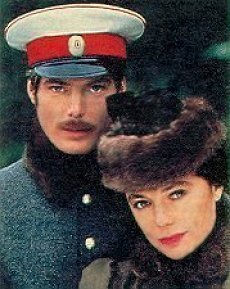
The best-known Anna is Greta Garbo, but Anna has also been portrayed by Vivian Leigh, Jaqueline Bisset (with a dashing Christopher Reeve as Vronsky), and Sophie Marceau (filmed on location in Russia). There’s also a BBC miniseries starring Victoria Allum. You can also see the story as a ballet or musical or opera.  There is a silent film version, thought to be lost, and a Russian movie that is hard to find, and an Egyptian version called “River of Love.”  I wish I could hear the radio version with Ingrid Bergman and Gregory Peck and see the 1961 television movie with Sean Connery and Claire Bloom.


Related Tags:


Based on a book Classic Drama For Your Netflix Queue Romance
THE MOVIE MOM® is a registered trademark of Nell Minow. Use of the mark without express consent from Nell Minow constitutes trademark infringement and unfair competition in violation of federal and state laws. All material © Nell Minow 1995-2026, all rights reserved, and no use or republication is permitted without explicit permission. This site hosts Nell Minow’s Movie Mom® archive, with material that originally appeared on Yahoo! Movies, Beliefnet, and other sources. Much of her new material can be found at Rogerebert.com, Huffington Post, and WheretoWatch. Her books include The Movie Mom’s Guide to Family Movies and 101 Must-See Movie Moments, and she can be heard each week on radio stations across the country.

Website Designed by Max LaZebnik