
Les Misérables
Posted on December 24, 2012 at 6:00 pm

Fair warning: I seem to be impervious to the appeal of “Les Misérables.” I was not a fan of the stage show or the songs, but I understand that it is the most popular musical of all time, and I approached this movie version with an open mind. My take is that it will make the fans happy, but I am still unpersuaded.
The musical is based on Victor Hugo’s vast novel about Jean Valjean (a magnificent Hugh Jackman), who served 19 years in prison for stealing a loaf of bread to feed his family and spends the rest of his life trying to do good and to avoid the relentless pursuit of Police Inspector Javert (Russell Crowe), who is trying to put him back in prison for violating his parole.
When Valjean is first set free, he is bitter and angry. He repays the kindness of a priest who tries to help him by stealing valuable silver treasures from the church. Immediately captured, he is returned to the priest (played by Colm Wilkinson, the foremost Valjean in the stage version). But the priest insists that the items were gifts, and with the police watching, he encourages Valjean to take more. Valjean is transformed by this compassion and generosity, and he vows to be as good, loving, and devoted to helping others as the man who cared for him.
Years later, Valjean, under another name, is prosperous and public-spirited. He owns a factory and he is mayor of his town. Fantine (a heart-breaking Anne Hathaway) works in his factory to support a daughter she boards with an innkeeper and his wife. She loses her job because she refuses to sleep with a foreman and is forced into prostitution. Valjean is horrified and feels responsible. As she lies dying, he promises to care for her daughter, Cosette.
Valjean rescues Cosette from the corrupt innkeeper (Sasha Baron Cohen) and his wife (Helena Bonham-Carter). But he has attracted the attention of Javert, and so he and Cosette must hide. Ten years later, with Paris in the upheaval of a revolution, an idealistic young man named Marius (“My Week with Marilyn’s” Eddie Redmayne) sees Cosette (Amanda Seyfried) and instantly falls in love with her. In the midst of uprisings and violent reprisals, Valjean tries to keep his promise to Fantine and keep Cosette safe and happy.
 Production designer Eve Stewart has done a masterful job, making the setting as vibrant and as essential to the story-telling as any of the characters. Director Tom Hooper (“The King’s Speech”) made a critical contribution by having the actors sing their parts while they were filming, instead of pre-recording them to be played back when the movie was being shot. Since the movie is “sung-through” (all dialogue is sung rather than alternating speaking and singing), this gives the music a welcome organic quality and immediacy. Hathaway’s character is on screen for only a brief time, but her big number, the “I Dreamed a Dream” song memorably sung by Susan Boyle, is wrenching. Hooper keeps the camera on her beautiful face, like the “Nothing Compares 2 U” Sinead O’Connor video, the better to feel her anguish, and it is a stunning moment. Elsewhere, he over-does the artsy angles and sometimes assumes too much familiarity with the storyline. Crowe’s voice is not up to the task and Seyfried’s is stretched beyond its capacity. Newcomer to film Samantha Barks (from the London cast) as Eponine, the daughter of the innkeepers who also loves Marius, sings like an angel and lights up the screen.
It’s a long slog at nearly three hours, for a non-Miz-head. But I came away with more understanding of those who are.
Parents should know that this is an epic story of struggle against oppression with disturbing and graphic abuse of prisoners and others, many characters injured and killed, sad deaths (including death of a child), and a woman accused of sexual misconduct and forced into prostitution.
Family discussion: How does the priest change Jean Valjean’s notion of what he should do? Why was Javert so conflicted? Why were the rebels willing to risk their lives?
If you like this, try: the PBS concert specials saluting the 10th and 25th anniversaries of the musical and the non-musical film versions

 , is as much an idealized fantasy figure as any adorkable chick-lit single girl rocking her Jimmy Choos and self-deprecating quips until Mr. Perfect puts a ring on it. The testosterone version has the observational and analytic skills of Sherlock Holmes, the “who was that masked man” righting-wrongs-and-leaving-town career path of the Lone Ranger, and the single-minded devotion to righteous indignation firepower of Rambo, and he will never, ever, ever put a ring on anyone.
 , written and directed by “The Usual Suspects” screenwriter Christopher McQuarrie. It opens with a scene of a sniper shooting random passers-by, and it is especially jarring when we see him aiming at a child. I would say that it might have made sense to delay the release of the film because it is unfortunate to have it open a week after the shooting of children and teachers in Newtown, Connecticut, but it may be that after that horrible tragedy there will never be a good time for a movie that turns carnage into entertainment. Within the world of the movie, a world people willingly enter because they want to see some guilt-free fights, chases, and shoot-outs, it is reasonably effective. But if it is harder to enter that world these days, perhaps that is not a bad thing.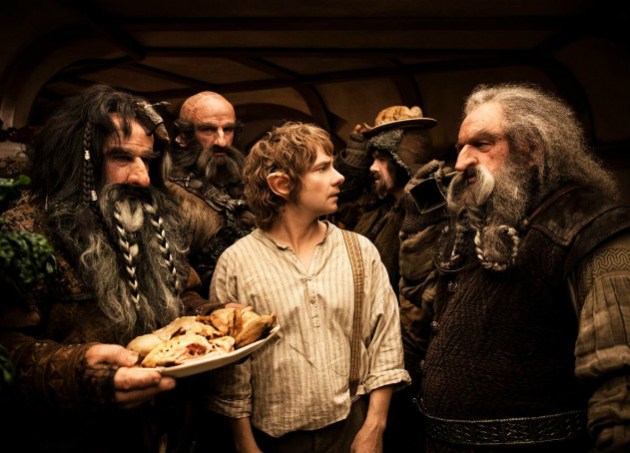
 . Director Peter Jackson returns to J.R.R. Tolkien’s Middle Earth for this “Lord of the Rings” prequel, the adventure of young Bilbo Baggins, the hobbit we meet in the LoTR trilogy as the middle-aged uncle of the heroic Frodo. We see many familiar faces, especially Ian McKellan as the wizard Gandalf, the sepulchral Christopher Lee as Saruman, Cate Blanchett as the ethereal Galandriel, Hugo Weaving as the regally gracious Elrond, and Andy Serkis plus CGI as Gollum, and the now-familiar but still marvelously eye-filling New Zealand locations.What is most different here is that Jackson has doubled the frames-per-second for a new hyper-clarity. The 24 frames per second standard that has been in effect since the beginning of the sound era has been upped to 48, giving the film a depth of detail that is so fresh it can be a little unsettling. We subconsciously associate the quality of light and focus with the video used for news programs and lower-budget sitcoms (think of the difference between the indoor and outdoor scenes in the old “Monty Python” episodes), so it can take a while to get used to it in a richly imagined fantasy, especially when close-ups reveal the pores of a character’s skin like a magnifying mirror at a department store makeup counter and the quality of light seems chillier and more sterile. We get so much visual information that it takes a while to re-calibrate our ability to separate the meaningful from the superfluous.