Billie Eilish: Hit Me Hard and Soft – The Tour Live in 3D

Billie Eilish: Hit Me Hard and Soft – The Tour Live in 3D

Posted on May 7, 2026 at 5:50 pm

B +
Lowest Recommended Age: Middle School
MPAA Rating: Rated PG-13 for strong language and suggestive references
Profanity: Strong language and sexual references in song lyrics
Alcohol/ Drugs: None
Violence/ Scariness: None
Diversity Issues: A theme of the movie
Date Released to Theaters: May 8, 2026
Copyright 2026 Paramount

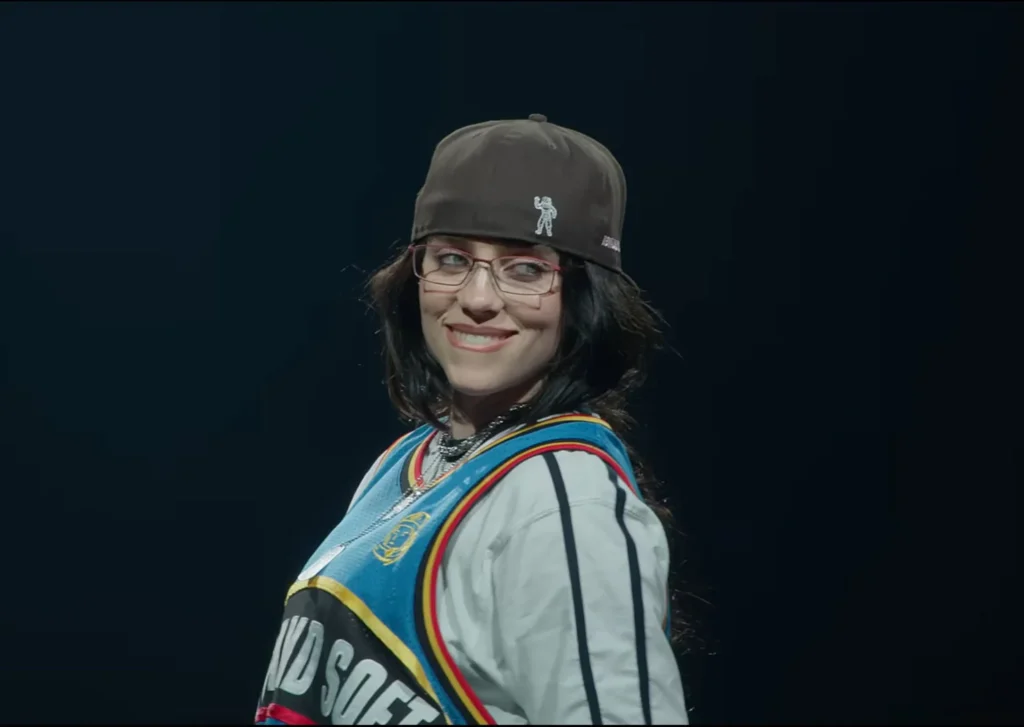
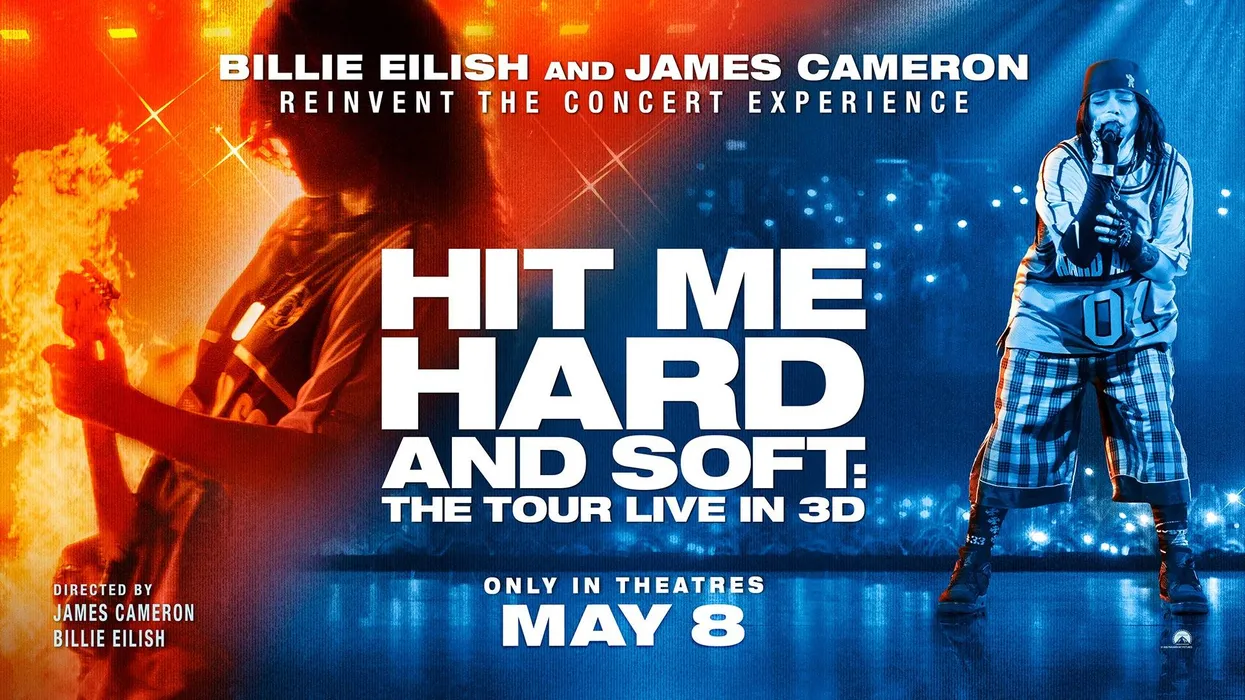
If you don’t know better, when you see Billie Eilish come on stage by herself in a huge area, looking like she is wearing the clothes she slept in, bopping a bit as she walks around the perimeter of the stage that juts into the audience, you might think she is winging it. There may not be a sequin in sight, no choreography with spangled dancing girls, very few digital effects and just two back-up singers, simply dressed in polo shirts and pleated skirts. But Eilish is in control of every detail including meticulously staged lighting effects, a floating platform (reassuringly, she is tethered to it), and bursts of flame. As we will see, that also includes a powerful connection with every individual in the two gigantic arenas that are the settings for this 3D IMAX documentary concert film co-directed by Oscar-winners James Cameron and — I did say every detail — Eilish herself. She even used a camera to shoot some of the footage.

For a moment, I was annoyed at what I thought was the hands blocking the screen from the row in front of me. Then I realized they were not blocking the screen; they were on it. Cameron, the man behind the “Avatar” franchise, knows how to create a truly immersive experience. Like most concert films, this one has brief interviews with fans expressing their adoration and images audience members happily sobbing as they sing along as well as some backstage moments, in this case mostly with Cameron interviewing his co-director in an atmosphere of utter comfort and respect. One of the movie’s sweetest moments has Eilish looking through her window to see fans camped out below. She holds up a hand-lettered sign telling them she loves them and they of course go wild.

And one of the documentary’s most touching moments is when Eilish, who is in such confident command on stage, tells Cameron that while she loves performing “more than anything,” she was worried that she would not be able to because she was not comfortable in what she thought of as the expected presentation of young women singers (see the above references to sequins and choreography). Learning that she could be not just accepted but cherished for presenting herself as is (she smiles that she does her own hair and make-up, both minimal) is as important to her as the understanding and appreciation her fans find in her music. Over and over we hear them say that it is the generosity and insight in her music that makes them feel seen in a way that gives them hope and self-acceptance.

Early in the film, Eilish receives flowers and a loving note from her brother, Finneas, wishing her well on her first tour without him. That makes it all the more meaningful when he shows up late in the film to join her on stage. The relationship between them as siblings and musicians is a joy to watch, as is seeing Eilish play the audience as though it is a musical instrument. She is a truly remarkable performer. At one point, she lies down on the stage, cautioning her audience to stay as quiet as possible for just a minute so she can create a series of vocal loops requiring astonishing precision in a studio setting, near-unthinkable in live performance.

Her dedication to the fans is endearing, musing about the cuts and scrapes on her hands from trying to be in literal touch with as many as possible, and explaining that she wants to be the kind of performer her younger self would like to have been a fan of. As we are on stage with her, a part of these concerts, we can assure her that she has.

Parent should know that this film begins with a warning that it includes a lot of bright, flashing, and pulsing lights that may create problems for some viewers. Eilish’s lyrics have some strong language and sexual references.

Family discussion: Why did Billie Eilish think she would not be able to be herself on stage? What performers do you most admire and why?

If you like this, try: other concert films including performances by Taylor Swift, The Band, The Talking Heads, the Rolling Stones, and U2.
Related Tags:


3D Documentary IMAX movie review Movies -- format Movies -- Reviews Musical
Mercy

Mercy

Posted on January 22, 2026 at 6:33 pm

B
Lowest Recommended Age: Middle School
MPAA Rating: Rated PG-13 for intense violence, mature thematic elements, some language, and drug/alcohol references
Profanity: Some strong language
Alcohol/ Drugs: Alcoholism, drinking and drunkenness, drug references and brief drug use
Violence/ Scariness: Woman stabbed to death, other characters injured and killed, guns, explosions, chases, young character taken hostage
Diversity Issues: Diverse characters
Date Released to Theaters: January 23, 2026
Copyright 2025 Amazon MGM

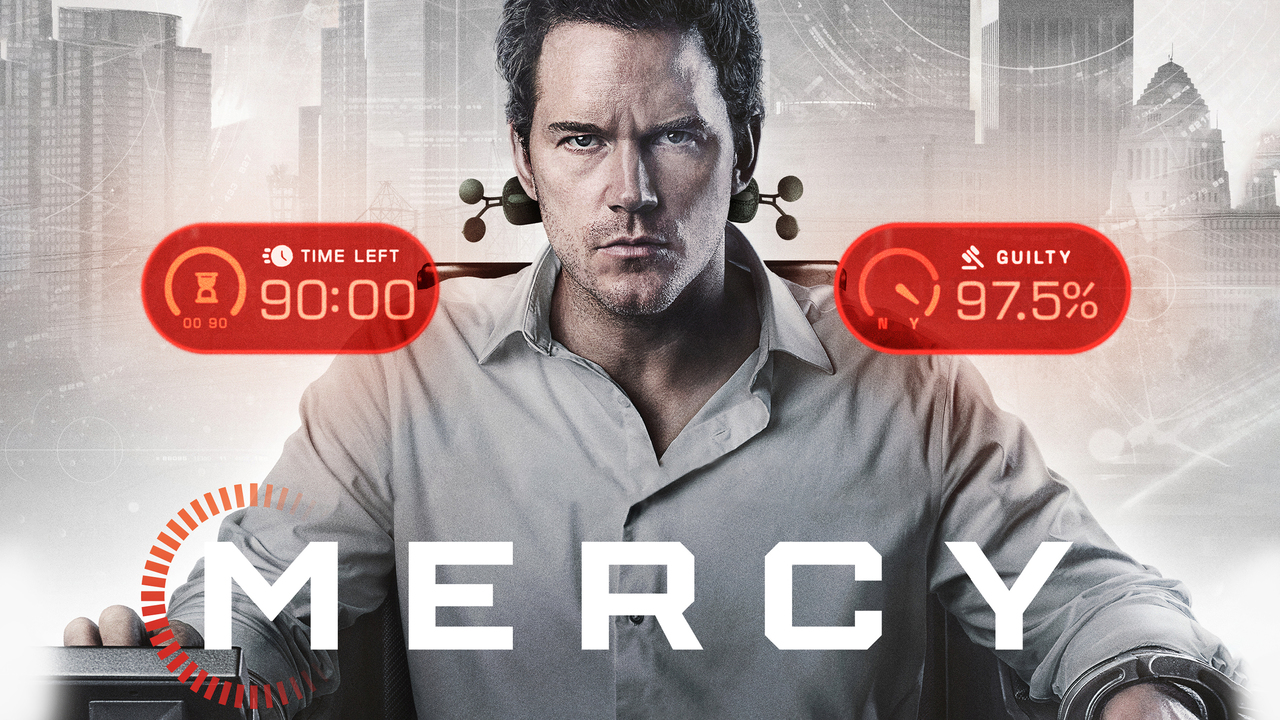
Chris Raven (Chris Pratt) wakes up, or maybe comes to, sitting in a chair, his wrists manacled. He is in Mercy Court, presided over by an AI judge who gives him 90 minutes to prove that he did not murder his wife. If he is not successful, he will immediately be executed.

“Mercy” is set in the near future, when civil unrest has led to the development of the AI court, reversing the Constitutional presumption of innocence and right to counsel with a system designed for efficiency. It is “the ultimate deterrent.” Chris is the 19th person to be tried by the AI judge, who appears on screen as a female character named Judge Maddox (Rachel Ferguson).

Chris does not even remember where he was the previous day and learns from the “judge” that his wife has been stabbed to death in the kitchen, her body discovered by their teenage daughter, Britt (Kylie Rogers). The “judge” plays the footage for him, showing him leaving work to return home, insisting on entering despite his wife telling him not to come in. No one else came to the house during that time period. Chris, a cop who was instrumental in developing the AI court system and brought in the first case, now sees what it is like to be on the other side. As the clock ticks down, Chris has access to all of footage, recordings, and records that are automatically stored online and is permitted to make calls to witnesses.

Producer/director Timur Bekmambetov specializes in action with a fantasy element like “Night Watch” and “Abraham Lincoln: Vampire Hunter” and that makes him a good fit for this film. We might not expect a movie set primarily in one spare room with a screen and a chair to be in IMAX 3D, but it keeps the visuals from feeling claustrophobia-inducing as Chris and the judge call up images of all of footage and data Chris calls up on the screen. Chris has an immersive experience, and the effects make us feel a part of it.

The set-up is strong, raising questions (though not spending much time exploring them) about how society balances safety and justice and imposing a tight time limit to build and sustain a feeling of urgency. Adopting if not reaching the ingenuity of telling the story on a screen of the innovative films “Searching’ and “Missing,” produced by Bekmambetov, he makes the best of that form of storytelling and Pratt does very well stuck in a chair, showing us how his character shifts from horrified, confused, and humiliated to the determined problem-solver cop he is.

The last part of the movie gets over-complicated, piling detail upon detail, and cutting some logical corners. But Pratt is, as always, a likable presence and we want to see him work through this mess and prove that he is innocent — and that at least for now humans can still outthink machines.

Parents should know that this movie included the murder of a mother, discovered by her daughter who is very traumatized, as well was peril and violence including guns, explosives, and a car chase, with characters injured and killed. Characters use strong language, some are alcoholics who struggle to stay sober and one starts drinking again and gets very drunk, there is brief drug use and reference to making and distributing drugs.

Family discussion: Do you think AI will ever be able to judge someone’s guilt? Did you think Chris was guilty and if you did, what changed your mind?

If you like this, try: “Missing” and “Searching”

Related Tags:


3D Crime IMAX movie review Movies -- format Movies -- Reviews Mystery Science-Fiction Thriller
Aquaman and the Lost Kingdom

Aquaman and the Lost Kingdom

Posted on December 21, 2023 at 2:12 pm

B-
Lowest Recommended Age: Middle School
MPAA Rating: Rated PG-13 for language and sci-fi violence
Profanity: Some strong language
Alcohol/ Drugs: Beer
Violence/ Scariness: Extended comic-book style fantasy action, some disturbing images of characters getting burned and stabbed, zombie-like characters, monsters
Diversity Issues: Diverse characters
Date Released to Theaters: December 22, 2023

Copyright WB 2023
I get the feeling everyone was just calling it in on this one. The DCCU is getting a makeover under James Gunn and Peter Safran and who knows what will happen given the prospect of the catastrophic leadership of David Zaslav burying his bad decisions and collecting a huge paycheck with a possible sale of Warner-Discovery to Paramount. And Jason Mamoa already made it clear this was his last Aquaman movie. Whether the behind-the-scenes is the reason for this lackluster, derivative entry in the DC Cinematic Universe or not, the movie is a wait-for-streaming for all but the most devoted fans.

In our last episode, Aquaman (Momoa) killed a pirate named Jesse Kane, and his son, David (Yahya Abdul-Mateen II) vows to kill Aquaman in revenge. And Aquaman seizes control of the underwater kingdom from his half-brother Orm (Patrick Wilson). An extra scene in the credits has David Kane joining forces with marine scientist Stephen Shin (Randall Park), who promises to help David get his revenge if David will help him find the lost kingdom under the sea.

We pick up a few years later, where, in the first of a series of clangingly obvious foreshadowing signals, Arthur/Aquaman is now married to Mera (Amber Heard) and he tells us the most important thing in the world to him is their baby son, Junior. Aquaman divides his time between his home at the shore, with his human father, Tom (Temuera Morrison) helping to care for Junior, and his undersea kingdom. He is often frustrated with the bureaucracy of the kingdom’s council. And he is very concerned about the land countries destroying the environment, but, with his kingdom’s long history of secrecy, he cannot reach out to the upper world.

David has found the lost kingdom and the source of immense evil power in the black trident. A frozen spirit who looks like a cross between Groot and the Green Goblin says he will give that power to David if he will bring him the descendent of his enemy, which turns out to be guess who.

Actually, it’s guess whos, but that comes later. In order to fight David, Aquaman will have to team up with Orm, the half-brother who tried to kill him, and who is now in prison. The council will never approve, knowing that breaking Orm out of prison will start a war with his captors, but no matter, Aquaman does it anyway.

Much of the storyline is similar to “The Black Panther,” a kingdom with superior technology trying to decide whether to let the rest of the world know who they are and a villain seeking revenge with a conclusion for one character very reminiscent of Killmonger. And the mechanical octopus-like machine seems an awful lot like the one from “The Incredibles.” Topo, the real (CGI) octopus, is, fun, though, and I wish we’d seen more of him. The special effects range from okay to pretty good. Martin Short makes the best of a character who seems like a cross between Jabba the Hutt and a champion from RuPaul’s drag race.

It swings back and forth between meaningless nods to the issue of climate change (the most damaging technology is imaginary), action scenes with lots of monsters and machines, cliche dialog (“It’s time for me to reclaim my destiny!”), and corny winks at the audience. Here’s hoping the Gunn/Safran regime can do better.

NOTE: Stay for one mid-credits scene

Parents should know that this film has some strong language and constant comic book-style action with some grisly images of monsters. Characters are in peril and there are graphic wounds.

Family discussion: What influenced the relationship between Arthur and Orm? How would we think of environmental threats differently if we thought humanoid creatures lived there? Why did Aquaman try to save David?

If you like this, try: the other DC comics films and the comic books, especially the Neal Adams versions

Related Tags:


3D Comic book/Comic Strip/Graphic Novel movie review Movies -- format Movies -- Reviews Scene After the Credits Series/Sequel Superhero
Spies in Disguise

Spies in Disguise

Posted on December 24, 2019 at 5:05 pm

B +
Lowest Recommended Age: Kindergarten - 3rd Grade
MPAA Rating: Rated PG for action, violence, and rude humor
Profanity: Some schoolyard language
Alcohol/ Drugs: Transformation potion
Violence/ Scariness: Action/cartoon-style violence, consequences of violence an issue in the film
Diversity Issues: Diverse characters and issues of diversity but includes the "bad buy with disabilities" cliche
Date Released to Theaters: December 25, 2019
Date Released to DVD: March 9, 2020

Copyright 20th Century Fox 2019
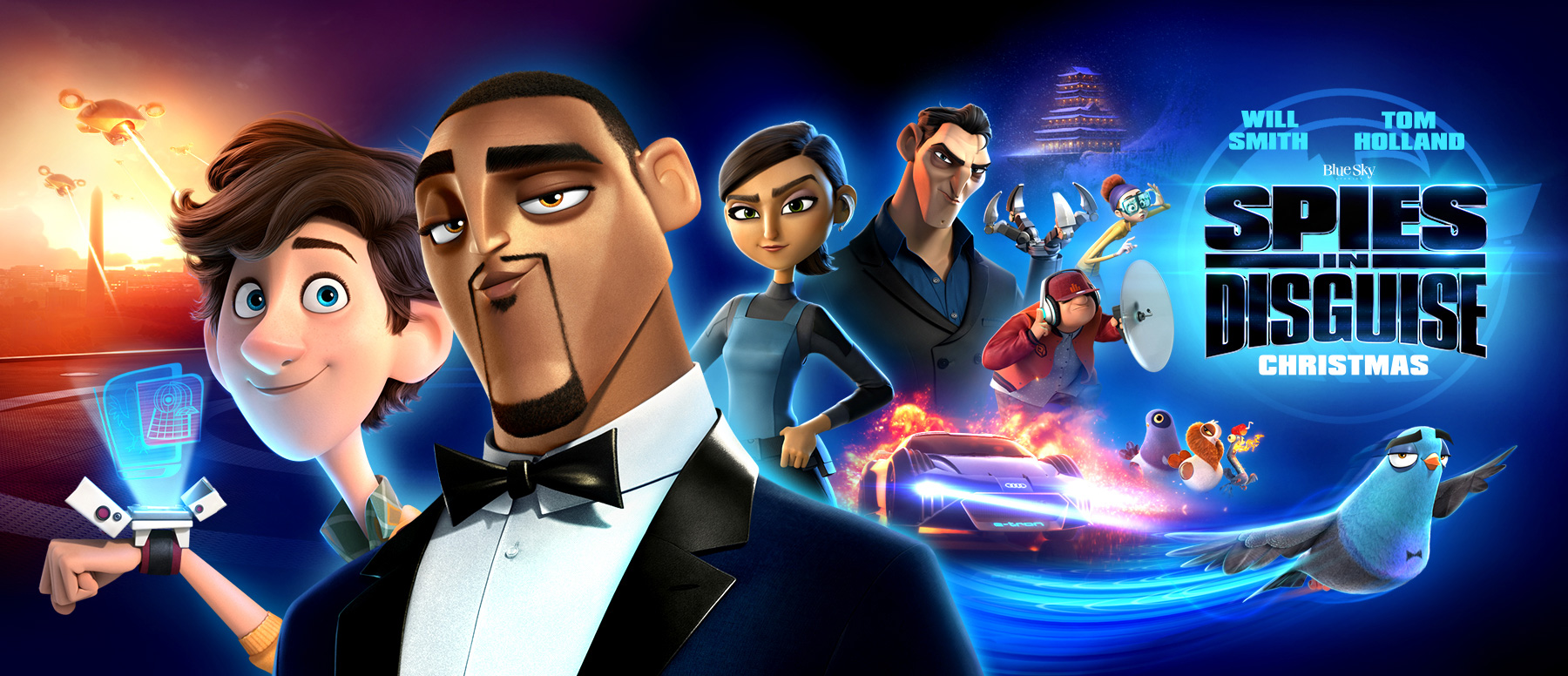
Will Smith is one of the most charismatic performers in movie history, and his confident physical grace and handsome face are movie magic. But it just might be that his highest and best use is as the voice of an animated character, For “Spies in Disguise” he plays super-spy Lance Sterling, as cool and crisp as a stirred-not-shaken martini, who never musses his impeccably tailored tuxedo as he takes on dozens of bad guys with an assortment of whiz-bang gadgets, an occasional well-placed karate chop, and a banging playlist. Like Robin Williams in “Aladdin,” only animation can keep up with Smith’s mercurial imagination (and help us forget Smith’s well-intentioned but short-of-the-mark efforts to re-create that character in this year’s live actin version). Smith does not cycle kaleidoscopically between dozens of characters as Williams did; he is always himself, but as we see here he contains rapidly shifting moods and thoughts that “Spies in Disguise” brings to life with visual wit and energy that match everything Smith brings to the film. “Spies in Disguise” is a stylish spy caper with heart and humor, an endearing friendship, and an equally endearing affection for Team Weird. Come on, you know you’re part of that team, too.

Lance is after some sort of MacGuffin thingamajig about to be sold by international weapons dealer Kimora (Masi Oka) to a mysterious buyer with a robot hand named (in case we didn’t know he was the villain) Killian, played by Ben Mendelsohn, who seems to own all the bad guy roles these days. (It is too bad this film could not avoid the tired convention of the evil guy with disabilities.) With astounding skill and panache — and some cool-spy quips — Lance saves the day and is greeted at home back in CIA headquarters as a hero.

Until….it turns out that the briefcase he so cleverly snatched away from Killian is empty. And it also turns out that surveillance footage shows Lance himself is the one who grabbed the whateveritis. Suddenly, the whole CIA is after him.

Meanwhile, Walter (“Spider-Man’s” Tom Holland) is a quirky, unashamedly weird gadget guy whose non-violent inventions include the “inflatable hug” protective device and “kitty glitter” that distracts the bad guys with adorable pictures of cats suspended in air. He was working out of tiny closet-like space in the CIA, until he was impulsively fired by Lance.

Lance likes to think he works alone and never needs anyone else’s help. But it is part of his job to know how to solve problems, and he has to admit that not only does he need help to hide from the agency while he tracks down whoever is pretending to be him, he is going to need resources he cannot get from the CIA any more.

Unfortunately, the only one who can help him is Walter, who is now pretty much off the grid as far as the CIA is concerned. Lance remembers Walter saying he could make spies disappear. So, Lance tracks him down and then discovers that it’s not “disappear” as in “invisible.” It’s “disappear” as in “bio-dynamic concealment,” transformation at the cellular level into someone, or something, no one will notice.

Lance learns too late that what he was been turned into is a pigeon. “Un-bird me!” he demands. But the antidote will take some time. And as much as Lance resists help, there are some things he cannot do as a winged creature who weighs about two pounds. So, Lance-as-pigeon and Walter with a backpack of gadgets and his personal comfort pigeon Lovey go off to find Kimora and Killian.

In the midst of all the action, Walter and Lance have a thoughtful conversation about the best way to resolve conflict. Lance believes in fighting fire with fire (“Evil doesn’t care that you’re nice”) and he never wants to depend on anyone. Walter believes in working as a team and does not think that hurting other people solves anything. This slightly mitigates the unfortunate reliance on the outdated cliche of a disfigured/disabled bad guy by making Lance face (literally) the consequences of his dashing “fire with fire” strategy.

Directors Nick Bruno and Troy Quade have created a film that is gorgeously designed with a swanky, stylish, slightly retro design, “Spies in Disguise” is visually bright, graphic, and engaging, and the characters and their interactions are vivid and appealing. Here’s hoping Blue Sky retains its quirky charm under its new ownership — and that we get to see Lance and Walter team up again.

Parents should know that the film has extended cartoon/action-style peril and action, with some characters injured and killed, chases, shoot-outs, and explosions. A theme of the movie is the consequence of collateral damage. There is some schoolyard language and some potty humor. Unfortunately, the movie relies on the outdated cliche of the disfigured/disabled villain whose injuries are a reason for his cruelty and anger.

Family discussion: Which of Walter’s gadgets would you like to have? Who is on your team and whose team are you on? What’s the best part of being weird?

If you like this, try: “Megamind,” “Robots,” and “Rio”

Related Tags:


3D Animation DVD/Blu-Ray movie review Movies -- format Spies
Toy Story 4

Toy Story 4

Posted on June 18, 2019 at 12:16 pm

A-
Lowest Recommended Age: Kindergarten - 3rd Grade
MPAA Rating: G
Profanity: Some schoolyard language
Alcohol/ Drugs: None
Violence/ Scariness: Fantasy/action peril and violence, character sacrifices a part of his body
Diversity Issues: None
Date Released to Theaters: June 21, 2019
Date Released to DVD: October 7, 2019

Let’s get right to the big three questions about “Toy Story 4.” Yes, it’s good, yes, you’re going to cry, and yes, you have to stay ALL the way to the end for one final blink-and-you’ll-miss-it moment that is worth the wait.

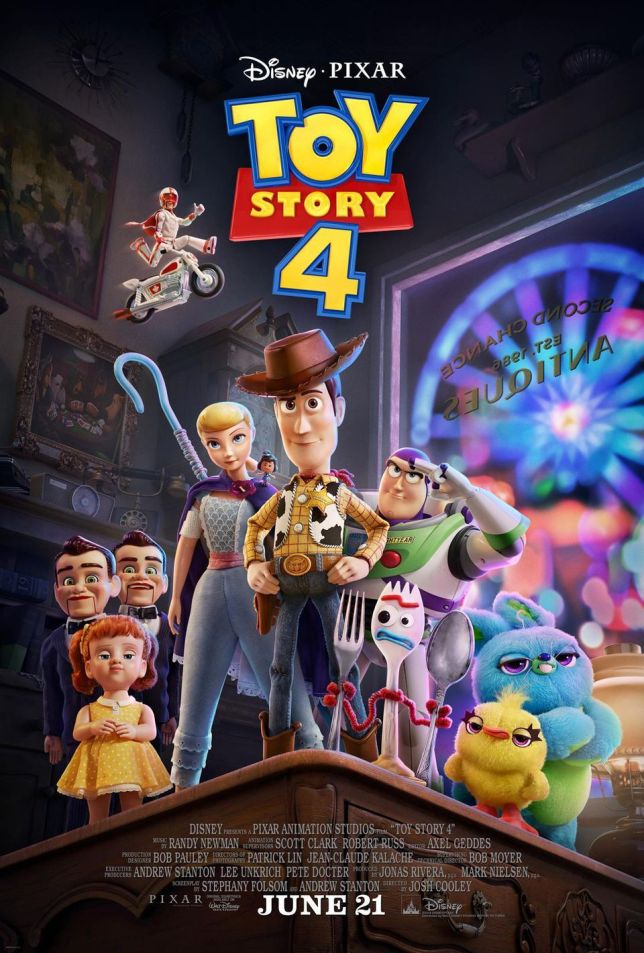
The small miracle of the “Toy Story” series is that a film that would have been memorable for its technology alone as the first fully computer-animated feature film, the shiny, plastic toy characters the focus because Pixar had not yet developed the technology to animate hair, fur, or more expressive faces, was smart, heartfelt, and genuinely moving. Woody (Tom Hanks) was a retro cowboy doll with a pull-cord attached to a voice box and said things like “There’s a snake in my boot” and “You’re my favorite deputy!” When their boy Andy was away and the toys came to life, Woody was their natural leader, looked up to by the other toys, including Mr. and Mrs. Potatohead, the T-Rex (Wallace Shawn), the slinky dog, and Bo Peep (Annie Potts).

And then a new toy arrived, a shiny spaceman named Buzz Lightyear (Tim Allen), with flashing lights and pop-out wings, and a digital voice to proclaim, “To infinity and beyond!” But Buzz did not know he was a toy, creating an existential conflict. He thought he really was a space explorer who could really fly. The conflict in the film came from Woody’s jealousy over Andy’s affection for the shiny new toy and his frustration in not being able to persuade Buzz that he was not “real” in the way he thought he was. His purpose was not to explore space and fight the evil Emperor Zurg. His purpose was to be a companion and inspiration and comfort to Andy, a boy we barely glimpse in the film. The excitement comes from the toys’ efforts to escape the mutilations of the boy next door and to be reunited with Andy when they become separated. The heartwarming theme of the film, though, is about the friendship that develops between the rivals and their mutual understanding of the meaning of their existence as Andy’s toys.

These themes continued through the next two films. The second raised the issue of value — the difference between a mint condition toy still in the box that can be sold for a good price and a well-loved toy that might be scuffed and missing some pieces but meant something to a child, even a child who has grown up and has other interests. The third film gracefully and very poignantly saw Andy leave for college but give his toys to the imaginative pre-schooler Bonnie, so they could continue to fulfill their purpose. The first image in the original film was of clouds in a blue sky that turned out to be painted on the ceiling of Andy’s room. The final image of the third one was the real sky, showing that Andy’s world had opened up.

So, how to move on from that perfect ending? With another existential crisis, or maybe two. Woody has always defined himself by being important to a child. But increasingly Bonnie is leaving him in the closet, even taking his sheriff star and pinning it on Jessie (Joan Cusack). When Bonnie is nervous about her first day of kindergarten, Woody sees a chance to be useful and he sneaks into her backpack so he can to with her.

But what comforts Bonnie at school is creating something new. From a plastic spork and a broken popsicle stick she makes a…something she calls “Forky” (Tony Hale). When Woody tells the other toys back at home that Bonnie made a friend at school, he is speaking literally. But, in a parallel to Buzz in the first movie, Forky does not know he’s a toy. He cannot adjust to the notion that he is more than a single-use plastic utensil whose destiny is to be thrown in the trash. He keeps trying to throw himself away. But Woody sees Forky as a chance to be useful to Bonnie. If Woody can’t be important to Bonnie, he can teach Forky how to be.

And once again, the characters are separated from each other and from their child. Bonnie and her family rent an RV and go on a trip that puts the toys in two settings rich with fascinating details, colorful characters, and all kinds of wildly inventive and delightfully treacherous adventures. The first is an antique shop, where Woody glimpses the lamp stand that his old friend — and maybe more — Bo Peep used to be on. He brings Forky inside to look for her, and there they meet Gabby Gabby (Christina Hendricks) a Chatty Cathy-style talking little girl doll with perfect curls and an imperfect voice box and her entourage of identical creepy-looking ventriloquist dummies all called Benson. Note that “Toy Story 2” involved “vintage” toys but now they are antiques. Keanu Reeves all but steals the film as a proudly Canadian Evel Knievel-style stunt rider toy called Duke Caboom.

The other new setting is a carnival, with rides and arcade games, and there we meet two plush toy prizes, Ducky and Bunny, voiced by Keegan-Michael Key and Jordan Peele, who have a blast riffing with each other. And it turns out that Bo Peep is there, too, having left her lamp, traveling with the carnival and seeing the world.

There are separations and perilous rescues, many near-misses and close calls, a gasp-inducing sacrifice, and a very sad farewell. The Pixar team is getting older, and they take us with them as they confront their own existential conundrums. You know you’re not going to get out of a Pixar movie without tears, and this one may be more like boo-hoo sobs. But that’s because we care about these characters and we care about the way they care about and for each other. Watch out for another shot of the sky — and for some fun scenes over the credits and, when the long, long list of filmmakers and production babies is over, a just-perfect scene at the very end.

Of course you can now buy a Forky doll. You can even choose between one that talks and one that walks. But I’m guessing that kids who see this movie will want to make something of their own.

Parents should know that this movie has extended action/fantasy-style peril with some scary ventriloquist dummies, and a genuinely shocking moment when a character voluntarily undergoes doll surgery to give up a piece of himself for another toy. Characters use some schoolyard language.

Family discussion: Why does Bonnie love Forky? How does Woody change Forky’s mind? Did Woody make the right decisions about Gabby Gabby and Bo Peep?

If you like this, try: The other “Toy Story” films and Pixar’s “A Bug’s Life” and “Monsters, Inc.”

Related Tags:


3D Animation Critics Choice Seal of Distinction DVD/Blu-Ray Fantasy movie review Movies -- format
THE MOVIE MOM® is a registered trademark of Nell Minow. Use of the mark without express consent from Nell Minow constitutes trademark infringement and unfair competition in violation of federal and state laws. All material © Nell Minow 1995-2026, all rights reserved, and no use or republication is permitted without explicit permission. This site hosts Nell Minow’s Movie Mom® archive, with material that originally appeared on Yahoo! Movies, Beliefnet, and other sources. Much of her new material can be found at Rogerebert.com, Huffington Post, and WheretoWatch. Her books include The Movie Mom’s Guide to Family Movies and 101 Must-See Movie Moments, and she can be heard each week on radio stations across the country.

Website Designed by Max LaZebnik