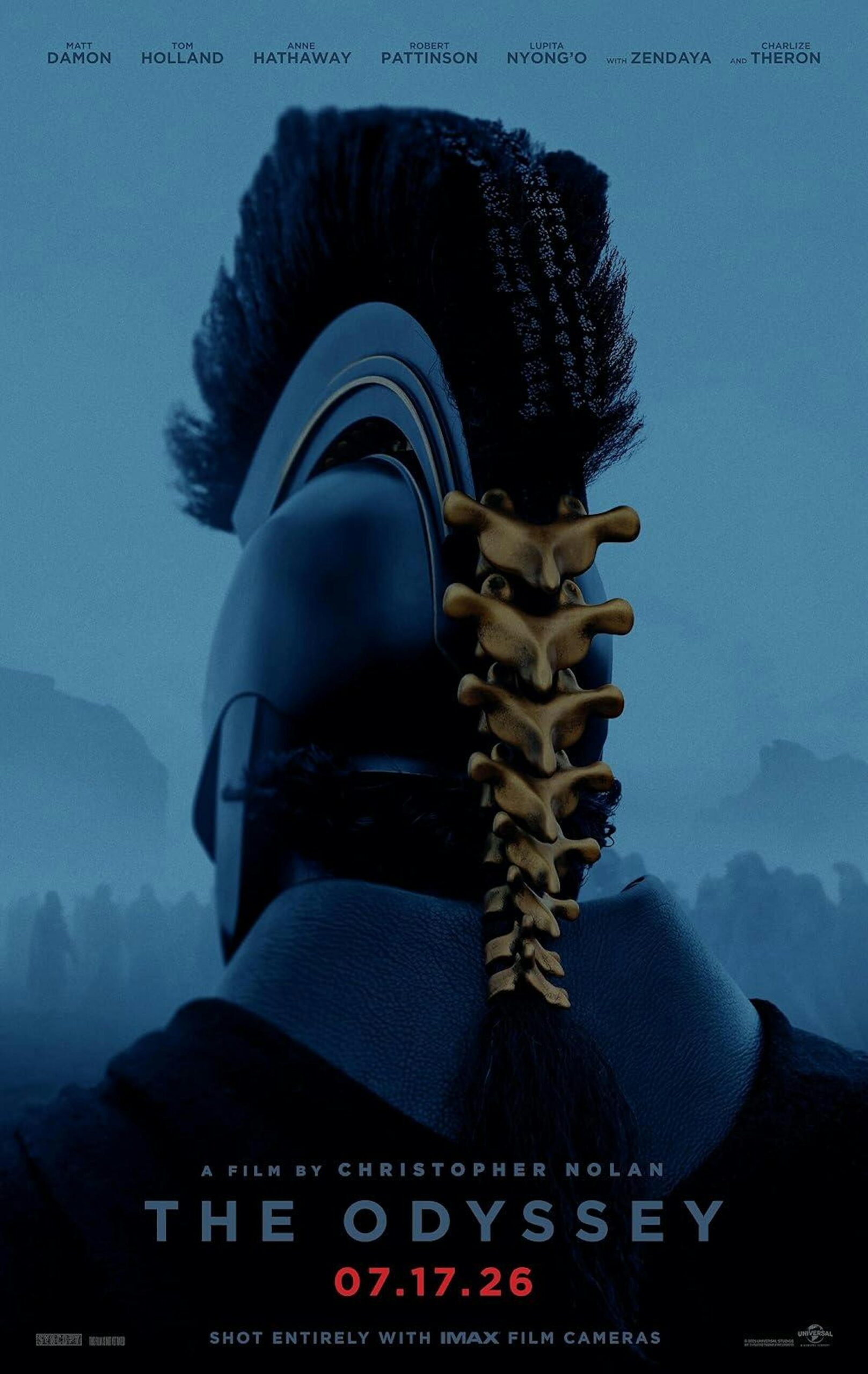
The Odyssey

The Odyssey

Posted on July 15, 2026 at 12:00 pm

B +
Lowest Recommended Age: High School
Profanity: Some strong language
Alcohol/ Drugs: Memory-erasing flowers, wine
Violence/ Scariness: Extenseive war-time peril and violence, monsters, many characters injured and killed, graphic and disturbing images
Diversity Issues: None
Date Released to Theaters: July 17, 2026
Copyright 2026 Universal

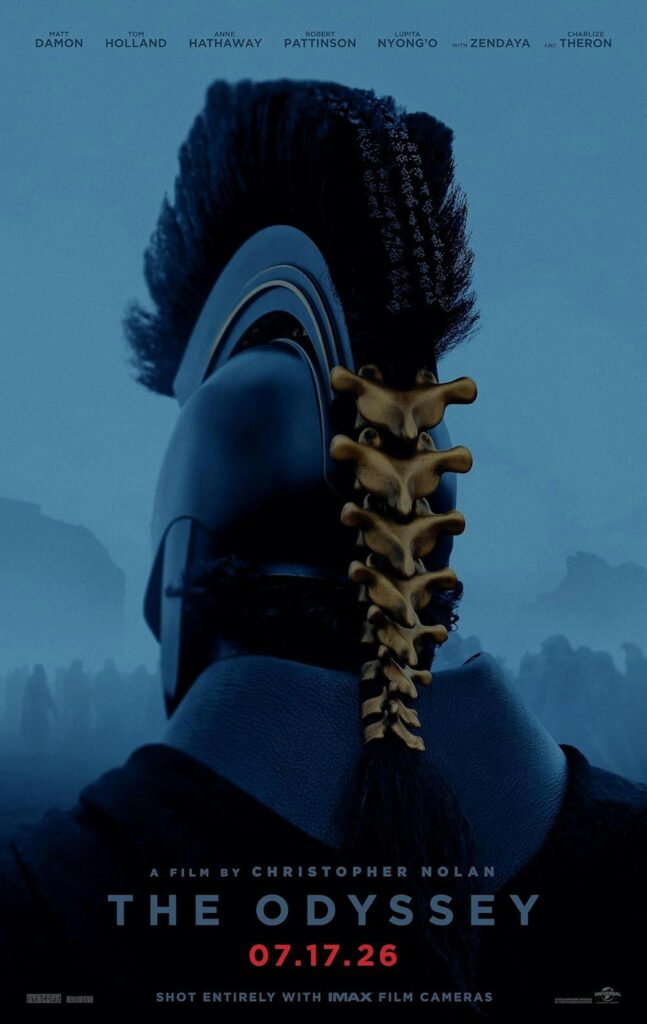
One of the foundational stories of the Western canon has a grand, sweeping, meticulously diligent new version in writer/director Christopher Nolan’s epic film, bristling with Oscar-winning talent and impressive seriousness of purpose. It is, with a few significant exceptions, true to Homer’s story dating back to 700-800 BC. But there are also vestigial reflections of Nolan’s previous film, “Oppenheimer,” both stories of men who must grapple with the consquences of their destructive, even ruthless, acts during wartime.

Matt Damon plays one of history’s most complex heroes, Odysseus, whose name and story still define journeys of adventure thousands of years later. The Odyssey follows Odysseus on his long voyage home after the victory of the Greeks, led by Agamemnon, with Achilles, Ajax, and Odysseus, in the Trojan War. Paris, a Trojan prince, had been asked to decide which of three goddesses was the most beautiful. Aphrodite, the goddess of love, bribed him by saying that if he picked her, she would give him the most beautiful human woman in the world. That woman was Helen (Lupita Nyong’o). She was the wife of the Greek king, Menelaus of Sparta (Jon Bernthal). But she is known throughout history as Helen of Troy, because she was kidnapped (or ran away with) Paris, leading to the war that made her known as “the face that launched a thousand ships.”

That war lasted ten years. It was Odysseus, known for his trickery, who came up with the idea of getting the soliders inside the Trojan’s impenetrable city by hiding in a gigantic statue of a horse, with a soldier named Sinon (Elliot Page) left behind to lie that the Greeks had retreated, leaving the horse as a tribute to the goddess Athena (Zendaya). When the Trojans drag it into the city, the Greek soldiers come out to win a decisive battle and end the war. This story is told in Virgil’s Anead, and in Nolan’s film we see parts of it more than once in flashbacks, part of elliptical, non-linear story-telling that may be confusing to those not familiar with Homer’s tale. (To refresh your memory or just get a quick recap, try this.)

But really, all you need to know is that Odysseus is on his way home, leading his men in (to start with) three boats, hoping to make it back before Agamemnon reaches his home just to be competitive. (Agamemnon will get home first but then be murdered by his wife, Helen’s sister (also Nyong’o).

It will take Odysseus a decade, with many stops along the way as the crew tries to replenish their provisions. The most well-known of their adventures are all brought to screen in unprecedented splendor by Nolan, and his “Oppenheimer” team, editor Jennifer Lame, production designer Ruth De Jong, and Oscar-winning cinematographer Hoyte van Hoytema, filming in Greece, Italy, Iceland, Morocco, and Scotland. This is the first-ever feature movie filmed entirely with IMAX cameras (in tribute, you can even get an IMAX camera popcorn bucket) and shown in 70 mm. The visuals are never less than spectacular. Odysseus and his men are traveling by boat and the sky and “the wine-dark sea” Homer described is filmed with a power and grandeur of a true epic. We get a visceral feeling of just how alone these men are, not just before GPS but before maps and navigation, entrusting to the gods to guide them home but knowing that the gods may be even more devious tricksters than Odysseus himself.

Odysseus tries to follow the “laws of Zeus,” particularly with regard to hospitable treatment of strangers, and killing even animals with honor, plucking his bow string to give them a chance to escape. When lives are at stake, though, he will do what is expedient. On their first stop, he leads his men onto an island where a cave is set up as a home, with a cozy fire. According to his beliefs about what the laws of Zeus require and assuming that the inhabitant of the cave will believe the same, he orders his men to stoke the fire to welcome their host. But the inhabitant is not a man. He is a gigantic cyclops, and in a genuinely terrifying moment, as soon as he enters the cave, he grabs one of the men and bites his head off. It is hard to understand why Nolan chose to omit one of the key elements of the story, Odysseus refusing to give the cyclops his name, instead saying he was called “Noman.” This is a very significant part of the story that is parallel to his not using his own name when he returns home, both relating to his sense of himself and his identity.

After a few more deaths, Odysseus is able to lead his men to an escape. But he violates his obligation to give the murdered men a decent burial. The conflict between his obligations under the law of Zeus and the choices to save as many lives as possible are a theme.
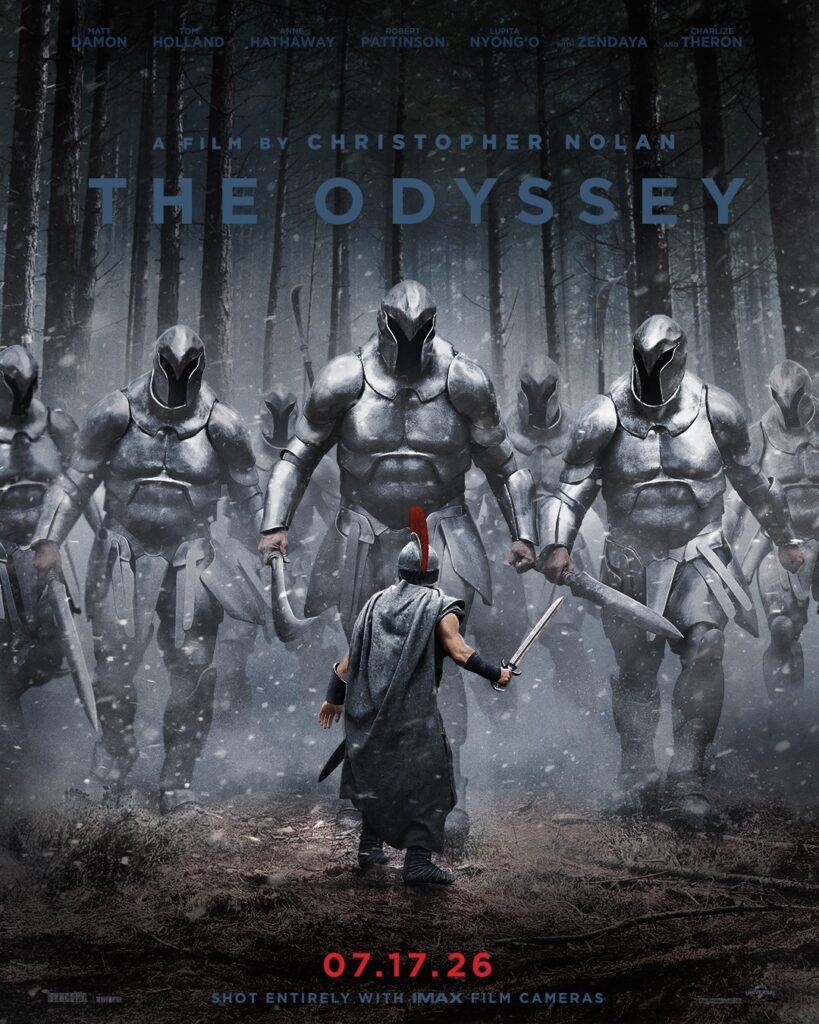
Copyright 2026 Universal

This conflict is presented in the immediate consequences of killing the cyclops. Odysseus learns that the monster was the son of the god Poseiden, who will now express his grief and anger by keeping them from reaching home. As in Homer’s original story, it explores the theme of human agency and the interference of the gods. We often see Odysseus near the goddess Athena.

Other adventures include two enchantresses. Calypso ( Charlize Theron) feeds Odysseus lotus flowers that make him forget the PTSD of his agonizing choices but also the fact that he has a family. Circe (Samatha Morton) turns his famished men into pigs (an extraordinary scene of transformation and body horror), and we see how clever Odysseus is in figuring out what she has done and forcing her to reverse the spell and help him get home. He travels to Hades where he meets the ghost of Sinon. He straps himself to the mast of his ship while his men have their ears blocked with wax to pass through the jagged rocks where the sirens sing men to their deaths.

Meanwhile, his wife, Penelope (Anne Hathaway) and son Telemachus (Tom Holland) are back in Ithaca, with dozens of suitors eating their food, drinking their wine, and trying to get Penelope to marry one of them so he can take over the kingdom. The most odious of the suitors is Antinous (Robert Pattinson), a maniuplative schemer who got Sinon to take his place in the war. Telemachus leaves Ithaca to see if he can find any news of his father from Menelaus.

It will take all of Odysseus’ craftiness and strength to defeat the suitors and reunite with his wife and son. Damon’s performance shows us all of the complexity that makes Odysseus an eternally enthralling hero. Pattinson continues to impress as he subverts his considerable looks and charisma to create a despicable, cowardly character. John Leguizamo is superb as the loyal Eumaeus. Even the three-hour run time cannot find enough time for Theron, Zendaya, and Morton, but each of those encounters could be an entire movie.

Nolan’s screenplay veers into colloquialisms that take us out of the movie now and then. But he has an unsurpassed gift for the language of cinema. The scenes of exploration, combat, and in Penelope’s castle in Ithaca are striking and narratively clear. Penelope fends off the suitors by telling them she cannot move forward until she finishes weaving a burial shroud for her late father-in-law. She weaves during the day and then unravels it at night. She appears modestly behind a screen as the suitors crowd the dining hall.

Nolan’s style is chilly and cerebral, with the female characters thinly sketched and too often just creating problems for or taking power away from men. That may be one reason that draws him to a story where a military hero has encounters with literal enchantresses who impede his progress. His exploration here of the conflicts even successful warriors feel about what they have done and what they have seen is moving. He made very significant changes to Homer’s concluding scenes (admittedly, contested by some scholars as added by others later). But the ending he chose has the same problems as the disputed version and it undermines the weight of what he has presented so compellingly throughout the story.

Parents should know that this film is extremely violence with many characters injured and killed, many with throats slit, monsters, ghosts, and graphic and disturbing images. Odysseus is drugged and characters drink wine. There is some strong language.

Family discussion: Why is this one of the most enduring stories in history? What does Odysseus regret the most? What decisions did he make that you think were wrong?

If you like this, try: the book (Fagles or Wilson translation) and a modern re-imagining from the Coen brothers, “O Brother Where Art Thou.”

Related Tags:


Based on a book Epic/Historical IMAX movie review Movies -- format Movies -- Reviews Remake Road Trip War
Nuremberg

Nuremberg

Posted on November 6, 2025 at 5:51 pm

A-
Lowest Recommended Age: High School
MPAA Rating: Rated PG-13 for violent content related to the Holocaust, disturbing images, strong language, and themes including suicide, smoking, and brief drug use
Profanity: Some strong language
Alcohol/ Drugs: Alcohol, drugs, and smoking
Violence/ Scariness: Wartime and Holocaust references, archival scenes from concentration camps
Diversity Issues: A theme of the movie
Date Released to Theaters: November 7, 2025

Those who have studied 20th century history know that after WWII the Allies did something no governments had ever done after a surrender. They held a formal trial, not about Germany’s acts of war but about the “crimes against humanity” that tortured, imprisioned, stole from, and murdered its own people, and tried to eradicate citizens based on their religion, disability, and sexual orientation. They were known as the Nuremberg trials.

Copyright Sony Pictures Classics 2025

But even those who have studied that process may not know that the American military also assigned its own psychiatrists to interview the first 22 German officers and political leaders. It was not, as in an ordinary criminal trial, to determine their ability to understand the proceedings and in some cases their culpability for their decisions, but to try to understand what kinds of minds would create what we now call the Holocaust. Those questions have continued to confound us for 80 years, and continue to be explored by historians and filmmakers, including recent documentaries like “The Last Days,” “Shoah,” and “The Grey Zone” and narrative films like “The Zone of Interest” and “A Real Pain.”

“Nuremberg,” based in part on the book The Nazi and the Psychiatrist by Jack El-Hai, follows three intersecting stories, the efforts of Supreme Court Justice Robert Jackson (Michael Shannon) to get the Allied countries together to agree on the trial, the charges, and its proceedings, the interviews military psychiatrist Douglas Kelley (Rami Malek) conducted with top Nazi official Hermann Göring (Russell Crowe), and Howie Triest (Leo Woodall) a young military officer assigned to Kelley as a translator.

Jackson’s plan seems impossible, “a logistical nightmare.” “What you’re talking about is trying them in some sort of legal limbo that doesn’t exist using laws that haven’t been written yet,” he is told, and reminded that Germany never attacked the US. He would have to get the involvement of all of the Allies to participate, including the USSR. He insists, “The world needs to know what these men did.”

There is an optimism behind it, an idea that if the top Nazis were both convicted and diagnosed, it would help make sure that nothing like the Holocaust would ever happen again.

The essence of the film is in the interviews/conversations between Kelley and Göring, and the two Oscar-winners and writer/director James Vanderbilt’s script make them among the most riveting screen moments of the year.

Vanderbilt is superb in revealing the complexity of the moral and legal issues. Kelley is trained to give therapy, with patient confidentiality. Jackson wants him to use his sessions to find Göring’s vulnerabilities, to help with the prosecution. General Eisenhower insists that there be no executions without a trial, giving the men the opportunity to defend themselves. The risk of failing to find them guilty is the risk of making them martyrs, allowing atrocities to happen again. Jackson and the military are also very aware that the humiliation Germany suffered at the end of WWI played a big part in Hitler’s rise. Göring tells Kelley why he followed Hitler: “Along came a man who said we could reclaim our former glory. Would you not follow such a man?”

Jackson reminds us that the war “started with laws,” and should end with them. They have to create a sense of fairness and justice without repeating the mistakes of the post WWI Paris Peace Conference that divided up German’s territories.

The movie is well paced, as a thriller, a courtroom drama, and an exploration of history and the human capacity for evil and for good. It is never didactic or heavy-handed. There are moments of humor and excellent performances by all.

Vanderbilt has a gift for telling details like Göring ripping the lace-edged hem of his wife’s slip to make a white flag of surrender as his car reaches the Americans, and then casually telling them to get his luggage, as though the American soldiers are baggage handlers.

When the military thinks Kelley is too sympathetic, they bring in another psychiatrist (Colin Hanks), who is clear that he is there to write a book about it. Kelley is disturbed by this unabashed acknowledgement of self-interest. The film lets us know that Kelley did himself write a book, though, 22 Cells in Nuremberg: A Psychiatrist Examines the Nazi Criminals. It is hard to find but well worth reading, especially its conclusion, calling for the same commitments we are still trying to achieve today. It is impossible to watch this film without being chilled by what happened in Germany. It is impossible not to think about the lessons we have failed to learn.

Parents should know that this film includes references to wartime violence and the Holocaust, with real archival footage of concentration camps. There is some strong language and characters drink, smoke, and use drugs.

Family discussion: Compare the Nuremberg trials to a later version, South Africa’s Truth and Reconciliation Commission. Which is better? When the current global conflicts are resolved, how should we treat those involved?

If you like this, try: “Judgment at Nuremberg.” a 1961 film about the later trials, with waning interest in pursuing the Nazi judges, exploring the issues of responsibility for those in lower-level roles. and the American Experience documentary, “The Nuremberg Trials

Related Tags:


Based on a book Based on a true story Drama Epic/Historical movie review Movies -- format Movies -- Reviews War
Juliet & Romeo

Juliet & Romeo

Posted on May 8, 2025 at 5:23 pm

C
Lowest Recommended Age: Middle School
MPAA Rating: Rated PG-13 for some violence, bloody images and suggestive material
Profanity: Mild language
Alcohol/ Drugs: Alcohol and drugs
Violence/ Scariness: Sword fight, attempted suicide
Diversity Issues: A theme of the movie
Date Released to Theaters: May 9, 2025

As he did with “Spinning Gold,” based on his father’s career in music, writer/director Timothy Scott Bogart has Temu-ed a great story and it is barely watchable. This time, it is Shakespeare’s “Romeo and Juliet,” which he has renamed “Juliet & Romeo,” made some changes to the characters and storyline, reworked the dialogue so instead of exquisite poetry in iambic pentameter it’s more like college kids exchanging texts.

Copyright 2025 Briarcliff Entertainment

However, the fabulous production design by the brilliant Dante Ferretti and beautiful cinematography by Byron Werner are top-notch and the sword fights are ably staged. Oh, and this is a musical, with pop torch songs by Evan Kidd Bogart, who is a producer of the film, the composer of Beyonce’s hit, “Halo,” and Timothy Scott Bogart’s brother.

It isn’t as though we don’t already have a straightforward but artistic version in Franco Zeffirellis version with teenagers playing the young lovers and a sublime version with 20th century flair but Shakespeare’s language, in Baz Luhrman’s “Romeo + Juliet,” starring Leonardo DiCaprio and Claire Danes.

This version begins a scene-setting intro that lets us know immediately what’s in store. Not just because we see the tragic couple dead before the story flashes back to three days earlier, but because Shakespeare’s

Two households, both alike in dignity
 (In fair Verona, where we lay our scene),
 From ancient grudge break to new mutiny,
 Where civil blood makes civil hands unclean.
 From forth the fatal loins of these two foes
 A pair of star-crossed lovers take their life;
 Whose misadventured piteous overthrows
 Doth with their death bury their parents’ strife.

becomes an “in the last episode”-style update somewhere between Shakespeare and the crawl at the beginning of “The Phantom Menace.”

We get a few Shakespearean crumbs just to remind us of what we’re missing. There are a couple of references to “what’s in a name,” and one to “all’s well that ends well.” But most of the dialogue is at the level of “I’m okay,” “You’re a great kisser,” and the repeated song lyric, “I knew that my heart would never be the same.” At one point Romeo sort of proposes by telling Juliet he wants to “turn our prose into poetry.” This screenplay has done the reverse.

Parents should know that this movie, like the play that inspired it, has fight scenes including sword fights, with characters injured and killed, and an apparent suicide. There are sexual references.

Family discussion: If you were going to update this story, what would you do? Why has this story continued to enthrall audiences for more than 500 years?

If you like this, try: “Rosaline,” a sharp, witty re-telling of the Romeo and Juliet story from the perspective of the young woman Romeo was in love with before he met Juliet, the Oscar-winning “Shakespeare in Love,” and the Baz Luhrmann and Franco Zeffirelli versions of Shakespeare’s play and

Related Tags:


Based on a play Epic/Historical movie review Movies -- format Movies -- Reviews Romance
Gladiator II

Gladiator II

Posted on November 20, 2024 at 6:25 pm

B-
Lowest Recommended Age: Mature High Schooler
MPAA Rating: Rated R for strong bloody violence
Profanity: Fierce language
Violence/ Scariness: Extended, intense, and graphic violence, swords, animal attacks, characters injured and killed, disturbing images
Date Released to Theaters: November 22, 2024
Date Released to DVD: January 22, 2025
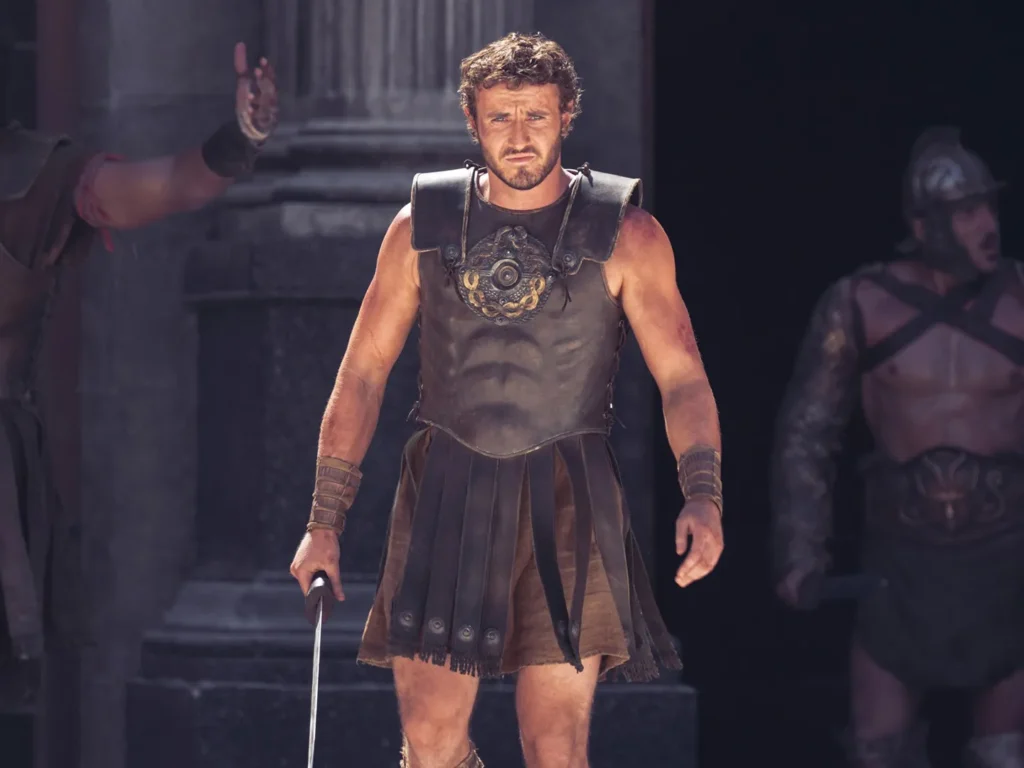
This image has an empty alt attribute; its file name is GLADIATOR-2-121124-MCDGLTW_PA010.jpg-1024x768.webp
Gladiator II copyright 2024 Paramount

“Gladiator II” looks magnificent. Denzel Washington effortlessly steals every scene he is in and all but winks at us to show how much he is enjoying it. But the script is weak and too repetitive , the movie is too long, and the fight scenes, no matter how staged, just get numbing after a while. When I saw it, the audience was so disconnected from the storyline that they laughed at an admittedly corny reveal that was clearly a turning point that puts one of the main characters in danger.

For those who still remember the details of 2000’s Oscar-winning “Gladiator,” starring Russell Crowe, this film takes place a generation later, with only one returning main character aside from a couple of brief flashbacks and Derek Jacobi in a few scenes as a member of the political elite.

Connie Nelson is back as Lucilla, the royal daughter of the idealistic Emperor Marcus Aurelius, who was murdered by his son and her brother in the first film. She is now married to Rome’s top soldier, Marcus Acacius (Pedro Pascal).

We get a few minutes of blissful farm life in a remote village before the Roman navy arrives to take it over and the farmer and his beautiful and beloved wife have to suit up as soldiers. We know what happens to peaceful farmers and beautiful, beloved wives in these kinds of movies. Indeed, this is pretty much a replay of the first “Gladiator,” except this time the beautiful wife is also a fierce soldier. No big difference, though, because she gets killed off to fuel what we will later hear is the farmer’s biggest asset as an arena fighter, not strength or skill but rage.

That assessment of the farmer (Mescal) comes from Macrinus (Washington), who runs the gladiator program, wears only the finest glam. He is a trusted purveyor of news and rumors to everyone in Rome, especially Geta (Joseph Quinn of “Stranger Things”) and Caracalla (Fred Hechinger of “Thelma”), the decadent young emperor-brothers who whine and lounge around in white face make-up except when they are enjoying the bloody battles in the colosseum. When the farmer-turned fighter says what he wants is a chance to cut off Acacius’ head, Macrinus tells him he will have it, and his freedom, too, if he succeeds in the arena.

Paul Mescal and Pedro Pascal are two of the most charismatic, versatile, and talented actors in movies. Mescal can make a smile convey more than a page of dialogue or 15 minutes of backstory. Pascal has unmatchable comic timing. The one-dimensional characters they play do not give them a chance to show us their best. Instead, they have distractingly bulked up, like Popeye after the spinach. They look great in those Roman skirts, especially in the fight scenes, but even they cannot make the wooden dialogue and awkward plot twists work.

So much for the plot. Some people may want to make parallels between the fall of Rome and some of today’s headlines, but it won’t get you very far. I’m not going to give away the not-much-of-a-twist, which is in the trailer, so if you don’t want to know, don’t peek. In fact, you might do better to watch the without sound (you’d miss the score but you’d also miss the sounds of bones crunching and blood spurting). The dialogue is clunky and the storyline is hackneyed. The fans who come for the spectacle and pageantry will do fine, though, as director Ridley Scott and production designer Arthur Max make all of the long shots very impressive. Those who are there for the fight scenes will appreciate the variety — swords, of course, and attacks by crazed monkeys, sharks, and a rhino.

For me, though, it started to feel more like a game than a story and much too long.

Parents should know that this film has extended, very graphic violence with many characters injured and killed and many, many disturbing bloody images and sounds including decapitation. Characters drink alcohol and use drugs. A character essentially commits suicide. There is a reference to venereal disease.

Family discussion: Was rage the gladiator’s most valuable quality? How were the gladiator and the general alike?

If you like this, try: “Gladiator” with Russell Crowe

Related Tags:


Action/Adventure Drama DVD/Blu-Ray Epic/Historical Movies -- format Movies -- Reviews Series/Sequel VOD and Streaming
Blitz

Blitz

Posted on November 7, 2024 at 12:06 pm

B +
Lowest Recommended Age: High School
MPAA Rating: Rated PG-13 for thematic elements including some racism, violence, some strong language, brief sexuality and smoking
Profanity: Some strong and racist language
Alcohol/ Drugs: Drinking and smoking
Violence/ Scariness: Extended wartime violence with bombing, characters injured and killed
Diversity Issues: A theme of the movie
Date Released to Theaters: November 8, 2024
Copyright 2024 Apple

“Blitz” is set in the chaotic wartime bombing of London, when the Nazis attacked the city from the sky for more than 8 months, and many families sent their children to stay with strangers in the countryside to keep them safe. Writer/director Steve McQueen immerses us in the terrifying assault, the bombs seeming pointed directly at us, no way of knowing where they will land or what kind of destruction they will cause.

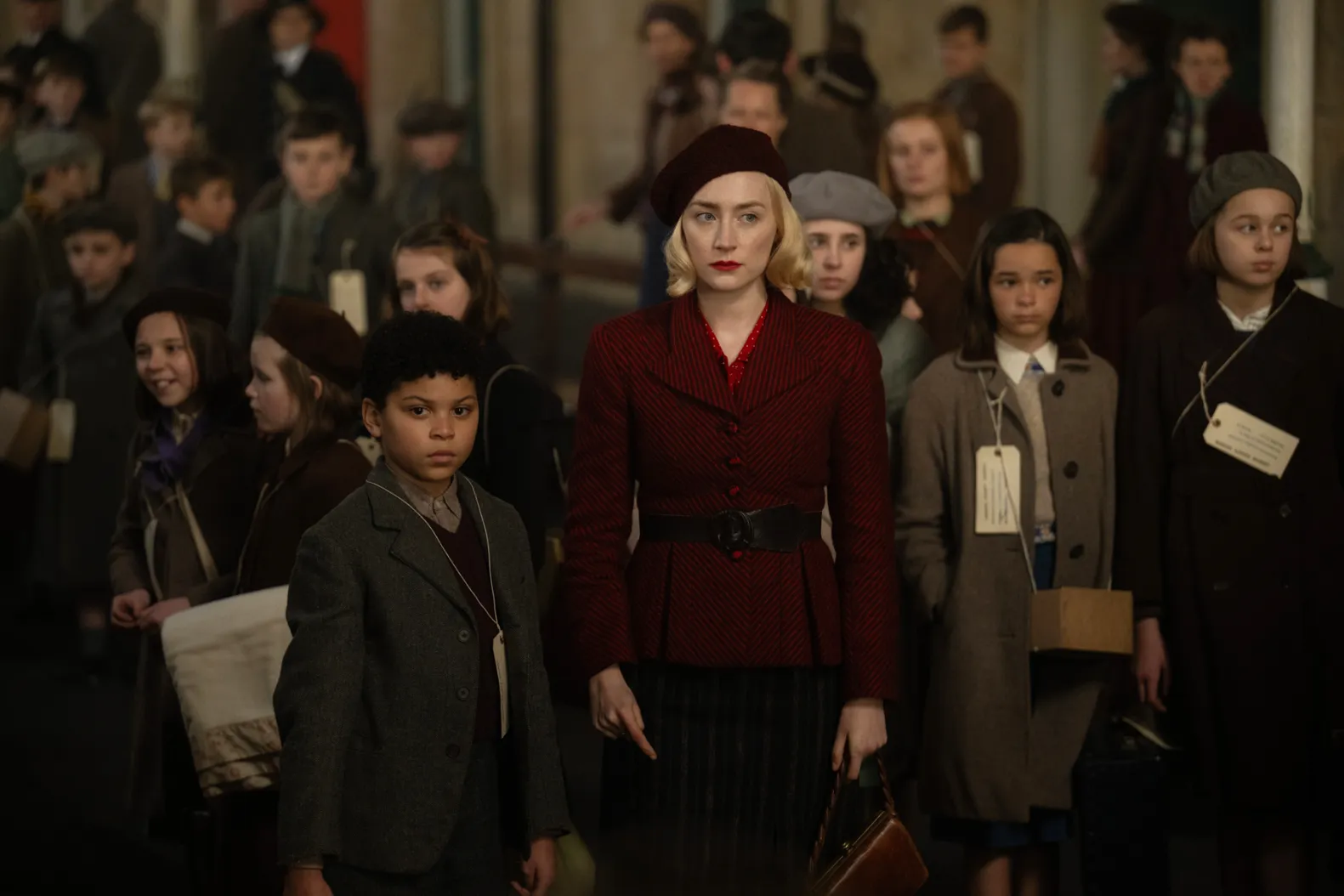
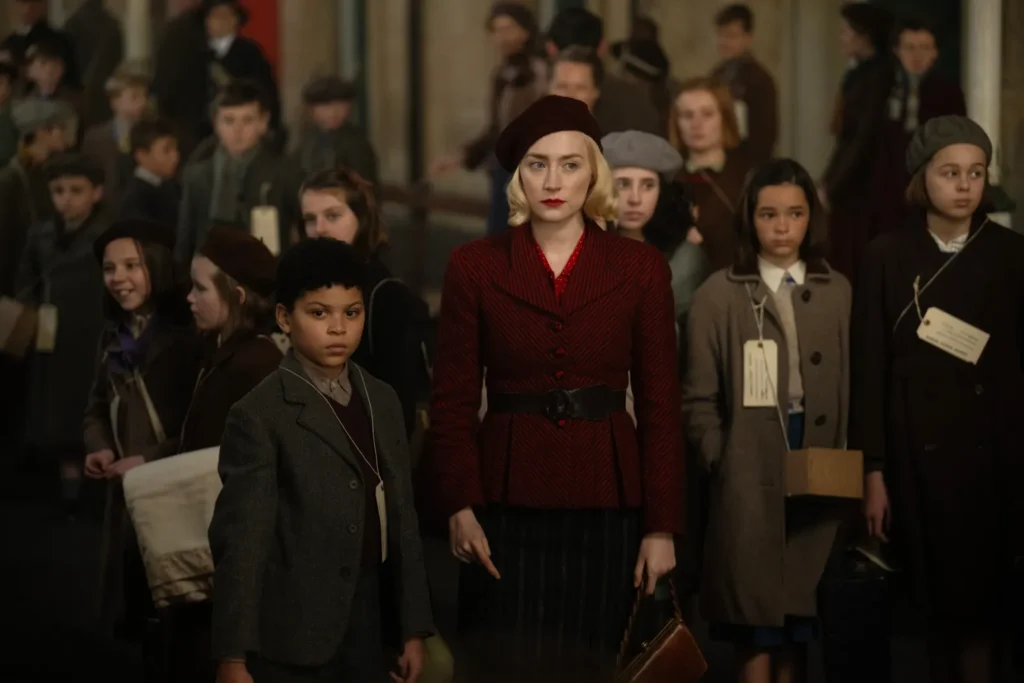
Fire and rubble are everywhere, and the water pressure in the firehose is so powerful that it jumps out of the hands of the people trying to help. The overwhelming attacks are met with determination and resilience. But within it is the recognition that they are terrified. When the security guards try to keep people fleeing the bombs out of the underground Tube stations, people push through. A live radio broadcast intended to boost morale features musical performances by weapons manufacturing workers, the British version of Rosie the Riveter. It is interrupted with protests about inadequate safety. Recognizing that nowhere is safe, London parents prepare to send their children away. One of those children is George (Elliot Heffernan), the nine-year-old bi-racial son of Rita (Saoirse Ronan), who works in the munitions factory.

They live with Rita’s father, Gerald (Paul Weller) and they are a close and devoted family. Gerald is a piano player in a bar in the evening. Rita has a lovely singing voice and is featured in that radio broadcast. Music plays a key role throughout the film, from two different nightclub scenes featuring Black performers to people camping out in bomb shelters singing songs to keep their spirits up.

Rita brings George to the train, loaded with children, each tagged like a piece of luggage. There is very little supervision and no kindness or sympathy. George, frightened and angry, barks “I hate you!” at Rita, who is already devastated at sending him away. As the train chugs into the countryside, some boys on the train try to bully George. He feels so much regret about the way he left his mother that he decides to go back home. He jumps from the train with no idea of where he is or how far he is from London. His journey is a Dickensian odyssey. Heffernan is the heart of the film, and he gives a thoughtful, soulful performance.

Nine is an age right at the cusp between the magical thinking of a child and the beginning of a deepening understanding of the world of adults. McQueen, so good at conveying the chaos of the Blitz, is even better at conveying that liminal moment. Through the havoc, George seems to travel in a protective aura of innocence. He is smart and brave, but we see through his eyes and understand the dire risks George is facing far better than he does.

George meets a lot of people along the way, including three young brothers who refused to be placed in different homes, Ife, a kind-hearted African-born security officer (Benjamin Clémentine), and a cruel group of scavengers who steal from dead bodies and destroyed buildings. They capture George because he is small enough and expendable enough to send into places they cannot reach. The lost boy themes echo Great Expectations and David Copperfield, giving George’s story a connection to heroic myth. Along the way, we get flashbacks showing us the racism experienced by George and his now-absent father. The bombs keep falling.

There is a optimism in the film that seems inaccurate for the era, including a Capra-esque speech chastising those in a shelter who do not want to interact with people of color and a very idealized character in Ife. Even within the context of George’s naive perspective and the “carry on” imperatives of the era, it is out of place, the present speaking through the past. Maybe we still need it to hear it.

Parents should know that this movie is a wartime story with intensive bombing attacks, characters are injured and killed and there are graphic and disturbing images. It also includes cruel and criminal behavior and racism. A child is in danger through much of the story. People having sex are overheard by others, including a child.

Family discussion: How did Ife change George’s mind about himself? What did the scene in the subway with characters from earlier in the film mean? What does music mean to the characters?

If you like this, try: “Hope and Glory” and “Au Revoir, Les Enfants,” other WWII stories from a child’s perspective

Related Tags:


Drama Epic/Historical Family Issues movie review Movies -- format Movies -- Reviews Stories About Kids War
THE MOVIE MOM® is a registered trademark of Nell Minow. Use of the mark without express consent from Nell Minow constitutes trademark infringement and unfair competition in violation of federal and state laws. All material © Nell Minow 1995-2026, all rights reserved, and no use or republication is permitted without explicit permission. This site hosts Nell Minow’s Movie Mom® archive, with material that originally appeared on Yahoo! Movies, Beliefnet, and other sources. Much of her new material can be found at Rogerebert.com, Huffington Post, and WheretoWatch. Her books include The Movie Mom’s Guide to Family Movies and 101 Must-See Movie Moments, and she can be heard each week on radio stations across the country.

Website Designed by Max LaZebnik