The Odyssey

The Odyssey

Posted on July 15, 2026 at 12:00 pm

B +
Lowest Recommended Age: High School
Profanity: Some strong language
Alcohol/ Drugs: Memory-erasing flowers, wine
Violence/ Scariness: Extenseive war-time peril and violence, monsters, many characters injured and killed, graphic and disturbing images
Diversity Issues: None
Date Released to Theaters: July 17, 2026
Copyright 2026 Universal

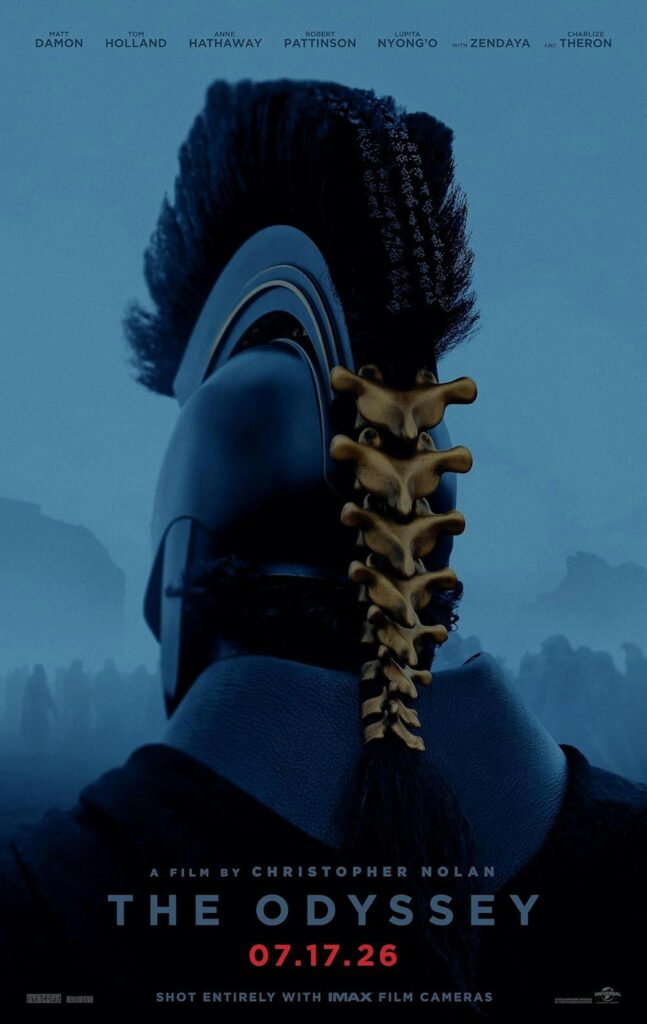
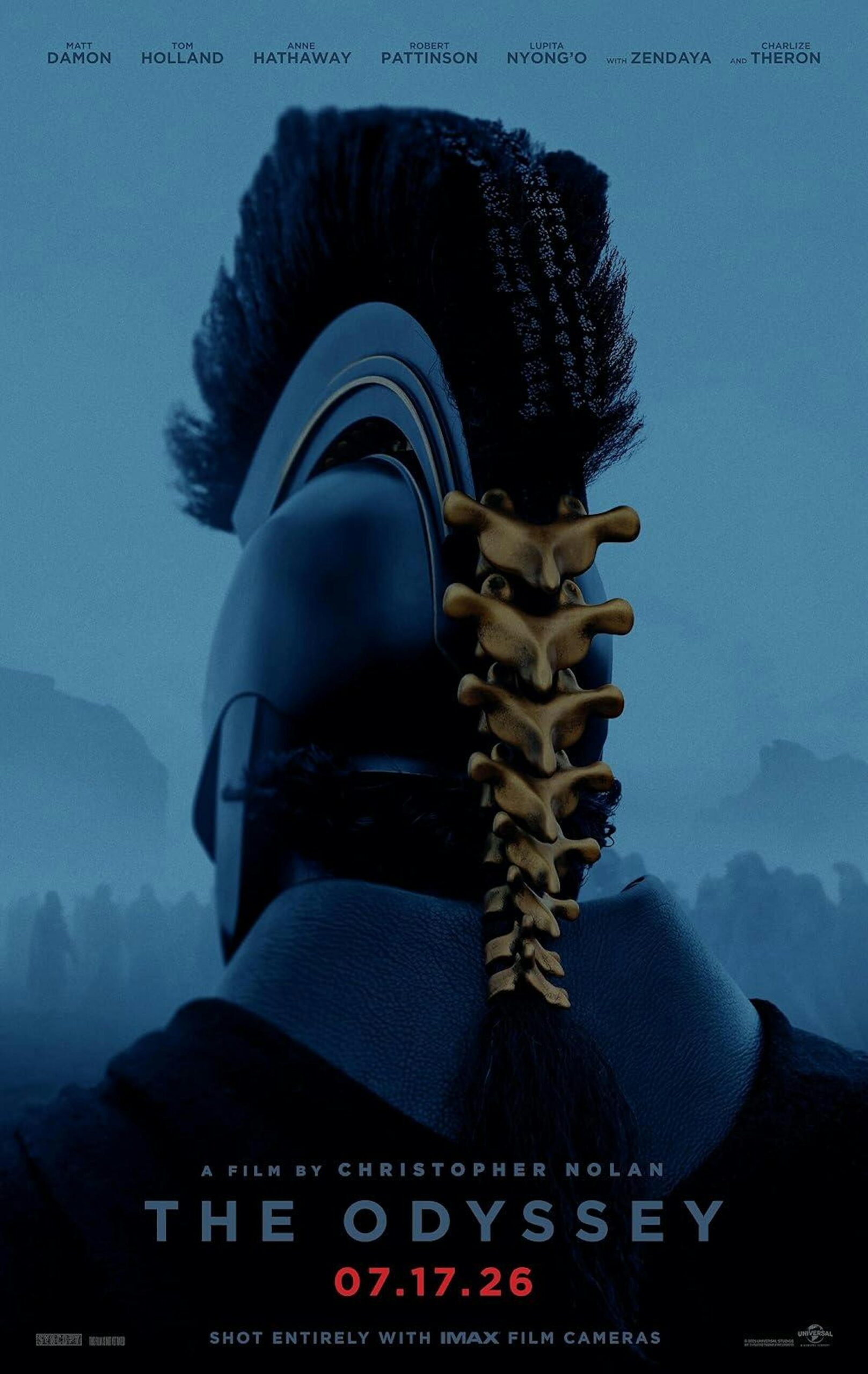
One of the foundational stories of the Western canon has a grand, sweeping, meticulously diligent new version in writer/director Christopher Nolan’s epic film, bristling with Oscar-winning talent and impressive seriousness of purpose. It is, with a few significant exceptions, true to Homer’s story dating back to 700-800 BC. But there are also vestigial reflections of Nolan’s previous film, “Oppenheimer,” both stories of men who must grapple with the consquences of their destructive, even ruthless, acts during wartime.

Matt Damon plays one of history’s most complex heroes, Odysseus, whose name and story still define journeys of adventure thousands of years later. The Odyssey follows Odysseus on his long voyage home after the victory of the Greeks, led by Agamemnon, with Achilles, Ajax, and Odysseus, in the Trojan War. Paris, a Trojan prince, had been asked to decide which of three goddesses was the most beautiful. Aphrodite, the goddess of love, bribed him by saying that if he picked her, she would give him the most beautiful human woman in the world. That woman was Helen (Lupita Nyong’o). She was the wife of the Greek king, Menelaus of Sparta (Jon Bernthal). But she is known throughout history as Helen of Troy, because she was kidnapped (or ran away with) Paris, leading to the war that made her known as “the face that launched a thousand ships.”

That war lasted ten years. It was Odysseus, known for his trickery, who came up with the idea of getting the soliders inside the Trojan’s impenetrable city by hiding in a gigantic statue of a horse, with a soldier named Sinon (Elliot Page) left behind to lie that the Greeks had retreated, leaving the horse as a tribute to the goddess Athena (Zendaya). When the Trojans drag it into the city, the Greek soldiers come out to win a decisive battle and end the war. This story is told in Virgil’s Anead, and in Nolan’s film we see parts of it more than once in flashbacks, part of elliptical, non-linear story-telling that may be confusing to those not familiar with Homer’s tale. (To refresh your memory or just get a quick recap, try this.)

But really, all you need to know is that Odysseus is on his way home, leading his men in (to start with) three boats, hoping to make it back before Agamemnon reaches his home just to be competitive. (Agamemnon will get home first but then be murdered by his wife, Helen’s sister (also Nyong’o).

It will take Odysseus a decade, with many stops along the way as the crew tries to replenish their provisions. The most well-known of their adventures are all brought to screen in unprecedented splendor by Nolan, and his “Oppenheimer” team, editor Jennifer Lame, production designer Ruth De Jong, and Oscar-winning cinematographer Hoyte van Hoytema, filming in Greece, Italy, Iceland, Morocco, and Scotland. This is the first-ever feature movie filmed entirely with IMAX cameras (in tribute, you can even get an IMAX camera popcorn bucket) and shown in 70 mm. The visuals are never less than spectacular. Odysseus and his men are traveling by boat and the sky and “the wine-dark sea” Homer described is filmed with a power and grandeur of a true epic. We get a visceral feeling of just how alone these men are, not just before GPS but before maps and navigation, entrusting to the gods to guide them home but knowing that the gods may be even more devious tricksters than Odysseus himself.

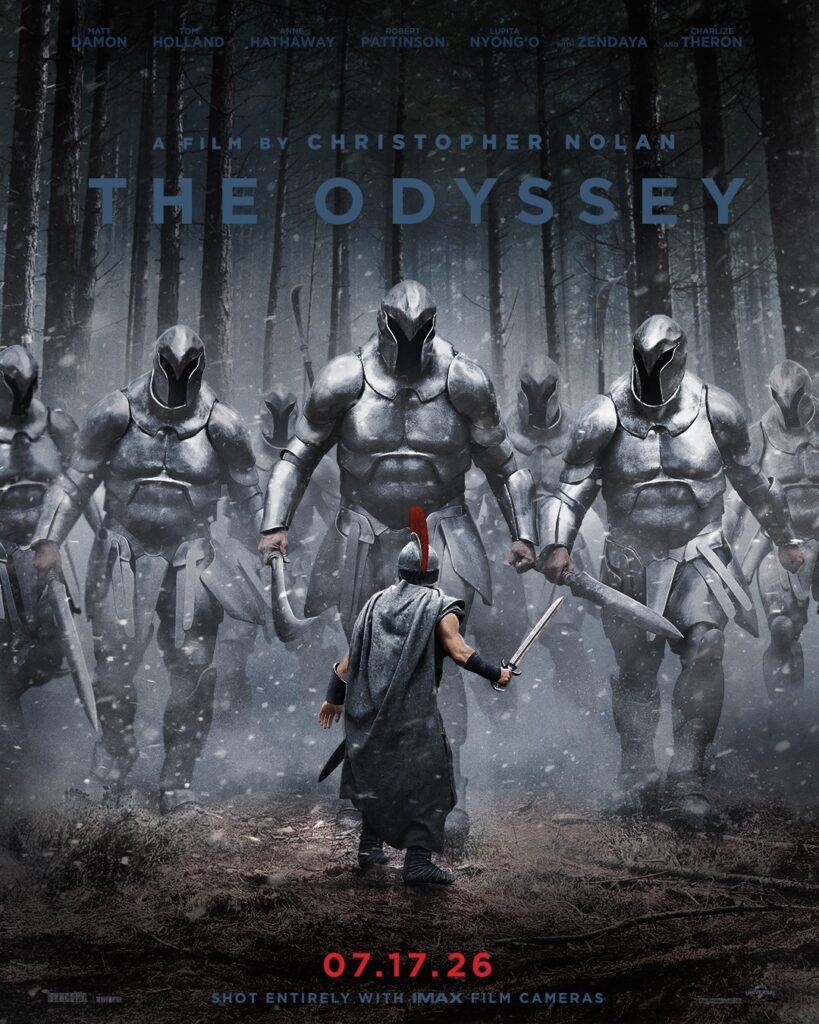
Odysseus tries to follow the “laws of Zeus,” particularly with regard to hospitable treatment of strangers, and killing even animals with honor, plucking his bow string to give them a chance to escape. When lives are at stake, though, he will do what is expedient. On their first stop, he leads his men onto an island where a cave is set up as a home, with a cozy fire. According to his beliefs about what the laws of Zeus require and assuming that the inhabitant of the cave will believe the same, he orders his men to stoke the fire to welcome their host. But the inhabitant is not a man. He is a gigantic cyclops, and in a genuinely terrifying moment, as soon as he enters the cave, he grabs one of the men and bites his head off. It is hard to understand why Nolan chose to omit one of the key elements of the story, Odysseus refusing to give the cyclops his name, instead saying he was called “Noman.” This is a very significant part of the story that is parallel to his not using his own name when he returns home, both relating to his sense of himself and his identity.

After a few more deaths, Odysseus is able to lead his men to an escape. But he violates his obligation to give the murdered men a decent burial. The conflict between his obligations under the law of Zeus and the choices to save as many lives as possible are a theme.
Copyright 2026 Universal

This conflict is presented in the immediate consequences of killing the cyclops. Odysseus learns that the monster was the son of the god Poseiden, who will now express his grief and anger by keeping them from reaching home. As in Homer’s original story, it explores the theme of human agency and the interference of the gods. We often see Odysseus near the goddess Athena.

Other adventures include two enchantresses. Calypso ( Charlize Theron) feeds Odysseus lotus flowers that make him forget the PTSD of his agonizing choices but also the fact that he has a family. Circe (Samatha Morton) turns his famished men into pigs (an extraordinary scene of transformation and body horror), and we see how clever Odysseus is in figuring out what she has done and forcing her to reverse the spell and help him get home. He travels to Hades where he meets the ghost of Sinon. He straps himself to the mast of his ship while his men have their ears blocked with wax to pass through the jagged rocks where the sirens sing men to their deaths.

Meanwhile, his wife, Penelope (Anne Hathaway) and son Telemachus (Tom Holland) are back in Ithaca, with dozens of suitors eating their food, drinking their wine, and trying to get Penelope to marry one of them so he can take over the kingdom. The most odious of the suitors is Antinous (Robert Pattinson), a maniuplative schemer who got Sinon to take his place in the war. Telemachus leaves Ithaca to see if he can find any news of his father from Menelaus.

It will take all of Odysseus’ craftiness and strength to defeat the suitors and reunite with his wife and son. Damon’s performance shows us all of the complexity that makes Odysseus an eternally enthralling hero. Pattinson continues to impress as he subverts his considerable looks and charisma to create a despicable, cowardly character. John Leguizamo is superb as the loyal Eumaeus. Even the three-hour run time cannot find enough time for Theron, Zendaya, and Morton, but each of those encounters could be an entire movie.

Nolan’s screenplay veers into colloquialisms that take us out of the movie now and then. But he has an unsurpassed gift for the language of cinema. The scenes of exploration, combat, and in Penelope’s castle in Ithaca are striking and narratively clear. Penelope fends off the suitors by telling them she cannot move forward until she finishes weaving a burial shroud for her late father-in-law. She weaves during the day and then unravels it at night. She appears modestly behind a screen as the suitors crowd the dining hall.

Nolan’s style is chilly and cerebral, with the female characters thinly sketched and too often just creating problems for or taking power away from men. That may be one reason that draws him to a story where a military hero has encounters with literal enchantresses who impede his progress. His exploration here of the conflicts even successful warriors feel about what they have done and what they have seen is moving. He made very significant changes to Homer’s concluding scenes (admittedly, contested by some scholars as added by others later). But the ending he chose has the same problems as the disputed version and it undermines the weight of what he has presented so compellingly throughout the story.

Parents should know that this film is extremely violence with many characters injured and killed, many with throats slit, monsters, ghosts, and graphic and disturbing images. Odysseus is drugged and characters drink wine. There is some strong language.

Family discussion: Why is this one of the most enduring stories in history? What does Odysseus regret the most? What decisions did he make that you think were wrong?

If you like this, try: the book (Fagles or Wilson translation) and a modern re-imagining from the Coen brothers, “O Brother Where Art Thou.”
Related Tags:


Based on a book Epic/Historical IMAX movie review Movies -- format Movies -- Reviews Remake Road Trip War
Lucky Strike

Lucky Strike

Posted on June 25, 2026 at 5:23 pm

B +
Lowest Recommended Age: High School
MPAA Rating: Rated R for violence, some grisly images, and language
Profanity: Some strong language
Alcohol/ Drugs: Alcohol
Violence/ Scariness: Intense and graphic war violence, many characters injured and killed, disturbing images
Diversity Issues: Depicts the era's segregated military
Date Released to Theaters: June 26, 2026
Copyright 2026 Roadside Attractions

In snowy December of 1944, Hitler launched his last big attack in the Ardennes Forest that runs through Belgium, France, and Luxembourg, in what became known as the Battle of the Bulge. It was a major turning point in the war in Europe that would end with Hitlere’s death and Germany’s surrender six months later. “Lucky Strike,” inspired by a true story, is about an injured US soldier who was caught behind enemy lines early in the battle and had to find his way back to his unit with the help of then-brand-new technology that allowed him to communicate his position.

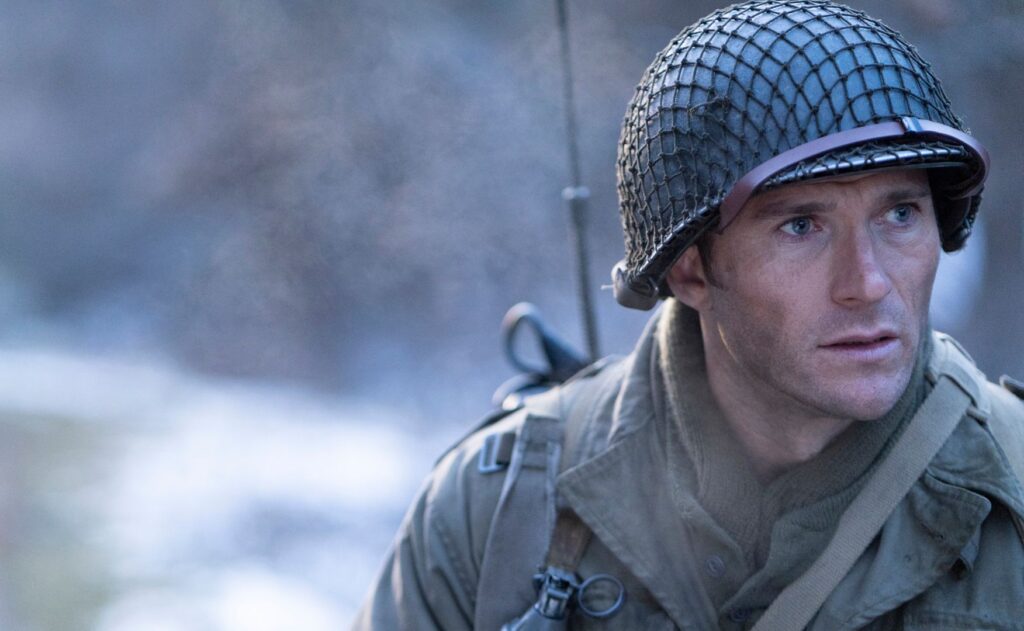
Scott Eastwood plays Colonel John Castle, a man who chose to enlist even though he was exempt from the draft because he was an engineer who could contribute to the war effort on the home front. He is part of a dedicated but exhausted unit in Charlie Company, 324th Infantry Regiment,  part of the U.S. 44th Infantry Division.

Castle is assigned to oversee a small group directed to cut off the road the Germans are approaching, setting and firing off explosives to block them. They are warned that this Nazi division is ruthless, killing everying instead of taking prisoners. They are ambushed by the Nazi forces and everyone but Castle is killed.

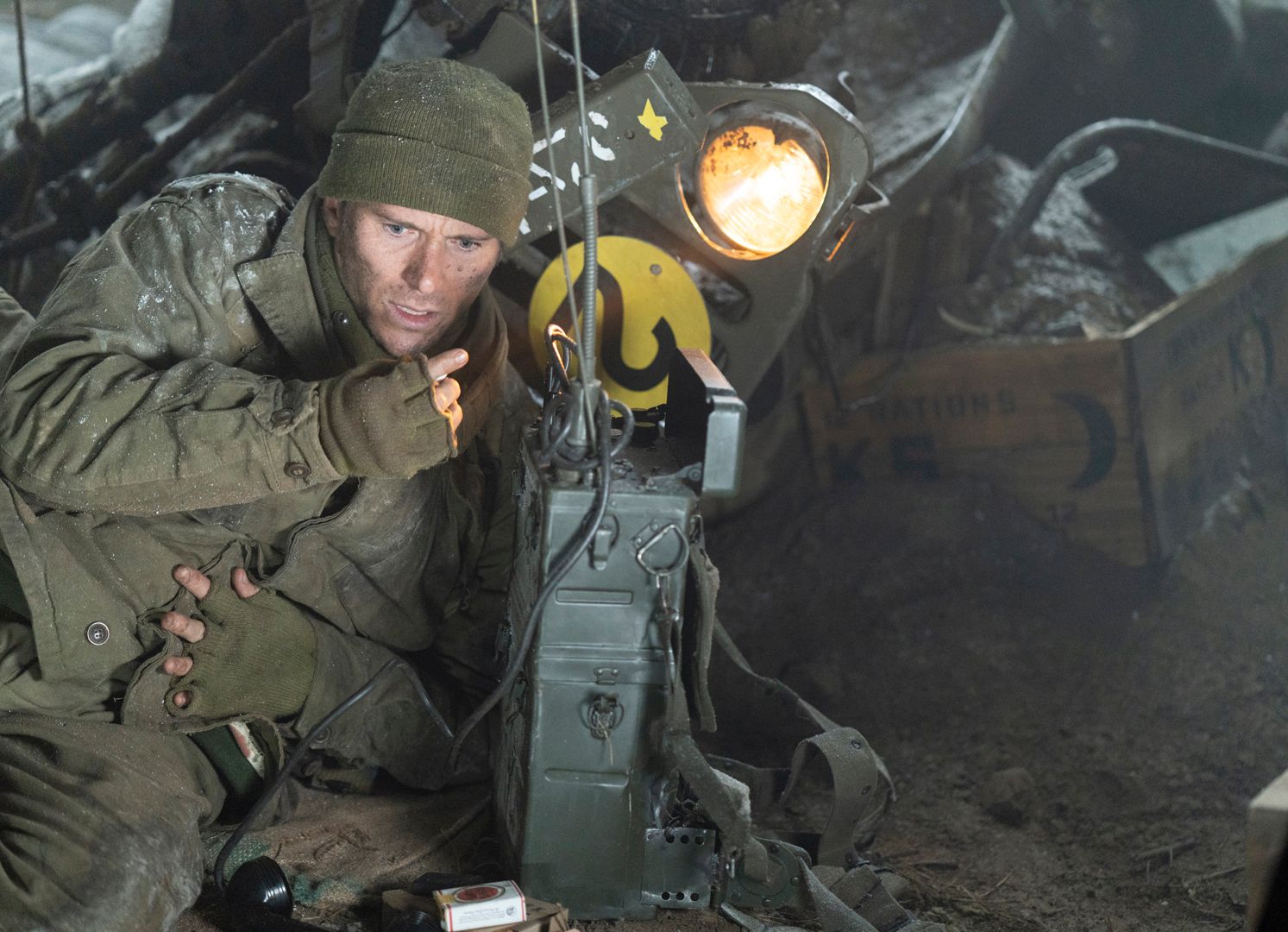
With the new communications device, the size of a backpack and nicknamed “Lassie,” Castle learns that he is 30.5 km (about 19 miles) from a rendezvous spot and the overwhelmed soldiers do not have the resources to rescue him. Much of the film is about his near-escapes along the way and the way that Lassie keeps him connected. And we also see how he repaid the person who made sure that Lassie would survive the direst conditions, played by the always-magnificent Aunjanue Ellis-Taylor in a performance of endless dignity and grace.

The screenplay is co-written by “The Outpost’s” Rod Lurie, a West Point graduate with a deep understanding of the military and a superb eye for pacing and detail. Everything in the film is from Castle’s point of view. If people speak French or German, he does not understand them and so we do not get subtitles. There are some breathtaking “oners,” scenes that are all in one long take, which make Castle’s experiences extremely tense and intense. He has an eye for telling details. Castle removes the dog tags from his dead crew, and we glimpse the Star of David on one and the cross on another, connecting us to the soldiers who have just made the ultimate sacrifice and to the diversity of the country they were fighting for.

The cinematography by Lorenzo Senatore is stunning, with three different color palettes for different settings. It opens in black-and-white, emphasizing the fog and snow, with another scene of an American group being wiped out by Nazis. The scenes set in the US are warm and vibrant. In contrast, Castle’s mission and his long way back are more muted.

Lurie’s co-screenwriter is Marc Frydman, who went to school in France, where American veterans were honored by being invited to tell their stories. He was so struck by the one who sought out the person responsible for Lassie that he wanted to tell the story. The different dangers Castle faces along the way are well-crafted — a fight in the very close quarters of the front seat of a truck is especially exciting — and the scenes at the end (with a child who shares his name with Lurie’s late son), are meaningful.

Parents should know that this is a war story with many characters injured and killed, including civilians. There are guns and explosions. Character drink, smoke (see the movie’s title) and use some strong and crude language.

Family discussion: Why did Castle refuse the exemption and enlist? How did he decide who to trust? What technology is important to you and how could you thank the people responsible for it? What technology do you wish would be invented or would you like to invent?

If you like this, try: “To Hell and Back,” “Pressure,” “The Longest Day,” and “Dunkirk’

Related Tags:


Action/Adventure Inspired by a true story movie review Movies -- format Movies -- Reviews War
Movies for Memorial Day 2026

Movies for Memorial Day 2026

Posted on May 24, 2026 at 10:28 am

Memorial Day is more than the beginning of summer; it is a day to remember those who made the ultimate sacrifice. I hope you can take some time to think of those we have lost. Turner Classic Movies has an excellent line-up of classic films. Some more movies to pay your respects:

The Outpost was on my top ten list for 2020, a movie that was sadly overlooked because it came out in the early weeks of the pandemic shutdown. It is based on the book by Jake Tapper. There are war stories that are about strategy and courage and triumph over evil that let us channel the heroism of the characters on screen. And then there are war stories that are all of that but also engage in the most visceral terms with questions of purpose and meaning that touch us all. “The Outpost” is that rare film in the second category, an intimate, immersive drama from director Rod Lurie, a West Point graduate and Army veteran who knows this world inside out and brings us from the outside in. His next film, coming out this summer, is “Lucky Strike,” based on the true story of a WWII soldier trapped behind enemy lines, starring Scott Eastwood.

The Blue Angels Glen Powell, who played a pilot in “Top Gun: Maverick” and “Devotion” is also a real-life pilot who has flown with “the best of the best,” the Navy’s Blue Angels. He produced this documentary that takes us behind the scenes and into the sky, even “inverted” (upside down!) with the Blues.

Air Force Elite: Thunderbirds This 2025 Netflix documentary takes us through the history and training of the legendary flight squadron, produced by Barack and Michelle Obama.

Gardens of Stone James Caan and James Earl Jones star in a film about the 1st Battalion 3d Infantry Regiment (The Old Guard) at Fort Myer, Virginia, the U.S. Army’s Honor Guard. They conduct the funerals of fallen soldiers and guard the Tomb of the Unknown Soldier at Arlington National Cemetery. Francis Ford Coppola directed this touching, elegiac story.

Hallowed Grounds This PBS documentary explores 22 overseas military cemeteries, with stories of the soldiers who are buried there and the people who keep their memories alive.

Taking Chance An officer (Kevin Bacon) escorts the body of a young Marine killed in Iraq. Each stop along the way is meaningful.

Mr. Roberts is a WWII story about a Navy cargo ship, based on the experiences of author Thomas Heggen. Henry Fonda stars in the title role or an executive officer who tries to protect the men from a tyrannical captain. Broadway, and the outstanding cast includes William Powell, James Cagney, and Oscar-winner Jack Lemmon.

Band of Brothers is the extraordinary series from Steven Spielberg and Tom Hanks about ordinary men who came together to do extraordinary things as soldiers in Easy Company in WWII.

Red Tails is the story of the Tuskegee Airmen, the legendary heroes who risked their lives for a country that did its best to hold them back.

Related Tags:


Based on a true story Holidays Movie Mom’s Top Picks for Families Movies for Grown-Ups Trailers, Previews, and Clips War
Nuremberg

Nuremberg

Posted on November 6, 2025 at 5:51 pm

A-
Lowest Recommended Age: High School
MPAA Rating: Rated PG-13 for violent content related to the Holocaust, disturbing images, strong language, and themes including suicide, smoking, and brief drug use
Profanity: Some strong language
Alcohol/ Drugs: Alcohol, drugs, and smoking
Violence/ Scariness: Wartime and Holocaust references, archival scenes from concentration camps
Diversity Issues: A theme of the movie
Date Released to Theaters: November 7, 2025

Those who have studied 20th century history know that after WWII the Allies did something no governments had ever done after a surrender. They held a formal trial, not about Germany’s acts of war but about the “crimes against humanity” that tortured, imprisioned, stole from, and murdered its own people, and tried to eradicate citizens based on their religion, disability, and sexual orientation. They were known as the Nuremberg trials.

Copyright Sony Pictures Classics 2025

But even those who have studied that process may not know that the American military also assigned its own psychiatrists to interview the first 22 German officers and political leaders. It was not, as in an ordinary criminal trial, to determine their ability to understand the proceedings and in some cases their culpability for their decisions, but to try to understand what kinds of minds would create what we now call the Holocaust. Those questions have continued to confound us for 80 years, and continue to be explored by historians and filmmakers, including recent documentaries like “The Last Days,” “Shoah,” and “The Grey Zone” and narrative films like “The Zone of Interest” and “A Real Pain.”

“Nuremberg,” based in part on the book The Nazi and the Psychiatrist by Jack El-Hai, follows three intersecting stories, the efforts of Supreme Court Justice Robert Jackson (Michael Shannon) to get the Allied countries together to agree on the trial, the charges, and its proceedings, the interviews military psychiatrist Douglas Kelley (Rami Malek) conducted with top Nazi official Hermann Göring (Russell Crowe), and Howie Triest (Leo Woodall) a young military officer assigned to Kelley as a translator.

Jackson’s plan seems impossible, “a logistical nightmare.” “What you’re talking about is trying them in some sort of legal limbo that doesn’t exist using laws that haven’t been written yet,” he is told, and reminded that Germany never attacked the US. He would have to get the involvement of all of the Allies to participate, including the USSR. He insists, “The world needs to know what these men did.”

There is an optimism behind it, an idea that if the top Nazis were both convicted and diagnosed, it would help make sure that nothing like the Holocaust would ever happen again.

The essence of the film is in the interviews/conversations between Kelley and Göring, and the two Oscar-winners and writer/director James Vanderbilt’s script make them among the most riveting screen moments of the year.

Vanderbilt is superb in revealing the complexity of the moral and legal issues. Kelley is trained to give therapy, with patient confidentiality. Jackson wants him to use his sessions to find Göring’s vulnerabilities, to help with the prosecution. General Eisenhower insists that there be no executions without a trial, giving the men the opportunity to defend themselves. The risk of failing to find them guilty is the risk of making them martyrs, allowing atrocities to happen again. Jackson and the military are also very aware that the humiliation Germany suffered at the end of WWI played a big part in Hitler’s rise. Göring tells Kelley why he followed Hitler: “Along came a man who said we could reclaim our former glory. Would you not follow such a man?”

Jackson reminds us that the war “started with laws,” and should end with them. They have to create a sense of fairness and justice without repeating the mistakes of the post WWI Paris Peace Conference that divided up German’s territories.

The movie is well paced, as a thriller, a courtroom drama, and an exploration of history and the human capacity for evil and for good. It is never didactic or heavy-handed. There are moments of humor and excellent performances by all.

Vanderbilt has a gift for telling details like Göring ripping the lace-edged hem of his wife’s slip to make a white flag of surrender as his car reaches the Americans, and then casually telling them to get his luggage, as though the American soldiers are baggage handlers.

When the military thinks Kelley is too sympathetic, they bring in another psychiatrist (Colin Hanks), who is clear that he is there to write a book about it. Kelley is disturbed by this unabashed acknowledgement of self-interest. The film lets us know that Kelley did himself write a book, though, 22 Cells in Nuremberg: A Psychiatrist Examines the Nazi Criminals. It is hard to find but well worth reading, especially its conclusion, calling for the same commitments we are still trying to achieve today. It is impossible to watch this film without being chilled by what happened in Germany. It is impossible not to think about the lessons we have failed to learn.

Parents should know that this film includes references to wartime violence and the Holocaust, with real archival footage of concentration camps. There is some strong language and characters drink, smoke, and use drugs.

Family discussion: Compare the Nuremberg trials to a later version, South Africa’s Truth and Reconciliation Commission. Which is better? When the current global conflicts are resolved, how should we treat those involved?

If you like this, try: “Judgment at Nuremberg.” a 1961 film about the later trials, with waning interest in pursuing the Nazi judges, exploring the issues of responsibility for those in lower-level roles. and the American Experience documentary, “The Nuremberg Trials

Related Tags:


Based on a book Based on a true story Drama Epic/Historical movie review Movies -- format Movies -- Reviews War
Movies For Memorial Day 2025

Movies For Memorial Day 2025

Posted on May 25, 2025 at 12:15 pm

Memorial Day is more than the beginning of summer; it is a day to remember those who made the ultimate sacrifice. I hope you can take some time over the weekend to think of those we have lost. Some movies to pay your respects:

The Outpost was on my top ten list for 2020, a movie that was sadly overlooked because it came out in the early weeks of the pandemic shutdown. It is based on the book by Jake Tapper. There are war stories that are about strategy and courage and triumph over evil that let us channel the heroism of the characters on screen. And then there are war stories that are all of that but also engage in the most visceral terms with questions of purpose and meaning that touch us all. “The Outpost” is that rare film in the second category, an intimate, immersive drama from director Rod Lurie, a West Point graduate and Army veteran who knows this world inside out and brings us from the outside in.

The Blue Angels Glen Powell, who played a pilot in “Top Gun: Maverick” and “Devotion” is also a real-life pilot who has flown with “the best of the best,” the Navy’s Blue Angels. He produced this documentary that takes us behind the scenes and into the sky, even “inverted” (upside down!) with the Blues.

Air Force Elite: Thunderbirds This 2025 Netflix documentary takes us through the history and training of the legendary flight squadron, produced by Barack and Michelle Obama.

Gardens of Stone James Caan and James Earl Jones star in a film about the 1st Battalion 3d Infantry Regiment (The Old Guard) at Fort Myer, Virginia, the U.S. Army’s Honor Guard. They conduct the funerals of fallen soldiers and guard the Tomb of the Unknown Soldier at Arlington National Cemetery. Francis Ford Coppola directed this touching, elegiac story.

Hallowed Grounds This PBS documentary explores 22 overseas military cemeteries, with stories of the soldiers who are buried there and the people who keep their memories alive.

Taking Chance An officer (Kevin Bacon) escorts the body of a young Marine killed in Iraq. Each stop along the way is meaningful.

Mr. Roberts is a WWII story about a Navy cargo ship, based on the experiences of author Thomas Heggen. Henry Fonda stars in the title role or an executive officer who tries to protect the men from a tyrannical captain. Broadway, and the outstanding cast includes William Powell, James Cagney, and Oscar-winner Jack Lemmon.

Band of Brothers is the extraordinary series from Steven Spielberg and Tom Hanks about ordinary men who came together to do extraordinary things as soldiers in Easy Company in WWII.

Red Tails is the story of the Tuskegee Airmen, the legendary heroes who risked their lives for a country that did its best to hold them back.

Related Tags:


For Your Netflix Queue War
THE MOVIE MOM® is a registered trademark of Nell Minow. Use of the mark without express consent from Nell Minow constitutes trademark infringement and unfair competition in violation of federal and state laws. All material © Nell Minow 1995-2026, all rights reserved, and no use or republication is permitted without explicit permission. This site hosts Nell Minow’s Movie Mom® archive, with material that originally appeared on Yahoo! Movies, Beliefnet, and other sources. Much of her new material can be found at Rogerebert.com, Huffington Post, and WheretoWatch. Her books include The Movie Mom’s Guide to Family Movies and 101 Must-See Movie Moments, and she can be heard each week on radio stations across the country.

Website Designed by Max LaZebnik