Michael

Michael

Posted on April 22, 2026 at 12:04 pm

B-
Lowest Recommended Age: High School
MPAA Rating: Rated PG-13 for some thematic material, language, and smoking
Profanity: Some strong language
Alcohol/ Drugs: Smoking
Diversity Issues: Child abuse, parent whips a child with a belt
Date Released to Theaters: April 24, 2026
Copyright 2026 Lionsgate

To understand what kind of movie this is, you need to know that most, but not all, of Michael Jackson’s siblings and most, but not all, of his children were producers. His lawyer, John Branca, also produced and is played by Miles Teller.

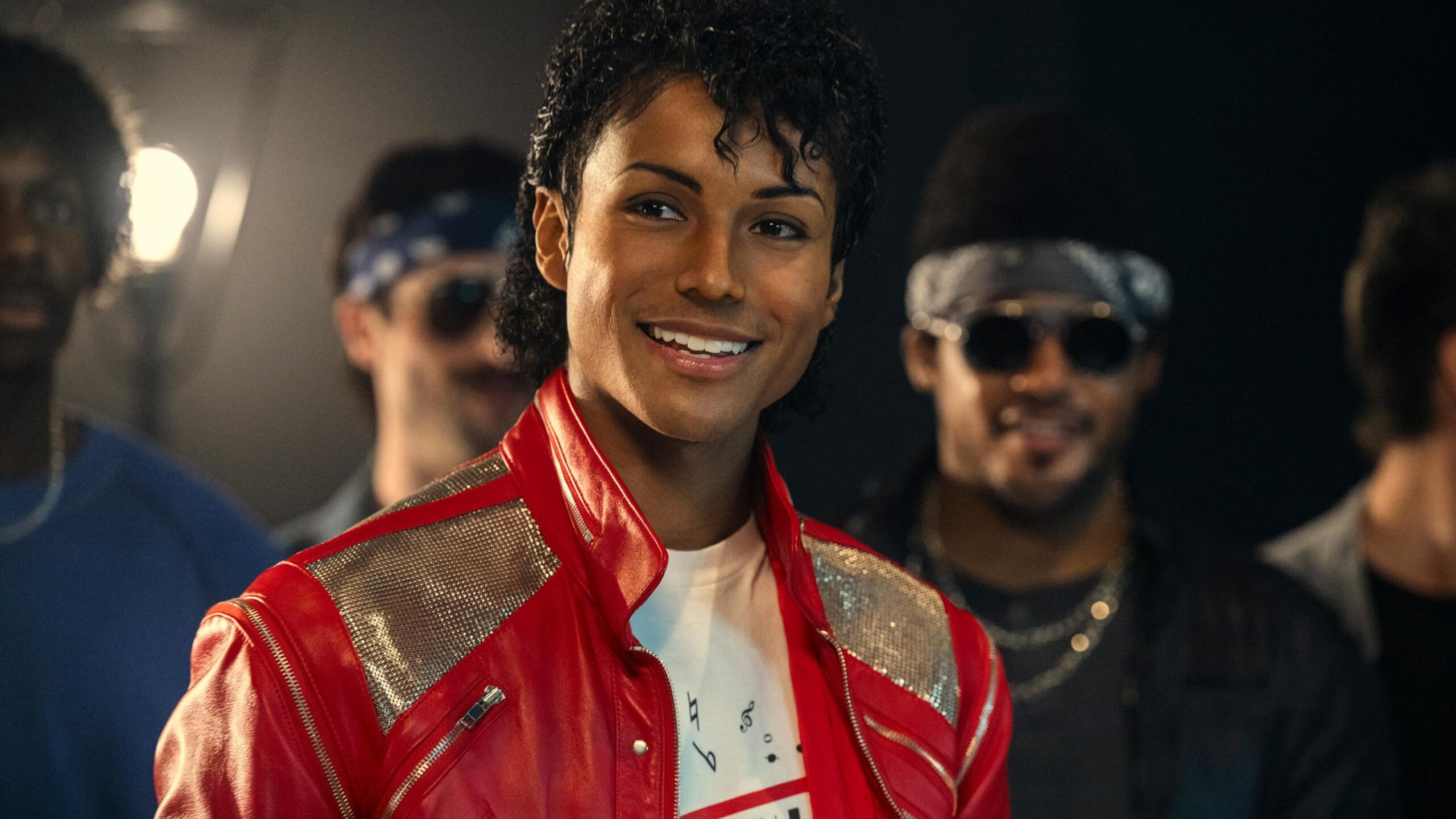
Janet Jackson, Michael’s sister and a musical superstar of almost equal prominence, who did not produce, is erased from the story. So his non-superstar sister Rebbie. So is any possible fault or flaw in the title character, and any effort to give the rest of the characters any depth or personality. What it does find time for is way too many scenes of ecstatic fans at concerts and Michael visiting sick children. The movie has its entertaining moments, mostly when Jaafar Jackson replicates some of his uncle’s most iconic performances, but the dramatic sections are weak and sanitized.

The late self-titled “King of Pop” is played by his real-life nephew, Jermaine Jackson’s son, Jaafar., who evokes the memory of his uncle with his look (before and after nose job) and moves. Colman Domingo is powerfully crafty and brutal as Joseph Jackson, the cruel factory worker who was determined to make his children his ticket out of Gary, Indiana, and did not hesitate to pull out his belt to whip them if he felt they were not paying him enough respect. Nia Long is warm and empathetic as Katherine Jackson, whose quiet support for Michael gives him something to hold onto and whose mild protests get less mild after Michael’s success.

A stand-out here is Juliano Valdi as young Michael Jackson, both in his ability to show us the then 10-year-old (but claiming to be 8) as an already-electrifying performer. (I well remember how dazzling my sisters and I were by the Jackson 5’s first national television appearance, introduced by Diana Ross.)

The Michael of this film is a 20th century Peter Pan and we are constantly reminded of how he identified with that character, writing his father’s name next to a depiction of Captain Hook. He is portrayed here as a gentle, almost angelic, innocent who considers his pets (including a giraffe, a llama, and Bubbles the chimp) as his only friends and who loves to be swept away by classic old films. His bodyguard, Bill (KeiLyn Durrel Jones) is sympathetic. But he seems to have no relationship with anyone in his family except his mother, and in the most simplistic and superficial terms the movie suggests that the only issue is learning how to stand up to his father. We learn little about what inspires his music and what performing means to him. There’s nothing here about “We Are the World” and the controversies over his marriage, his children, his mutilating surgeries, and the allegations of abuse.

The question you have to ask yourself about a musical biography is whether it has something to say beyond what we get from watching archival footage of the subject. The answer here is no. Weirdly, we see Michael tell director John Landis to shoot the dance in the “Thriller” music video the way Fred Astaire insisted his dance numbers should be shot: a steady camera showing the full bodies of the dancers, but the dance numbers here do not follow that good advice. They are dynamic but they cut away from what we want to see.

And the portrayals are paper-thin. We do not learn anything about Michael’s relationship to his siblings, what any human friendships he had were like, or what inspired his music. The movie is clear about Joseph’s exploitation of Michael, trying to control him to continue to do what is best for the family (meaning money and attention for Joseph), with no commitment or even recognition of what might be best for Michael. Joseph wants him to continue to perform with the family, making solo music only on his off hours. We are supposed to cheer for Michael when he gets a lawyer to stand up to Joseph and then stands up for himself. But it is hard to see this film as anything but continuing the family’s efforts to make money from Michael’s talent. At the end we wonder whether he would see this as just another attempt to profit from his legacy.

Parents should know that this film includes child abuse, smoking, body dysmorphia, and a scary accident when Jackson is badly burned. He also visits very sick children and patients.

Family discussion: Is this a fair representation of Michael Jackson? What more do you want to know? Why was he so beloved?

If you like this, try: “The Jacksons: An American Dream,” “This is It,” “The Jacksons: Road to Victory,” and clips of Michael Jackson singing and dancing

Related Tags:


Based on a true story Biography Family Issues movie review Movies -- format Movies -- Reviews Musical Race and Diversity
Song Sung Blue

Song Sung Blue

Posted on December 24, 2025 at 9:27 am

A-
Lowest Recommended Age: Middle School
MPAA Rating: Rated PG-13 for Rated PG-13 for thematic material, some strong language, some sexual material and brief drug use
Profanity: Strong language
Alcohol/ Drugs: Pharmaseutical abuse, character is a recovering alcoholic
Violence/ Scariness: Offscreen serious injury and recovery
Diversity Issues: None
Date Released to Theaters: December 24, 2025
Copyright Focus 2025

First there was Neil Diamond, one of the foremost singer-songwriters of the 1970s-90s. And then there was a Milwaukee couple billed as Lightning and Thunder who described their act not as a Neil Diamond tribute act, but a Neil Diamond experience. (“Experience” in this case meaning a fog machine and a leaf blower to blow back their hair.) Then there was a documentary named “Song Sung Blue” about Lightning and Thunder (real names, Mike and Claire Sardina, about the success of their act but also about their setbacks and challenges, about the music and about their love story. And now, like the infinite regression of the girl on the ketchup bottle we have two huge Hollywood stars, very slightly dimming their imperishable glamour to star in a feature film of the same name, and it is one of the most purely enjoyable films of the year, with heartfelt performances and joyous music.

Jackman plays Mike, a divorced Vietnam veteran in recovery from alcoholism who has a teenage daughter. He is passionate about performing (a character astutely observes that a recovering alcoholic will find something else to be addicted to and his is music), and he is very specific about what he wants to do. His stage name is Lightning.

He first sees Claire (Hudson), a divorced mother of a teenage daughter and a younger son, when she is performing in a curly black wig as Patsy Cline. Back at her house, they start singing together and it is instant magic. Their chemistry as performers and as a romantic couple shines from the screen. Soon they get married (at the Wisconsin State Fair) and blend their families. One particularly nice scene is when the two teenage girls get together and form their own instant connection over their family upheavals and some weed.

There are some setbacks along the way, including a mistake in booking that has them performing their first gig not, as they thought, for a motor home convention but for a motorcycle club gathering. But soon, with the help of friends, their crowd-pleasing appearances lead to an enthusiastic local following. Those friends include characters played by Jim Belushi, as the gentle, very sincere tour bus driver who signs on to book their gigs, Michael Imperioli as a devoted friend and Buddy Holly impersonator who is thirty years older than Holly ever got to be, and Fisher Stevens as a dentist so on board he gets Lightning a replacement tooth with a bolt of lightning on it. All three give endearingly open-hearted performances. Lightning and Thunder sing the Neil Diamond songs like they are brand new, with superb musicality. We can see that they are most alive when they are on stage.

“I just want to sing and be happy and feel loved!” Claire tells her daughter. “I will be Neil Diamond, but I’ll also be me,” Mike promises. “He’s…artistic,” says Mike’s daughter to Claire’s daughter, meaningfully. “Most alcoholics trade one addiction for another. Music is that for Dad.” Those comments, along with impeccable work by production designer Clay A. Griffith and costume designer Ernesto Martinez tell us what we need to know about Mike and Claire. But writer/director Craig Brewer is also telling us a deeper story about the healing power of performing music to lift the spirits, bring people together, create a sense of meaning and purpose, and just make us feel good.

Claire is badly injured in a freak accident. Mike has heart problems. But they love each other and the audiences love them. And then they get a call from Eddie Vedder, who wants them to open for Pearl Jam when they play at a huge music festival in Wisconsin. (A terrific performance by John Beckwith as a slightly laconic but enormously decent Vedder and be sure to check out the footage of that real-life performance.)

Thanks to Brewer, the movie never condescends to Mike, Claire, or their friends. It takes the same joy in their performances that their fans do. Jackson is excellent as Mike and Hudson is a revelation here, never better, with a perfect Wisconsin broad A, exquisite harmonies, and so much joy on stage we cannot help but bask in it. As Claire recovering from her injury, depressed and knocked out on painkillers, she is raw and heartbreakingly vulnerable. We know she cannot give up the music, and seeing her back on stage, reconnecting with the pure joy of the music and the audience, connects us with all of that and with the love story, too.

Parents should know that this film has strong language, a recovering alcoholic, a serious injury and painkillers, and a teen pregnancy.

Family discussion: What’s the best Neil Diamond song? Were you surprised that Eddie Vedder invited Mike and Claire to open for Pearl Jam? If you were in the audience, how would you have responded?

If you like this, try: The documentary of the same name and of course the music of Neil Diamond

Related Tags:


Based on a true story Biography Drama movie review Movies -- format Movies -- Reviews Musical
Nuremberg

Nuremberg

Posted on November 6, 2025 at 5:51 pm

A-
Lowest Recommended Age: High School
MPAA Rating: Rated PG-13 for violent content related to the Holocaust, disturbing images, strong language, and themes including suicide, smoking, and brief drug use
Profanity: Some strong language
Alcohol/ Drugs: Alcohol, drugs, and smoking
Violence/ Scariness: Wartime and Holocaust references, archival scenes from concentration camps
Diversity Issues: A theme of the movie
Date Released to Theaters: November 7, 2025

Those who have studied 20th century history know that after WWII the Allies did something no governments had ever done after a surrender. They held a formal trial, not about Germany’s acts of war but about the “crimes against humanity” that tortured, imprisioned, stole from, and murdered its own people, and tried to eradicate citizens based on their religion, disability, and sexual orientation. They were known as the Nuremberg trials.

Copyright Sony Pictures Classics 2025

But even those who have studied that process may not know that the American military also assigned its own psychiatrists to interview the first 22 German officers and political leaders. It was not, as in an ordinary criminal trial, to determine their ability to understand the proceedings and in some cases their culpability for their decisions, but to try to understand what kinds of minds would create what we now call the Holocaust. Those questions have continued to confound us for 80 years, and continue to be explored by historians and filmmakers, including recent documentaries like “The Last Days,” “Shoah,” and “The Grey Zone” and narrative films like “The Zone of Interest” and “A Real Pain.”

“Nuremberg,” based in part on the book The Nazi and the Psychiatrist by Jack El-Hai, follows three intersecting stories, the efforts of Supreme Court Justice Robert Jackson (Michael Shannon) to get the Allied countries together to agree on the trial, the charges, and its proceedings, the interviews military psychiatrist Douglas Kelley (Rami Malek) conducted with top Nazi official Hermann Göring (Russell Crowe), and Howie Triest (Leo Woodall) a young military officer assigned to Kelley as a translator.

Jackson’s plan seems impossible, “a logistical nightmare.” “What you’re talking about is trying them in some sort of legal limbo that doesn’t exist using laws that haven’t been written yet,” he is told, and reminded that Germany never attacked the US. He would have to get the involvement of all of the Allies to participate, including the USSR. He insists, “The world needs to know what these men did.”

There is an optimism behind it, an idea that if the top Nazis were both convicted and diagnosed, it would help make sure that nothing like the Holocaust would ever happen again.

The essence of the film is in the interviews/conversations between Kelley and Göring, and the two Oscar-winners and writer/director James Vanderbilt’s script make them among the most riveting screen moments of the year.

Vanderbilt is superb in revealing the complexity of the moral and legal issues. Kelley is trained to give therapy, with patient confidentiality. Jackson wants him to use his sessions to find Göring’s vulnerabilities, to help with the prosecution. General Eisenhower insists that there be no executions without a trial, giving the men the opportunity to defend themselves. The risk of failing to find them guilty is the risk of making them martyrs, allowing atrocities to happen again. Jackson and the military are also very aware that the humiliation Germany suffered at the end of WWI played a big part in Hitler’s rise. Göring tells Kelley why he followed Hitler: “Along came a man who said we could reclaim our former glory. Would you not follow such a man?”

Jackson reminds us that the war “started with laws,” and should end with them. They have to create a sense of fairness and justice without repeating the mistakes of the post WWI Paris Peace Conference that divided up German’s territories.

The movie is well paced, as a thriller, a courtroom drama, and an exploration of history and the human capacity for evil and for good. It is never didactic or heavy-handed. There are moments of humor and excellent performances by all.

Vanderbilt has a gift for telling details like Göring ripping the lace-edged hem of his wife’s slip to make a white flag of surrender as his car reaches the Americans, and then casually telling them to get his luggage, as though the American soldiers are baggage handlers.

When the military thinks Kelley is too sympathetic, they bring in another psychiatrist (Colin Hanks), who is clear that he is there to write a book about it. Kelley is disturbed by this unabashed acknowledgement of self-interest. The film lets us know that Kelley did himself write a book, though, 22 Cells in Nuremberg: A Psychiatrist Examines the Nazi Criminals. It is hard to find but well worth reading, especially its conclusion, calling for the same commitments we are still trying to achieve today. It is impossible to watch this film without being chilled by what happened in Germany. It is impossible not to think about the lessons we have failed to learn.

Parents should know that this film includes references to wartime violence and the Holocaust, with real archival footage of concentration camps. There is some strong language and characters drink, smoke, and use drugs.

Family discussion: Compare the Nuremberg trials to a later version, South Africa’s Truth and Reconciliation Commission. Which is better? When the current global conflicts are resolved, how should we treat those involved?

If you like this, try: “Judgment at Nuremberg.” a 1961 film about the later trials, with waning interest in pursuing the Nazi judges, exploring the issues of responsibility for those in lower-level roles. and the American Experience documentary, “The Nuremberg Trials

Related Tags:


Based on a book Based on a true story Drama Epic/Historical movie review Movies -- format Movies -- Reviews War
Blue Moon

Blue Moon

Posted on October 21, 2025 at 5:24 pm

A-
Lowest Recommended Age: High School
MPAA Rating: Rated R for language and sexual references
Profanity: Very strong and explicit language
Alcohol/ Drugs: Drinking, smoking, alcoholism
Violence/ Scariness: Reference to sad death and wartime trauma
Diversity Issues: References to homophobia
Date Released to Theaters: October 24, 2025

Lorenz Hart, called Larry by most people, was one of the greatest lyricists of all time. He and Richard Rodgers created songs of ineffable wit and pure poetry, mingling melancholy with romanticism, songs like “My Funny Valentine” (“Your looks are laughable/unphotographable/but you’re my favorite work of art”), “Bewitched, Bothered, and Bewildered” (“I’m wild again, beguiled again/A simpering, whimpering child again/Bewitched, bothered and bewildered – am I”), and the song that gives this movie its title, “Blue Moon” (“And then there suddenly appeared before me/The only one my arms will hold/I heard somebody whisper, “Please adore me”/And when I looked, the moon had turned to gold”).

Copyright 2025 Sony Pictures Classics

This movie takes place on one night, almost entirely in one place, Broadway’s favorite bar and restaurant, the now-century-old Sardi’s. It is 1943, and it is a night that will change American theater and the fortunes of Rodgers and Hart forever. Unfortunately the fortunes of the two men will change in opposite directions. It is the opening night of “Oklahoma!” (with an exclamation point in the title), which moved Broadway musicals from fanciful light entertainment with forgettable plots and dancing chorus girls doing taps and kicks to stories about American archetypes, choreographed by Agnes de Mille, who made the dance help define the story and characters, and with songs by Rodgers and his new partner, Oscar Hammerstein, that moved the story forward.

Hart (played by Ethan Hawke, with a comb-over and some movie magic to make him appear to be under five feet tall), sees the opening number of the show and knows immediately that it will be a huge hit, that it is corny and superficial, that he could never produce anything like it, and that his partnership with Rodgers is doomed. So he leaves the play and goes to the bar, where he talks to a sympathetic bartender (Bobby Cannavale) and a GI on leave, playing the piano (Jonah Lees).

One of the most heartbreaking and beautifully written scenes of the year has Rodgers (Andrew Scott) and Hart talking about the possibility of working together again. They argue about the purpose and meaning of what they do. Hart wants to send a message. Rodgers wants to make people happy and be successful. Rodgers wants to meet at 9 and work on a schedule. Hart wants to struggle for inspiration. It is agonizing to watch as it is for the characters because they have obvious respect and admiration and gratitude for one another, and because they are both right, both wrong, and incapable of finding a way to reach one another. Another brilliantly conceived scene has two of the mid-century’s most gifted writers talking to each other, Hart and E.B. White (Patrick Kennedy). The dialog is gorgeously written, a conversation between two men who know what it is to appreciate language of precision and beauty.

The movie is about Hart’s fatal combination of sense of superiority and self-loathing. We sometimes see that conflict in his lyrics, as in “The Lady is a Tramp.” He is charming and seductive but he is also smart enough to deliver devastating barbs. Hart is anguished by longing for the impossible, here personified by a 20-year-old college girl named Elizabeth (Margaret Qualley).

He wants desperately to be loved. He quotes the line from “Casablanca,” “Nobody ever loved me that much.” But he is so terrified of the risks of intimacy that he is compelled to pursue the unobtainable or push away anyone who might get too close, to make sure he never gets another “I love you, but not that way” response. Elizabeth wants to use him to meet Rodgers, but she really does care for him. Unfortunately, what she loves about him is his endless, hungry interest in what she says, things, and does, which she is young enough to mistake for affection instead of manipulation and a twisted sense of himself as the participant in her stories rather than the one who hears them after the fact.

Elizabeth is based on a real-life character whose correspondence with Hart was part of the basis of the film. But the big scene between them is a disappointment, too long, too redundant. The brief appearances by not-yet-famous visitors to the opening night party whose names might be more recognizable today could be of interest to those immersed in theater history, but it becomes stunt-ish and distracting. That is just because the rest of it is so good we want to get back to what it does

Director Richard Linklater and screenwriter Robert Kaplow last worked together on the under-appreciated “Me and Orson Welles,” another story about a complicated creator of ambitious art. And Linklater has a second film coming out this year, “Nouvelle Vague,” about another complicated creator of ambitious art, Jean-Luc Goddard as he made his first film, “Breathless.”

In the film, Hart explains that he fell in love with intricate internal rhymes when he heard George M. Cohan’s “Over There.” Kaplow’s script is itself lyrical, a beautiful meditation one life, art, loss, and longing, and this film shows us that Hart is himself something of an intricate internal rhyme, complex, unexpected, and sometimes hard for others to understand.

Parents should know that this movie includes drinking and alcoholism, smoking, strong language, and explicit sexual references.

Family discussion: Why was it hard for Rodgers and Hart to understand each other and compromise? What do we learn from Hart’s conversation with E.B. White?

If you like this, try: Listening to Ella Fitzgerald singing the Rodgers and Hart songbook, and if you don’t mind its utter historical inaccuracy and just want to enjoy performances of classic Rodgers and Hart songs by Judy Garland, Lena Horne, Betty Garrett, and Mickey Rooney, watch “Words and Music”

Related Tags:


Based on a true story Biography movie review Movies -- format Movies -- Reviews
The Penguin Lessons

The Penguin Lessons

Posted on March 27, 2025 at 5:55 pm

B +
Lowest Recommended Age: High School
MPAA Rating: Rated PG-13 for strong language, some sexual references and thematic elements
Profanity: Strong language
Alcohol/ Drugs: Alcohol
Violence/ Scariness: Mostly off-screen depiction of a military coup, characters captured and beaten
Diversity Issues: None
Date Released to Theaters: March 28, 2025

“I had you as a head down sort of fellow. Anything for a quiet life.” Jonathan Pryce as the headmaster of a posh private school in Buenos Aires is disappointed to discover that the English professor he thought wanted to hide from the world and, especially, from his feelings, might have started out that way but due to an outside influence, had become a head up sort of fellow who was increasingly less quiet.

That professor is Tom Michell (Steve Coogan), who is joking-not-joking when he tells the headmaster his career has been “steadily working my way down,” and then adds, “geographically speaking.” Both are Brits who have ended up in Argentina just as it is on the brink of a military coup in 1976. The headmaster explains that there is “trouble in the streets and the economy is in free fall,” but their school is a haven where wealthy families send their sons. He tells the faculty it is also a haven from any conversation about politics. “Whatever strong opinions you may have, keep them to yourselves and don’t bore the rest of us.”

The coup happens and the school sends the students home for a week until the country calms down. All this means to Michell is a chance to go to Uruguay for a chance to drink and perhaps find some ladies. A lonely colleague from Finland (Björn Gustafsson) comes along, telling Michell, “I like you.” Michell responds, more wry than bitter, “Do you? I don’t.”

They go to a bar and Michell meets a beautiful woman who takes him for a walk on the beach. They come across a Magellanic penguin drenched in oil from a spill. Only because he wants to impress (meaning, have sex with) the lady, Michell agrees to clean off the penguin. The lady then leaves and Michell is about to discover that penguins are very loyal and this one will not leave him.

That is how Michell ends up hiding a penguin, later named Juan Salvador, in his room. The flightless bird is quickly discovered by the maid and her granddaughter, Sofia (Alfonsina Carrocio) who gives him his name, from the Spanish version of Jonathan Livingston Seagull.

The setting makes this more than the typical “grumpy or grieving person finds solace, hope, and connection with an animal” movie. Screenwriter Jeff Pope, who worked with Coogan on “Philomena,” “The Lost King,” and “Stan and Ollie,” took the real-life story of a 23-year-old teacher and adapted it to Coogan’s strengths as an actor. This is one of the best performances from someone who is not given a chance to show all he can do often enough. At first he is remote, though not humorless. He tries to reach his “privileged and spoiled” students by explaining sarcasm. Then, as it becomes harder to pretend to ignore the atrocities around him, especially after Sofia is taken, the poetry he shares with his students begins to tend first toward loss, then courage, integrity, even rebellion. There’s a wonderful moment when Michell is on the phone with the local zoo, saying he will kill the bird if they won’t take Juan Salvador, quickly gesturing to the penguin reassuringly.

The combination of horrific national tragedy with the personal story of someone unconnected to the community does not always work. But people do struggle to work through their own losses and sometimes they do find connection in unexpected places that help them reconcile emotions they thought were too painful to acknowledge. There is so much warmth and humor in this story that we cannot help feeling touched by the story and maybe even thinking about a penguin of our own.

Parents should know: This movie occurs during a brutal military coup and while much of the abuse is off-screen, a character is “disappeared” and the end credits acknowledge that thousands were captured and killed during this period. Characters use strong language, drink alcohol, and mention sex

Family discussion: When did Michell’s feelings about the penguin begin to change? Why did everyone want to talk to the penguin?

If you like this, try: The book by the real Tom Michell, My Penguin Friend, and the beloved documentary March of the Penguins

Related Tags:


Based on a book Based on a true story Comedy Documentary movie review Movies -- format Movies -- Reviews School
THE MOVIE MOM® is a registered trademark of Nell Minow. Use of the mark without express consent from Nell Minow constitutes trademark infringement and unfair competition in violation of federal and state laws. All material © Nell Minow 1995-2026, all rights reserved, and no use or republication is permitted without explicit permission. This site hosts Nell Minow’s Movie Mom® archive, with material that originally appeared on Yahoo! Movies, Beliefnet, and other sources. Much of her new material can be found at Rogerebert.com, Huffington Post, and WheretoWatch. Her books include The Movie Mom’s Guide to Family Movies and 101 Must-See Movie Moments, and she can be heard each week on radio stations across the country.

Website Designed by Max LaZebnik