Blue Moon

Blue Moon

Posted on October 21, 2025 at 5:24 pm

A-
Lowest Recommended Age: High School
MPAA Rating: Rated R for language and sexual references
Profanity: Very strong and explicit language
Alcohol/ Drugs: Drinking, smoking, alcoholism
Violence/ Scariness: Reference to sad death and wartime trauma
Diversity Issues: References to homophobia
Date Released to Theaters: October 24, 2025

Lorenz Hart, called Larry by most people, was one of the greatest lyricists of all time. He and Richard Rodgers created songs of ineffable wit and pure poetry, mingling melancholy with romanticism, songs like “My Funny Valentine” (“Your looks are laughable/unphotographable/but you’re my favorite work of art”), “Bewitched, Bothered, and Bewildered” (“I’m wild again, beguiled again/A simpering, whimpering child again/Bewitched, bothered and bewildered – am I”), and the song that gives this movie its title, “Blue Moon” (“And then there suddenly appeared before me/The only one my arms will hold/I heard somebody whisper, “Please adore me”/And when I looked, the moon had turned to gold”).
Blue Moon
Copyright 2025 Sony Pictures Classics

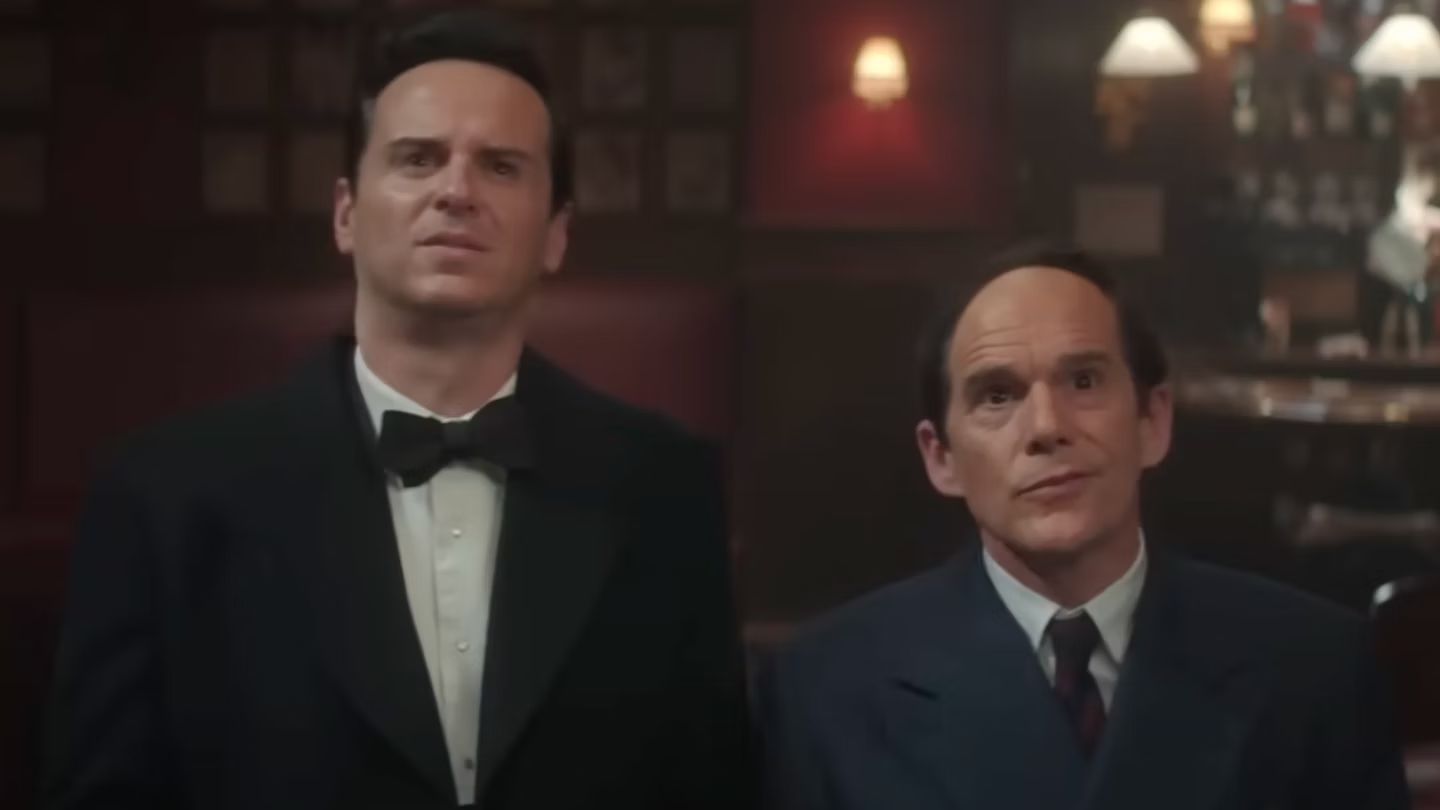
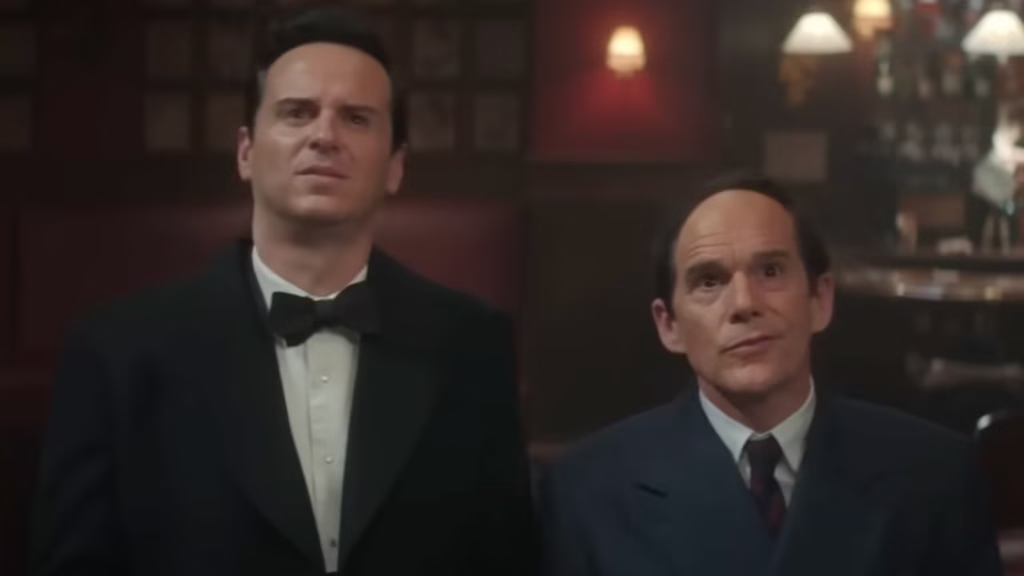
This movie takes place on one night, almost entirely in one place, Broadway’s favorite bar and restaurant, the now-century-old Sardi’s. It is 1943, and it is a night that will change American theater and the fortunes of Rodgers and Hart forever. Unfortunately the fortunes of the two men will change in opposite directions. It is the opening night of “Oklahoma!” (with an exclamation point in the title), which moved Broadway musicals from fanciful light entertainment with forgettable plots and dancing chorus girls doing taps and kicks to stories about American archetypes, choreographed by Agnes de Mille, who made the dance help define the story and characters, and with songs by Rodgers and his new partner, Oscar Hammerstein, that moved the story forward.

Hart (played by Ethan Hawke, with a comb-over and some movie magic to make him appear to be under five feet tall), sees the opening number of the show and knows immediately that it will be a huge hit, that it is corny and superficial, that he could never produce anything like it, and that his partnership with Rodgers is doomed. So he leaves the play and goes to the bar, where he talks to a sympathetic bartender (Bobby Cannavale) and a GI on leave, playing the piano (Jonah Lees).

One of the most heartbreaking and beautifully written scenes of the year has Rodgers (Andrew Scott) and Hart talking about the possibility of working together again. They argue about the purpose and meaning of what they do. Hart wants to send a message. Rodgers wants to make people happy and be successful. Rodgers wants to meet at 9 and work on a schedule. Hart wants to struggle for inspiration. It is agonizing to watch as it is for the characters because they have obvious respect and admiration and gratitude for one another, and because they are both right, both wrong, and incapable of finding a way to reach one another. Another brilliantly conceived scene has two of the mid-century’s most gifted writers talking to each other, Hart and E.B. White (Patrick Kennedy). The dialog is gorgeously written, a conversation between two men who know what it is to appreciate language of precision and beauty.

The movie is about Hart’s fatal combination of sense of superiority and self-loathing. We sometimes see that conflict in his lyrics, as in “The Lady is a Tramp.” He is charming and seductive but he is also smart enough to deliver devastating barbs. Hart is anguished by longing for the impossible, here personified by a 20-year-old college girl named Elizabeth (Margaret Qualley).

He wants desperately to be loved. He quotes the line from “Casablanca,” “Nobody ever loved me that much.” But he is so terrified of the risks of intimacy that he is compelled to pursue the unobtainable or push away anyone who might get too close, to make sure he never gets another “I love you, but not that way” response. Elizabeth wants to use him to meet Rodgers, but she really does care for him. Unfortunately, what she loves about him is his endless, hungry interest in what she says, things, and does, which she is young enough to mistake for affection instead of manipulation and a twisted sense of himself as the participant in her stories rather than the one who hears them after the fact.

Elizabeth is based on a real-life character whose correspondence with Hart was part of the basis of the film. But the big scene between them is a disappointment, too long, too redundant. The brief appearances by not-yet-famous visitors to the opening night party whose names might be more recognizable today could be of interest to those immersed in theater history, but it becomes stunt-ish and distracting. That is just because the rest of it is so good we want to get back to what it does

Director Richard Linklater and screenwriter Robert Kaplow last worked together on the under-appreciated “Me and Orson Welles,” another story about a complicated creator of ambitious art. And Linklater has a second film coming out this year, “Nouvelle Vague,” about another complicated creator of ambitious art, Jean-Luc Goddard as he made his first film, “Breathless.”

In the film, Hart explains that he fell in love with intricate internal rhymes when he heard George M. Cohan’s “Over There.” Kaplow’s script is itself lyrical, a beautiful meditation one life, art, loss, and longing, and this film shows us that Hart is himself something of an intricate internal rhyme, complex, unexpected, and sometimes hard for others to understand.

Parents should know that this movie includes drinking and alcoholism, smoking, strong language, and explicit sexual references.

Family discussion: Why was it hard for Rodgers and Hart to understand each other and compromise? What do we learn from Hart’s conversation with E.B. White?

If you like this, try: Listening to Ella Fitzgerald singing the Rodgers and Hart songbook, and if you don’t mind its utter historical inaccuracy and just want to enjoy performances of classic Rodgers and Hart songs by Judy Garland, Lena Horne, Betty Garrett, and Mickey Rooney, watch “Words and Music”
Related Tags:


Based on a true story Biography movie review Movies -- format Movies -- Reviews
The Penguin Lessons

The Penguin Lessons

Posted on March 27, 2025 at 5:55 pm

B +
Lowest Recommended Age: High School
MPAA Rating: Rated PG-13 for strong language, some sexual references and thematic elements
Profanity: Strong language
Alcohol/ Drugs: Alcohol
Violence/ Scariness: Mostly off-screen depiction of a military coup, characters captured and beaten
Diversity Issues: None
Date Released to Theaters: March 28, 2025
The Penguin Lessons

“I had you as a head down sort of fellow. Anything for a quiet life.” Jonathan Pryce as the headmaster of a posh private school in Buenos Aires is disappointed to discover that the English professor he thought wanted to hide from the world and, especially, from his feelings, might have started out that way but due to an outside influence, had become a head up sort of fellow who was increasingly less quiet.

That professor is Tom Michell (Steve Coogan), who is joking-not-joking when he tells the headmaster his career has been “steadily working my way down,” and then adds, “geographically speaking.” Both are Brits who have ended up in Argentina just as it is on the brink of a military coup in 1976. The headmaster explains that there is “trouble in the streets and the economy is in free fall,” but their school is a haven where wealthy families send their sons. He tells the faculty it is also a haven from any conversation about politics. “Whatever strong opinions you may have, keep them to yourselves and don’t bore the rest of us.”

The coup happens and the school sends the students home for a week until the country calms down. All this means to Michell is a chance to go to Uruguay for a chance to drink and perhaps find some ladies. A lonely colleague from Finland (Björn Gustafsson) comes along, telling Michell, “I like you.” Michell responds, more wry than bitter, “Do you? I don’t.”

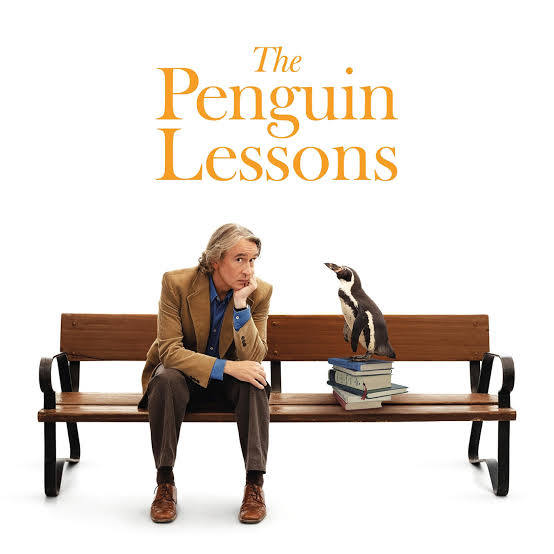
They go to a bar and Michell meets a beautiful woman who takes him for a walk on the beach. They come across a Magellanic penguin drenched in oil from a spill. Only because he wants to impress (meaning, have sex with) the lady, Michell agrees to clean off the penguin. The lady then leaves and Michell is about to discover that penguins are very loyal and this one will not leave him.

That is how Michell ends up hiding a penguin, later named Juan Salvador, in his room. The flightless bird is quickly discovered by the maid and her granddaughter, Sofia (Alfonsina Carrocio) who gives him his name, from the Spanish version of Jonathan Livingston Seagull.

The setting makes this more than the typical “grumpy or grieving person finds solace, hope, and connection with an animal” movie. Screenwriter Jeff Pope, who worked with Coogan on “Philomena,” “The Lost King,” and “Stan and Ollie,” took the real-life story of a 23-year-old teacher and adapted it to Coogan’s strengths as an actor. This is one of the best performances from someone who is not given a chance to show all he can do often enough. At first he is remote, though not humorless. He tries to reach his “privileged and spoiled” students by explaining sarcasm. Then, as it becomes harder to pretend to ignore the atrocities around him, especially after Sofia is taken, the poetry he shares with his students begins to tend first toward loss, then courage, integrity, even rebellion. There’s a wonderful moment when Michell is on the phone with the local zoo, saying he will kill the bird if they won’t take Juan Salvador, quickly gesturing to the penguin reassuringly.

The combination of horrific national tragedy with the personal story of someone unconnected to the community does not always work. But people do struggle to work through their own losses and sometimes they do find connection in unexpected places that help them reconcile emotions they thought were too painful to acknowledge. There is so much warmth and humor in this story that we cannot help feeling touched by the story and maybe even thinking about a penguin of our own.

Parents should know: This movie occurs during a brutal military coup and while much of the abuse is off-screen, a character is “disappeared” and the end credits acknowledge that thousands were captured and killed during this period. Characters use strong language, drink alcohol, and mention sex

Family discussion: When did Michell’s feelings about the penguin begin to change? Why did everyone want to talk to the penguin?

If you like this, try: The book by the real Tom Michell, My Penguin Friend, and the beloved documentary March of the Penguins

Related Tags:


Based on a book Based on a true story Comedy Documentary movie review Movies -- format Movies -- Reviews School
Brave the Dark

Brave the Dark

Posted on January 23, 2025 at 5:31 pm

B
Lowest Recommended Age: Middle School
MPAA Rating: Rated PG-13 for domestic violence/bloody images, suicide, some strong language, teen drinking, drug material and smoking
Profanity: Some strong language
Alcohol/ Drugs: Teen drinking and smoking, drugs
Violence/ Scariness: Domestic violence, murder, suicide, abuse, guns
Diversity Issues: None
Date Released to Theaters: January 24, 2025
Brave the Dark

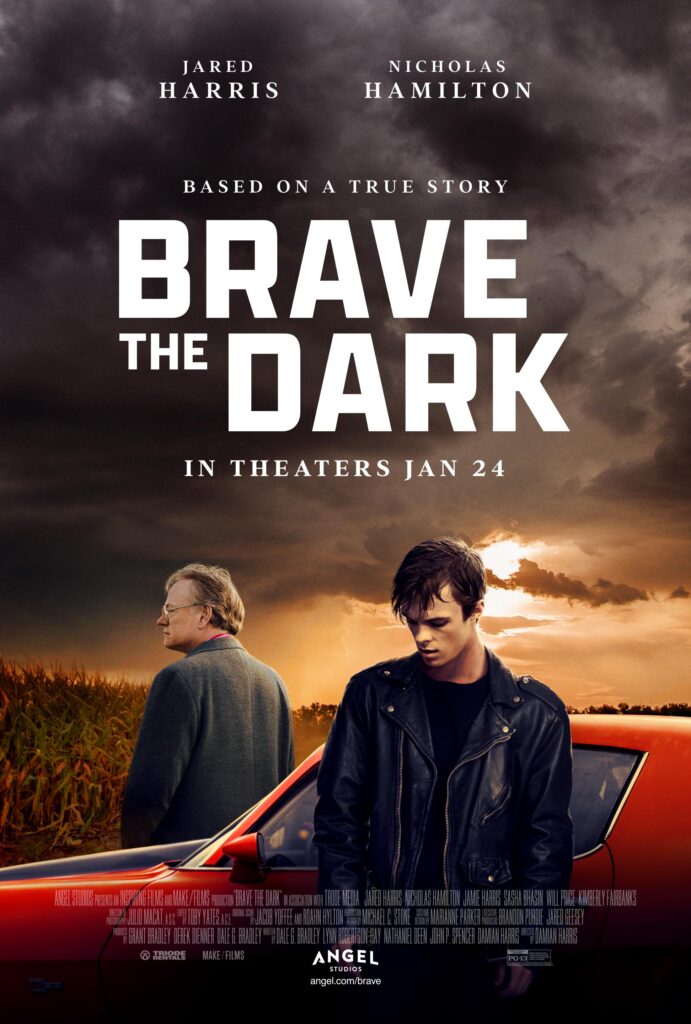
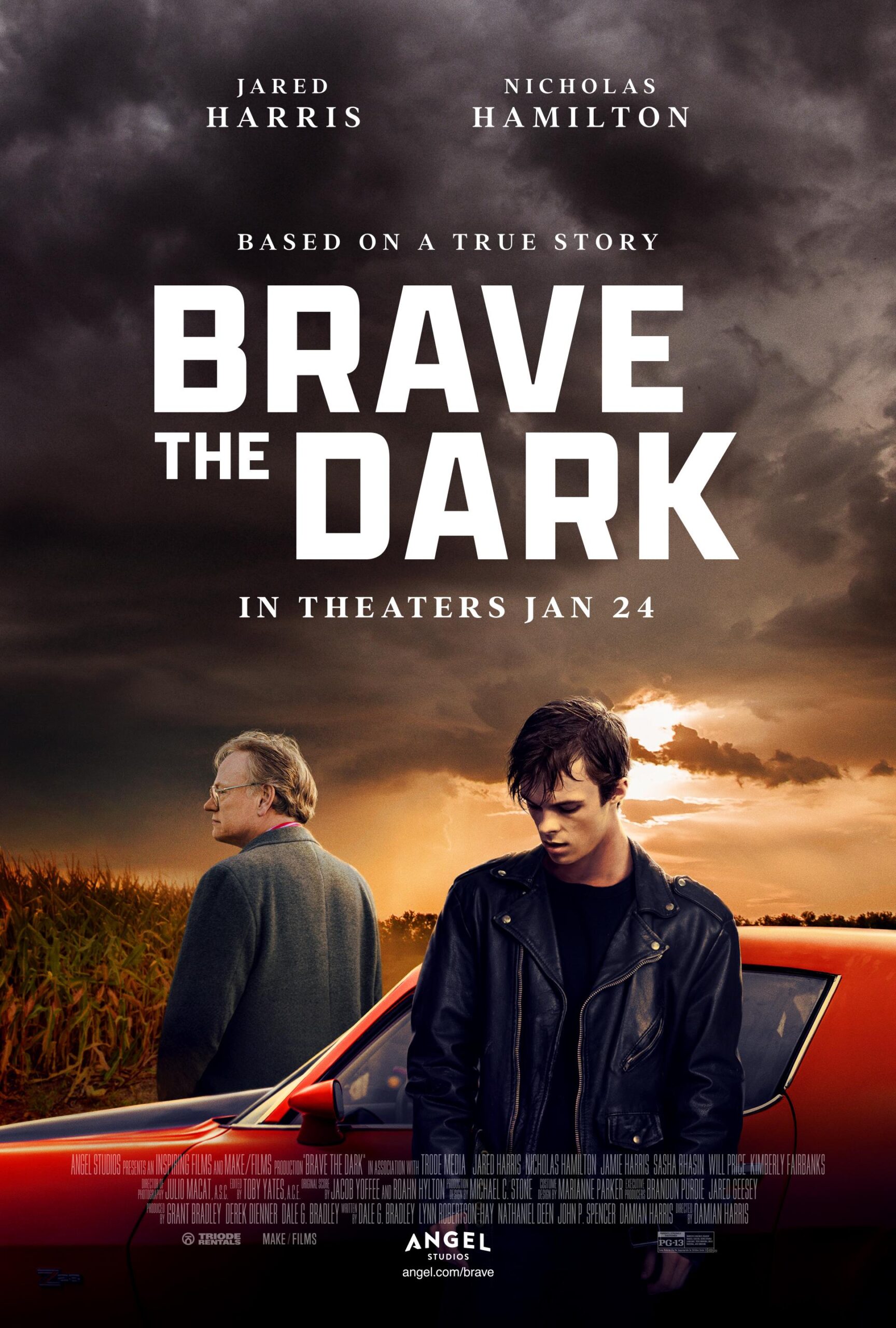
An angry teenager can seem like an immovable object. Most adults have a hard time finding the patience to be the irresistible force that reflects back unconditional support. “Brave the Dark” is based on the true story of a teacher who was that for many students over the years, especially for Nate, a boy who desperately needed a reason to believe that life had more to offer than abuse, trauma, and disappointment. It was made with love by the now-grown boy himself, with three brothers from the other side of the ocean who saw a story that needed to be shared.

The three brothers are the sons of actor Richard Harris (“Camelot” and the original Dumbledore). Damien Harris directed and co-wrote the screenplay. Jared Harris (“Chernobyl” and “Mad Men”) plays teacher Stan Deen. And Jamie Harris plays Barney, the tough probation officer assigned to Nate when he gets in trouble. While the heart of the film is the relationship between Nate and Stan, the scenes with Stan and Barney are among the highlights. The two characters have a history that left them respecting one another but they are very different. Stan is almost preposterously optimistic and Barney is as tough and cynical as you might expect a parole officer whose job is riding herd on acting-out teenagers to be. Jamie and Jared have great chemistry and really spark off each other so well we could imagine a whole other movie about them.

But this is Nate’s story. When we first see him, he’s running track at his high school. We won’t find out why until later, when we learn he has been living in a car after eight years in an orphanage starting at age 6 and failed placements with four foster families. And he has friends who invite him to go along on a break-in. For them it’s fun. For him it’s a way to get some money for food. But he is caught. He gets sent to prison.

Stan Deen cannot let Nate stay there. He is just that guy, as we see when the prison guard explains that only family is allowed to see Nate, and Stan glances at the portrait on the wall and asks to see the warden. This is not some “I need to see the manager” thing. As we will learn, Stan has made the lives of everyone in Lancaster County better, teaching them or their kids, helping them through tough times. Of course the warden is a former student. And many of the movie’s best moments are like this one, when Stan always just seems to know and be loved by everyone.

Stan is a bit of an oddball. He’s a bit awkward but he is incapable of being anything but completely authentic. That, more than anything else, is what gets Nate started on thinking of himself and his life’s possibilities differently. But in order to move forward, he has to be willing to be honest about the past, about the unthinkable tragedy he witnessed as a child. It is something his grandparents insisted he lie about, even to himself. Witnessing Stan’s natural honesty shows Nate that he can be honest, too.

Stan, who once dreamed of being an actor, is directing a school production — tellingly — of “Flowers for Algernon.” That story is the basis for the movie “Charly,” which won an Oscar for Cliff Robertson as a man with low cognitive skills who has an experimental surgery that — temporarily — gives him superior intelligence. The brief moments we see in the play parallel the movie’s themes about increased understanding as Nate’s interactions with one of the play’s leads, the girl who broke up with him after he was arrested. Viewers should know those scenes were shot in the school auditorium where the real Stan Deen staged plays with his students, and that it is now named in his honor.

Stan was feeling stuck after the death of his mother. He is able to move forward by allowing Nate to move into his home, even into what was his mother’s bedroom. There are setbacks and struggles, but that makes the conclusion and the images of the real Stan and Nate at the end especially moving.

Parents should know that this film has strong language, drinking, smoking, and drugs, and a mostly off-screen depiction of murder and suicide witnessed by a small child. The story includes abuse, abandonment, homelessness, and teen crime.

Family discussion: Why was Stan different from the other teachers? What teachers have made the biggest difference in your life? Can you be more like Stan?

If you like this, try: “Stand and Deliver” and “Coach Carter”

Related Tags:


Based on a true story High School movie review Movies -- format Movies -- Reviews Stories about Teens
A Complete Unknown

A Complete Unknown

Posted on December 25, 2024 at 9:00 am

B +
Lowest Recommended Age: High School
MPAA Rating: Rated R for language
Profanity: Strong language
Alcohol/ Drugs: Drinking, smoking, and marijuana
Violence/ Scariness: References to war, some scuffles
Diversity Issues: None
Date Released to Theaters: December 13, 2024
A Complete Unknown
Copyright 2024 Searchlight

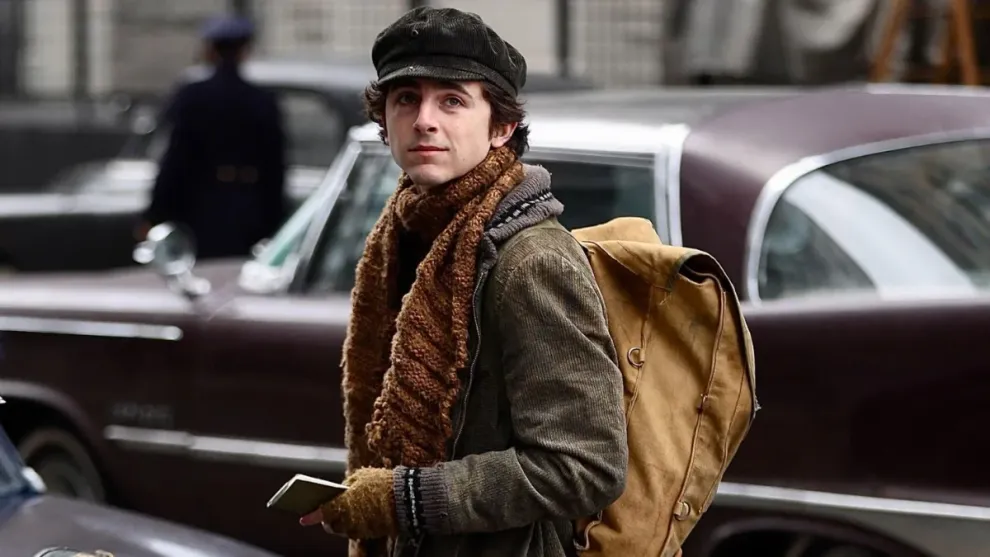
“A Complete Unknown” is the story of Bob Dylan’s early years in New York, based on Elijah Wald’s book Dylan Goes Electric!: Newport, Seeger, Dylan, and the Night That Split the Sixties. It begins with Dylan’s first stop after he arrives from Minnesota, a visit to see Woody Guthrie (Scoot McNairy), who was paralyzed and unable to speak, with Huntington’s disease. Guthrie has another visitor, Pete Seeger (Edward Norton, capturing Seeger’s nerdy, generous, gentle optimism). Dylan (Timothée Chalamet) takes out his guitar to play a song he wrote in tribute to Guthrie. The two folk singers are impressed. We then follow the 21-year-old singer/songwriter as he creates some of the century’s most groundbreaking and influential music while mistreating most of the people around him, until he creates a near-riot at the Newport Folk Festival by plugging in his guitar and “going electric.”

Biographical films, especially those about musicians, tend to have the same format, as so devastatingly destroyed in the parody “Walk Hard.” There’s the precocity and one or two formative childhood experiences, then the moment someone on the board in the recording studio says, “Hey, wait, this kid can play/sing!” Success, setback, moments of inspiration, fights with managers/bandmates/romantic partners, often a descent into drugs and/or alcohol, various breakups, possibly a health crisis, and then either an early death or some kind of rebound.

Wisely, this film, from director James Mangold, who co-wrote the screenplay with Jay Cocks, avoids most of the cliches, and makes no kind of effort to understand or reveal the inner workings of the famously inscrutable Dylan. The title of the film, of course taken from the lyrics of “Like a Rolling Stone,” applies to its subject. It is not that the movie tries and fails to help us understand Bob Dylan; on the contrary, it recognizes that Dylan defies that kind of simplification. And that he doesn’t need it and we should not attempt it. Anything we need to know is in the songs.

And so, this movie does give us the songs, full performances with Chalamet’s singing close enough to Dylan’s voice in the 60s, and perhaps with just a bit more lyrical clarity and tunefulness. The movie thus seems like one brilliant song after another, with interludes of Dylan being a terrible boyfriend. For the fans of Dylan the icon as well as Dylan the musician, there are several well-known highlights of his biography, like encounters with other future luminaries. Joan Baez is played with verve and a sweet, clear singing voice by Monica Barbaro, but with no sense of the complexity and conflicts portrayed in the recent documentary . The most amusing is Boyd Holbrook as a young Johnny Cash, who exchanges supportive letters with Dylan and, when they finally meet at Newport, encourages him to “muddy the carpet,” and stir up some trouble. Elle Fanning plays Sylvie, a character based on Suze Rotolo, the young woman pictured holding Dylan’s arm on the cover of his Freewheelin’ Bob Dylan record. She is credited with exposing Dylan to social activism. She tells him songs should be about more than Johnny Appleseed and the Dust Bowl, but Fanning’s scenes are mostly about being disappointed at what a bad boyfriend Dylan is.

At first, Dylan says all he wants is to be a musician and eat. But then he gets successful. He feels oppressed and under pressure. The fans want him to stay the same. He wants to try new ideas. More than that, he does not want to be told what not to do. He gets more reserved, more internal. but his hair keeps getting fuzzier.

The best scene in the movie is when Pete Seeger is hosting his low-key public access television show. He thought Dylan, by then very famous and very busy, was not going to show up. He invited a back-up guest, a Black folk musician. Dylan does show up. Another performer might have apologized and taken over or just rescheduled and allowed the substitute musician to play. But Dylan lights up at the prospect of jamming with him. He starts to play. Seeger joins in. It is the most illuminating, touching, and engaging moment in the movie.

Parents should know that this film includes some strong language, drinking, constant smoking, and marijuana. There are some unhappy confrontations and references to wartime violence.

Family discussion: Was Dylan right about what people wanted to hear when they asked where the songs come from? Which song means the most to you and why? Was he wrong to play electric music at a folk festival? Why did he do it?

If you like this, try: the classic documentary about Bob Dylan during these years, “Don’t Look Back” and a later documentary, Bob Dylan–The Never-Ending Narrative

Related Tags:


Based on a book Based on a true story Biography movie review Movies -- format Movies -- Reviews Musical
Sing Sing

Sing Sing

Posted on August 1, 2024 at 6:20 pm

A-
Lowest Recommended Age: High School
MPAA Rating: Rated R for language
Profanity: Very strong language, n-word
Alcohol/ Drugs: References to drug dealing
Violence/ Scariness: References to armed robbery and murder, fights, sad deaths of human and pet
Diversity Issues: A theme of the movie
Date Released to Theaters: August 2, 2024

Actors playing kings are wearing robes of velvet, encrusted with jewels. They take their bows to enthusiastic applause. Then they go back to the dressing room, remove their costumes, and put on the clothes they wear all day, every day, their prison uniforms. These men are incarcerated in the famously bleak maximum security prison in New York, the one with the deceptively upbeat name Sing Sing (derived from the name of the Indian tribe that once occupied the land).

Sing Sing
Copyright 2024 A24

The RTA (Rehabilitation Through Art) program at Sing Sing was created by the men who are incarcerated. Esquire wrote an article about it called “The Sing Sing Follies (A Maximum Security Comedy),” and that inspired Clint Bentley and Greg Kwedar, the co-screenwriters of the indie gem “Jockey” to start from scratch with their own research, interviewing the participants in the RTA program. Colman Domingo came on as star and co-producer. Most of the cast are formerly incarcerated men cast as characters based on their own experiences. Unusually, and crucially, the producers of the film put their money where their mouths were, and everyone, including the crew and the first-time screen actors, had equal pay and has an equal participation in the film’s profits. At a screening held at the Smithsonian’s National Museum of African American History and Culture, co-star Clarence “Divine Eye” Maclin told said in a post-screening Q&A that the recidivism rate of participants in RTA is 3 percent, as compared to over 60 percent for the rest of the prison population.

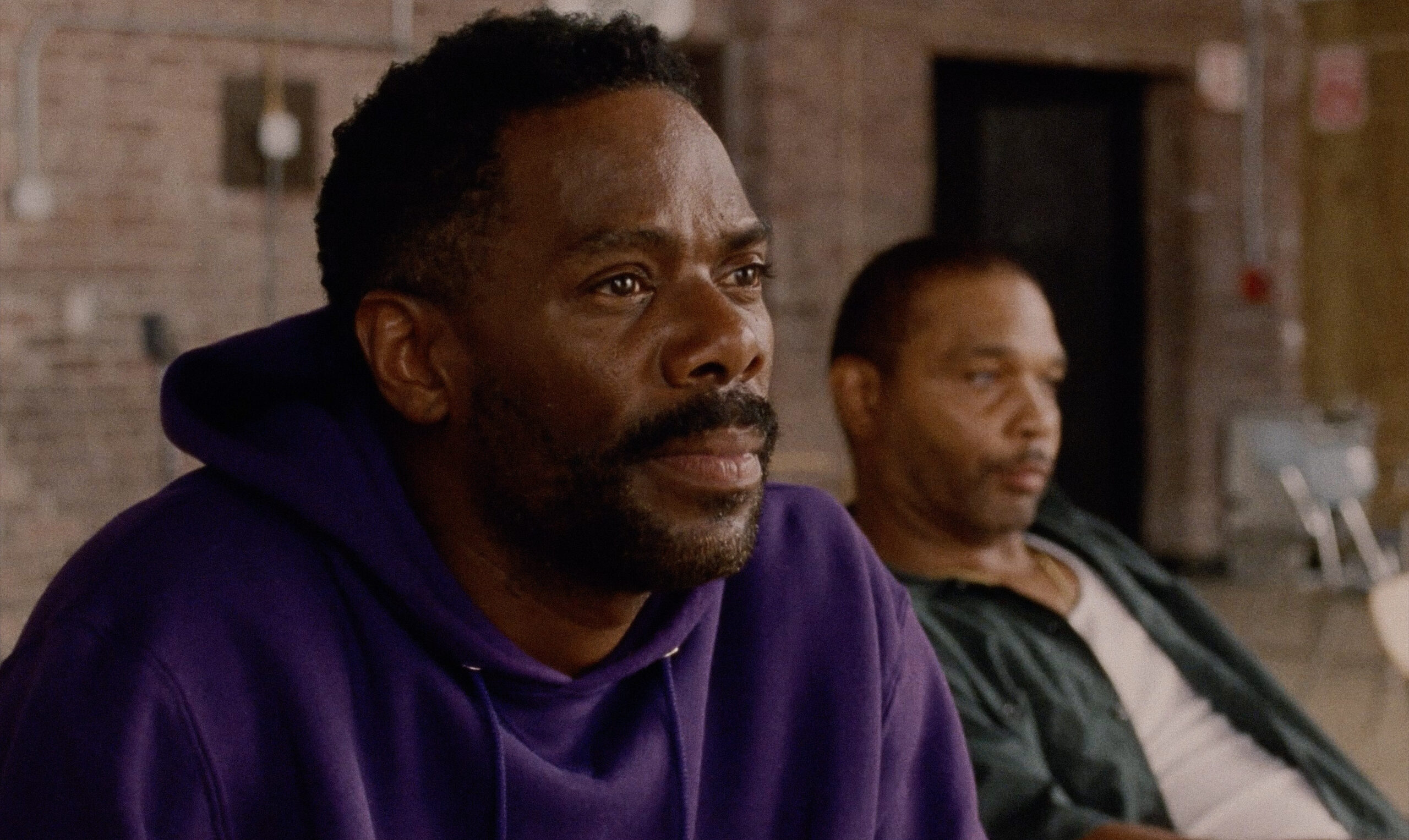
Domingo gives what is clearly one of the best performances of the year as Divine G, a founder of the theater program. Divine G is an author and playwright. His tiny cell includes a typewriter and stacks of books. He helps other incarcerated men prepare for their parole hearings and is seeking clemency for himself, based on a taped confession that has been discovered since his trial and appeals. He feels a genuine brotherhood with the others, but he still has a sense of pride in his education and accomplishments. We get glimpses of his sense of superiority. (Note: the character we see briefly, asking Divine G to sign a copy of one of his books, is the real Divine G.)

“The Sound of Metal’s” Paul Raci plays Brent, a patient and sympathetic outside facilitator of the small theater group, who gives them exercises (“Now walk like you just won the lottery! Now like a zombie!” “Now close your eyes and imagine a place where you feel happy and peaceful”) and guides them through the stages of production. Divine G offers them a play he wrote about corruption in the recording industry, but the men want a story about cowboys, ancient Egypt, Robin Hood, time travel, and Hamlet, and Brent agrees to write the script for them.

The RTA participants realize quickly that there is a freedom within the walls of their rehearsals that they do not have anywhere else. They realize more slowly that participation unwinds tightly coiled emotions they hid from others and did not not even acknowledge to themselves. The protective wall they have used all their lives, the one they may think keeps them alive and not obsessed with the absence of hope, the one that communicates confidence, power, and hostility — that has to be abandoned if they want to be a part of RTA. By trying on the characters they play, they explore feelings they would not let themselves acknowledge. They make themselves vulnerable to being known, by their casemates, by their audiences, by themselves. They go from being afraid of being seen to inviting others to see them.

One detail that audiences may find heartbreaking comes when Brent asks the men to close their eyes and imagine a place where they feel at peace. Some of the men cannot put themselves in a place outside the walls of the prison, even in their imagination. One they may find touching is when Divine G points to a small open square, smaller than a postcard, in the metal screen on the window. He likes to look at that square. It makes him feel in touch with the outside. Another is when a formerly incarcerated man returns to encourage the men and tell them what his experience has been like on the outside.

And one they might find jarring, at least at first, is the way the men in RTA address each other as “Beloved.” The real-life Divine G, a producer and writer on the film, told me that they chose that word to replace the n-word, which the men were using as a kind of semi-hostile, semi-insulting term of affection. His co-founder, Sean Dino Johnson, who appears as a character inspired by his own life, told me the first play the group put on was about the history and import of the n-word.

Domingo is extraordinary here, conveying his character’s struggles with the subtlest details of expression and posture. He is matched along the way with the RTA alumni, especially Clarence Maclin as a character with his name and some of his history. Two men begin to trust one another and then, unabashedly, proudly, call each other “beloved,” setting up the story for an ending of enormous power and meaning.

Parents should know that this story takes place in a maximum security prison and some characters are there because they were drug dealers, armed robbers, or murderers. They take responsibility for their choices but the focus of the film is on the human capacity to learn and get better. Characters use very strong language, including the n-word. There are sad deaths of a human and a beloved pet.

Family discussion: What is your most perfect spot? Why is laughter so important in the rehearsal room? What play would you like to be in?

If you like this, try: “The Quilters,” a short documentary about a program that teachers men in prison to make quilts for foster children, “Greenfingers,” with Clive Owen, based on a program in the UK where men in prison create gardens.

Related Tags:


Based on a true story Drama movie review Movies -- format Movies -- Reviews
THE MOVIE MOM® is a registered trademark of Nell Minow. Use of the mark without express consent from Nell Minow constitutes trademark infringement and unfair competition in violation of federal and state laws. All material © Nell Minow 1995-2026, all rights reserved, and no use or republication is permitted without explicit permission. This site hosts Nell Minow’s Movie Mom® archive, with material that originally appeared on Yahoo! Movies, Beliefnet, and other sources. Much of her new material can be found at Rogerebert.com, Huffington Post, and WheretoWatch. Her books include The Movie Mom’s Guide to Family Movies and 101 Must-See Movie Moments, and she can be heard each week on radio stations across the country.

Website Designed by Max LaZebnik