Mortdecai

Posted on January 23, 2015 at 9:36 am
Copyright Lionsgate 2015

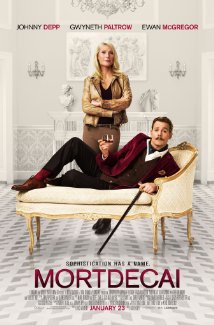
There’s a lot of noise in “Mortdecai” but what I remember most is the silences where everything pauses for a moment to allow the audience to laugh without drowning out the next witty riposte. Nope, just crickets, as there was no laughter, just grim resolve on the part of those of us professionally obligated to stick it out through the bitter end.

“Mortdecai” is based on series of 1970’s comic novels by Kyril Bonfignioli about an art dealer with connections to the upper class and the criminal underground, which provide him with many opportunities for mischief. I’m sure they are all high-spirited and merry and racy and fun, but by the evidence of this film they are also dated, overly precious, and not susceptible to translation into film. Perhaps it was possible decades ago and in print rather than on screen to find it funny when someone is repeatedly shot and injured, often accidentally by his employer, or when someone else is shot and killed. But not now and not like this.

Maybe gag reflexes brought on by Mortdecai’s mustache and widespread barfing brought on by tampering with a sumptuous buffet can be funny when left to the imagination. Not likely, but clever writing might just make it possible as our imaginations are very good at filtering descriptions according to our comfort levels. It’s another thing entirely when it is unavoidably seen and heard. Cue the crickets.

Over the past few years, with the exception of a brief appearance in “Into the Woods” Johnny Depp has made one catastrophically bad movie after another. As proof of the adage that no good deed goes unpunished, the success of his offbeat, fey Captain Jack Sparrow, initially objected to by the studio execs who were very unhappy with the early footage, has given Depp license to go way over the top with quirks and twitches in films like “The Lone Ranger” and “Tusk.” As I noted in my review, in “Transcendence” his performance was so robotic when he was playing a human that it hardly made a difference when he turned into a computer. Here, as the title character, a caricature of a pukka sahib colonial twit/Brit, embodies the fatal combination of profound unpleasantness with the expectation of being seen as irresistibly adorable not just by the other characters but by the audience.

Paul Bettany provides the film’s only bright moments as Jock Strapp, Mordecai’s Swiss army knife of a sidekick, as adept at ironing his lordship’s handkerchiefs as he is at hand-to-hand combat, getaway car driving, anticipating that Lady Mortdecai (Gwyneth Paltrow, looking like the cover of Town and Country in very fetching riding gear) will want the guest room made up for her husband as soon as she sees his new mustache, and bedding many, many, many ladies. Ewan McGregor does his valiant best but is wasted as the Oxbridge-educated MI5 official (and former classmate of Mortdecai, with a crush on Lady M). Director David Koepp, whose “Premium Rush” was a nifty little thriller with unexpected freshness and wit, has stumbled here with a film that is badly conceived in every way, like its title character imagining itself as clever and endearing when in reality it is dull and repellent.

Parents should know that this movie includes strong and crude language, drinking and comic drunkenness, sexual references and situations, some crude, bodily function humor, comic peril and violence including guns, with characters injured and killed.

Family discussion: What was the best way to resolve the issue of the mustache? Who should have the Goya painting?

If you like this, try: The Mortdecai Trilogy and the Austin Powers films

Related Tags:


Based on a book Comedy Crime Satire

A Most Violent Year

Posted on January 15, 2015 at 5:58 pm

B+
Lowest Recommended Age: Mature High Schooler
MPAA Rating: Rated R for language and some violence
Profanity: Very strong language
Alcohol/ Drugs: Drinking, smoking
Violence/ Scariness: Crime and violence including guns, suicide
Diversity Issues: A theme of the movie
Date Released to Theaters: January 16, 2015
Date Released to DVD: April 6, 2015
Amazon.com ASIN: B00RNELG5E
Copyright A24 2014
Copyright A24 2014

After three very different movies, we know two things about writer/director J.C. Chandor. First, he is already one of today’s most original, thought-provoking directors, with a remarkably mature and insightful eye, and second, he is vitally interested in the survival instincts of characters who are under the direst of pressures. His “Margin Call” is the best take we have seen yet from Hollywood on the Wall Street meltdown, taking place in one day as a huge financial firm finds out it is on the wrong side of a bet that will bring down the entire company. It is filled with sharp, smart, character-defining dialogue that all but sizzles. His second film was “All is Lost,” an almost-wordless, one-character story with Robert Redford trying to stay alive a boat that is damaged in a collision, and an ending that viewers are still debating. And now, his third film is his first period piece, set in 1981 New York, one of the most violent years in the city’s history.

Oscar Isaac and Jessica Chastain star as Abel and Anna Morales, husband and wife and ambitious owners of a home heating oil company. The company is doing well and they have the chance to take it to the next level with the purchase of some property on the water that will reduce their delivery costs. But they are under tremendous pressure, moving into an expensive new home, on the hook to come up with the money for the land in 30 days, under investigation by a prosecutor who is equally ambitious (“Selma’s” David Oyelowo), and being pushed hard by cut-throat competition from his competitors, who harass his drivers, hijack his trucks, and steal his oil.

Like Michael Corleone, Abel wants to be strictly legitimate, but he is not there yet.

Both husband and wife are trying to move past their origins into the upper middle class. Abel is an immigrant who began as a driver for the company when it was owned by Anna’s father, a gangster.  They love each other deeply, but each is by nature mistrustful and secretive.  “You won’t like what happens if I get involved,” Anna tells Abel, and they both know he is right.  Anna and Abel may have some trust issues but Isaac and Chastain, who have been friends since they studied together at Juilliard, as actors have a fearlessness with each other that requires complete trust as actors.  Every scene they are in together crackles.

We first see Abel running through the streets.  This was when running first became popular as exercise.  But Abel is running all the time.  Isaac is always calm and reassuring in his manner, but he has a white-hot inner fury.  That is probably what drew Anna to him.  He wants it all — money, respectability, family.  And he knows that in order to get it he will have to deal with some very bad people and some very weak people and that means he might have to do some very bad things and some people might get hurt.

In his first period film, Chandor creates an atmosphere so authentic we can almost taste the smog.  He has been compared to Sidney Lumet for the gritty, layered texture of the settings and the storyline.  He is extraordinarily gifted with actors, starting with the casting.  Alessandro Nivola is superb as a highly civilized gangster who lives in a home so fortified it tells us how thin that veneer of civilization really is.  He creates a complex and fully-realized world that brings home Faulkner’s famous line: “The past isn’t dead.  It isn’t even past.”

Parents should know that this film includes very strong language, and some peril and violence including guns, suicide, and criminal activity, drinking, and smoking.

Family discussion: How would this story be different if it took place today?  Why does the film begin with Abel running?

If you like this, try: “Margin Call” and “All is Lost” from the same director

Related Tags:


Crime Drama DVD/Blu-Ray Pick of the Week

Inherent Vice

Posted on January 8, 2015 at 5:58 pm

B
Lowest Recommended Age: Adult
MPAA Rating: Rated R for drug use throughout, sexual content, graphic nudity, language and some violence
Profanity: Very strong, explicit, and crude language
Alcohol/ Drugs: Extensive substance abuse including drinking, smoking, and drugs, drug dealing
Violence/ Scariness: Peril and violence
Diversity Issues: Diverse characters
Date Released to Theaters: January 9, 2015
Copyright IAC films 2014

We love mystery stories because they reassure us that questions have answers and justice is possible. But some mystery stories are there to remind us that life is complicated and messy, and sometimes answers are just more questions. This is one of those stories.

Inherent Vice is a novel by the famously private author Thomas Pynchon, whose books are dense, complex, and thus rich fodder for grad students and intelligentsia. Writer/director Paul Thomas Anderson (“Boogie Nights,” “Magnolia,” “There Will Be Blood,” “The Master”) is also known for dense, complex stories, and he likes to focus on decay, corruption, and bruised innocence. They are well matched in this weed noir story, sort of Dashiell Hammett crossed with Hunter Thompson.
The original set-up is right out of a classic detective story. A beautiful woman named Shasta Fay Hepworth (Katherine Waterston) visits her ex-boyfriend, Doc (Joaquin Phoenix), some kind of hippie detective, to ask for his help. The narrator (singer Joanna Newsom), in a hypnotic, vocal fry deadpan, lets us know right away that Doc would be better off telling her to leave. But he cannot say no to Shasta or to a mystery, so he is on the case.

Shasta’s new boyfriend is a wealthy (and married) developer named Mickey Wolfman (Eric Roberts). Shasta believes that Wolfman’s wife and her boyfriend are trying to have him committed so they can get his money.  As Doc begins to look into this, he encounters many odd characters, most with their own unsolved mysteries, some of which begin to intersect with the Wolfman story or with each other or both.  And it all comes together, or doesn’t, in a haze of, yes, decay, corruption, and bruised innocence that is about the failure of the American Dream or existential chaos or the fragility of our concept of reality, or maybe just that the journey and those who accompany us along the way are more important than the destination.  Also, something about the optimism and passion for changing society of the 60’s giving way to the me-decade and passion for individual self-exploration of the 70’s.

Doc encounters a number of extremely colorful characters as he explores a series of mysteries that appear to be linked, or perhaps all part of one big mystery involving a secret and very powerful malevolent force.  The only one who seems to know what’s going on is the almost-never-seen narrator, and it’s not clear whether we’re supposed to root for the characters or laugh at them.  But as always, Anderson’s impeccable casting and music choices are captivating, and there is an amusing contrast between his attention to every detail of camera placement, editing, production design, and dialog and the convoluted storyline and druggy fog surrounding the characters.  I’m not sure what it was that I watched, but I have to admit I enjoyed watching it.

Parents should know that this film has just about everything we consider “adult content,” including constant very strong, explicit, and crude language, nudity and very explicit sexual references and situations including prostitution and adultery, drinking, drugs of all kinds and drug dealing, and violence including guns.

Family discussion: Why did Doc help Shasta? Why did he help Coy? Why is Doc a detective?

If you like this, try: “Boogie Nights” and “There Will Be Blood” by the same director and the book by Thomas Pynchon

Related Tags:


Based on a book Crime Drama Movies -- format Mystery

Foxcatcher

Posted on November 20, 2014 at 5:55 pm

Copyright Sony Pictures 2014

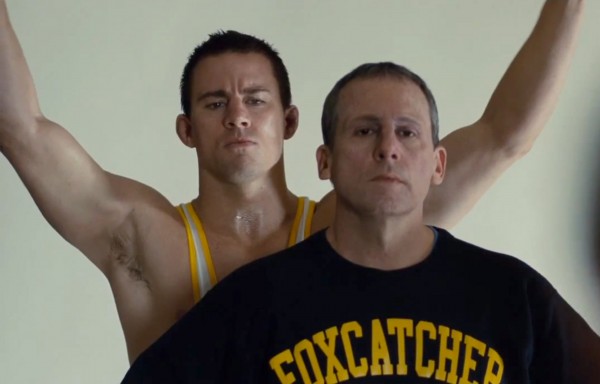
John Eleuthère Du Pont was of the wealthiest men in the world. He was an ornithologist, a philatelist, a purchaser of military weapons (including a tank), a wrestling fan who set up a luxurious training facility for the US Olympic team, and a murderer who died in prison in 2010. Steve Carell, almost unrecognizable, does a better job of erasing himself than of creating a different character. He has a hawkish nose, a set of small, inbred-looking teeth, a clenched posture, and the aristocratic delivery of a prep school graduate used to deference from everyone but his mother. But he is never able to make it all into anything but a cipher. Director Bennett Miller (“Capote,” “Moneyball”) and screenwriters Dan Futterman and E. Max Frye wisely stay away from simple explanations and Lifetime Made-for TV-style histrionics.  Miller’s pallette is drab and his presentation is spare, in contrast to the opulence of the Du Pont estate and the training facility. But the film overcorrects, as though underplaying and long, silent stretches without even a musical score can somehow convey seriousness and import.

It begins promisingly as we see Olympic gold medalist Mark Schultz (a somber Channing Tatum) stumbling his way through a talk to some bored schoolkids about character and America, and then waiting awkwardly for his pay, $20. And one of the best scenes of the year is his practice session with his brother, best (and only) friend, and coach, David Schultz (Mark Ruffalo), also a gold medalist. There is enormous tenderness in David’s touch as he pushes on Mark’s arms to stretch him, and even as it seamlessly turns into a wrestling match that eloquently conveys intimacy, trust, dependence, and some competition as well.


Mark gets a call from some Du Pont factotum, inviting him to come to Delaware to meet John on his luxurious estate, called Foxcatcher because of the fox hunting history of the Du Ponts, a rare family that has been wealthy since the earliest days of American history.

On the surface, John conveys an easy noblesse oblige as he introduces himself, and Mark is nowhere near worldly enough to see the arrogance and instability under the surface.  Mark has been listening to coaches all his life.  When John says he likes to be called “Eagle,” Mark sees leadership. When John says he wants to help Mark be the best in the world, Mark sees a chance for something he did not let himself realize he wanted, a chance to be more independent.  And independence is what John is looking for, too.  He is an adult dependent in many ways on his mother, bitter about her focus on horses and her obvious feelings for him, somewhere between indifference and contempt.

John builds a lavish training facility (in real life for more sports than just wrestling).  “Foxcatcher” is emblazoned everywhere.  The athletes are polite, even respectful, but no one thinks John has anything but money to contribute.  Mark loves being seen as special and gets caught up in John’s decadent lifestyle.  But then John, who has the attention span of a mayfly, decides he needs to bring Dave in, too.  Dave’s lack of interest only makes him more determined.  Soon, Dave and his wife and children are at Foxcatcher.  Mark is resentful.  John is increasingly unstable and there is no one there to stop him until it is too late.  When it’s over, he is affectless.  The problem is, too much of the movie is as well.

Parents should know that this film has tense and disturbing confrontations, some violence including murder, strong language, drinking, and drugs

Family discussion: What was John hoping to achieve by sponsoring wrestlers? How did he feel about John? How did he feel about Dave? Why?

If you like this, try: “Capote” and “Reversal of Fortune”

Related Tags:


Based on a true story Crime Drama Sports

John Wick

Posted on October 23, 2014 at 5:44 pm

Copyright Summit Entertainment 2014

This is a movie directed by two stunt men, which means it is pretty much a first-person shooter video game projected onto a movie screen. But that also means that it is directed by people who really know stunts and the kills on screen (reportedly more than 80) are on display for maximum effect. It delivers exactly what it promises, with a couple of surprisingly sharp and witty touches that lift it above the usual bang bang. There aren’t many movies where the funniest line is the way a character says, “Oh.” And I loved the idea of a very high-end, very specialized safe house/hotel just for assassins. Of course the only currency accepted is gold coins. And of course there is a doctor on duty 24/7 to sew up wounds without any pesky questions.

Keanu Reeves plays the title character and we know from the beginning of the film that he is not having a good day. We see him very badly, maybe mortally wounded, lying out in the rain, watching a video of his wife on his phone. And then we go back a couple of days to see what got him there.

His wife (Bridget Moynahan) is dying. At the funeral, he has an cryptic and uneasy conversation with Marcus (Willem Dafoe), a former colleague. That night, alone in his beautiful but spare home, John accepts delivery of a package. It is an adorable puppy, a gift from his late wife, with a note telling him that “you still need something, someone to love.” She urges him, “now that I’ve found my peace, find yours.”

When he goes out to get food for the dog, he stops to fill up his vintage ’69 Mustang with gas. An arrogant, hot-headed young Russian thug (Alfie Allen) wants to buy the car, snarling that everything has its price. His handler/bodyguard apologizes courteously and they go their separate ways. But that night, when John is asleep, they break into his house, brutally attack him, kill his puppy, and steal the car.

But they have stolen from the wrong person. Before he left the business to live blissfully with his wife, John Wick was employed as a killer and he was very, very good at it. “He was the one you sent to kill the boogeyman,” Viggo, the crime kingpin (Michael Nyqvist) says grimly. He has reason to know, as he was John’s employer. Viggo once saw him kill three guys with a pencil. And Viggo has reason to be grim; the hothead who stole John’s car was Viggo’s own spoiled son.

John gets out his sledgehammer to break the concrete floor and get to the weapons and stash of gold coins he had hidden there. He suits up (bulletproof vest and impeccably tailored grey duds), and off he goes, dodging the attacks from Viggo’s goons and then from the open contract Viggo puts out on him for any hitman (or women) who is willing to take him on, mowing down everyone, and I mean everyone (well, everyone male) who gets in his way.

Reeves is well cast as the implacable, unstoppable John Wicks, and Nyqvist (“Mission Impossible: Ghost Protocol” and the Swedish “Girl With the Dragon Tattoo” series) is outstanding as the wily Viggo. There are some nice darkly comic moments (trust me about that “Oh,” and a later reprise), but this is all about the stunts, and as pure adrenaline action fodder, this movie delivers the goods.

Parents should know that this film includes extremely graphic and intense violence with many characters (and a dog) injured and killed, disturbing images including spurting blood, wounds, stabbing, assault weapons, and explosives, strong language, smoking, drinking, drugs, skimpy clothes

Family discussion: Does everything have a price? Why did Viggo decide to make a deal? What did he mean when he said “this life follows you?”

If you like this, try: “Shoot ‘Em Up” and “Point Break”

Related Tags:


Action/Adventure Crime Thriller
THE MOVIE MOM® is a registered trademark of Nell Minow. Use of the mark without express consent from Nell Minow constitutes trademark infringement and unfair competition in violation of federal and state laws. All material © Nell Minow 1995-2026, all rights reserved, and no use or republication is permitted without explicit permission. This site hosts Nell Minow’s Movie Mom® archive, with material that originally appeared on Yahoo! Movies, Beliefnet, and other sources. Much of her new material can be found at Rogerebert.com, Huffington Post, and WheretoWatch. Her books include The Movie Mom’s Guide to Family Movies and 101 Must-See Movie Moments, and she can be heard each week on radio stations across the country.

Website Designed by Max LaZebnik