Ballad of a Small Player

Ballad of a Small Player

Posted on October 17, 2025 at 8:57 am

B-
Lowest Recommended Age: High School
MPAA Rating: Rated R for language and suicide
Profanity: Strong language
Alcohol/ Drugs: Alcohol, smoking, brief drug use
Diversity Issues: Diverse characters
Date Released to Theaters: October 17, 2025

A character in “Ballad of a Small Player” tells a story about a gambler who dies and discovers that in the afterlife he is still gambling, but now he always wins. “This heaven?” he asks in amazement. “No,” he is told. “You’re in hell.”

Copyright 2025 Netflix

The import of the story may be lost on the person it is told to, but it is not lost on the audience, who will understand that it is the story we are watching. Not because he is a winner, but because winning or losing, the gambling compulsion is its own hell.

In this film, the part of hell is played by Macao, the real-life gambling capital of the world, gorgeously photographed by James Friend. It looks like gambling may feel to someone who cannot give it up; thrilling, glamorous but also seedy, seductive, and dangerous.

The character who calls himself Lord Doyle (Colin Farrell) is a gambler. He wakes up in a luxurious hotel room littered with the clutter of a dozen different room service meals. He shaves and dresses in a handsome and expensive-looking green velvet suit, and fails to duck the hotel management that would like him to pay up on the $350,000 he owes them. A bellman explains he can no longer get access to the hotel limos, but whispers the name Rainbow, a casino that gives credit.

The big money game is Baccarat, and Doyle tells us millions can be won and lost in a single hand. The hostess/purveyor of credit is Dao Ming (Fala Chen). Later, after a gambler commits suicide by leaping out of a window, his widow accuses Dao Ming of causing her husband’s death and Doyle protects her. Dao Ming brings him back to her apartment. The next morning, he wakes to find her gone, but she has written a number on his palm.

The pressure on Doyle intensifies when he is tracked down by an investigator from London (Tilda Swinton), seeking repayment of money he stole when he was still called by his original name, Riley. If he does not pay back almost a million pounds, she will have him arrested.

Elements of the film tell us it may be a dream, a fantasy, or a deathbed hallucination. Or perhaps it is hell, with Doyle/Riley stuck in some kind of loop of big risks and bad decisions.

Parents should know that this film includes suicides, strong language, drinking, smoking, drug use, and criminal behavior.

Family discussion: How are Riley and Dao Ming alike and how are they different? What part of this film is a dream or fantasy?

If you like this, try: “Hard Eight” and “Molly’s Game”

Related Tags:


Crime Drama movie review Movies -- format Movies -- Reviews
Honey, Don’t!

Honey, Don’t!

Posted on August 21, 2025 at 6:43 pm

B-
Lowest Recommended Age: Mature High Schooler
MPAA Rating: Rated R for strong sexual content, graphic nudity, some strong violence, and language
Profanity: Strong and crude language
Alcohol/ Drugs: Alcohol
Violence/ Scariness: Peril and violence, many characters injured and killed, very graphic and disturbing images
Diversity Issues: None
Date Released to Theaters: August 22, 2025
Copyright 2025 Focus

I liked “Drive Away Dolls,” Ethan Coen’s previous film starring Margaret Qualley as a free-spirited queer woman who has a series of crazy adventures involving gangsters and a mysterious suitcase many people are interested in. “Honey Don’t!” is not a sequel, more an offshoot that aims for the same sort of vibe, this time with Qualley as a queer private detective in Bakersfield, California. Qualley is mesmerizing but the movie is too meandering, more a series of set-pieces than a story.

Qualley is the title character, independent, confident, direct, and quippy. She is a female version of the classic movie detective, a loner (we see her casually dismissing a one-night stand) but resolutely honest. A man wants to hire her to find out if his boyfriend is cheating and Honey tries to talk him out of it because if he wants to hire her, it means he already knows. A woman who made an appointment to consult Honey ends up dead and in a car that overturned rolling down a ridge on the side of the road. Her prospective client never made it to the hiring point, but Honey investigates.

Others have gone to the upside down car before her. Marty, the local homicide detective (Charlie Day), who keeps trying to ask Honey out on a date, is there with the forensic crew. Before they got there, a mysterious woman with a Lulu bob arrived on a motorcycle, reached into the car to pull a ring from the dead woman’s finger, took time to go skinny dipping in the lake, and left.

This is not the kind of film where everything ties up at the end. It is the kind of film that lurches from scene to scene as though it is one of those Pass the Paper/Exquisite Corpse drawing games where no one knows what the first and second part of the picture looks like when it is their turn to draw the third. The individual set-pieces are very entertaining, especially Honey’s meeting with an aspiring mega-church preacher (Chris Evans) whose pulpit is between two giant portraits of himself and who tells his congregation to “submit and serve the lord,” often meaning having submitting to serving him by having sex.

The actors and filmmakers are clearly having a blast, especially costume designer Peggy Schnitzer, whose ensembles for Qualley are all knock-outs. The movie features the slightly surreal dialogue that is beloved by the Coen brothers and the love for female bodies and sexuality that we saw in “Drive Away Dolls” continues to be sigh-worthy, no matter what your pronouns or orientation. There are moments of inspired derangement. Overall, though, there’s more style than substance, a hollowness that even Qualley’s star quality cannot make up for.

Parents should know that this film has peril and violence with many characters injured and killed and some graphic and disturbing images. It also includes nudity and very explicit sexual situations including a threesome and bondage. Characters use strong language and drink alcohol.

Family discussion: Why did Honey feel obligated to investigate Mia’s death? What questions did she ask that made a difference?

If you like this, try: “Drive Away Dolls”

Related Tags:


Crime movie review Movies -- format Movies -- Reviews
Nobody 2

Nobody 2

Posted on August 14, 2025 at 5:37 pm

B +
Lowest Recommended Age: Mature High Schooler
MPAA Rating: Rated R for strong bloody violence and language throughout
Profanity: Very strong language
Alcohol/ Drugs: Alcohol, drug dealing
Violence/ Scariness: Extended very intense and graphic violence, characters injured and killed, graphic and disturbing images
Diversity Issues: None
Date Released to Theaters: August 15, 2025

The first “Nobody” (2021) was a surprise, with Bob Odenkirk, who was not an action movie star, playing a guy no one would expect to be willing and very, very able to fight lots of intimidating guys with many weapons. It was popular enough for a sequel, based on the same kind of “who is that guy?” expectations. Basically, it’s a cartoonish but extremely violent series of fight scenes, but the dark humor, improvised weaponry, and good spirits make it very entertaining. If you don’t get too rattled by the very graphic and disturbing images.

Copyright 2025 Universal

Like the first film, this begins with Hutch (Odenkirk), bloodied and bruised and, this time, apparently missing part of a finger, being interrogated by a pair of FBI agents. Then we go back to find out what happened.

Following the events of the first film, Hutch (Odenkirk) is in debt to a criminal kingpin known as The Barber (Colin Salmon). His wife, Becca (Connie Nielson) knows that his “job” is paying off that debt by undertaking tasks that involve grave danger. After a brief scene with Hutch waiting in a hotel lobby, wearing a badge from some kind of conference (clearly camouflage), we see him follow some guys in dark suits into an elevator. And then, jump to another rewind as he explains to The Barber what happened, setting the heightened tone for what is ahead, basically: extreme violence along the lines of a Looney Tunes cartoon, if Hutch was Road Runner AND Wile E. Coyote AND all the blow-up equipment from Acme.

As Hutch’s family gets up in a series of mornings, we can see that like many families they are stressed and feeling disconnected. Hutch’s wife, Becca (Connie Nielson) and son Brady (Gage Munroe) resent Hutch for being gone all the time. His younger daughter, Sammy (Paisley Cadorath) is just glad to see him when he’s there. Hutch decides the solution is a family vacation. He tells The Barber he’s taking a break, and books a visit to the place where he was happiest as a child, a small tourist town with a water park. They swing by to pick up Hutch’s father, David (Christopher Lloyd).

It’s rickety and cheesy, especially the “honeymoon suite” festooned with fake palm leaves, but Becca appreciates the effort and the family is determined to do their best to enjoy it. But at an arcade, Brady gets into an altercation with a teenage townie and that brings the family to the attention of the cruel and corrupt local sheriff (Colin Hanks) and the businessman who runs the town, Henry (John Ortiz).

This leads to a series of one-upping fight scenes, building to a confrontation with a small army working for the evil crime boss known as Landina (Sharon Stone, having a blast dancing in a pants suit and stabbing a cheating gambler in the hand). A most-welcome RZA shows up again as Hutch’s katana-master brother.

Director Timo Tjahjantoo, taking over from Ilya Naishuller, makes the best of the fight scenes, with a “John Wick” level of balletic movement. Hutch’s specialty, in addition to a John Wayne-category punch, is his ability to improvise with whatever is around him, and this movie gives him plenty to improvise with, from the emergency phone in an elevator to the pieces of the games at an arcade, equipment on a boat, and the final confrontation, boobytrapping an old-school water park like it’s Kevin’s house in “Home Alone.”

The premise of conflict between Hutch’s commitment to his family and the roiling rage that makes him good at killing plays out well as it echoes with his father, brother, and son, thanks to a strong script by Derek Kolstad and Aaron Rabin and a fine performance by Odenkirk. It’s easy to overlook how good he is because of all that is happening on screen, but it would just be cartoonish without Odenkirk’s ability to make us understand Hutch’s layers of emotion. It’s nice to get a glimpse of Becca’s side of things. She gets to be much more than the usual “Oh, honey, don’t do anything scary or dangerous” female role, making us wish for a prequel to fill in the details behind her story about how they met.

Parents should know that this is an exceptionally violent film with guns, knives, fire, and explosions. Many characters are injured and killed and there are many graphic and disturbing images. Characters are criminals who deal in drugs and bombs. Characters use strong language, drink and get drunk. There is some marital kissing and mild sexual references.

Family discussion: What are the parallels in the stories of the father-son relationships of Hutch, Brady, and David and Henry and Max? In what way to David, Hutch, and Henry want their sons to be better than they are?

If you like this, try: the first film and “Shoot-Em Up”

Related Tags:


Action/Adventure Crime movie review Movies -- format Movies -- Reviews Series/Sequel
Highest 2 Lowest

Highest 2 Lowest

Posted on August 14, 2025 at 5:22 pm

A-
Lowest Recommended Age: Mature High Schooler
MPAA Rating: Rated R for brief drug use and language throughout
Profanity: Constant very strong language including the n-word
Alcohol/ Drugs: Alcohol and drug use
Violence/ Scariness: Peril and violence including guns, characters injured
Diversity Issues: Diverse characters
Date Released to Theaters: August 15, 2025
Copyright 2025 A24

Denzel Washington and Spike Lee reunite for the first time since 2006’s “Inside Man” for an elegiac but vibrant story that is complicated and messy. Like life. It is an engrossing crime drama, a family story, a commentary on culture and society, bursting with ideas, masterfully acted by Washington, who just keeps getting better.

The movie begins with Washington’s character, notably called David King, on top of the world. Soaring shots of New York City’s skyline at its most glamorous and inviting are accompanied by Rodgers and Hammerstein’s “Oh, What a Beautiful Morning,” from “Oklahoma.” We end on a spectacular penthouse balcony, with King greeting the day. We will see his Architectural Digest-ready apartment, filled with fine art and elegant furnishings.

It may not be a beautiful day for King. His company is about to be purchased by a conglomerate with no special background or interest in music or in supporting the emerging Black artists who are so important to King. He predicts that what they want to do is dismiss all of the newer talent and monetize the archive by licensing it for commercials. His plan is to raise the money to buy back enough of a share from a board member, Patrick (Michael Potts), so he will be able to veto the deal. Putting this deal together causes him to let down his wife, Pam (Ilfenesh Hadera), who was about to make a large contribution to charity, and break a promise to his son, Trey (Aubrey Joseph), to watch him at a basketball camp led by former Boston Celtic Rick Fox. Trey is disappointed, but happy to meet up at the camp with his best friend, Kyle (Elijah Wright), King’s godson, and the son of widower, ex-con, and King’s chauffeur, Paul Christopher (played by Elijah Wright’s real-life dad).

Then, King gets a call that Trey has been kidnapped for ransom and they are demanding $17,500,000 in Swiss francs. The reason it has to be in francs, not dollars, is clever, like many of the details of the crime, but for some reason this kidnapper makes no effort to stop King from calling the police. The kidnapper also makes another mistake. He mistook Kyle for Trey. Will King continue with plans to take the money he needs to keep his company to pay ransom for someone else’s son?

The way the ransom exchange and subsequent events play out, including a subway train filled with excited Yankees fans and a Puerto Rican Day festival featuring “Do the Right Thing’s” Rosie Perez is tightly constructed. We may think we are in the middle of a gritty first-class thriller, but it turns out there is more. As often happens in Spike Lee movies, the world before us is heightened and the storyline becomes less linear. Is this the story of a crime? Is it about the moral assignment of responsibility? About money? About mistakes? About forgiveness? About risk? About art? About family? All of the above. Like life.

There are winks at the audience, references to Lee’s well-known love of basketball and the Yankees (look for a cheeky sign in the subway car), and a door labeled A24, the name of the film’s studio, to remind us what a personal statement it is. The score by Howard Drossin is arresting but unexpected, a Celtic tone that contrasts with what we might expect for a suspenseful moment.

Washington is utterly mesmerizing as King, crafty, calculating, but essentially a good man, devoted to his wife and son and to music and the people who make it. He knows that what made his company great (there are framed magazine covers with his face on them in his office and references to his many Grammy awards) was his “best ears in the business.” And he knows that the business is not as great as it once was. The supporting cast is superb, with stand-out performances by A$AP Rocky as rapper Yung Felon and Princess Nokia as a young mother. The highlights of this magnificent film, even more than the crime thriller section, are the (mostly) quiet conversations King has with both characters.

Lee and Washington know, as King tells an aspiring singer, that “the hard times will come from the money and the mayhem follows.” They know that “all money isn’t good money” and how to tell the difference. This is a literal masterpiece, based on the term’s origin as work that shows all of the mastery of an experienced creator. It is a crowning achievement by men who have put in the work, learned the lessons over decades, and bring out the best in one another.

Parents should know that this film has extended strong language including many uses of the n-word and a crude and sexist term for a body part. Characters smoke weed and drink alcohol. The story involves a violent crime. Most of the violence occurs off-screen, but there are guns and shooting and characters are injured.

Family discussion: What made King change his mind about paying the ransom? What does he mean about “trying to be practical?” When were the police helpful and when were they not helpful? What does it mean to say “attention is the biggest form of currency,” and do you agree?

If you like this, try: “Inside Man,” “Malcom X,” “Do the Right Thing,” “Chi-Raq,” and “He Got Game”

Related Tags:


Based on a book Crime Drama Family Issues movie review Movies -- format Movies -- Reviews Remake Thriller
Juror #2

Juror #2

Posted on October 25, 2024 at 5:46 pm

B-
Lowest Recommended Age: High School
MPAA Rating: Rated PG-13 for PG-13 for some violent images and strong language
Profanity: Some strong language
Alcohol/ Drugs: Drinking, drunkenness, and alcoholism
Violence/ Scariness: Murder trial, graphic and disturbing descriptions and images of dead body
Diversity Issues: None
Date Released to Theaters: November 1, 2024
Copyright 2024 Warner Brothers

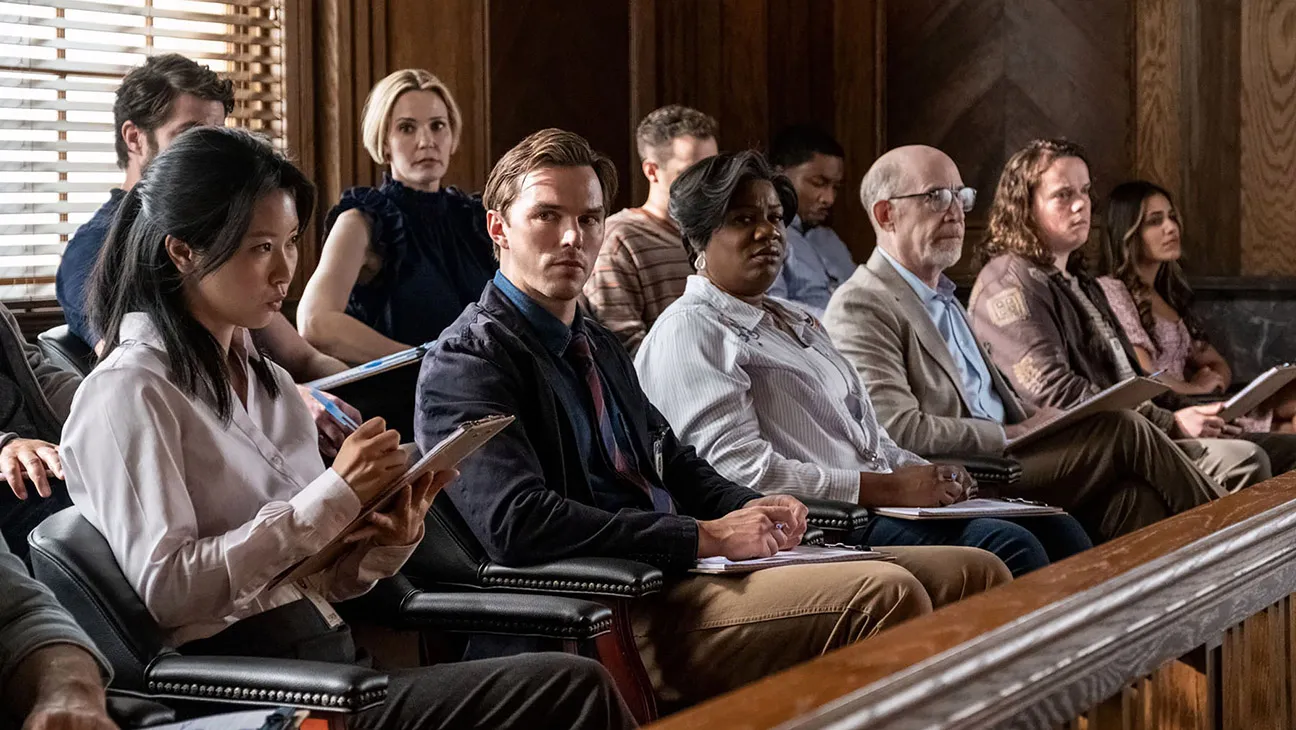
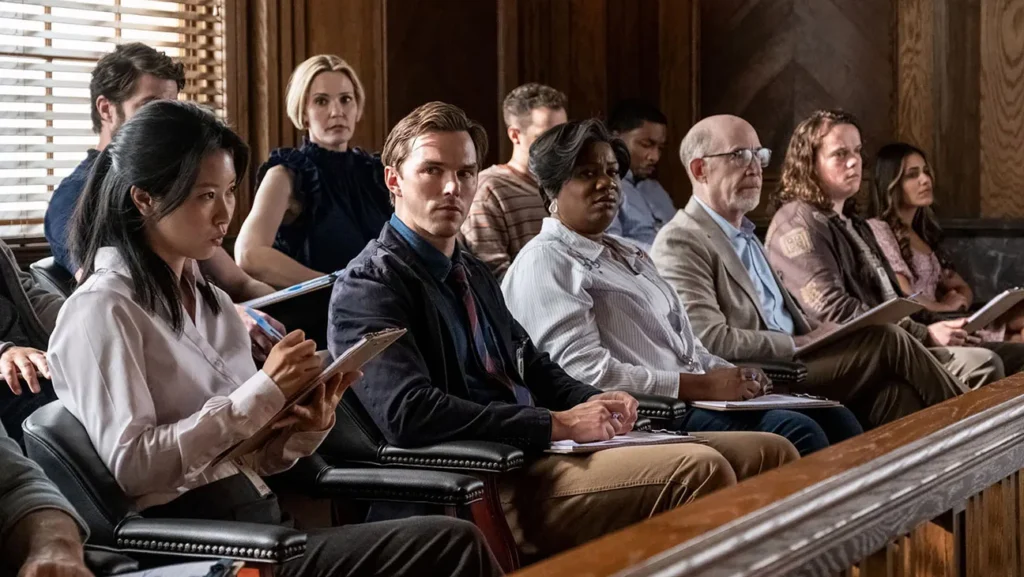
“Juror #2,” directed by Clint Eastwood, has a preposterous premise and a first-rate cast valiantly trying to make it seem less preposterous. Nicholas Hoult plays Justin, a teacher whose wife Allison (Zoey Deutch) is nearing the end of a high-risk pregnancy. Justin has just been called for jury duty. He tries to get out of it by explaining his situation, but the judge (the always excellent Amy Aquino), dryly points out that his hours in the courtroom will keep him away from his wife no longer than his hours at work.

He is assigned to a criminal case. James Michael Sythe (Gabriel Basso) has been charged with the murder of his girlfriend, Kendall (played in flashbacks by Eastwood’s daughter, Francesca Eastwood). Arguing the high-profile case are prosecutor Faith Killebrew (Toni Collette) and Eric Resnick (Chris Messina), Faith’s law school classmate and sometime drinking buddy, a public defender trying to persuade the jury that his client is innocent.

As the lawyers make their opening arguments, telling the story of the night Kendall was killed following an argument with Sythe in a rowdy bar (the bar is even named Rowdy’s, just to make sure we get the point), it begins to dawn on Justin that he was at Rowdy’s that night and saw the argument. As someone who really does not want to be there and told his wife he would do whatever it took to get out of serving, he completely ignores the fact that that memory in and of itself would be a reason to alert the judge that he is a material witness and cannot serve as a juror. But no, instead he thinks more about what happened that night and realizes that while he thought he hit a deer as he was driving home from the bar in a heavy downpour, he may have, indeed he probably did hit Kendall and is responsible for her death. And he decides on two equally important goals: not letting an innocent man be convicted of murder and keeping himself out of prison.

That’s a LOT! And then everything keeps getting melodramatically ramped up even further. Faith is running for District Attorney on a platform of protecting the community from crime, with the election just days away and apparently the vote depending on the outcome of this case. Justin is in recovery and his AA sponsor is a lawyer (Kiefer Sutherland) who advises him not to come forward. And then we are in jury deliberations a la “12 Angry Men,” with an assortment of characters. On the first round of voting, Justin is the only “not guilty.” He has to try to persuade the rest of the jury that there is reasonable doubt without letting them know about his own involvement.

One of the other jurors is a former cop (J.K. Simmons). Another is a med student. Their expertise shifts the balance, but the central question ends up being whether anyone can change.

Eastwood is 94 and outspoken about his political views (remember his debate with the empty chair?). A few cranky old guy elements flicker in and out of the film. It’s more than a low-grade potboiler with high-grade actors for him. He wants to say something about his worldview and he is not subtle. The first image in the film is Allison wearing a blindfold as Justin leads her into the room he has prepared for the baby. This is the part of a movie where usually, in the least time possible, we get to know the main characters well enough to care about whatever challenges lay before them. But Eastwood wants to say something beyond the adorable couple so excited about the new baby and so devoted to each other. The blindfold comes back a few more times in the statue of Justice in front of the courthouse, the one of the woman holding up the scales, with a blindfold over her eyes.

If he wants what may be his final film to make a statement about the inadequacies of the criminal justice system, though, it is one that is muddled by (1) a retired police detective who is dedicated and capable (though willing to act outside the law), and (2) see “preposterous” and “melodramatically” above.

Parents should know that this is the story of a murder case and there are graphic and disturbing images of the body as well as flashbacks showing the suspect and the victim drunk and fighting with each other.

Family discussion: What should Justin have done and when? What should Faith have done and when?

If you like this, try; “12 Angry Men,” “Reservation Road,” “The Judge,” and John Grisham films like “The Rainmaker” and “The Client”

Related Tags:


Courtroom Crime Drama movie review Movies -- format Movies -- Reviews
THE MOVIE MOM® is a registered trademark of Nell Minow. Use of the mark without express consent from Nell Minow constitutes trademark infringement and unfair competition in violation of federal and state laws. All material © Nell Minow 1995-2026, all rights reserved, and no use or republication is permitted without explicit permission. This site hosts Nell Minow’s Movie Mom® archive, with material that originally appeared on Yahoo! Movies, Beliefnet, and other sources. Much of her new material can be found at Rogerebert.com, Huffington Post, and WheretoWatch. Her books include The Movie Mom’s Guide to Family Movies and 101 Must-See Movie Moments, and she can be heard each week on radio stations across the country.

Website Designed by Max LaZebnik