“Section 60: Arlington National Cemetery” is a documentary from HBO about “the saddest acre in America,” the final resting place of our military who made the ultimate sacrifice in Iraq and Afganistan. Emmy-winning producers Jon Alpert and Matthew O’Neill (Baghdad ER) capture the profound combination of loss, love and pride felt by cemetery visitors, portraying the losses sustained in military conflicts while honoring those who gave their lives for our country. The film shows the pain and grief of the families and friends who visit to pay tribute and find comfort and a sense of community. HBO has also listed resources for grieving families and those who want to help them.
After documentary filmmaker Arnon Goldfinger’s grandmother died at age 97 in Israel, he brought a film crew to her apartment where she and his grandfather lived from the time they immigrated to what was then called Palestine just before World War II. He was fascinated by their home, which seventy years later looked as though it had been transplanted from their birthplace in Germany. The books on the shelves were in German. They always spoke German in their home. Most of their lives were lived in Israel, but they lived as though they were still in Berlin.
Goldfinger thought he would learn something about his grandparents as the family sorted through their belongings. But he could never have imagined what he would find or where it would take him. His grandmother had saved issues of one of the most virulently anti-Semitic newspapers distributed in Nazi Germany. This discovery led to a journey that illuminated one of the strangest friendships imaginable, represented by an artifact that is almost unthinkable — a coin with a Jewish star on one side and a Nazi swastika on the other. The movie also focuses on the strain this inquiry put on Goldfinger’s relationship with his mother, who was almost as passionate about not finding out the answers to his questions as Goldfinger was about seeking them.
I spoke to Goldfinger when he was in Washington, D.C. to show the film, which opens tomorrow.
What did you think you were going to film?
To be honest, I just wanted to be there with the camera and document the world I knew was going to disappear very quickly. I thought it would be an even quicker process. I knew this flat all my life and I had an ambivalent feeling toward it. On the one hand, I had an attraction to this world, to this culture, to those books, to the secrets, the mystery. On the other hand, as an Israeli it was so foreign, so German, so connected to the tragic happenings in the Holocaust. It was only later I had an idea to make a film, but even then the idea was just something very short. People would ask, “What can you learn about someone from what they leave behind?” This shows you can learn a lot.
What does your mother think about the movie?
I was very afraid of course. Our relationship was close before and if it would stay like that, it would be fine. But I was surprised. It brought us closer. She was very supportive of the film. After the first screening, when she first saw it, she said she saw it was important for her, too. When her friends saw the film, they said to her, “We didn’t know, either. We didn’t ask.” She felt that she was not alone.
Why was your mother reluctant to know more?
She was really raised in a German house. I remember as a kid, hearing her argue with her parents in German. But when she went out of the flat, she was in Tel Aviv, the Mediterranean combined with bohemian, a place of vibrance. She lived two lives. But like all of the people of her age, she wanted to leave the past behind her, as you see when you look at her flat, not even any dust from the past. Your house is the place you want to live in. And she wanted to live with with barriers to all the historical items. Before I made the film I thought it was her character. But now I understand it’s a barrier from all the pain and sorrow.
You met with Edda, the daughter of the Nazi couple who were your grandparents’ friends. Tell me something about your impressions.
They were lovely people, very friendly, welcoming, warm. That made it harder. If they were nasty it would have been easier for me. During my research I would think, “Maybe it’s not possible, maybe it’s not right” that this friendship existed between my grandparents and the Nazis. If I called someone out of the blue and said “My grandparents knew your parents, I would not recognize one name.” But the way she recognized it so immediately, the way she knew and was so glad to hear from me in such an open way and with such memories — I don’t remember even one gift my parents’ friends gave me — but for her, she remembered so much.
What about her father, the man who was your grandparents’ friend while having an important role in the Nazi party?
I found much more about him than what is in the film. It was important to say that he did not live the Nazi party. He was involved in anti-Semitic propaganda. But he wanted to stay in contact with Jews. I found all kinds of other things about him, nothing that would change your mind, no smoking gun, but you could ask yourself, “Did he have an alternative?” The way to describe what happened was this. Nobody knew what Hitler wanted, but everybody knew if they did something Hitler did not want, it’s the end. It was a classic regime of terror. There’s a book called Alone in Berlin that described life in the war. It’s horrible. I am a Jew; I don’t so much identify with them, but still I can understand and ask the question, “Could he do something?” If you look at his career, you won’t find him in the concentration camps. He is in the headquarters, spying, thinking. For me, it’s enough.
One of the most shocking moments for me was when Edda told me that she knew my family had lost someone in the concentration camps. She did not have the details right. She thought it was my grandfather’s mother, not my grandmother’s mother. She’s a little mistaken with the details but it shows that she and therefore her parents knew some of what happened. That means my grandparents were sitting over there in the garden where we were, discussing the death of someone from their family with a man who was a Nazi. Did they ask him if he received their letter asking for help? Did he tell them he could not help them? There were a lot of lies over there.
My favorite character in the movie was your grandmother’s friend. What a beautiful face. I felt I knew your grandmother by seeing her friend.
She was my grandmother’s closest friend and like an aunt to me. When I first approached her, she did not want to be filmed. She was the only one, and I could not understand why. It took me almost a year to persuade her. But she said, “I will give you half an hour, but you come alone.” I told her I had to bring a cameraman and a sound man, and she said, “No, no, no.” In the end, it was only me and the cameraman. I figured she would see it is not threatening and she would let me stay longer. The cameraman said, “Be careful. Remember who you are dealing with. Ask the questions you want in the beginning not as usual at the end.” After 32 minutes she told me it is enough. Three months later she passed away. Her daughter was so happy that I captured her in her beauty. There’s such elegance in those characters.
Why did your grandmother keep the Der Angriff newspapers even though they were filled with anti-Semitic propaganda?
There was something emotional about it, a memory from a very, very important event in their life. The idea was to keep an eye on the Nazi and push him to include more Zionist material in his story. There may be a possibility my grandfather even edited the article. It was something very vivid at the time and maybe she forgot about it. She never opened it again. Maybe she forgot about it.
The film is telling an amazing story about a Nazi and a Jew, but really it is a movie about family, what you know about your family, what you want to know, what you can know. Those questions anyone can identify with, especially in America, a place of immigrants. Some people who see the movie tell me, “I want to ask my parents more about our history.” And some say, “I need to get rid of a lot of the things in my house!”
I.S. 318 is a below-the-poverty-line inner city junior high school. And its students have won more national chess championships than any other in the country. So this is a touching and inspiring story of triumph and what can be accomplished in spite of the most daunting of obstacles if there is someone who believes in you. And it is a story of the joys of intellectual passion and a game that goes back centuries, even in an era of saturation in digital media. There is much of what you expect — gifted kids, dedicated teacher, tense anticipation, thrilling victories. The characters are endearing and their stories are stirring.
This movie is also frank about the vulnerability of these programs. We see so much that is made possible by so little, and how fragile even that little can be. These children have endless spirit, skill, and devotion. They can solve complex mathematical puzzles that involve intricate, multi-step strategies. But the adults around them may not be able to show the same level of commitment or ability to think ahead to enable these kids to continue to benefit from the chess program.
Parents should know that this film includes the portrayal of children in difficult circumstances and some schoolyard language.
Family discussion: What do you have to be good at to succeed in chess? What makes this chess program so important to the kids?
If you like this try: “Mad Hot Ballroom” and “Searching for Bobby Fischer” — and try a game of chess!
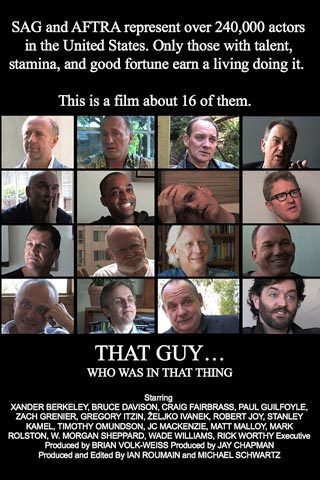
“That Guy” — Showtime’s Documentary About Character Actors
Posted on October 13, 2012 at 3:59 pm
I have a special affection for character actors. They have to create a character and move the story forward without having the luxury of time and the audience’s primary attention, and they have to do it without overshadowing the star. So I was delighted to see Showtime’s tribute to character actors, a documentary called, “That Guy….Who Was in That Thing.” Candid interviews with actors who all look familiar but not instantly recognizable, who might be mistaken for someone you went to school with or once saw at a family reunion cover touchy subjects like auditions, being a guest star on a show where the stars do not think it is worthwhile even to introduce themselves, going for months without a job, family and financial stress, being stuck with a lot of technical talk or exposition, and the pure joy of having the opportunity to perform. It’s On Demand through November 13 and well worth a look.


 that described life in the war. It’s horrible. I am a Jew; I don’t so much identify with them, but still I can understand and ask the question, “Could he do something?” If you look at his career, you won’t find him in the concentration camps. He is in the headquarters, spying, thinking. For me, it’s enough.
 newspapers even though they were filled with anti-Semitic propaganda?