
Side by Side — Documentary About Film-Making
Posted on August 5, 2012 at 3:55 pm
This looks fabulous!
Posted on August 5, 2012 at 3:55 pm
This looks fabulous!
Posted on July 30, 2012 at 9:41 pm
I was delighted to get an update from Marc Erlbaum about what has happened since our interview about his new documentary on what people think about the meaning of life. Here’s his latest, a sweet reminder that while we sometimes focus on all that is wrong so that we can work to make it better, sometimes it is just as important to focus on what is right.
And here is an interview with a man who wants to help us see what — and who — we over look.
I’ve added my support to this wonderful project and if you want to find out more and look at additional stories about what people find meaningful, check out lifemeanswhat.com
Posted on July 30, 2012 at 8:00 am
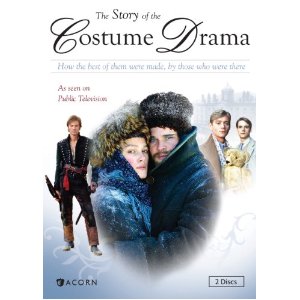
 One of the greatest pleasures of costume drama is, of course, the costumes. Stories set in different places and times invite us into their world and tell us about their characters through the details and artistry of the wardrobe. Whether it is a real-life couple who were world-renowned fashion icons like the Duke and Duchess of Windsor in Edward & Mrs. Simpson

 Costume designers study fashion, history, and literature and actors often say that their performances are inspired by the feel of the clothes. Many work closely with costume designers to help create their characters. Whether it is the high collars of the Victorian era or the high waists of Jane Austen’s characters a century earlier, from the exquisite hand embroidery on a lace-trimmed ball gown to the correct placement of the sleeve buttons on a soldier’s uniform, from the lacing on the corset to the plume in a hat and the starch in an apron, the costumes help make the story real and enthralling. On this new DVD, the designers tell their stories, with comments and appearances from stars like Helen Mirren, Alex Kingston, Keira Knightley, Gillian Anderson, Jeremy Irons, John Hurt, Daniel Radcliffe, Catherine Zeta-Jones, Ioan Gruffudd, and Colin Firth. This is an outstanding behind-the-scenes documentary that is sure to give you a better appreciation of costume drama and remind you of favorites from the BBC you want to re-watch and new series you want to try.
Posted on July 24, 2012 at 3:27 pm
As we prepare for the memorable moments of the 2012 Olympics, let’s take another look at this one, when a black American competed in Hitler’s Berlin and, as the world watched, he put the lie to Hitler’s claims about Aryan superiority. He won four gold medals. He then came home to an America still 20 years away from meaningful progress on civil rights. His life was not easy. He had to take the freight elevator to the reception honoring him. He was not invited to the White House to celebrate his achievements.
https://www.youtube.com/watch?v=K1XclGwJY8sI was privileged to meet the great Jesse Owens many years ago in Chicago. I will always remember his graciousness and how thrilling it was to shake hands with a legend.
Posted on July 21, 2012 at 6:13 am
One of the most fascinating documentaries of the year is “Searching for Sugar Man,” the extraordinary story of musician Sixto Diaz Rodriguez, who made two albums in the 1970’s and then disappeared from performing. It is a moving reminder that each of us has the potential for influence far beyond our ability to imagine.
From the film’s website:
In 1968, two producers went to a downtown Detroit bar to see an unknown recording artist – a charismatic Mexican-American singer/songwriter named Rodriguez, who had attracted a local following with his mysterious presence, soulful melodies and prophetic lyrics. They were immediately bewitched by the singer, and thought they had found a musical folk hero in the purest sense – an artist who reminded them of a Chicano Bob Dylan, perhaps even greater. They had worked with the likes of Marvin Gaye and Stevie Wonder, but they believed the album they subsequently produced with Rodriguez – Cold Fact
– was the masterpiece of their producing careers.
Despite good reviews, Cold Fact was a commercial disaster and marked the end of Rodriguez’s recording career before it had even started. Rodriguez sank back into obscurity. All that trailed him were stories of his escalating depression, and eventually he fell so far off the music industry’s radar that when it was rumored he had committed suicide, there was no conclusive report of exactly how and why. Of all the stories that circulated about his death, the most sensational – and the most widely accepted – was that Rodriguez had set himself ablaze on stage 4 having delivered these final lyrics: “But thanks for your time, then you can thank me for mine and after that’s said, forget it.” The album’s sales never revived, the label folded and Rodriguez’s music seemed destined for oblivion.
This was not the end of Rodriguez’s story. A bootleg recording of Cold Fact somehow found its way to South Africa in the early 1970s, a time when South Africa was becoming increasingly isolated as the Apartheid regime tightened its grip. Rodriguez’s anti-establishment lyrics and observations as an outsider in urban America felt particularly resonant for a whole generation of disaffected Afrikaners. The album quickly developed an avid following through word-of-mouth among the white liberal youth, with local pressings made. In typical response, the reactionary government banned the record, ensuring no radio play, which only served to further fuel its cult status. The mystery surrounding the artist’s death helped secure Rodriguez’s place in rock legend and Cold Fact quickly became the anthem of the white resistance in Apartheid-era South Africa. Over the next two decades Rodriguez became a household name in the country and Cold Fact went platinum.
The New York Times wrote:
n the other side of the globe, in South Africa, Rodriguez had become as popular as the Rolling Stones or Elvis Presley. But he never knew of that success. He never saw a penny in royalties from it, and he spent decades doing manual labor to make ends meet and raise his three daughters. It wasn’t until fans in South Africa, trying to verify rumors he was dead, tracked him down through the Internet and brought him there to perform to adoring multitudes, that his career was resuscitated.
“This was the greatest, the most amazing, true story I’d ever heard, an almost archetypal fairy tale,” said Malik Bendjelloul, the Swedish director of “Searching for Sugar Man,” a documentary that opens on Friday in New York and Los Angeles. “It’s a perfect story. It has the human element, the music aspect, a resurrection and a detective story.”
My friend and fellow critic Tim Gordon interviewed Rodriguez on his Keeping it Reel podcast (it starts about half an hour into the program) and it is well worth a listen.