Patriots Day

Patriots Day

Posted on January 12, 2017 at 5:28 pm

Copyright 2016 CBS Films

Writer/director Peter Berg and actor/producer Mark Wahlberg have now made their third film in a row on the same theme: real life stories of everyday people showing exceptional courage and dedication in the direst and most tragic circumstances. “Lone Survivor” was the story of a disastrous Navy SEAL operation. “Deepwater Horizon” was the story of the BP oil rig explosion. Now “Patriots Day” is the story of law enforcement from the terrorist attack at the Boston Marathon to the killing and capture of the brothers responsible.

In all three films, Berg takes a story we know — or think we do — and creates a gripping, tense drama centered on a man who exemplifies American values of decency and integrity and shows exceptional ability to rise to the occasion. Wahlberg is a perfect choice to play those roles, and here he gives grace and dignity to the role of Tommy Saunders, a composite character based on the Boston cops who were on the ground when the bombs exploded, oversaw triage to manage the crowd and oversee emergency services and then tracked down the people responsible in just 19 hours.

And as in the earlier films, Berg’s focus is not on the people making the big policy decisions but on the people who are dealing with the consequences. He begins a brief but vivid chance to get invested in some of the key players just before Boston’s annual Patriots Day race, including some of the participants who will later be injured and Saunders, unhappy about being assigned to the race and struggling with a bad knee. Everything is the usual benign chaos until suddenly it becomes terrifying and catastrophic as the bombs explode near the finish line and no one knows what happened, who caused it, or whether more attacks are coming, with an anxious score by Trent Reznor and Atticus Ross, as Saunders and the other cops have to try to figure out what is going on, surrounded by severely injured people and panicked crowds — and, probably, somewhere, the bombers.

The minute-by-minute procedural section is engrossing, with territorial squabbles and conflicting priorities involving the police force and the FBI. The injured people may have crucial information the cops need right away but they also have injuries that need treatment right away, treatment that could make it difficult or impossible for them to talk or remember. The press insists on releasing photos of possible suspects despite law enforcement’s concerns that it could impair the investigation. And what do you do when a key witness insists on a lawyer, or decides to leave the police station? One of the most powerful scenes in the film is the interrogation by a hijab-wearing FBI agent of the wife of one of the suspects, an incendiary performance by “Supergirls” Melissa Benoist. The film does not take a position on the abandonment of Constitutional rights in an emergency with perhaps hundreds of life at stake; it just presents it as the immensely complex problem with no right answer that it is.

And then, with ultimate respect, it concludes with footage of some of the real heroes. That’s the crying part, as it should be.

Parents should know that the theme of the film is a real-life terrorist attack with many characters injured and killed and some graphic and disturbing images of bodies and wounds; also very strong language, some bigotry, and some drug use.

Family discussion; How did social media affect the way this attack was investigated? What does this movie have in common with the two other fact-based stories from the same director and star?

If you like this, try: “Lone Survivor” and “Deepwater Horizon”

Related Tags:


Based on a true story Drama
Paterson

Paterson

Posted on January 5, 2017 at 6:52 pm

Paterson (Adam Driver of “Girls” and “The Force Awakens”) lives in Paterson, the New Jersey home of Paterson Falls, and of poets William Carlos Williams and Allen Ginsburg. In writer/director Jim Jarmusch’s sweetest film to date, we see a week in the life of Paterson, a bus driver who writes poetry, mostly love poetry to his adorable wife Laura (a delicious performance from the beautiful Golshifteh Farahani), and in the life of his namesake home town.

Copyright Bleecker Street 2016

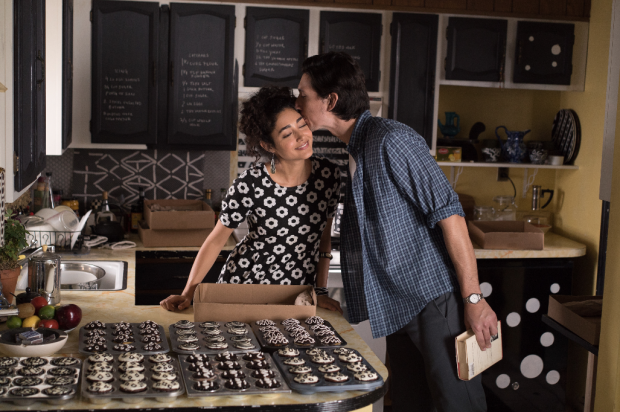
Each morning begins with Paterson and Laura asleep in bed, cuddling tenderly. He wakes up to what Laura calls his “silent alarm clock,” puts on his watch, nuzzles her gently, and gets ready for work. As we become used to his routine, walking to the bus depot with his lunchbox, lovingly packed by Laura, hearing the daily complaints from the dispatcher, listening to the conversations of the passengers, Laura’s imaginative dinners and wild experiments with design, walking Marvin the bulldog and stopping by the neighborhood bar for a beer, the smallest details become significant, whether reinforcing our understanding of his quotidian life or surprising us with its minor variations. Be sure to watch Marvin the dog for one of the film’s most delightful surprises.

Driver is better known for anguished and intense performances, in “Girls,” as Kylo Ren in “The Force Awakens” and, 50 pounds lighter, as one of the priests in Martin Scorsese’s current release, “Silence.” It is a pleasure to see him here, thoughtful, sensitive, with a hint of a more traumatic past — note the photo on a bedside table, of Driver himself in his days as a Marine), but amused and pleasantly bemused by the world around him and unabashedly adoring his beautiful, devoted wife. I’m not sure I’ve ever seen him laugh before, certainly not with such evident pleasure, and it made me want to see much more of this side of him.

While Paterson is contemplative and focused, considering words carefully as he walks, Laura is impulsive and enthusiastic, with new creative projects and inspirations all the time. Each day, Paterson comes home to find that Laura has covered the rug or the shower curtain or her dress or cupcakes with op art-like geometric designs in black and white. When they go out to an old movie together, she winningly says she likes it because it is in black and white. Their support for each others’ creative projects is endearing, and their pleasure in each other and in each other’s pleasure is exquisite.

Not much happens. There’s a mechanical problem on the bus, which Paterson handles responsibly, despite not having a cell phone. An unhappy customer at the bar creates a fuss, and Paterson intervenes quickly and capably, almost through sheer muscle memory from his military training, though it shakes him a little. He happens upon three other poets, a spoken artist practicing in a laundromat (Method Man), a nine year old waiting for her mother and sister, and a Japanese tourist carrying a volume by William Carlos Williams. He compliments the young poet on her internal rhymes. It turns out the sister she is waiting for is her twin. The film itself is full of doubles and twins, including the matched names, a series of internal rhymes that match the lyricism and cadence of Paterson’s poems, written by Ron Padgett and his life, modest, diligent, precise, aware. We come away from the film filled with the alertness and engagement Paterson and Laura bring to their days.

Parents should know that there is a brief scene with a gun, threatening murder and suicide, and some strong language and sexual references.

Family discussion: Who is your favorite poet? How did Paterson incorporate what went on around him into his work? Why didn’t he want to make a copy of his notebook?

If you like this, try: “Only Lovers Left Alive” and the poetry of William Carlos Williams

Related Tags:


Drama Independent
A Monster Calls

A Monster Calls

Posted on January 5, 2017 at 5:50 pm

Copyright 2016 Universal

It turns out that there is something even more painful than the most devastating loss imaginable. That is the lesson of “A Monster Calls,” based on the Carnegie Medal and the Greenaway Medal award winning book by Patrick Ness, illustrated by Jim Kay, from an idea by the late human rights activist Siobhan Dowd.

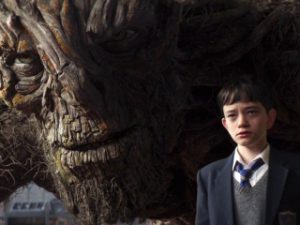
It takes place in the Irish countryside. “We begin,” the movie tells us, “like so many stories, with a boy too old to be a kid and too young to be a man and a nightmare.” The boy is Conor (Lewis MacDougall), whose adored single mother (Felicity Jones) is struggling with cancer and the ravages of its treatment. While other boys are gently awakened by their parents and sent off to school with a good breakfast and a lovingly packed lunch, it is Conor who makes breakfast for his mother (there are rows of medicine bottles in the kitchen cupboard). He also does the laundry before he goes to school, where a bully threatens him. He has a frosty grandmother (Sigourney Weaver) and an affectionate but useless father (Toby Kebbell). So, he is alone with his grief, his fear, his anger, and his paints, which he must learn to use to express them all.

Let’s think for a moment about the title: “A Monster Calls.” Is that “calls” as in “pays a call,” or comes to visit? Is it “calls” as in “calls out to?” Is it “calls” as in “calls out from?”

A teacher says sympathetically, “If you ever want to talk…” Conor’s dad arrives from America, where he lives with his new wife and new baby, and he takes Conor to an amusement park. But Conor does not want to talk and he is not amused. A glimpse of the old “King Kong,” Fear and Fury bookends, and a shiver-inducing creaking noise give us a hint that a terrifying, destructive monster may be coming.

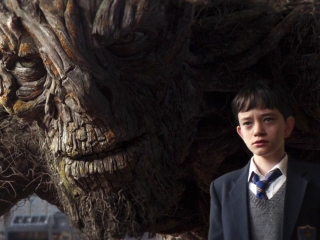
And then, yes, Conor is visited by a monster, an enormous walking yew tree with the rumbling voice of Liam Neeson. Conor may think the monster is there to protect him, but that is not exactly true. He says he is there to tell Conor three stories, and then, he says, Conor must tell him one and it must be true. The monster’s stories have a yew tree connection, as does a possible new treatment for Conor’s mother. They begin like traditional fairy tales but do not pretend that the resolutions are fair or straightforward. The fury within the stories seems to take over Conor and he finds himself becoming violent before telling his story forces him to admit what terrifies him even more than the prospect of losing his mother.

This is a complex, richly imagined film with a deep understanding, clear-eyed but compassionate. The stories it contains help us to be honest about our own.

Parents should know that this film is about a boy whose mother is dying of cancer. There are some other disturbing images and situations, including a bully and a monster.

Family discussion: Which story surprised you the most and why? Why was it important for Conor to tell his story? What monsters live inside us?

If you like this, try: the book by Patrick Ness and “Secondhand Lions”

Related Tags:


Based on a book Drama Family Issues Illness, Medicine, and Health Care Stories About Kids
Hidden Figures

Hidden Figures

Posted on December 23, 2016 at 9:15 am

Copyright 20th Century Fox

The sign on the office door said, “Colored Computers.” That was not a reference to IBM’s Big Blue or to a machine of any kind. In the early days of the space race at NASA, computers were people doing all of the complex, unprecedented math calculations by hand, and the “colored” computers were the African-American women who had more talent, more dedication, more integrity, despite less pay, less credit, and less resources than their colleagues. Twice marginalized, as women and as African-Americans, they were heroically dedicated, capable, and resilient. Their story, unknown until the book by Margot Lee Shetterly, is beautifully told in this heartwarming, inspiring film.

Katherine Johnson (Taraji P. Henson), Dorothy Vaughan (Octavia Spencer), and Mary Jackson (singer Janelle Monáe, “Moonlight”) are stopped by a highway patrolman on their way to their office at NASA. They get out of the car, expecting the worst. In his own way, the white patrolman expects the worst, too. This is Virginia, just a few years after the state shut down the entire school system to avoid complying with the Supreme Court’s decision in Brown v. Board of Education. This is the same era depicted in “Loving,” the true story of the couple who challenged Virginia’s laws prohibiting marriage for people who were not of the same race.

This was also the era of the space race. President John F. Kennedy famously said, “We choose to go to the moon. We choose to go to the moon in this decade and do the other things, not because they are easy, but because they are hard, because that goal will serve to organize and measure the best of our energies and skills, because that challenge is one that we are willing to accept, one we are unwilling to postpone, and one which we intend to win, and the others, too.” But there was another reason to go to the moon. The Soviet Union was ahead of us in space exploration, and beating them had huge symbolic, morale, and political value.

And that meant that something was more important than the deeply institutionalized racism and sexism of the era — ability. These women and their colleagues were simply too good to be overlooked. And to contribute all that they were able, that meant removing some obstacles and indignities. It was not until Johnson’s boss (Kevin Costner) exploded because she was not at her desk when he needed her that he learned she had to go a quarter of a mile to the “colored” bathroom in another building. And it was her vital importance to the project, not any commitment to inclusion or justice, that led him to insist on change. John Glenn (a likable performance by “Everybody Wants Some!!‘s Glen Powell) refused to get on the rocket ship that would make him the first person to orbit the earth until Johnson personally verified the calculations.

Henson, Spencer, and Janelle Monáe are clearly thrilled to have roles of such significance and depth and honor their characters with performances of wit and subtle charm. When Jackson has to go to court for the opportunity to take the evening classes at a segregated local high school that will qualify her for an engineering degree, when Vaughan decides to teach herself computer programming to make sure that the first-ever mainframe being installed at NASA does not make her work obsolete, when Johnson explains that it may be unprecedented to have a woman in the top-level meeting but it is also unprecedented to send a man to the moon, we see the power of their intellect and the steel in their souls. A light-hearted girl’s night shows us the support they gave each other and how much it meant to each of them.

Johnson, Jackson, and Vaughan plotted a course for NASA to put men into space. They also plotted a course for all of us to do things because they are hard, because they are important, because we can do better.

Parents should know that this movie includes extensive portrayal of the racial and gender prejudice of its time, along with smoking and social drinking and some language.

Family discussion: Why did the women in this film continue to be so loyal to a system that constantly disrespected them? Why did Dorothy Vaughan want to learn how to use the IBM machine? What do you think of her reply to Vivian Michael?

If you like this, try: “The Right Stuff” and “The Dish”

Related Tags:


Based on a true story Drama Gender and Diversity Race and Diversity
Fences

Fences

Posted on December 22, 2016 at 5:43 pm

Copyright 2016 Paramount

August Wilson’s towering play, the winner of the Tony and Pulitzer prizes, has been magnificently put on screen by director/star Denzel Washington, who won a Tony for the play’s 2012 Broadway revival, and who works with much of that show’s cast in this version.

Wilson’s own screenplay wisely avoids the usual impulse to “open up” a play by adding locations and reducing the dialogue. The best known of Wilson’s ten-play “Pittsburgh cycle,” one for each decade of the 20th century, “Fences” is a story of epic scope and mythic resonance. The gorgeous dialog makes poetry out of the kind of talk we hear around us all day: the jokes, mock insults, and bragging of co-workers and long-time friends, the intimate humor of a longtime couple, anguished confrontation, bitter recollection, back-and-forth that skims the surface while the emotions roil and explode below. To the extent that it preserves the artificiality of a theatrical performance, it emphasizes its ambitious reach. If a play has a character named Gabriel (Mykelti Williamson) who is cognitively impaired following a war injury, who carries a trumpet, and who constantly reminds his brother of a betrayal and survivor guilt, if the tile “Fences” is literal and metaphorical and the character building the fence talks about keeping out the actual angel of death, the audience must recognize these signals of serious, profound, dramatic engagement with eternal themes and be grateful for the chance to be a part of it.

Washington plays Troy, a garbageman who was once a star of a Negro Leagues baseball team but was too old to cross over into the Major Leagues the way Jackie Robinson did. He still keeps a bat and ball in the back yard. He still holds onto the bitterness and dashed dreams of his years as a player. But now, he just wants a promotion to driver, a job only held by white men where he works.

His wife is Rose (Oscar-winner Viola Davis, who also won a Tony for her performance in the revival). We first see Troy bragging to his best friend Bono (Stephen McKinley Henderson) about how he laid down the law when he met Rose, telling her he was not interested in marriage. She laughs indulgently and affectionately, but makes it clear that it was quite the contrary. “I told him if he wasn’t the marrying kind, then move out the way so the marrying kind could find me.”

Troy and Rose have a son in high school, Cory (Jovan Adepo), a talented football player. Rose sees football as a chance for Cory to attend college, and Cory desperately wants to play. But Troy refuses, saying “The white man ain’t gonna let you get nowhere with that football noway.” His mind and spirit have been so constricted by what he has faced that he cannot bring himself to believe that real opportunity exists for Cory. Or perhaps he cannot face the possibility that Cory will do what he could not.

Troy also has an older son, Lyons (Russell Hornsby), with a woman he never married. Lyons, a musician, asks Troy for a loan, mostly as a way to find a way to talk to him, to find a way to see if he means anything to him. Troy tells him he should not need to ask for money, and Lyons responds, “If you wanted to change me, you should’ve been there when I was growing up.”

And Troy worries about his brother Gabriel, who lived with Troy and and Rose in a home they bought with his disability money, but who has moved down the street because he wants more independence. Troy feels guilty for not taking care of him, and for living in a house he would not have been able to afford but for his brother’s disability.

And so, he makes a bad decision that will shatter his family’s foundation. The scene where Davis goes from disbelief to shock to fury will be used for decades in acting class, but she is just as impressive in the movie’s final moments. While Troy occupies much of the screen time and dialogue, it is really Rose who is the heart of the story. Troy can brood, but cannot change. He can hurt, but he cannot heal. He is so damaged that he cannot offer his sons love or respect. But see Rose’s strength. Her resolve is not grounded in compromise or concession. Her soul has expanded to encompass all of life’s contradictions. And it is the great gift of this film that it expands ours, too.

Parents should know that this film includes themes of racism and adultery, some strong language, sexual references, and a sad death.

Family discussion: Do you agree with Rose’s choice? Why didn’t Troy want Cory to play football? What do we learn from Troy’s relationship with Gabriel?

If you like this, try: “A Raisin in the Sun” and “Desire Under the Elms”

Related Tags:


Based on a play Drama Race and Diversity
THE MOVIE MOM® is a registered trademark of Nell Minow. Use of the mark without express consent from Nell Minow constitutes trademark infringement and unfair competition in violation of federal and state laws. All material © Nell Minow 1995-2026, all rights reserved, and no use or republication is permitted without explicit permission. This site hosts Nell Minow’s Movie Mom® archive, with material that originally appeared on Yahoo! Movies, Beliefnet, and other sources. Much of her new material can be found at Rogerebert.com, Huffington Post, and WheretoWatch. Her books include The Movie Mom’s Guide to Family Movies and 101 Must-See Movie Moments, and she can be heard each week on radio stations across the country.

Website Designed by Max LaZebnik